Last updated: May 10, 2026
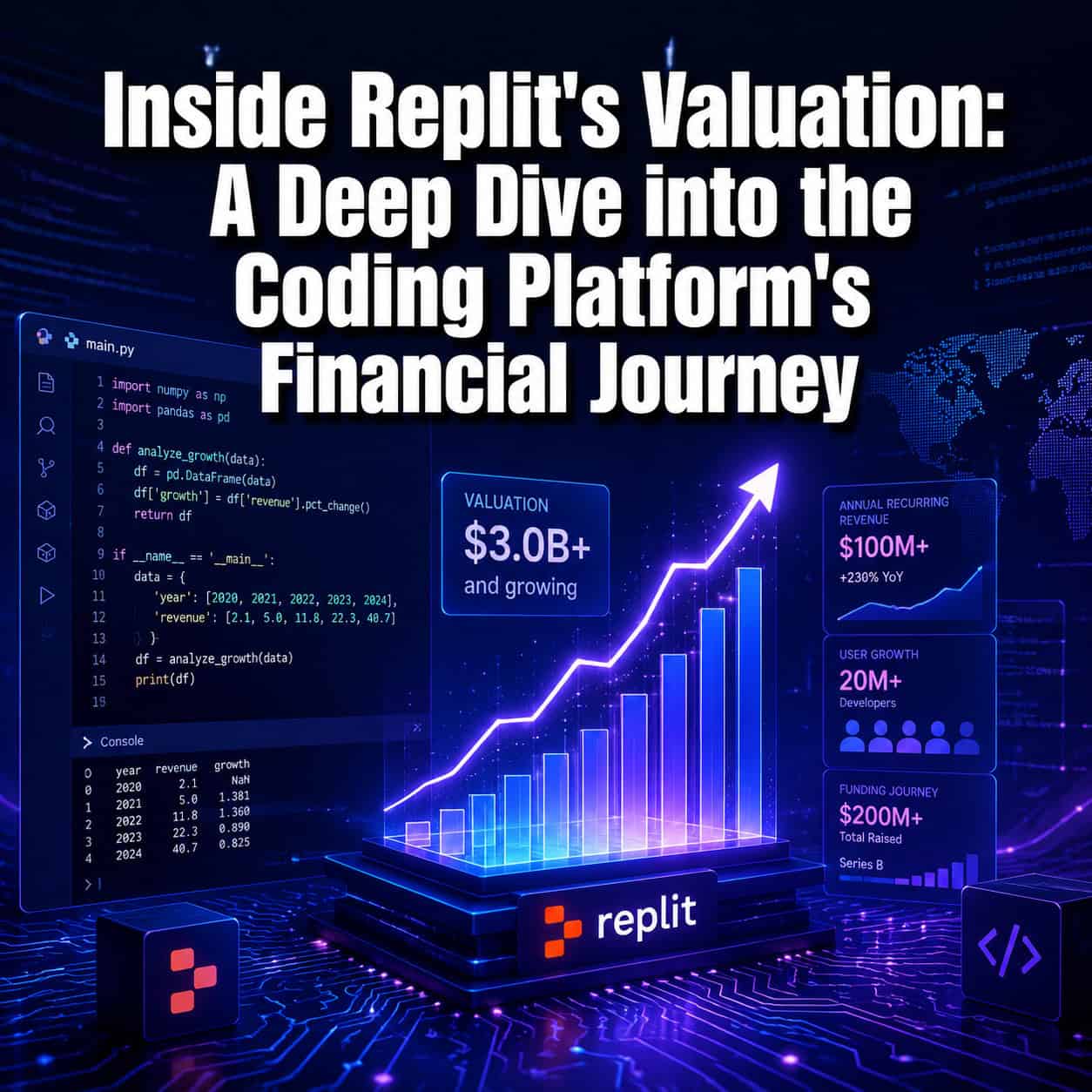
Quick Answer: Replit’s valuation tripled from $3 billion to $9 billion in just six months, fueled by a $400 million funding round in March 2026 [2]. The company’s AI-powered coding agents are driving consumption-based revenue that analysts project will reach $1 billion in annual recurring revenue (ARR) by the end of 2026 [7]. This makes Replit one of the fastest-growing AI developer platforms in the market.
Key Takeaways
- Replit raised $400M at a $9B valuation in March 2026, led by Georgian Partners [2][3]
- The company tripled its valuation in six months (from $3B to $9B) [2]
- CEO Amjad Masad confirmed Replit is tracking toward $1B ARR in 2026 [7]
- Net revenue retention sits at 300%, meaning existing customers spend 3x more over time [7]
- Sacra analysts estimate Replit hit $150M ARR by September 2025
- Accenture invested in Replit in April 2026 to push AI development into enterprises
- Agent 4, launched March 2026, enables building web apps, mobile apps, and dashboards from natural language
- Replit’s pricing model has shifted toward consumption-based credits, drawing some criticism from hobbyists

How Did Replit Reach a $9 Billion Valuation?
Replit’s $9 billion valuation came from a $400 million Series C round announced on March 11, 2026, led by Georgian Partners [2][3]. This wasn’t a gradual climb. The company hit $3 billion just six months earlier, meaning it tripled in half a year.
Several factors drove this rapid increase:
- AI agent adoption: Replit’s Agent product turned casual users into paying customers who consume compute credits
- Enterprise traction: Companies began using Replit to build internal tools without hiring dedicated developers
- Revenue velocity: 300% net revenue retention means customers expand spending dramatically after onboarding [7]
- Market timing: Investor appetite for AI developer tools peaked in early 2026
CEO Amjad Masad posted on LinkedIn that investors recognized Replit’s unique position: a platform where non-developers can build production software using AI [4]. This expands the total addressable market far beyond traditional developer tools.
For context, Replit’s earlier rounds valued the company at $800 million (2022) and $1.16 billion (2023) [6]. The jump to $9 billion represents a nearly 8x increase in under three years.
What’s Driving Replit’s Revenue Growth Toward $1 Billion ARR?
Replit’s revenue engine runs on two layers: subscriptions and consumption-based AI credits. The AI credits are the growth driver. When users deploy Agent to build apps, they burn through compute tokens that generate revenue beyond the base subscription.
According to Sacra analysts, Replit reached approximately $150M ARR by September 2025. CEO Masad confirmed in a May 2026 TechCrunch interview that the company tracks toward $1B ARR by year-end [7].
Key revenue drivers include:
- Agent usage: Each AI-generated app consumes credits for compute, hosting, and AI inference
- Enterprise contracts: Accenture’s April 2026 investment signals enterprise adoption at scale
- Expansion revenue: That 300% net revenue retention means a customer paying $1,000/month eventually pays $3,000/month [7]
- Hosting fees: Apps built on Replit stay on Replit’s infrastructure
The consumption model works because AI agents make it easy to build more. A marketing team that builds one internal dashboard quickly builds five more. Each deployment costs credits.
If you’re interested in how AI tools are reshaping content and development workflows, our guide to AI-powered content generation tools covers the broader landscape.
Inside Replit’s Valuation: How Does Agent 4 Change the Business Model?
Agent 4, released March 11, 2026, fundamentally shifts what Replit can do and who pays for it. The update introduced Design Canvas (infinite boards with live previews), shared project collaboration, and support for building web apps, mobile apps, dashboards, and AI tools from plain English prompts.
This matters for valuation because it expands Replit’s customer base beyond developers:
| User Type | What They Build | Revenue Impact |
|---|---|---|
| Developers | Production apps, APIs | High credit consumption |
| Product managers | Internal tools, dashboards | Medium consumption, high volume |
| Entrepreneurs | MVPs, prototypes | Rapid iteration, recurring usage |
| Enterprise teams | Custom workflows | Largest contracts |
Matt Palmer described Agent 4 as reshaping Replit “beyond apps,” enabling multi-format outputs that weren’t possible before. The shared collaboration feature replaced the old fork-and-merge workflow, making team adoption smoother.
For enterprises, Security Center 2.0 (launched May 7, 2026) added bulk vulnerability management across deployed apps. This addresses a key enterprise objection: “Can we trust AI-generated code in production?”
The combination of easier building and enterprise-grade security creates a flywheel. More users build more apps, which generates more revenue, which funds more AI improvements.
Those exploring no-code platforms for building websites will find Replit occupies a unique middle ground between no-code simplicity and full coding power.

How Does Replit Compare to Cursor, GitHub Copilot, and Bolt.new?
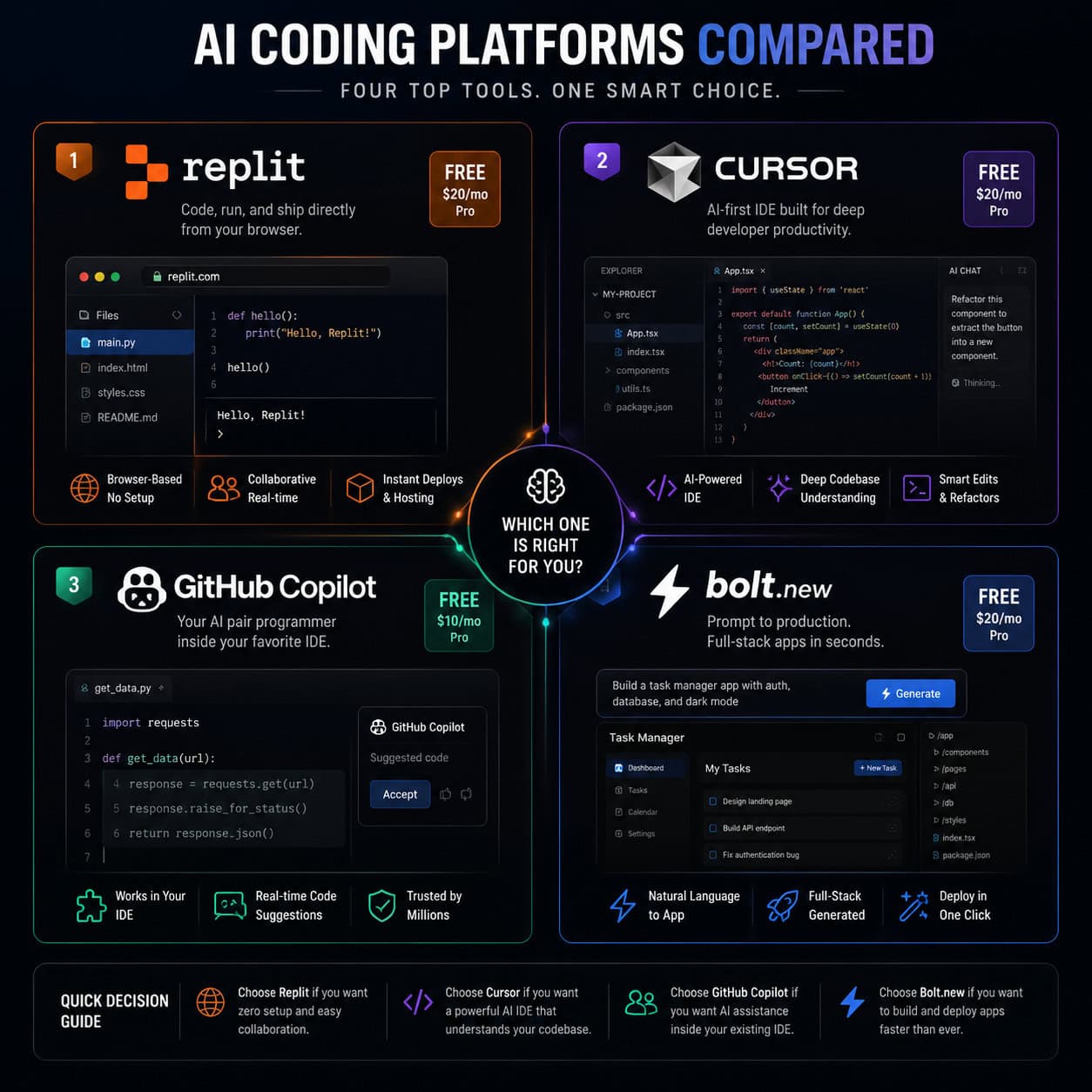
Replit competes in a crowded AI coding market, but each tool serves different needs. Here’s how they stack up as of 2026:
| Platform | Best For | Pricing | Key Strength |
|---|---|---|---|
| Replit | Browser-based full-stack building | $25/month Core + credits ($50-150 real-world) | Complete environment, deployment included |
| Cursor | Professional devs, large codebases | $20/month Pro | VS Code fork, multi-file editing |
| GitHub Copilot | IDE integration, existing workflows | Free tier (60 Codespace hours) | Works inside your existing tools |
| Bolt.new | Quick prototypes | $25/month (10M tokens) | Simpler pricing, fast output |
| Lovable | Non-technical users | $25/month | Easiest learning curve |
Choose Replit if: You want to go from idea to deployed app without leaving your browser, and you value collaboration features.
Choose Cursor if: You’re a professional developer working on existing codebases who needs AI assistance within a desktop IDE.
Choose GitHub Copilot if: You already use VS Code and want AI suggestions without changing your workflow.
Common mistake: Assuming Replit’s $25/month Core plan covers everything. Real-world usage with Agent typically costs $50-150/month due to consumption credits. Critics have noted this pricing unpredictability drives hobbyists toward GitHub Codespaces.
For teams evaluating AI-powered website builders, Replit offers more customization but requires comfort with a code-adjacent environment.
What Are the Risks to Replit’s Valuation Going Forward?
A $9 billion valuation at roughly $150-200M ARR implies a 45-60x revenue multiple. That’s aggressive, even for AI companies. Several risks could challenge this trajectory:
- Pricing backlash: The shift to $25/month Core with no free hosting has pushed hobbyists away. Community goodwill matters for developer platforms.
- Competition intensifying: Cursor raised significant funding, GitHub Copilot has Microsoft’s distribution, and new entrants appear monthly.
- Vendor lock-in concerns: Apps built on Replit run on Replit’s infrastructure. Some developers resist this dependency.
- Execution risk on $1B ARR: Going from $150M to $1B in one year requires sustained 500%+ growth.
- Apple ecosystem friction: Masad mentioned “fighting Apple” in his May 2026 interview, suggesting mobile deployment challenges [7].
However, the 300% net revenue retention provides a strong foundation. Even if new customer acquisition slows, existing customers are spending dramatically more each quarter.
If you’re building on platforms with similar growth trajectories, understanding automation workflows can help you maximize output regardless of which tool you choose.
Inside Replit’s Valuation: What Does the Accenture Partnership Mean?
Accenture’s April 2026 investment in Replit signals enterprise validation. The partnership integrates Replit with Google Cloud services including Cloud Run and BigQuery, giving enterprise customers familiar infrastructure underneath Replit’s AI layer.
This matters because:
- Enterprise revenue is stickier than individual subscriptions
- Accenture’s consulting network introduces Replit to Fortune 500 companies
- Google Cloud integration reduces the “vendor lock-in” objection for large companies
- Higher contract values accelerate the path to $1B ARR
Masad stated he’d “rather invest in customers than sell” [7], suggesting Replit plans to remain independent and use partnerships like Accenture to grow rather than pursuing an acquisition exit.
For enterprises already using tools like WordPress for their web presence, Replit’s internal tool-building capabilities complement rather than replace existing stacks. Our WordPress AI plugin guide covers how AI integrates into established platforms.
FAQ
What is Replit’s current valuation in 2026? Replit is valued at $9 billion as of March 2026, following a $400 million funding round led by Georgian Partners [2][3].
How much revenue does Replit generate? Sacra analysts estimate Replit reached $150M ARR by September 2025. CEO Amjad Masad confirmed the company tracks toward $1B ARR by end of 2026 [7].
Who are Replit’s main investors? Key investors include Georgian Partners (led the $9B round), Accenture (April 2026 strategic investment), and earlier backers from Series A and B rounds [6][2].
Is Replit profitable? Replit has not publicly confirmed profitability. The company is in growth mode, prioritizing customer acquisition and product development over near-term profits [7].
How does Replit make money? Through a combination of monthly subscriptions ($25/month Core plan) and consumption-based AI credits that users spend when deploying Agent to build and host applications.
What is Replit Agent? Replit Agent is an AI system that builds complete applications from natural language descriptions. Agent 4 (March 2026) added Design Canvas, shared collaboration, and support for web, mobile, and dashboard projects.
Is Replit suitable for professional developers? Yes, but professional developers working on large existing codebases may prefer Cursor. Replit excels for new projects, prototypes, and teams that want browser-based collaboration.
Can I use Replit for free? Replit offers limited free access, but removed free hosting in 2026. Meaningful usage with AI Agent requires the Core plan ($25/month) plus additional credits.
How does Replit compare to no-code tools? Replit generates actual code (unlike pure no-code tools) but uses AI to make the process accessible to non-developers. It offers more flexibility than no-code website builders but has a steeper learning curve.
Conclusion
Replit’s journey from a browser-based coding environment to a $9 billion AI platform happened faster than almost anyone predicted. The combination of AI agents, consumption-based pricing, and enterprise partnerships creates a revenue model that could realistically hit $1B ARR by late 2026.
Actionable next steps if you’re evaluating Replit:
- For individual builders: Start with the Core plan and budget $50-100/month total (subscription plus credits) for realistic usage
- For enterprise teams: Explore the Accenture/Google Cloud integration path for compliance-friendly deployment
- For investors watching this space: Monitor quarterly ARR updates and whether the 300% net retention holds as the customer base broadens
- For competitors: The pricing criticism around unpredictable credits represents an opportunity to differentiate with simpler models
Whether Replit justifies its $9B valuation depends entirely on execution over the next 12 months. The fundamentals—retention, enterprise adoption, and AI capability—are strong. The question is whether growth can outpace the aggressive multiple investors have assigned.
For more coverage of AI tools reshaping how we build online, explore our AI content optimization guide and AI category archives.
References
[1] Replit Raises 400 Million Dollars – https://blog.replit.com/replit-raises-400-million-dollars [2] Replit Snags 9b Valuation 6 Months After Hitting 3b – https://techcrunch.com/2026/03/11/replit-snags-9b-valuation-6-months-after-hitting-3b/ [3] Replit Raises 400m At 9b Valuation – https://fnex.com/replit-raises-400m-at-9b-valuation/ [4] Amjad Masad LinkedIn Post on $400M Raise – https://www.linkedin.com/posts/amjadmasad_weve-raised-400m-at-a-9b-valuation-investors-activity-7437543313680982016-r0Js [6] Replit Funding – https://www.clay.com/dossier/replit-funding [7] Replit’s Amjad Masad On The Cursor Deal Fighting Apple And Why He’d Rather Not Sell – https://techcrunch.com/2026/05/01/replits-amjad-masad-on-the-cursor-deal-fighting-apple-and-why-hed-rather-not-sell/