Last updated: May 1, 2026
Quick Answer: OpenAI’s digital hub is the interconnected ecosystem of platforms, tools, APIs, partnerships, and training resources that OpenAI operates to make AI accessible to developers, enterprises, creatives, and everyday users. In 2026, this hub spans everything from ChatGPT and the OpenAI API to open-weight models, sector-specific innovation programs, and a $500 billion infrastructure investment called Stargate. Understanding how these pieces fit together helps you decide which entry point is right for your goals.
Key Takeaways
- OpenAI’s ecosystem is not one product — it’s a layered hub of APIs, consumer apps, enterprise services, open-weight models, and training platforms.
- GPT-OSS, OpenAI’s first open-weight model release since GPT-2, is available in 120B and 20B parameter sizes under the Apache 2.0 license, distributed initially through Dell’s Enterprise Hub on Hugging Face. [3]
- The Stargate project — a joint venture between OpenAI, SoftBank, and Oracle — represents a $500 billion commitment to AI infrastructure, anchored in Abilene, Texas. [7]
- OpenAI Academy offers free and structured AI skills training for individuals and organizations looking to build practical competency. [6]
- The CFDA x OpenAI Innovation Hub pairs fashion brands with AI tool builders for year-long, funded collaborations — a model that shows how OpenAI is expanding into creative industries. [1]
- Azure OpenAI services give enterprises secure, fine-tunable access to OpenAI’s latest reasoning and multimodal models without building infrastructure from scratch. [8]
- Choosing your entry point matters: casual users start with ChatGPT, developers use the API, enterprises use Azure or GPT-OSS on-premises, and learners start with OpenAI Academy.

What Exactly Is OpenAI’s Digital Hub and Why Does It Matter?
OpenAI’s digital hub is the full collection of platforms, programs, and partnerships through which OpenAI delivers AI capabilities to the world. It’s not a single website or app — it’s an architecture of access points designed for different users, industries, and technical skill levels.
This matters because AI adoption depends heavily on accessibility. A solo developer, a Fortune 500 company, a fashion brand, and a high school student all have different needs. Inside OpenAI’s digital hub, exploring the gateway to cutting-edge AI innovation means understanding that OpenAI has deliberately built multiple on-ramps to the same underlying technology.
The core layers of OpenAI’s digital hub include:
- Consumer products (ChatGPT, DALL-E, Sora) — for general users and creatives
- Developer APIs — for building custom applications on top of OpenAI models
- Enterprise services (Azure OpenAI) — for secure, scalable business deployment [8]
- Open-weight models (GPT-OSS) — for organizations that need on-premises control [3]
- Training and education (OpenAI Academy) — for skill building [6]
- Sector-specific programs (CFDA Innovation Hub) — for industry-specific adoption [1]
- Infrastructure investment (Stargate) — the physical backbone powering it all [7]
💡 Decision rule: If you’re evaluating OpenAI for your organization, start by identifying which layer matches your technical capacity and data governance requirements — not which model sounds most impressive.
How Does the OpenAI API Serve as the Core Gateway?
The OpenAI API is the primary technical gateway through which developers and businesses access OpenAI’s models programmatically. It allows you to integrate language understanding, image generation, speech processing, and reasoning into your own products without managing the underlying model infrastructure.
For most builders, the API is where inside OpenAI’s digital hub, exploring the gateway to cutting-edge AI innovation becomes practical and hands-on.
What the API gives you:
- Access to models including GPT-4o, o3, and multimodal variants
- Fine-tuning capabilities for domain-specific customization
- Embeddings for semantic search and retrieval-augmented generation (RAG)
- Function calling for structured outputs and tool use
- Usage-based pricing, so you pay for what you consume
Common API use cases:
| Use Case | Model Type Best Suited |
|---|---|
| Customer support chatbot | GPT-4o (fast, conversational) |
| Legal document analysis | o3 (reasoning-heavy) |
| Image captioning | Multimodal (vision-enabled) |
| Semantic search | Embeddings API |
| Code generation | GPT-4o or fine-tuned variant |
Common mistake: Developers often start with the most powerful (and expensive) model by default. Match model capability to task complexity — a simple FAQ bot doesn’t need a reasoning model.
For teams building AI-powered web products, pairing the OpenAI API with tools like AI website creators that build professional sites without code can significantly accelerate deployment. You can also explore how to integrate an AI-powered chatbot into WordPress as a practical starting point.

What Is GPT-OSS and Who Should Use Open-Weight Models?
GPT-OSS is OpenAI’s first open-weight model release since GPT-2, available in two sizes — 120B and 20B parameters — under the Apache 2.0 license. [3] This is a significant shift because it allows organizations to download, deploy, and modify the model weights directly, rather than relying on OpenAI’s hosted API.
Dell Technologies is the exclusive initial OEM distributor, making GPT-OSS available through the Dell Enterprise Hub on Hugging Face. [3] This means enterprises can run GPT-OSS on Dell AI Factory infrastructure, keeping data entirely on-premises.
Who should consider GPT-OSS:
- Organizations in regulated industries (healthcare, finance, legal) where data cannot leave internal systems
- Companies that need to fine-tune models on proprietary datasets without sending data to a third party
- Research institutions that want to study model behavior at the weights level
- Enterprises with existing GPU infrastructure looking to reduce per-query API costs at scale
Who should stick with the hosted API:
- Startups and small teams without dedicated ML infrastructure
- Applications where latency and uptime guarantees matter more than data locality
- Teams without in-house ML engineering capacity to manage model serving
📌 Edge case: Apache 2.0 licensing is permissive for commercial use, but organizations should still conduct their own legal review for specific deployment contexts, especially in regulated sectors.
What Is the Stargate Project and How Does It Shape OpenAI’s Infrastructure?
Stargate is a $500 billion joint venture between OpenAI, SoftBank, and Oracle to build AI infrastructure across the United States, with its anchor megafactory located in Abilene, Texas. [7] It represents the physical foundation that makes OpenAI’s digital hub possible at scale.
Without infrastructure at this scale, the compute demands of training and serving frontier AI models become a bottleneck. Stargate is OpenAI’s answer to that constraint.
What Stargate means in practice:
- Massive expansion of data center capacity dedicated to AI workloads
- Reduced dependency on third-party cloud providers for training runs
- Potential for lower latency and higher availability for API users over time
- Job creation and domestic AI infrastructure development in the U.S.
Why this matters to developers and enterprises:
If you’re building products on OpenAI’s API, Stargate’s infrastructure expansion is a long-term signal of supply stability. More compute capacity means OpenAI can serve more concurrent users, train larger models, and potentially reduce costs over time.
🏗️ The Abilene facility is one of the largest AI-specific construction projects ever undertaken, signaling that AI infrastructure is now treated as critical national and commercial infrastructure — similar to power grids or telecommunications networks.

How Is OpenAI Expanding Into Industry-Specific Innovation Hubs?
OpenAI is moving beyond general-purpose AI tools by partnering with industry organizations to create focused innovation programs. The CFDA x OpenAI Innovation Hub is the clearest example of this strategy in action.
The CFDA x OpenAI Innovation Hub pairs six fashion brands with six AI tool builders for year-long collaborations. [1] Each pairing receives mentorship, technical support, and funding to develop and test pilot projects that apply AI to fashion design, production, supply chain, or retail.
This model is notable for several reasons:
- It’s not a hackathon — the year-long timeline allows for real product development, not just prototypes
- It’s bilateral — fashion brands learn AI capabilities while AI builders learn industry-specific constraints
- It’s funded — reducing the financial risk for smaller brands that want to experiment with AI
What this signals about OpenAI’s broader strategy:
OpenAI appears to be building a playbook for sector-specific adoption. Fashion is one vertical; expect similar programs in architecture, healthcare, education, and media. For creative professionals, this means AI tools are increasingly being designed with domain knowledge baked in, not just general capability.
If you work in a creative field, understanding how AI tools are being built for your industry is worth tracking. For context on how AI is already changing design workflows, see our guide to the best AI graphic design tools for creative workflows and explore AI-powered content generation tools that are already available.

How Can Individuals and Teams Build Skills Through OpenAI Academy?
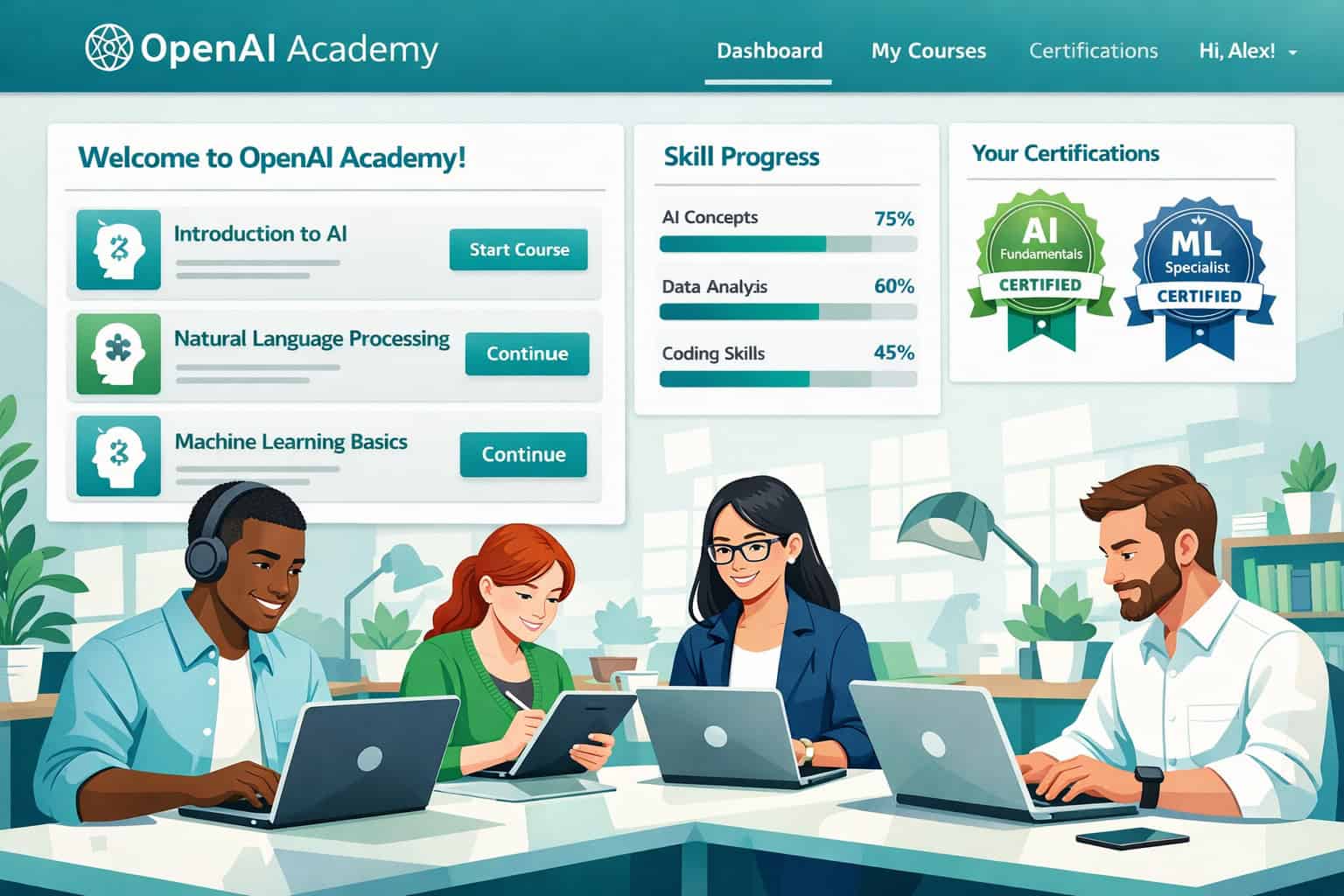
OpenAI Academy is OpenAI’s dedicated platform for AI skills training, designed to help individuals and organizations build practical competency with AI tools and concepts. [6] It’s one of the most underused entry points into OpenAI’s digital hub, especially for non-technical users.
Who OpenAI Academy is for:
- Professionals who use AI tools at work but want structured learning
- Educators and students building foundational AI literacy
- Organizations that need to upskill teams before deploying AI tools
- Developers who want to deepen their understanding of model behavior and prompt design
What you can expect from the platform:
- Structured courses covering AI fundamentals, prompt engineering, and use-case application
- Content designed for different skill levels, from beginner to advanced
- Practical exercises tied to real OpenAI products and APIs
🎓 Actionable tip: If you’re introducing AI tools to a team, have everyone complete a baseline module on OpenAI Academy before your first deployment. It reduces the gap between what the tool can do and what users actually try.
For teams looking to extend their AI learning into content and SEO workflows, our practical guide to AI-powered content optimization covers how to apply these skills immediately.
How Do Azure OpenAI Services Fit Into the Enterprise Picture?
Azure OpenAI services give enterprises access to OpenAI’s latest models — including reasoning models and multimodal capabilities — through Microsoft’s cloud infrastructure, with enterprise-grade security, compliance, and fine-tuning options. [8]
For organizations that already operate within the Microsoft ecosystem, Azure OpenAI is often the most practical path to deploying OpenAI models at scale.
Key advantages of Azure OpenAI for enterprises:
- Data privacy: Your data is not used to train OpenAI’s base models
- Compliance: Supports regulatory frameworks including HIPAA, SOC 2, and GDPR
- Integration: Works natively with Azure’s broader AI and data services
- Fine-tuning: Allows model customization on your own datasets within Azure’s environment
- SLA-backed uptime: Enterprise service level agreements for reliability
Azure OpenAI vs. Direct OpenAI API — a quick comparison:
| Factor | Azure OpenAI | Direct OpenAI API |
|---|---|---|
| Data residency | Azure regions (configurable) | OpenAI infrastructure |
| Compliance certifications | Extensive (HIPAA, SOC 2, etc.) | More limited |
| Fine-tuning | Yes | Yes |
| Pricing model | Azure consumption + model costs | Pay-per-token |
| Best for | Regulated enterprises | Startups, developers |
| Setup complexity | Higher | Lower |
Common mistake: Enterprises sometimes choose Azure OpenAI for compliance reasons but don’t configure the data handling settings correctly. Always review the Azure OpenAI data privacy documentation specific to your deployment region.
What Are the Most Common Ways People Misunderstand OpenAI’s Ecosystem?
Several persistent misconceptions slow down adoption and lead to poor tool choices. Here are the most frequent ones, and what’s actually true.
Misconception 1: “OpenAI is just ChatGPT.” ChatGPT is one consumer product. The broader ecosystem includes APIs, open-weight models, enterprise services, education platforms, and infrastructure — each serving different needs.
Misconception 2: “Using OpenAI means your data trains their models.” This is not automatically true. Azure OpenAI and certain API configurations explicitly exclude your data from training. Always check the specific data use policy for your deployment method. [8]
Misconception 3: “Open-weight models are always better for privacy.” Open-weight models like GPT-OSS give you control over deployment, but privacy depends on how you configure and secure your infrastructure — not just on having the weights. [3]
Misconception 4: “The most powerful model is always the right choice.” Matching model capability to task complexity is more important than using the largest model. Smaller, faster models often outperform larger ones for specific, well-defined tasks.
Misconception 5: “AI tools replace the need for design and content skills.” AI tools augment skilled practitioners. Understanding design principles, content strategy, and user experience remains essential. For example, knowing how to use AI SEO tools effectively still requires SEO knowledge to interpret and act on the output.
FAQ: OpenAI’s Digital Hub and AI Innovation Gateway
Q: Is OpenAI’s API the same as ChatGPT? No. ChatGPT is a consumer product with a chat interface. The OpenAI API is a programmatic interface for developers to build their own applications using OpenAI’s models. They use similar underlying models but serve different users.
Q: Can I use OpenAI models without sending data to OpenAI? Yes. GPT-OSS models can be deployed on your own infrastructure under the Apache 2.0 license, keeping all data local. [3] Azure OpenAI also offers strong data privacy guarantees where your data is not used to train OpenAI’s base models. [8]
Q: What is the Stargate project? Stargate is a $500 billion joint venture between OpenAI, SoftBank, and Oracle to build AI infrastructure in the United States. The anchor facility is in Abilene, Texas. [7] It’s designed to provide the compute capacity needed for next-generation AI development and deployment.
Q: Who is OpenAI Academy for? OpenAI Academy is for anyone who wants structured AI skills training — from complete beginners to professionals looking to deepen their understanding of AI tools and concepts. [6] It’s particularly useful for teams preparing to deploy AI tools organizationally.
Q: What is the CFDA x OpenAI Innovation Hub? It’s a year-long program that pairs six fashion brands with six AI tool builders, providing mentorship, technical support, and funding to develop AI pilot projects specific to the fashion industry. [1] It’s a model for sector-specific AI adoption programs.
Q: How do I choose between the 20B and 120B GPT-OSS models? Start with the 20B model for most enterprise tasks — it requires significantly less compute and is faster to deploy. Use the 120B model when you need higher reasoning quality for complex, multi-step tasks and have the GPU infrastructure to support it. [3]
Q: Is OpenAI only for large enterprises? No. OpenAI’s ecosystem spans individual users (ChatGPT free tier), solo developers (API with pay-per-token pricing), small businesses (ChatGPT Team), and large enterprises (Azure OpenAI, GPT-OSS). The entry point scales with your needs and budget.
Q: What’s the difference between Azure OpenAI and the direct OpenAI API? Azure OpenAI offers enterprise compliance certifications (HIPAA, SOC 2, GDPR), configurable data residency, and Microsoft ecosystem integration. [8] The direct API is simpler to set up and better suited for developers and startups without strict regulatory requirements.
Q: Does OpenAI have tools for non-technical creatives? Yes. ChatGPT, DALL-E for image generation, and Sora for video are all designed for non-technical users. The CFDA Innovation Hub also shows OpenAI’s commitment to building tools specifically for creative industries. [1]
Q: How does AI fit into web design and content workflows? AI tools are increasingly integrated into design and content platforms. For practical applications, see our guides on AI-powered content optimization and the best AI graphic design tools for workflow integration ideas.
Conclusion: Your Next Steps Into OpenAI’s Ecosystem
Inside OpenAI’s digital hub, exploring the gateway to cutting-edge AI innovation is less about picking the “best” tool and more about matching the right access point to your actual situation.
Here’s how to move forward, based on where you are:
If you’re new to AI: Create a free ChatGPT account and spend two weeks using it daily for real work tasks. Then take a foundational course on OpenAI Academy. [6]
If you’re a developer: Get API access, start in the Playground, and build one small proof-of-concept before committing to architecture decisions.
If you’re an enterprise leader: Evaluate Azure OpenAI against your compliance requirements. [8] If data residency is non-negotiable, assess GPT-OSS through Dell’s Enterprise Hub. [3]
If you’re in a creative industry: Follow the CFDA Innovation Hub model — find the intersection between your domain expertise and AI capability, then pilot a specific, bounded use case. [1]
If you’re building AI-powered web products: Combine OpenAI’s API with no-code and low-code tools. Our guide to the best no-coding website design software platforms for 2026 and AI-powered chatbot integration for WordPress are practical starting points.
The Stargate infrastructure investment [7] signals that OpenAI is building for the long term. The ecosystem will keep expanding — but the fundamentals of choosing the right access point, matching model capability to task, and managing data responsibly will remain constant.
Start with one entry point. Get specific results. Then expand.
References
[1] Cfda Openai Launch Innovation Hub – https://cfda.com/news/cfda-openai-launch-innovation-hub/
[3] Openai S Gpt Oss Models Dell Ai Factory Unlocking Enterprise Ai On Your Terms – https://www.dell.com/en-us/blog/openai-s-gpt-oss-models-dell-ai-factory-unlocking-enterprise-ai-on-your-terms/
[6] academy.openai – https://academy.openai.com
[7] Watch (Stargate Project) – https://www.youtube.com/watch?v=GhIJs4zbH0o
[8] Openai (Azure AI Foundry) – https://azure.microsoft.com/en-us/products/ai-foundry/models/openai