Last updated: May 1, 2026
Quick Answer: The most influential AI websites in 2026 span three categories: AI assistants you use directly (ChatGPT, Claude, Gemini), research and intelligence sources (Stanford AI Index, MIT Technology Review, ArXiv), and development platforms (TensorFlow, PyTorch, Azure AI). Choosing the right ones depends on whether you need to do something with AI, learn about it, or build with it.
Key Takeaways
- ChatGPT leads all AI tools with 5.5 billion monthly visits and 57.59% market share among AI platforms as of February 2026 [4]
- Three AI assistants cover most use cases: ChatGPT (versatility), Claude (long documents and nuance), and Gemini (Google ecosystem integration) [6]
- For research and strategic insight, Stanford AI Index, MIT Technology Review, and ArXiv are the highest-authority sources available
- Perplexity is the best choice for real-time, source-cited research without hallucinations [3]
- Development platforms like TensorFlow, PyTorch, and Azure AI serve builders and enterprises deploying AI at scale [5]
- The Gradient and McKinsey on AI offer critical thinking and business ROI analysis that goes beyond surface-level news [1]
- Matching the website to your goal — using, learning, or building — saves time and produces better outcomes than trying every platform
Why Does the AI Website Landscape Matter So Much Right Now?
The AI web has become genuinely hard to map. As of 2026, hundreds of platforms compete for attention, and the gap between the most useful and the merely hyped is enormous. Knowing which sites to trust — and for what purpose — is the difference between gaining a real productivity edge and wasting hours on tools that underdeliver.
This guide to Navigating the Digital Frontier: A Comprehensive Guide to the Most Influential AI Websites organizes the landscape into clear categories so you can act immediately, not just browse.
A single data point makes the scale clear: ChatGPT alone receives 5.5 billion monthly visits, commanding 57.59% of the AI tools market [4]. That’s not just popularity — it signals that a massive shift in how people work, research, and create is already underway. The question isn’t whether AI websites matter. It’s which ones are worth your time.
What Are the Most-Visited AI Websites in 2026?
Traffic data tells you where people are going, but not always why. The top platforms by monthly visits reveal both dominant tools and emerging challengers worth watching.
| Platform | Monthly Visits (est.) | Market Share | Primary Use |
|---|---|---|---|
| ChatGPT | 5.5 billion | 57.59% | General AI assistant |
| Canva | 870.4 million | 9.11% | AI-assisted design |
| Gemini | 805.6 million | 8.43% | Google-integrated assistant |
| Perplexity | Growing rapidly | — | AI-powered research |
| Claude | Growing rapidly | — | Long-form reasoning |
Source: Exploding Topics, February 2026 [4]
What this table doesn’t show is quality of use. Many ChatGPT visits are quick, single-turn queries. Claude users tend to work on longer, more complex tasks. Gemini benefits from deep integration with Google Workspace, making it stickier for teams already in that ecosystem.
Choose based on use case, not just popularity.
Which AI Assistant Should You Actually Use?
For most people, three AI assistants cover nearly every scenario: ChatGPT, Claude, and Gemini. Specialized alternatives exist for specific needs, but starting with these three is the right call for the majority of users [6].

ChatGPT (OpenAI)
ChatGPT is the most versatile general-purpose AI assistant available. It handles writing, coding, brainstorming, summarization, and complex reasoning across virtually every domain. The GPT-4o model (included in the free tier with limits) is capable enough for most daily tasks.
Best for: Everyday tasks, content drafts, coding help, quick explanations Free tier: Yes, with usage limits Paid plans: ChatGPT Plus at $20/month unlocks faster responses and access to newer models
Claude (Anthropic)
Claude is the strongest option for tasks involving long documents, nuanced writing, and careful reasoning. It handles large context windows better than most competitors, making it ideal for analyzing reports, drafting detailed proposals, or working through complex arguments.
Best for: Long-form analysis, editing, document review, nuanced conversation Free tier: Yes Paid plans: Claude Pro at $20/month
Gemini (Google)
Gemini integrates directly with Google Docs, Gmail, Drive, and Search, which makes it the natural choice for anyone already working in Google Workspace. Its real-time web access is also a consistent advantage for current information.
Best for: Google Workspace users, real-time web queries, multimodal tasks Free tier: Yes Paid plans: Gemini Advanced via Google One AI Premium
Specialized Alternatives Worth Knowing
- Perplexity: Best for real-time research with cited sources — it functions as an AI search engine that shows its work, reducing hallucination risk significantly [3]
- Microsoft Copilot: Strong choice for Microsoft 365 users, embedded in Word, Excel, and Teams
- Grok (xAI): Useful for X (Twitter) data and less filtered responses
- DeepSeek r1: A capable open-weight model worth considering for technical and research tasks [6]
For teams building AI into their websites or workflows, check out this guide on AI-powered content generation tools and how to use AI SEO tools for WordPress to improve site rankings.
Where Should You Go to Learn About AI Seriously?
The best AI learning resources are not the ones with the most social media followers — they’re the ones with the most rigorous standards. For anyone navigating the digital frontier and building real knowledge about AI, these sources stand apart.

Stanford AI Index
The Stanford AI Index is one of the most authoritative sources of empirical data on global AI adoption, investment, and capability benchmarks [1]. It publishes annual reports packed with hard statistics that researchers, executives, and policymakers actually use to make decisions. If you need numbers you can cite with confidence, this is the starting point.
Best for: Researchers, strategists, journalists, policy analysts
MIT Technology Review
MIT Technology Review focuses on long-term innovation trajectories — think 5, 10, and 20-year outlooks — rather than chasing weekly news cycles [1]. Its analysis of how emerging AI technologies will reshape industries is grounded in science, not hype. The publication has been around since 1899, and that institutional depth shows in the quality of its AI coverage.
Best for: Business leaders, investors, anyone making long-horizon decisions
OpenAI Blog
The OpenAI Blog offers rare transparency into how AI systems are constructed, tested, and deployed responsibly [1]. It covers model capabilities, safety frameworks, and real-world applications across industries. Even if you use Claude or Gemini as your primary assistant, reading OpenAI’s technical posts gives you a clearer picture of where the field is heading.
Best for: Technical practitioners, AI enthusiasts, product managers
ArXiv
ArXiv is where AI research appears before it becomes mainstream — sometimes years before [1]. Many technologies dominating the market today were first described in ArXiv preprints. For anyone who wants to spot trends early or understand the technical foundations of AI tools, it’s indispensable.
Best for: Researchers, engineers, competitive intelligence analysts
The Gradient
The Gradient specializes in deep analysis and critical thinking about AI approaches [1]. It actively challenges assumptions and helps readers avoid groupthink by prioritizing conceptual understanding over surface-level reporting. If you want to think more clearly about AI rather than just consume more content about it, The Gradient is worth bookmarking.
Best for: Thoughtful practitioners, academics, senior strategists
Academic Research Blogs
The Berkeley AI Research (BAIR) Blog and MIT News – Artificial Intelligence provide direct access to cutting-edge research in deep learning, robotics, human-AI interaction, and AI ethics [2]. These aren’t polished marketing pieces — they’re written by researchers for people who want to understand the actual work.
Best for: Graduate students, engineers, policy researchers
McKinsey on AI
McKinsey’s AI coverage is grounded in real corporate data, focusing on ROI, productivity improvements, and economic impact [1]. It’s less about what AI can do theoretically and more about what it does do in practice inside large organizations. For business leaders evaluating AI investments, this is one of the most practically useful sources available.
Best for: Executives, consultants, business analysts
What AI Development Platforms Do Builders and Enterprises Use?
If you’re building AI applications rather than just using them, the platform you choose shapes everything from model performance to deployment cost. The leading development platforms each have distinct strengths [5].
Google TensorFlow
TensorFlow is an open-source machine learning framework maintained by Google. It’s mature, well-documented, and widely used in production environments. Its ecosystem includes TensorFlow Lite for mobile deployment and TensorFlow.js for browser-based AI.
Choose TensorFlow if: You need production-grade deployment, mobile AI, or browser-based models
Meta PyTorch
PyTorch has become the dominant framework in AI research and is rapidly gaining ground in production. Its dynamic computation graph makes experimentation faster, which is why most academic papers and many startups use it as their default.
Choose PyTorch if: You’re doing research, rapid prototyping, or working with the latest model architectures
Microsoft Azure AI
Azure AI provides a managed cloud environment for deploying AI models at enterprise scale. It integrates with existing Microsoft infrastructure and offers services like Azure OpenAI Service, which gives enterprise customers access to GPT models with added security and compliance controls.
Choose Azure AI if: You’re an enterprise with Microsoft infrastructure, compliance requirements, or need managed deployment
IBM Watson
IBM Watson focuses on enterprise AI applications, particularly in regulated industries like healthcare, finance, and legal. It offers pre-built AI services and tools for natural language processing, document understanding, and process automation.
Choose IBM Watson if: You operate in a regulated industry with strict data governance requirements [5]
For teams looking to integrate AI directly into their web presence, the guide on AI website creators that build professional sites without code is a practical next step. You can also explore 12 best AI plugins for WordPress to automate website management for ready-made integration options.
How Do You Choose the Right AI Website for Your Specific Goal?
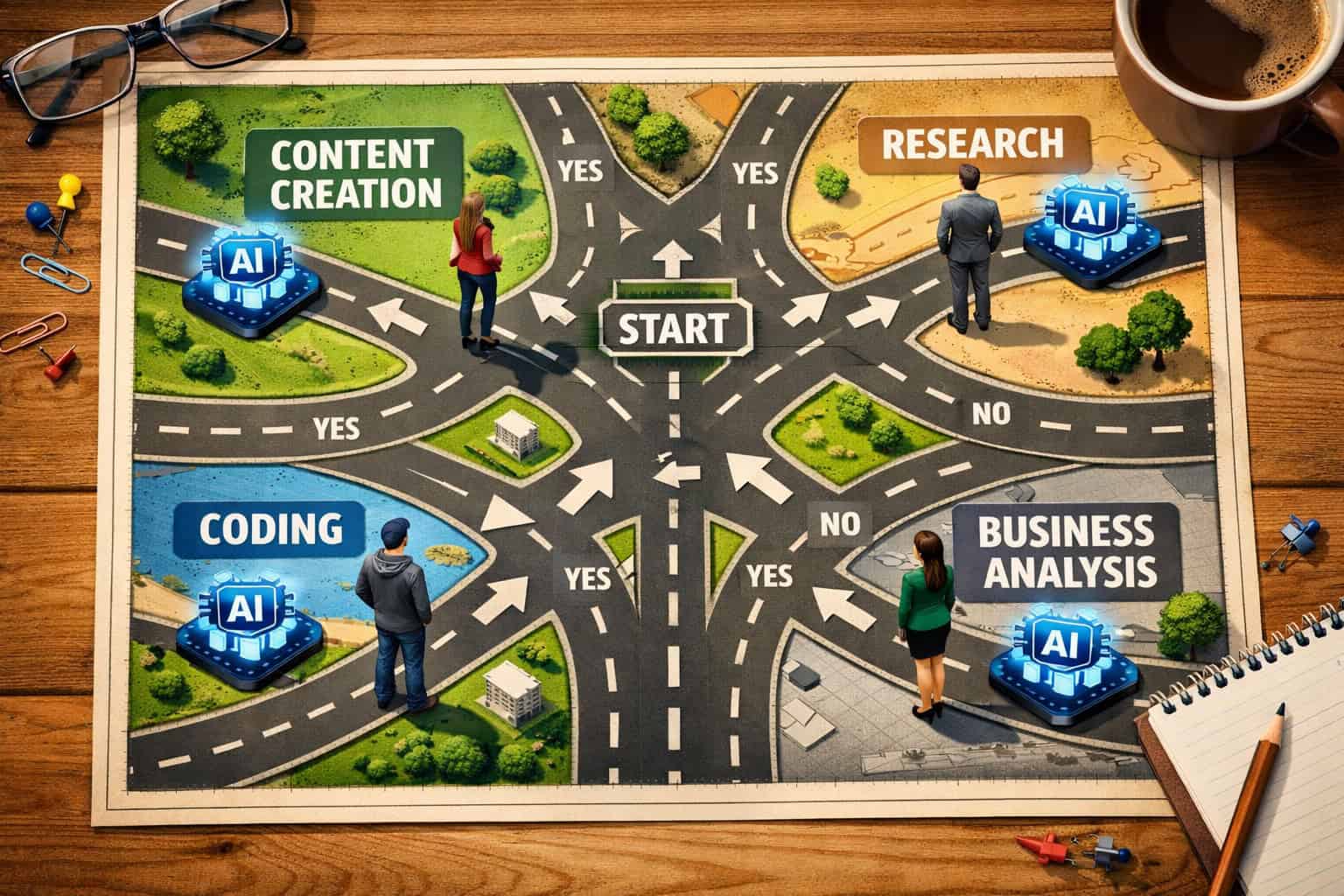
Matching the right AI resource to your specific goal is more valuable than knowing every platform. Here’s a decision framework that cuts through the noise.
Step-by-Step Decision Framework
Step 1: Define your primary goal
- I want to do something (write, code, analyze, design) → Go to AI assistants
- I want to learn about AI (research, strategy, policy) → Go to knowledge sources
- I want to build with AI (applications, models, APIs) → Go to development platforms
Step 2: Match the goal to the platform
| Goal | Best Platform | Why |
|---|---|---|
| Write content faster | ChatGPT or Claude | Versatile, strong language output |
| Research with citations | Perplexity | Source-cited, real-time |
| Analyze long documents | Claude | Large context window |
| Work in Google Workspace | Gemini | Native integration |
| Track AI industry trends | MIT Tech Review, Stanford AI Index | Rigorous, empirical |
| Build ML models | PyTorch or TensorFlow | Open-source, well-supported |
| Deploy enterprise AI | Azure AI or IBM Watson | Managed, compliant |
| Find early research signals | ArXiv | Pre-publication papers |
| Critical AI analysis | The Gradient | Challenges assumptions |
Step 3: Test before committing
Most AI assistants offer free tiers. Spend one week using your top two candidates for real work tasks before paying for a subscription. The platform that fits your workflow will become obvious quickly.
Common mistake: Choosing a platform based on brand recognition rather than task fit. Many users default to ChatGPT for everything when Claude would serve them better for document-heavy work, or Perplexity would be more reliable for research.
For teams building their web presence alongside AI tools, resources like AI-powered content optimization guides and the best AI graphic design tools for creative workflows can help integrate AI into design and content processes effectively.
What Are the Most Common Mistakes People Make When Choosing AI Websites?
The biggest mistake is treating AI websites as interchangeable. Each platform has a distinct strength profile, and using the wrong one for the wrong task produces mediocre results that make people underestimate AI’s actual value.
Here are the most frequent errors, and how to avoid them:
Mistake 1: Using a general assistant for research ChatGPT and Claude can hallucinate facts, especially for recent events or niche topics. For research that needs to be accurate, use Perplexity, which cites its sources and pulls from real-time web data [3].
Mistake 2: Ignoring free tiers before paying Nearly every major AI assistant offers a functional free tier. Committing to a $20/month subscription before testing the free version for a week is unnecessary. The free tiers of ChatGPT, Claude, and Gemini are all capable enough to evaluate fit.
Mistake 3: Skipping the knowledge sources Most people use AI tools but never read about AI strategy or research. Sites like the Stanford AI Index and McKinsey on AI provide context that makes you a smarter user of every AI tool you touch [1].
Mistake 4: Choosing development platforms by brand TensorFlow and PyTorch are both excellent. Choosing based on Google vs. Meta brand preference rather than your actual use case (production vs. research) leads to unnecessary friction [5].
Mistake 5: Treating ArXiv as too technical ArXiv abstracts are often readable without deep technical background. Skimming titles and abstracts weekly is a low-effort way to stay ahead of what’s coming before it hits mainstream AI tools.
Conclusion: Your Action Plan for Navigating the Digital Frontier
Navigating the Digital Frontier: A Comprehensive Guide to the Most Influential AI Websites comes down to one core principle: match the resource to the goal. The AI web is large and growing, but the number of sites that genuinely deserve your attention is much smaller than the noise suggests.
Here’s a concrete action plan to start today:
- Pick one AI assistant and use it daily for two weeks. Start with ChatGPT (most versatile) or Claude (best for documents). Don’t try to use all three simultaneously.
- Bookmark Perplexity for any research task where accuracy and citations matter. Use it instead of standard search for AI-related queries.
- Subscribe to one knowledge source. MIT Technology Review for long-horizon strategy, Stanford AI Index for data, or McKinsey on AI for business impact. One is enough to start.
- Check ArXiv titles weekly if you work in tech or research. Set a 10-minute calendar block. You’ll spot trends months before they become mainstream.
- If you’re building, test PyTorch for research and TensorFlow or Azure AI for production before committing to a stack.
The AI landscape will keep changing. But the habit of matching the right tool to the right task — and reading the right sources to stay informed — compounds over time. That’s the real advantage.
For more on integrating AI into your digital work, explore AI-powered content optimization strategies and the best no-code website design platforms for 2026 to see how AI tools are reshaping web creation as well.
Frequently Asked Questions
Q: What is the most popular AI website in 2026? ChatGPT is the most visited AI website with 5.5 billion monthly visits and a 57.59% market share among AI tools as of February 2026 [4].
Q: Is ChatGPT better than Claude or Gemini? Not universally. ChatGPT is the most versatile general-purpose assistant. Claude is better for long documents and nuanced reasoning. Gemini is stronger for users inside Google Workspace. The best choice depends on your specific tasks [6].
Q: What AI website is best for research? Perplexity is the best AI tool for research because it cites its sources in real time and pulls from current web data, significantly reducing the risk of inaccurate information [3].
Q: Where can I find authoritative data on AI adoption and investment? The Stanford AI Index publishes annual reports with empirical data on global AI adoption, investment trends, and capability benchmarks. It’s one of the most credible sources for hard statistics [1].
Q: What is ArXiv and why does it matter for AI? ArXiv is an open-access repository where researchers publish papers before formal journal review. Many AI technologies that dominate today appeared on ArXiv years before mainstream adoption, making it a valuable source for early trend identification [1].
Q: Which AI development platform should I use — TensorFlow or PyTorch? Choose PyTorch for research and rapid prototyping. Choose TensorFlow for production deployment, especially if you need mobile or browser-based AI. Both are open-source and well-supported [5].
Q: Are there free AI websites worth using? Yes. ChatGPT, Claude, Gemini, and Perplexity all offer functional free tiers. ArXiv, Stanford AI Index, and The Gradient are free to read. You can build a strong AI toolkit without paying anything initially.
Q: What AI websites are best for business leaders? McKinsey on AI for ROI and economic impact analysis, MIT Technology Review for long-term strategic outlook, and Stanford AI Index for empirical benchmarks are the three most useful sources for business decision-makers [1].
Q: Is Microsoft Copilot worth using? Yes, for Microsoft 365 users. Copilot integrates directly into Word, Excel, PowerPoint, and Teams, making it the most frictionless AI assistant for anyone already in the Microsoft ecosystem [6].
Q: What’s the difference between an AI assistant and an AI development platform? AI assistants (ChatGPT, Claude, Gemini) are tools you use directly to complete tasks. AI development platforms (TensorFlow, PyTorch, Azure AI) are frameworks and infrastructure for building AI applications and deploying models [5].
References
[1] The 12 Most Important Websites To Understand Artificial Intelligence – https://www.gokapital.com/the-12-most-important-websites-to-understand-artificial-intelligence/
[2] AI Blogs – https://onlinedegrees.sandiego.edu/ai-blogs/
[3] AI Platforms – https://www.lindy.ai/blog/ai-platforms
[4] Most Popular AI Tools – https://explodingtopics.com/blog/most-popular-ai-tools
[5] Navigating The World Of Artificial Intelligence Your Guide To Top AI Websites – https://www.raiaai.com/blogs/navigating-the-world-of-artificial-intelligence-your-guide-to-top-ai-websites
[6] Which AI To Use Now An Updated Opinionated – https://www.oneusefulthing.org/p/which-ai-to-use-now-an-updated-opinionated
Related: Unlocking Learning Potential: How Claude AI Transforms Online Course Experiences