Last updated: May 10, 2026
Quick Answer
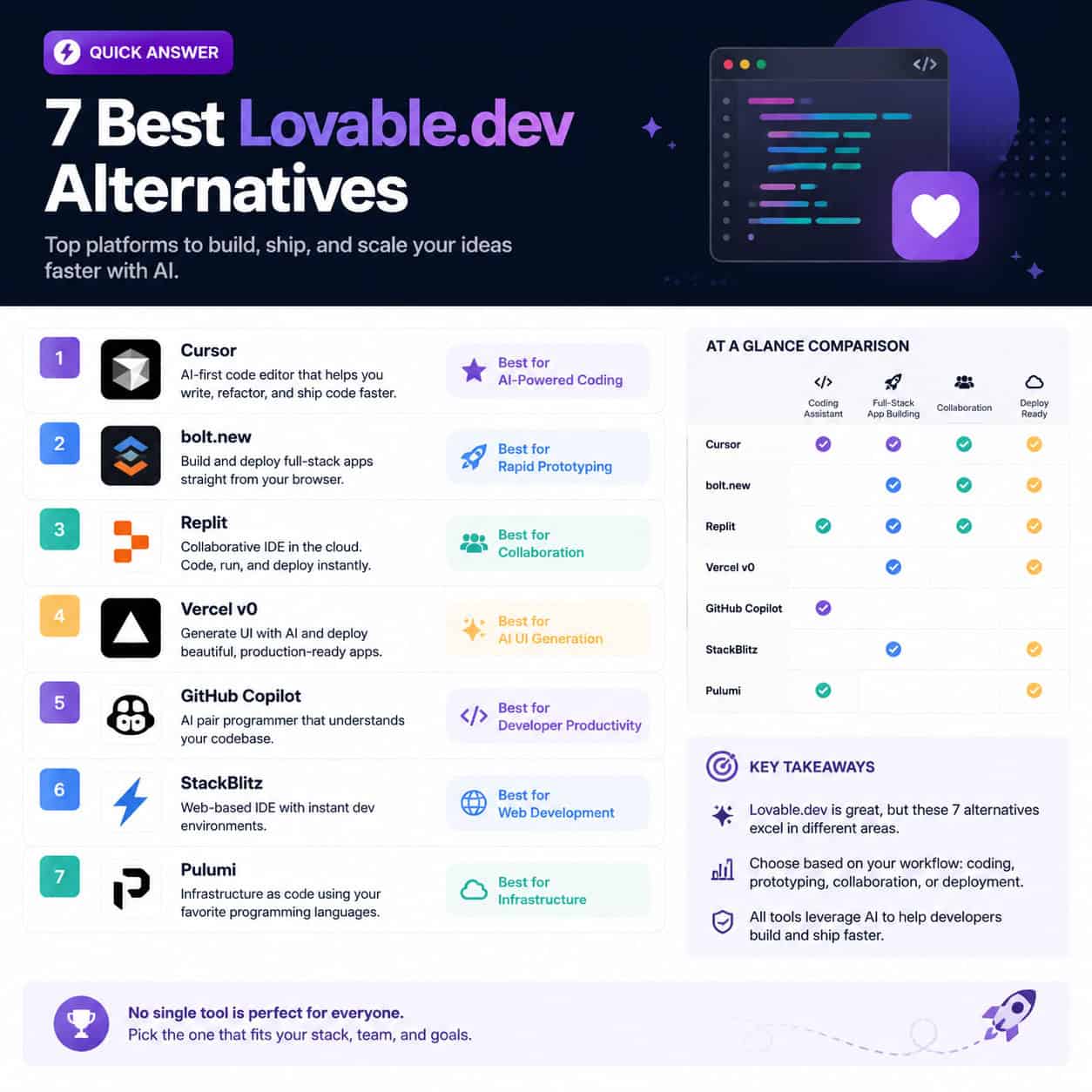
Lovable.dev is a powerful AI app builder, but its Supabase lock-in, credit-burning loops, and production scaling limits push many developers toward alternatives. The seven strongest options in 2026 are Bolt.new, v0 by Vercel, Cursor, Replit Agent, Bubble, Adalo, and WeWeb. Your best pick depends on whether you need rapid prototyping, native mobile apps, or production-ready scalability.
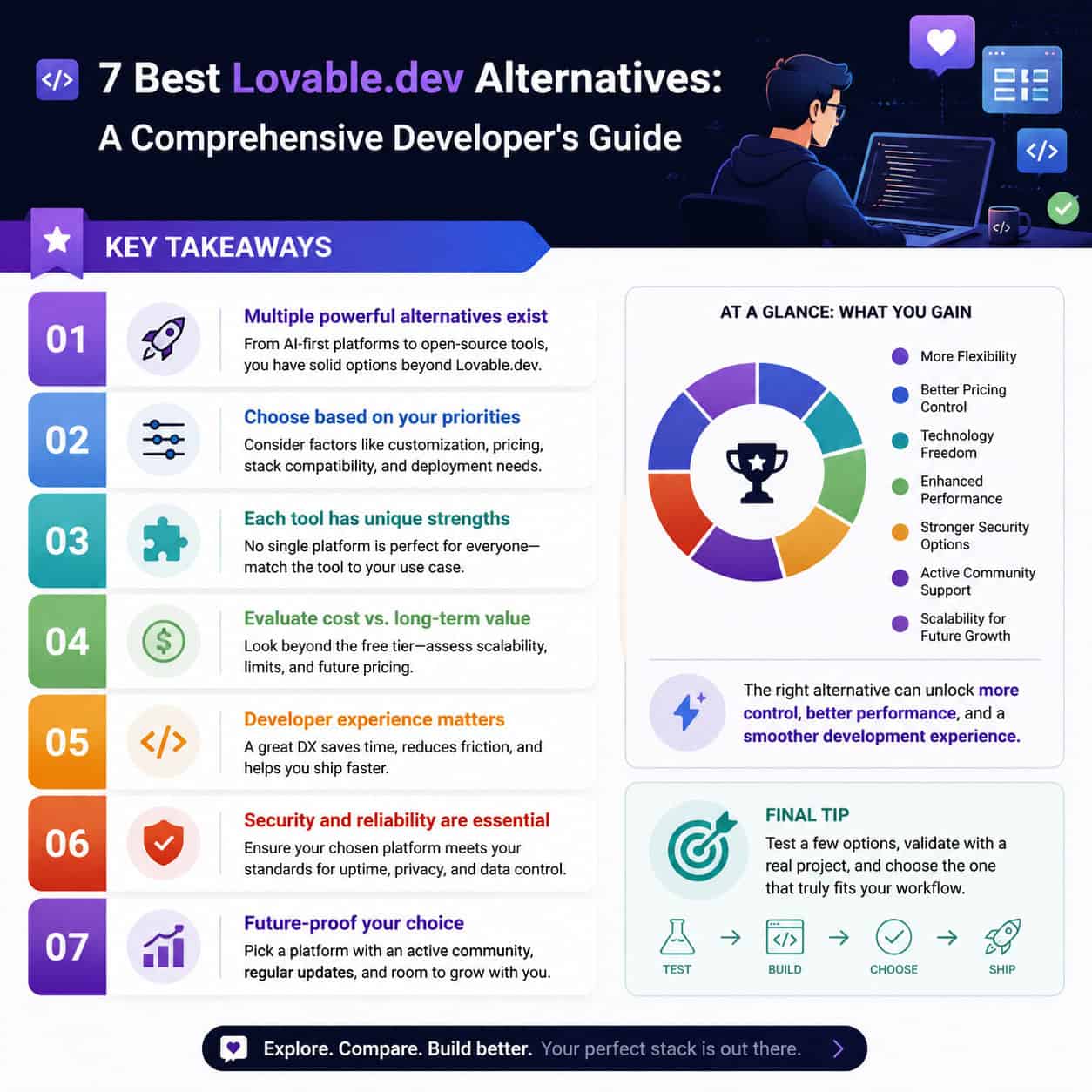
Key Takeaways
- Lovable excels at prompt-to-prototype speed but often hits a “70-80% wall” where AI loops consume credits without finishing the project [10].
- Bolt.new is the closest direct alternative for code-comfortable users, offering a browser IDE with better Git integration at $20-30/month [6].
- v0 by Vercel is ideal if you’re building React/Next.js interfaces and want clean UI scaffolding [6].
- Cursor ($20/month) works best for developers who want AI assistance inside a full IDE rather than a chat-only interface [10].
- Bubble is the strongest choice for production apps that need to scale beyond 5-10 concurrent users [8].
- Adalo fills the native mobile gap that Lovable can’t, offering iOS/Android publishing at $36/month with no credit system [10].
- WeWeb provides visual editing with multi-backend support, solving Lovable’s Supabase-only limitation.
- A security incident in April 2026 exposed public Lovable project data, raising concerns about the platform’s maturity for sensitive applications.
Why Are Developers Looking for Lovable.dev Alternatives in 2026?
Lovable.dev grew explosively, reportedly approaching $100 million monthly ARR spikes in early 2026. But rapid growth exposed real friction points that send developers searching for alternatives.
The core problems:
- Credit consumption loops. Lovable’s AI sometimes enters repetitive cycles trying to fix errors, burning through your monthly credits without making progress. Adalo’s analysis scored this the platform’s biggest weakness [10].
- Supabase lock-in. Lovable integrates exclusively with Supabase for backend services. If you need Firebase, Xano, or a custom API, you’re stuck.
- Production scaling. Multiple sources report that Lovable-generated apps struggle beyond 5-10 concurrent users without significant manual optimization [9].
- Security concerns. An April 2026 incident allowed authenticated users to access other users’ public project data, shaking confidence in the platform’s security posture.
- Web-only output. Lovable doesn’t generate native mobile apps. If you need App Store or Google Play publishing, you need a different tool.
These aren’t dealbreakers for everyone. Lovable remains unbeatable for generating an MVP in minutes from a text prompt [10]. But if you’ve hit any of these walls, this guide will help you find the right alternative.
What Makes a Good Lovable Alternative?
Before comparing tools, here’s what to evaluate. A strong alternative should address at least one of Lovable’s weaknesses without sacrificing its core strength (speed from prompt to working app).
Evaluation criteria I used:
| Criteria | Why It Matters |
|---|---|
| Code ownership | Can you export and self-host? |
| Backend flexibility | Are you locked into one provider? |
| Pricing model | Credits vs. flat rate vs. usage-based |
| Production readiness | Can the output handle real traffic? |
| Mobile support | Native apps or web-only? |
| AI quality | Does the AI loop or produce clean code? |
| Learning curve | How fast can you ship? |
If you’re exploring the broader no-code space, our guide to no-coding website design software platforms covers additional options beyond AI-first builders.
The 7 Best Lovable.dev Alternatives: A Comprehensive Developer’s Guide
1. Bolt.new — Best Direct Alternative for Code-Comfortable Users
Price: $20-30/month | Best for: Full-stack prototyping with Git control
Bolt.new runs entirely in the browser and generates full-stack applications from prompts, similar to Lovable. The key difference: better Git integration and more transparent code output [6]. You can see exactly what the AI generates, commit to GitHub, and deploy anywhere.
Choose Bolt.new if: You want Lovable’s speed but need proper version control and the ability to deploy outside a walled garden.
Skip it if: You’re non-technical. Bolt.new assumes you can read and occasionally fix code.
2. v0 by Vercel — Best for React/Next.js UI Generation
Price: $20-100/month | Best for: Frontend scaffolding and component generation
v0 focuses specifically on generating React and Next.js UI components from prompts [6]. It doesn’t try to build your entire backend. Instead, it produces clean, deployable frontend code that integrates naturally with the Vercel ecosystem.
Choose v0 if: You’re building a Next.js app and want AI to handle UI generation while you manage the backend yourself.
Skip it if: You need a complete app from a single prompt with backend included.
For designers transitioning from Figma to code, v0 pairs well with Figma-to-code plugins for a hybrid workflow.
3. Cursor — Best for Developers Who Want AI Inside Their IDE
Price: $20/month (unlimited) | Best for: Finishing what Lovable starts
Cursor isn’t a no-code builder. It’s a VS Code fork with deep AI integration. Many developers use it as a “second stage” tool: generate 70-80% with Lovable, then export the code and finish in Cursor where the AI can actually debug and refine without burning credits [10].
Choose Cursor if: You’re a developer who wants AI pair-programming, not AI-does-everything.
Skip it if: You can’t write or read code at all.
4. Replit Agent — Best for Hosted Full-Stack Development
Price: Usage-based billing | Best for: Teams wanting everything in one workspace
Replit Agent builds, hosts, and deploys apps from a single conversational interface. Unlike Lovable, your app runs on Replit’s infrastructure from the start, so there’s no export step [6]. The trade-off: you’re tied to Replit’s hosting.
Choose Replit if: You want zero DevOps friction and don’t mind platform dependency.
Skip it if: You need to self-host or have strict infrastructure requirements. Note that Apple briefly cracked down on Replit’s mobile app in early 2026, so mobile access may be inconsistent.
5. Bubble — Best for Scalable Production Applications
Price: $32+/month | Best for: Apps that need to handle real user loads
Bubble takes a fundamentally different approach. Instead of generating code from prompts, it provides a visual programming environment with one-click hosting [8]. The result: apps that actually scale in production, unlike Lovable’s output which often struggles beyond prototype-level traffic [9].
Choose Bubble if: You’re building a product that needs to serve hundreds or thousands of users reliably.
Skip it if: You want to own your code. Bubble apps live on Bubble’s platform.
Our review of drag-and-drop website builders provides additional context on visual builders like Bubble.
6. Adalo — Best for Native Mobile Apps Without Code
Price: $36/month (flat rate) | Best for: Publishing to App Store and Google Play
Adalo directly addresses Lovable’s biggest gap: mobile. It generates native iOS and Android apps with a visual builder, and charges a flat monthly rate with no credit system [10]. Adalo’s own analysis scored it highest among visual builders (5.94/10) while acknowledging Lovable leads in prompt-to-app speed (5.08/10).
Choose Adalo if: Your primary goal is a mobile app in the App Store without hiring native developers.
Skip it if: You’re building a complex web application or need AI-generated code you can customize.
7. WeWeb — Best for Multi-Backend Flexibility
Price: Free tier available; paid plans from $19/month | Best for: Teams already using Xano, Supabase, or custom APIs
WeWeb combines visual editing with AI assistance, but its standout feature is backend agnosticism. Connect Supabase, Xano, Firebase, REST APIs, or GraphQL endpoints. This directly solves Lovable’s single-integration limitation.
Choose WeWeb if: You have an existing backend and need a flexible frontend builder.
Skip it if: You want a single prompt to generate everything including the backend.
For teams integrating AI into broader web workflows, our guide to AI-powered content generation tools covers complementary solutions.
How to Choose the Right Alternative: A Decision Framework

The right choice depends on three factors: your technical skill, your end goal, and your budget model preference.
| Your Situation | Best Choice | Why |
|---|---|---|
| Want Lovable but better | Bolt.new | Same concept, better Git and export |
| Building React/Next.js UI | v0 | Purpose-built for that stack |
| Developer who wants AI help | Cursor | Full IDE power with AI |
| Need hosted workspace | Replit Agent | Zero DevOps, everything included |
| Building for real users at scale | Bubble | Production-grade from day one |
| Need native mobile app | Adalo | iOS/Android without native dev skills |
| Have existing backend | WeWeb | Connects to anything |
Common mistake: Choosing based on the demo alone. Every AI builder looks magical in a 2-minute video. Test with your actual use case, especially the parts that require custom logic or third-party integrations.
If you’re working with AI website creation tools more broadly, consider how these alternatives fit into your existing stack.
Can You Combine Multiple Tools?
Yes, and many experienced developers do. A common pattern in 2026:
- Generate the prototype with Lovable or Bolt.new (fastest from zero to something)
- Export the code to GitHub
- Refine and finish in Cursor (handles the last 20-30% that AI builders struggle with)
- Deploy on Vercel, Netlify, or your own infrastructure
This hybrid approach avoids the “70-80% wall” problem entirely [10]. You use each tool for what it does best rather than forcing one platform to handle everything.
For teams using design tools upstream, the Figma-to-Webflow conversion process offers another path from design to production.
FAQ
Is Lovable.dev still worth using in 2026? Yes, for initial prototyping. It remains the fastest way to go from a text description to a working web app. The problems emerge when you try to take that prototype to production [9].
Which alternative is cheapest? Cursor at $20/month with unlimited usage, but it requires coding skills. For non-coders, WeWeb’s free tier is the most accessible starting point.
Can I export my Lovable project and move to an alternative? Yes. Lovable lets you export code to GitHub [1]. From there, you can continue development in Cursor, Bolt.new, or any code editor.
Which alternative handles mobile apps best? Adalo is the only option on this list that produces native iOS and Android apps ready for app store submission [10].
Is Bolt.new better than Lovable? For developers who want code control and Git workflows, yes. For non-technical users who prefer chat-only interaction, Lovable’s interface is simpler [6].
What happened with Lovable’s security incident? In April 2026, a vulnerability allowed authenticated users to access public project data from other accounts. Lovable acknowledged and patched the issue, but it raised questions about platform maturity for sensitive applications.
Do any alternatives avoid credit-based pricing? Adalo ($36/month flat), Cursor ($20/month unlimited), and Bubble (flat monthly tiers) all avoid per-generation credit systems.
Which is best for a startup MVP? Lovable or Bolt.new for the initial build, then migrate to Cursor or a traditional stack once you have paying users and need to scale [9].
Conclusion
Lovable.dev earned its place as the fastest prompt-to-app tool available, but speed alone doesn’t build a business. If you’ve hit its credit loops, Supabase lock-in, or scaling ceiling, the alternatives in this guide each solve a specific problem.
Your next steps:
- Identify your primary pain point with Lovable (credits, mobile, scaling, backend flexibility).
- Test 2-3 alternatives from this list that address that specific issue.
- Consider the hybrid approach — use Lovable for generation, then finish in Cursor or export to your preferred stack.
- Evaluate production readiness before committing. Build your actual use case, not just the demo.
The AI builder space is moving fast. What matters isn’t picking the “best” tool — it’s picking the right tool for where your project is today and where it needs to be in six months.
References
[1] Welcome – https://docs.lovable.dev/introduction/welcome [6] Lovable Alternatives – https://www.builder.io/blog/lovable-alternatives [8] Lovable Vs Replit Vs Bubble Comparison – https://bubble.io/blog/lovable-vs-replit-vs-bubble-comparison/ [9] Startups Scaleups Lovable Limitations – https://www.fastdev.com/blog/blog/startups-scaleups-lovable-limitations/ [10] Best Lovable Alternatives 2026 – https://www.adalo.com/posts/best-lovable-alternatives-2026/