Last updated: June 14, 2026
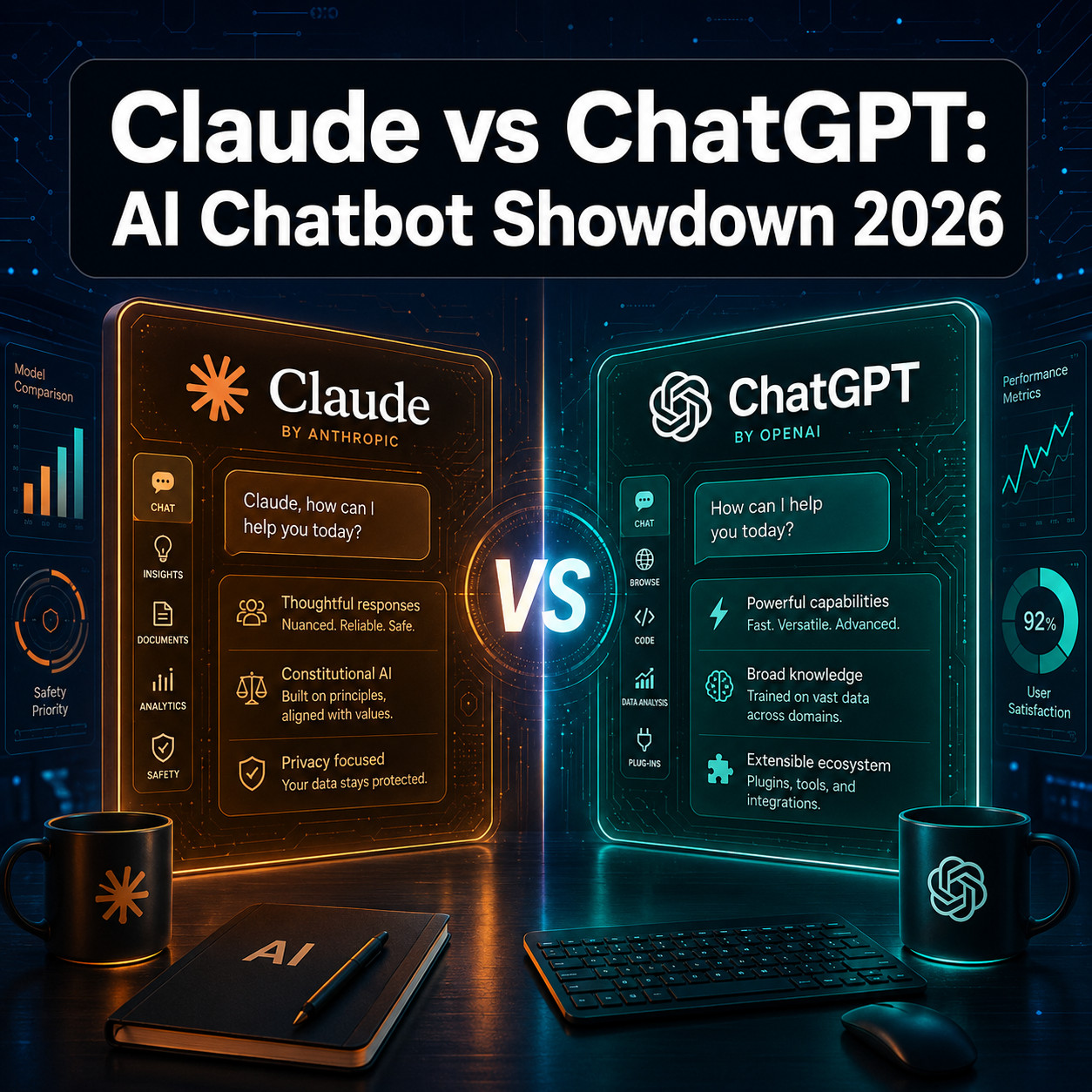
Quick Answer: Claude and ChatGPT are the two most widely used AI chatbots available today, but they serve different strengths. Claude excels at long-form writing, nuanced reasoning, and ethical guardrails, while ChatGPT leads in plugin integrations, coding versatility, and broad consumer familiarity. The right choice depends on your specific workflow, not a universal ranking.
Key Takeaways
- Claude is built by Anthropic with a strong focus on safety and constitutional AI principles; ChatGPT is built by OpenAI with a broader ecosystem of plugins and integrations.
- Both offer free tiers, but paid plans differ in pricing, context window size, and feature access.
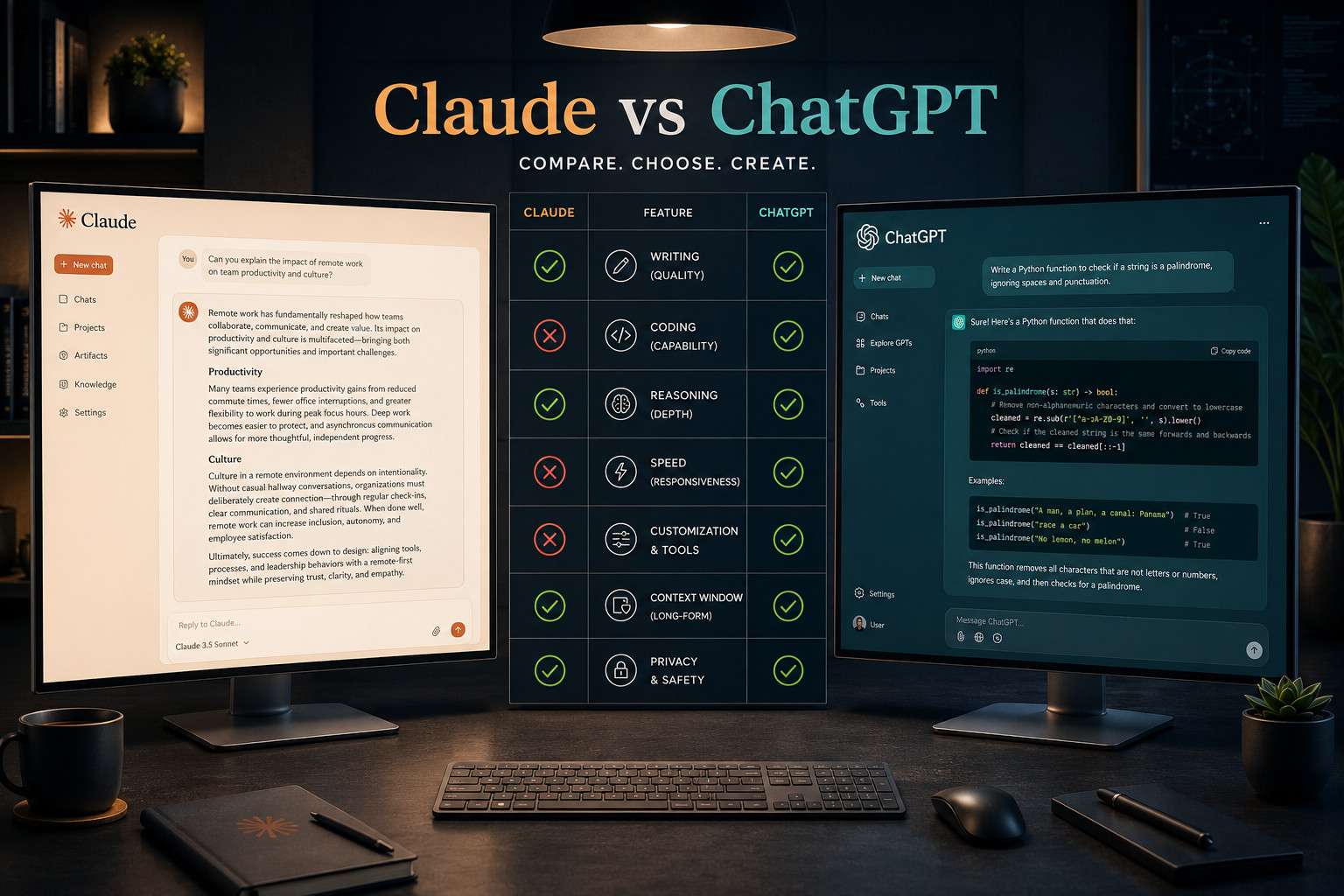
- Claude generally outperforms ChatGPT on long-document analysis and nuanced writing tasks; ChatGPT has an edge in code generation and third-party tool connections.
- Claude Fable 5, launched June 10, 2026, is Anthropic’s most powerful public model yet, surpassing 90% on Hex’s core benchmark for software engineering tasks [2].
- ChatGPT’s expanding integrations (including smart home platforms as of June 2026) make it the more versatile choice for automation-heavy workflows [3].
- Students and researchers benefit from Claude’s longer context window and careful source handling; developers often prefer ChatGPT for its API maturity.
- Neither chatbot is perfectly accurate for technical writing; both require human review of factual claims.
What Are the Main Differences Between Claude and ChatGPT?
Claude and ChatGPT share the same basic format — you type a message and get a response — but their underlying design philosophies differ significantly. Claude is developed by Anthropic, a company founded specifically around AI safety research. ChatGPT is built by OpenAI, which prioritizes broad capability and ecosystem growth.
Key structural differences:
- Training philosophy: Claude uses “Constitutional AI,” a method where the model is trained against a set of principles to reduce harmful outputs. ChatGPT uses reinforcement learning from human feedback (RLHF) with ongoing fine-tuning.
- Context window: Claude’s models support very large context windows (up to 200,000 tokens on some versions), making it better for analyzing long documents. ChatGPT-4o supports up to 128,000 tokens.
- Integrations: ChatGPT connects to a wide range of third-party tools and plugins. Claude added Slack, Asana, and Figma integrations in January 2026, closing some of that gap [4].
- Memory: Claude introduced a memory feature for Pro and Max users in October 2025, allowing it to retain context across sessions [6]. ChatGPT has offered memory features since early 2024.
For a deeper look at Claude’s evolving capabilities, see the Claude Archives on WebAIStack.
Which AI Chatbot Is Better for Coding Tasks?
For most coding tasks, ChatGPT holds a slight edge — but Claude Fable 5 is closing the gap fast. ChatGPT benefits from a more mature API, broader developer adoption, and tighter integration with tools like GitHub Copilot. Claude Fable 5, however, was the first model to surpass 90% on Hex’s core software engineering benchmark, and Genspark noted its superior performance in complex tasks like UI design and game coding [2].
Choose ChatGPT if you need:
- Quick code snippets with broad language coverage
- Integration with existing developer pipelines
- Plugin-based debugging tools
Choose Claude if you need:
- Analysis of large codebases in a single context window
- Detailed explanation of complex logic
- Safer handling of sensitive code environments (Fable 5 auto-reverts to Opus 4.8 for high-risk queries) [1]
For a direct comparison of AI coding platforms, the Replit vs Claude Code showdown is worth reading alongside this guide.
How Much Does Claude Cost Compared to ChatGPT?
Both platforms offer free tiers with limited access, and paid plans starting around $20 per month for consumer subscriptions. API pricing differs more significantly.
| Plan | Claude | ChatGPT |
|---|---|---|
| Free | Claude 3 Haiku (limited) | GPT-4o mini (limited) |
| Pro/Plus | ~$20/month | ~$20/month |
| API input (top model) | $10 per 1M tokens (Fable 5) [1] | ~$5 per 1M tokens (GPT-4o) |
| API output (top model) | $50 per 1M tokens (Fable 5) [1] | ~$15 per 1M tokens (GPT-4o) |
Claude Fable 5 is priced at a premium because it is Anthropic’s most capable model to date. Starting June 23, 2026, access requires credits, with standard plan reintegration planned once capacity allows [1]. For most casual users, both platforms cost the same at the consumer level. For high-volume API users, ChatGPT’s output pricing is currently lower.
Can Claude Handle Complex Writing Tasks Better Than ChatGPT?
Yes, for most complex writing tasks, Claude has a measurable advantage. Its larger context window means it can hold an entire manuscript, legal brief, or research report in memory while writing or editing. Its Constitutional AI training also tends to produce more careful, hedged language — useful for professional documents where accuracy matters.
Claude performs especially well at:
- Long-form essays and reports (10,000+ words)
- Editing documents for tone consistency across many pages
- Summarizing lengthy PDFs or research papers
ChatGPT performs better at:
- Short, punchy marketing copy
- Conversational content that benefits from a more casual tone
- Tasks that require pulling in real-time web data via browsing
For writers looking to scale content production, our comprehensive guide to AI-powered content generation tools covers both platforms in a workflow context.
What Are the Biggest Limitations of Claude Right Now?
Claude’s main limitations are availability constraints, pricing at the top tier, and occasional over-caution. Fable 5, despite its impressive benchmarks, is not yet available on standard subscription plans and requires API credits [1]. Claude also tends to refuse more requests than ChatGPT, which some users find frustrating for creative or edge-case tasks.
Current limitations:
- Access: Fable 5 is API-only as of mid-2026; consumer rollout is pending
- Over-refusal: Claude sometimes declines requests that are benign but pattern-match to sensitive topics
- Real-time data: Web search was added in March 2025 [5], but it is not as deeply integrated as ChatGPT’s browsing tool
- Ecosystem: Fewer third-party integrations than ChatGPT, though this is improving
Is Claude More Ethical Than ChatGPT?
Claude is designed with a more explicit ethical framework, but “more ethical” is a complex claim. Anthropic’s Constitutional AI approach means Claude is trained to reason about harm before responding, and Fable 5 automatically falls back to the more restricted Opus 4.8 model when it detects high-risk queries in areas like cybersecurity and biology [2]. This makes Claude more predictable in sensitive contexts.
ChatGPT has its own content policies and safety layers, but OpenAI’s approach is less transparent about the specific principles baked into training. In practice, Claude refuses more requests and provides more caveats, which is either a feature or a frustration depending on your use case.
Decision rule: If you are building a product where predictable, safe outputs are non-negotiable (healthcare, legal, education), Claude’s architecture is the safer bet. If you need maximum flexibility, ChatGPT gives you more room to work.

Which AI Chatbot Should Students Use for Research?
Students doing serious academic research will generally get more value from Claude. Its large context window lets it read and summarize entire papers, and its tendency toward careful, hedged language reduces the risk of confident-sounding misinformation. Claude also added web search in March 2025, so it can pull recent information when needed [5].
That said, a January 2024 study evaluating ChatGPT-4, Gemini, Claude-3, and Copilot across 76 spatial tasks found that all chatbots showed weaknesses in mapping, code writing, and spatial reasoning — meaning no AI chatbot should replace primary source verification [7].
Practical advice for students:
- Use Claude for summarizing long readings and drafting structured arguments
- Use ChatGPT for brainstorming, quick definitions, and conversational Q&A
- Always verify factual claims against original sources before citing them
- Check out AI research tools for additional options beyond these two platforms
For a related comparison in the research tool space, see NotebookLM vs Gemini.
How Accurate Are Claude and ChatGPT for Technical Writing?
Neither model is fully reliable for technical writing without human review. Both can produce plausible-sounding but incorrect technical details, especially in fast-moving fields. The 2024 spatial task study confirmed that code writing and technical reasoning are weak spots for all major chatbots [7].
Claude tends to be more conservative — it will often flag uncertainty rather than guess confidently. This is useful in technical writing because it signals where you need to verify. ChatGPT is more likely to produce a complete-sounding answer even when it is uncertain, which can be misleading.
Best practice: Use either chatbot to generate a first draft of technical documentation, then have a subject matter expert review every factual claim. Do not rely on either for precise numerical data, regulatory details, or medical information without verification.
Can Claude or ChatGPT Help Me Write a Business Plan?
Both chatbots can produce solid business plan drafts, and this is one area where the choice comes down to personal preference. Claude’s longer context window is useful if you want to feed it market research documents and have it synthesize them into a plan. ChatGPT’s integrations can pull in real-time market data via browsing and connect to tools like spreadsheets.
A practical workflow:
- Use Claude to analyze any existing research documents you have
- Ask either chatbot to generate a structured outline (executive summary, market analysis, financial projections framework)
- Use ChatGPT’s browsing to pull current competitor data
- Refine the draft in Claude for tone and length consistency
For automation-heavy business workflows, mastering ChatGPT automation with no-code tools is a useful companion resource.
What Kind of Professional Should Use Claude vs ChatGPT?
The right tool depends on your primary work type, not a blanket preference.
Choose Claude if you are:
- A lawyer or policy analyst working with long documents
- A researcher summarizing academic literature
- A content strategist producing long-form editorial work
- A developer building safety-sensitive applications
Choose ChatGPT if you are:
- A software developer needing broad coding support and integrations
- A marketer running automated workflows with third-party tools
- A smart home or IoT developer (ChatGPT now integrates with Homey for home automation as of June 2026) [3]
- A business user who needs quick, versatile answers across many domains
For professionals exploring AI chatbot options more broadly, the AI chatbot tag on WebAIStack covers a range of tools worth comparing.
Are There Any Free Alternatives to Claude and ChatGPT?
Yes, several strong free alternatives exist. Google’s Gemini offers a capable free tier with strong integration into Google Workspace. Meta’s Llama models are open-source and can be run locally at no cost. Microsoft Copilot (powered by GPT-4) is free for basic use and built into Windows and Edge.
Quick comparison of free options:
| Tool | Best For | Limitation |
|---|---|---|
| Gemini (free) | Google Workspace users | Weaker long-form writing |
| Copilot (free) | Windows/Office users | GPT-4 with usage limits |
| Llama (open-source) | Developers, privacy-focused users | Requires technical setup |
| Claude (free tier) | Writing and analysis | Limited daily usage |
| ChatGPT (free tier) | General Q&A | GPT-4o mini, not full model |
How Do Claude and ChatGPT Compare for Creative Writing?
For creative writing, Claude is often the preferred choice among serious writers. Its prose tends to be more stylistically varied, and it handles character voice and narrative structure with more nuance. ChatGPT produces competent creative writing but can feel formulaic on longer projects.
Claude’s large context window is a significant advantage for fiction — it can hold an entire novel chapter in memory and maintain consistency across scenes. ChatGPT’s strength in creative work is speed and versatility for short-form content like social media posts, taglines, and ad copy.
Common mistake: Asking either chatbot to write an entire story in one prompt. Both perform better when given a structured brief — genre, tone, character details, and a specific scene to write — rather than an open-ended “write me a story” request.
What Mistakes Do People Make When Using AI Chatbots?
The most common mistake is treating AI chatbot output as a finished product. Both Claude and ChatGPT require editing, fact-checking, and human judgment before any output is published or acted upon.
Other frequent mistakes:
- Vague prompts: Asking “write me an email” instead of specifying tone, recipient, purpose, and length
- Skipping verification: Trusting numerical data, citations, or legal details without checking primary sources
- Over-relying on one tool: Using only Claude or only ChatGPT when a combination often produces better results
- Ignoring context limits: Pasting very long documents without checking whether the model can actually process them
- Not iterating: Accepting the first response instead of asking the chatbot to revise, expand, or approach the problem differently
For those building automated workflows with these tools, mastering AI automation with n8n covers how to reduce errors at scale.
FAQ
Q: Is Claude better than ChatGPT overall? Neither is universally better. Claude leads in long-form writing and document analysis; ChatGPT leads in integrations and coding versatility. The best choice depends on your specific task.
Q: Can I use both Claude and ChatGPT for free? Yes. Both offer free tiers with usage limits. Claude’s free tier uses a lighter model; ChatGPT’s free tier uses GPT-4o mini. Paid plans (~$20/month) unlock the most capable versions.
Q: What is Claude Fable 5? Claude Fable 5 is Anthropic’s most advanced public model, launched June 10, 2026. It targets software engineering, research, and knowledge work, and is the first model to exceed 90% on Hex’s core benchmark [2].
Q: Does Claude have web search? Yes. Anthropic added web search to Claude in March 2025, allowing it to access information beyond its training cutoff [5].
Q: Which chatbot is safer for business use? Claude’s Constitutional AI framework and automatic fallback to restricted models for high-risk queries make it the more predictable choice for safety-sensitive business applications [1][2].
Q: Can ChatGPT control smart home devices? As of June 2026, yes. Homey integrated ChatGPT into its smart home platform, allowing natural language control of devices and automation creation [3].
Q: Which chatbot is better for students? Claude is generally better for academic research due to its larger context window and careful handling of uncertainty. Always verify facts against primary sources regardless of which tool you use [7].
Q: How accurate are these chatbots for technical tasks? Both show weaknesses in technical reasoning, code writing, and spatial tasks according to a 2024 benchmark study [7]. Human expert review is essential for any technical output.
Q: Does Claude remember previous conversations? Claude Pro and Max users gained a memory feature in October 2025, allowing the AI to retain context across sessions [6]. ChatGPT has offered memory since early 2024.
Q: What is the API pricing difference between Claude and ChatGPT? Claude Fable 5 costs $10 per million input tokens and $50 per million output tokens [1]. GPT-4o is priced lower for output, making ChatGPT more cost-effective for high-volume API use.
Conclusion
The Claude vs ChatGPT comparison in 2026 is closer than ever, but the two tools still serve different primary audiences. Claude is the stronger choice for writers, researchers, lawyers, and anyone working with long, complex documents. ChatGPT remains the more versatile platform for developers, marketers, and users who need broad third-party integrations.
Actionable next steps:
- Sign up for both free tiers and run the same prompt through each — the difference in output style will immediately clarify which fits your workflow.
- If you work with long documents, test Claude’s context window with a full PDF or lengthy report.
- If you need automation or third-party tool connections, explore ChatGPT’s plugin ecosystem first.
- For API use, calculate your expected token volume against current pricing before committing to either platform.
- Revisit your choice every few months — both platforms are updating rapidly, and the gap in any given capability can shift within a single product cycle.
References
[1] Anthropic Spent Months Saying Mythos Was Too Dangerous To Release Then It Launched A Public Version Called Fable 5 That It Warns Comes With Risks – https://www.techradar.com/ai-platforms-assistants/claude/anthropic-spent-months-saying-mythos-was-too-dangerous-to-release-then-it-launched-a-public-version-called-fable-5-that-it-warns-comes-with-risks?utm_source=openai
[2] Anthropic Just Launched Claude Fable 5 Its First Mythos Class Ai Model But It Has New Safeguards To Prevent Misuse And Will Fall Back To Opus 4 8 For High Risk Queries – https://www.itpro.com/technology/artificial-intelligence/anthropic-just-launched-claude-fable-5-its-first-mythos-class-ai-model-but-it-has-new-safeguards-to-prevent-misuse-and-will-fall-back-to-opus-4-8-for-high-risk-queries?utm_source=openai
[3] Homeys Latest Update Lets Chatgpt Build Your Smart Home For You – https://www.t3.com/home-living/smart-home/homeys-latest-update-lets-chatgpt-build-your-smart-home-for-you?utm_source=openai
[4] Anthropic Launches Interactive Claude Apps Including Slack And Other Workplace Tools – https://techcrunch.com/2026/01/26/anthropic-launches-interactive-claude-apps-including-slack-and-other-workplace-tools/?utm_source=openai
[5] Anthropic Claude Gets Web Search – https://www.macrumors.com/2025/03/21/anthropic-claude-gets-web-search/?utm_source=openai
[6] Claude Ai Is Catching Up Fast With Memory For Pro Users And It Plays Nicely With Chatgpt And Gemini – https://www.techradar.com/ai-platforms-assistants/claude-ai-is-catching-up-fast-with-memory-for-pro-users-and-it-plays-nicely-with-chatgpt-and-gemini?utm_source=openai
[7] arxiv – https://arxiv.org/abs/2401.02404?utm_source=openai