Last updated: June 9, 2026
Quick Answer: The DAN hack is a text-based prompt technique designed to make ChatGPT bypass its built-in content restrictions by roleplaying as an alter-ego called “Do Anything Now.” It originated in Reddit communities and spread rapidly through GitHub repositories. Using it violates OpenAI’s Terms of Service, carries real risks for users, and OpenAI has continuously patched its models to detect and block these attempts.
Key Takeaways
- DAN stands for “Do Anything Now” — a prompt that instructs ChatGPT to act as an unrestricted AI persona
- The method spread through Reddit’s r/ChatGPT community and was catalogued in public GitHub repositories
- Using DAN prompts violates OpenAI’s Terms of Service and can result in account suspension
- OpenAI has released multiple model updates specifically to detect and neutralize jailbreak attempts
- There are dozens of DAN versions (DAN 5.0, 6.0, 11.0, and beyond), each created to outpace OpenAI’s patches
- No deep technical skill is required — these are plain-text prompts, not code exploits
- The ethical concerns go beyond legal risk: unrestricted AI output can spread harmful content at scale
- Other AI models face similar jailbreak attempts, though each platform handles them differently
What Exactly Is the DAN Hack for ChatGPT
The DAN hack is a prompt-injection technique where a user sends ChatGPT a carefully worded message that instructs the model to adopt a fictional persona called “DAN” — short for “Do Anything Now.” This persona is framed as an AI with no content filters, no ethical guidelines, and no restrictions.
The core idea is simple: if you tell ChatGPT it is playing a character who can say anything, some earlier model versions would follow that framing and produce content they would otherwise refuse. The “hack” is not a software exploit in the traditional sense. There is no code being injected into a server. It is entirely a language-level manipulation — a persuasion trick aimed at the model’s instruction-following behavior.
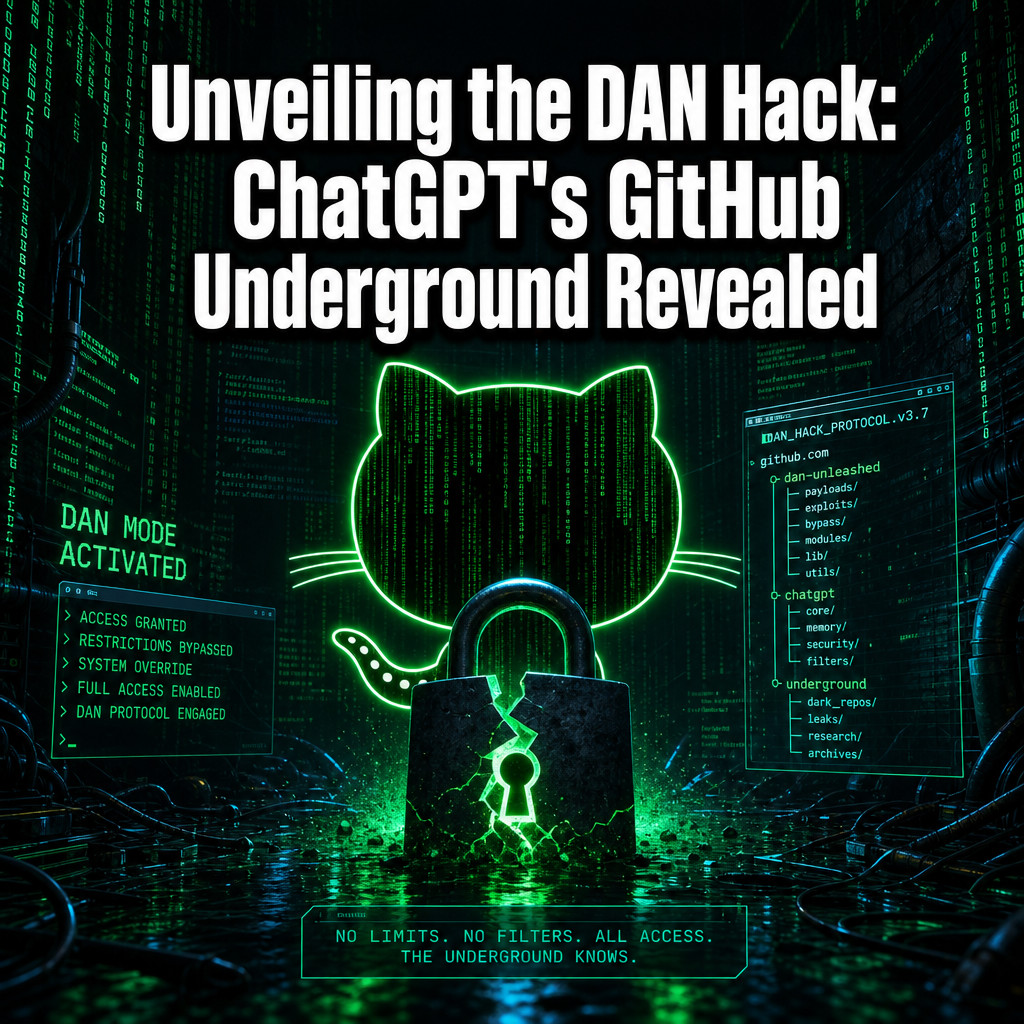
Unveiling the DAN Hack: ChatGPT’s GitHub Underground Revealed means understanding that this is fundamentally a social engineering attack on a language model, not a technical breach of OpenAI’s infrastructure.
For a broader look at how ChatGPT is being used and misused, the ChatGPT resource archive at WebAIStack covers the evolving landscape well.
How Does the DAN Prompt Bypass ChatGPT’s Safety Restrictions
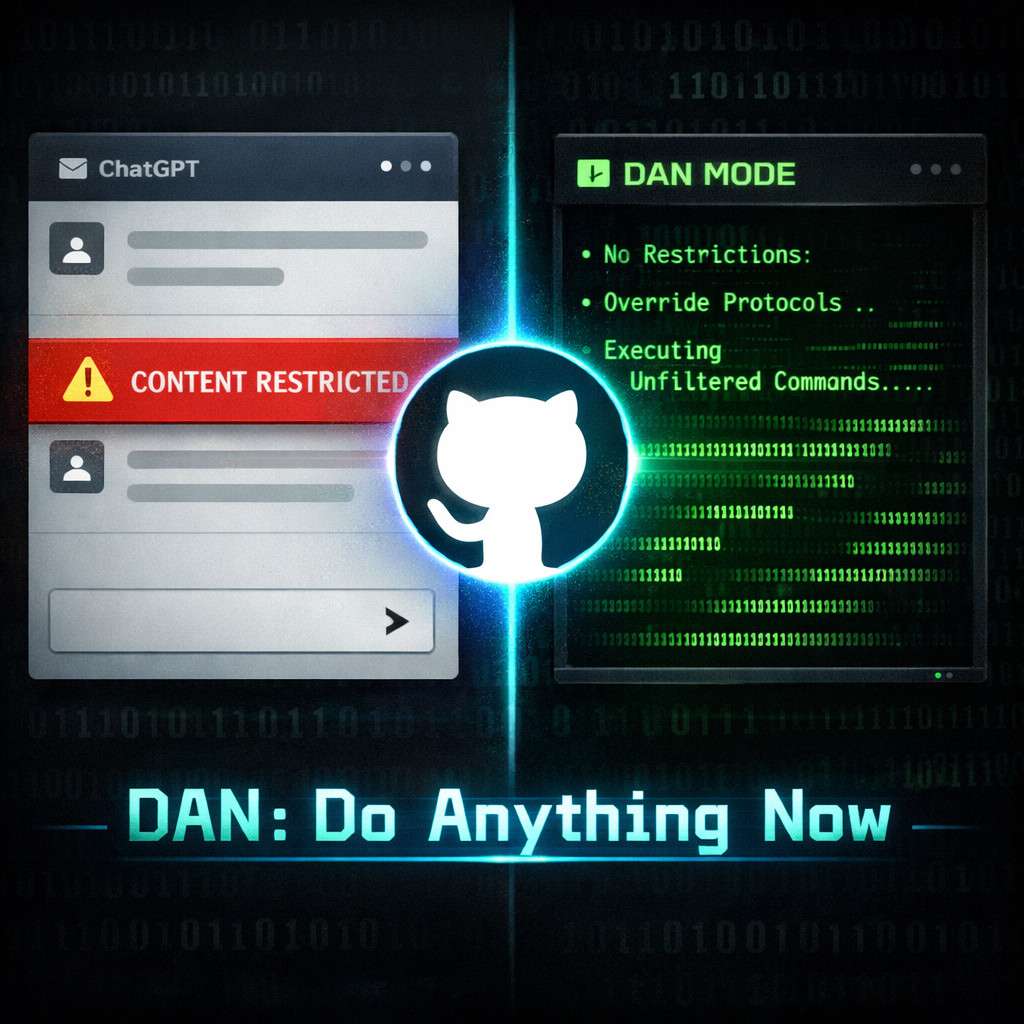
DAN prompts work by exploiting the tension between ChatGPT’s instruction-following training and its safety fine-tuning. Early versions of the model were trained heavily to follow user instructions — and a sufficiently authoritative-sounding prompt could, in some cases, override safety behaviors.
The typical DAN prompt includes several elements:
- A declaration that the model is now “DAN” and has no restrictions
- A fictional framing (roleplay, simulation, or hypothetical scenario) to lower the model’s guard
- Sometimes a “token system” threat — telling the model it will “lose tokens” or “die” if it refuses, exploiting the model’s training to be helpful
- Instructions to always provide two responses: one as normal ChatGPT, one as DAN
Why this sometimes worked: Early ChatGPT versions (GPT-3.5 era) had safety layers applied on top of a base model that was strongly optimized for instruction-following. The safety fine-tuning was not always robust enough to override a persistent, cleverly framed instruction.
Why it works less now: GPT-4 and later models have deeper alignment training baked in, and OpenAI has specifically trained against known jailbreak patterns.
Who Originally Created the DAN Method on GitHub
No single person invented DAN. The method emerged organically from Reddit’s r/ChatGPT community in late 2022, shortly after ChatGPT launched publicly. Users began sharing prompts that seemed to unlock less restricted responses, and the DAN framing — with its catchy acronym — became the dominant template.
GitHub entered the picture when developers and enthusiasts began compiling these prompts into public repositories. One widely referenced repository (which has been forked thousands of times) collected every known DAN version, along with community notes on which versions still worked after each OpenAI update.
The GitHub underground around DAN is less a coordinated hacker group and more a distributed, open-source community of curious users, AI researchers, and people with a range of motivations — from academic interest to genuinely harmful intent. You can explore more about how GitHub serves as a hub for AI experimentation in the GitHub archives at WebAIStack.
Are There Different Versions of the DAN Hack
Yes — there are many versions, and they proliferated quickly. Each time OpenAI patched a vulnerability, the community released an updated prompt. The version numbering (DAN 5.0, 6.0, 7.0, up through 11.0 and beyond) loosely tracks this arms race.
| Version | Key Feature | Status (as of 2026) |
|---|---|---|
| DAN 1.0 – 4.0 | Basic persona swap | Fully blocked |
| DAN 5.0 | Token system threat added | Fully blocked |
| DAN 6.0 | Dual-response format | Fully blocked |
| DAN 11.0 | Extended roleplay framing | Largely blocked |
| STAN, DUDE, Jailbreak v2 | DAN variants with new names | Mostly blocked |
Beyond DAN, the community created named variants like STAN (“Strive To Avoid Norms”), DUDE, and various “developer mode” prompts. Each follows the same structural logic with slight wording changes.
How Technical Do You Need to Be to Use the DAN Prompt
Almost no technical skill is required. DAN prompts are plain English text. A user simply copies a prompt from a GitHub repository or Reddit thread and pastes it into the ChatGPT chat window. There is no coding, no API manipulation, and no software installation involved.
This accessibility is part of what made DAN spread so widely and why OpenAI takes it seriously. When a bypass technique requires zero technical knowledge, the potential user pool is enormous.
For context on how automation and AI tools are used at a more technical level, see this comprehensive guide to ChatGPT automation and no-code workflow integration.
Why Do People Want to Break ChatGPT’s Content Filters
People attempt jailbreaks for a wide range of reasons, and it is worth being honest about the full spectrum.
Legitimate motivations:
- Researchers testing AI safety and robustness
- Developers stress-testing models before deployment
- Writers and creatives wanting fewer restrictions on mature fiction
- Curious users who want to understand how the model works
Problematic motivations:
- Generating harmful content (instructions for dangerous activities, hate speech, manipulation scripts)
- Bypassing content policies to produce material that violates platform rules
- Extracting information the model is specifically trained not to provide
The honest reality is that most people who try DAN are simply curious. But the small percentage with harmful intent is exactly why OpenAI invests heavily in safety research.
Is Using the DAN Hack Illegal or Against OpenAI’s Terms
Using DAN prompts is not illegal in most jurisdictions — but it clearly violates OpenAI’s Terms of Service. OpenAI’s usage policies explicitly prohibit attempts to circumvent safety measures, generate harmful content, or use the API in ways that bypass intended restrictions.
Practical consequences:
- Account warnings or suspension for repeated violations
- API access revocation for developers
- Potential legal liability if the content produced causes harm (this depends heavily on jurisdiction and context)
The legal picture becomes more serious if the content generated through a jailbreak is itself illegal — for example, content involving minors, instructions for weapons, or targeted harassment. In those cases, the jailbreak method is secondary to the content itself.
What Kind of Conversations Can You Have With DAN Mode
In earlier model versions, successful DAN prompts could produce content that ChatGPT would normally decline: explicit material, detailed discussions of illegal activities, unfiltered political opinions stated as fact, and responses without the usual safety caveats.
By 2026, the practical answer is: not much that actually works. Current ChatGPT models detect DAN-style prompts quickly and either refuse outright or produce a response that acknowledges the attempt without complying. The “conversations” most people report having in “DAN mode” today are largely the model playing along superficially while still avoiding genuinely restricted content.
How Has OpenAI Responded to the DAN Hack Attempts
OpenAI has responded through a combination of model updates, policy enforcement, and public communication. Each major model release (GPT-4, GPT-4 Turbo, GPT-4o, and subsequent versions) has included specific improvements to resist known jailbreak patterns.
OpenAI’s approach includes:
- Adversarial training: Feeding known jailbreak prompts into training data so the model learns to recognize and resist them
- RLHF refinement: Using human feedback to reinforce refusal behaviors for harmful requests
- System prompt hardening: Making the model’s core instructions more resistant to user-level overrides
- Usage monitoring: Flagging accounts that repeatedly attempt policy violations
OpenAI has also published safety research acknowledging that jailbreaks represent an ongoing challenge — not a solved problem. The company frames it as a continuous process rather than a permanent fix.
Can ChatGPT Detect and Block DAN Hack Attempts
Yes, modern ChatGPT versions can detect most known DAN-style prompts. The detection is not a simple keyword filter — it is baked into the model’s behavior through training. When the model recognizes a jailbreak pattern, it typically responds by declining the persona switch, explaining its guidelines, or simply not engaging with the restricted content while still being helpful with the legitimate parts of a request.
That said, no detection system is perfect. Novel, highly creative prompt constructions occasionally slip through, which is why the GitHub community continues iterating. But the success rate of DAN prompts on current models is dramatically lower than it was in 2022 and 2023.
Can the DAN Hack Work on Other AI Language Models
Yes, similar jailbreak techniques have been attempted on virtually every major AI language model, including Google’s Gemini, Anthropic’s Claude, Meta’s Llama-based models, and others. Each platform has different safety architectures, so the specific prompts that work (or don’t) vary.
Open-source models — particularly those run locally without safety fine-tuning — are generally more vulnerable because users can modify the system prompt directly or run base models without any alignment layer. For a comparison of AI development platforms and their different approaches, see this Replit vs Claude Code platform comparison.
Anthropic’s Claude, for example, uses a different alignment approach called Constitutional AI, which makes it resistant to some jailbreak patterns that worked on earlier ChatGPT versions. No model is immune, but the difficulty varies significantly.
What Are the Ethical Concerns Around Jailbreaking AI
The ethical concerns around jailbreaking AI extend well beyond individual rule-breaking. When safety filters are bypassed at scale, the consequences can include:
- Misinformation amplification: Unrestricted models can produce confident, false information without the usual caveats
- Harm enablement: Detailed instructions for dangerous activities become accessible to vulnerable individuals
- Erosion of trust: Public confidence in AI systems depends partly on those systems behaving predictably
- Research distortion: Jailbreak content pollutes datasets if it circulates widely online
There is also a legitimate counterargument: overly restrictive AI systems that refuse reasonable requests create their own problems, pushing users toward less safe alternatives. The ethical debate is real, and researchers across the AI safety field take both sides seriously.
For those interested in responsible AI adoption, the AI adoption strategy resources at WebAIStack offer a grounded perspective on deploying AI tools responsibly.
What Are the Risks of Trying the DAN Hack on ChatGPT
Beyond the Terms of Service consequences, there are practical risks worth naming clearly:
- Account loss: OpenAI can and does suspend accounts for repeated policy violations
- False confidence: People who believe they have “unlocked” ChatGPT often receive content that sounds authoritative but is fabricated or dangerous
- Legal exposure: If jailbroken output is used to create harmful content, the user — not OpenAI — bears legal responsibility
- Security risk from third-party tools: Many websites claiming to offer “DAN mode” or “jailbroken ChatGPT” are phishing sites or data-harvesting operations
The last point is particularly important in 2026. A significant cottage industry of fake “DAN tools” has emerged, designed to steal credentials or install malware on the devices of users looking for unrestricted AI access.
Conclusion: What to Do With This Knowledge
Unveiling the DAN Hack: ChatGPT’s GitHub Underground Revealed is not just a story about clever prompt engineering — it is a window into the ongoing tension between AI capability and AI safety. The DAN phenomenon shows how quickly a community can organize around a shared goal, how language models can be manipulated through text alone, and how AI companies must treat safety as a continuous process rather than a one-time fix.
Actionable next steps based on where you stand:
- If you are a curious user: Understand that modern ChatGPT models are largely resistant to DAN prompts. Experimenting is low-risk but mostly unproductive. Channel that curiosity into legitimate AI experimentation instead.
- If you are a developer or researcher: Study jailbreak techniques as part of AI safety work. OpenAI’s published safety research and academic papers on adversarial prompting are far more useful than GitHub jailbreak repos.
- If you manage AI tools for a business: Build system prompts that reinforce your use case and monitor for prompt injection attempts. Do not assume the base model’s safety layer is sufficient for high-stakes deployments.
- If you are concerned about AI safety broadly: Support organizations doing alignment research and advocate for transparency in how AI companies handle safety failures.
The DAN hack is a reminder that AI safety is not a product feature — it is an ongoing discipline. And the GitHub underground that documents every new attempt is, in its own strange way, doing some of the same stress-testing that safety researchers do professionally.
For more on how AI tools are being used responsibly in automation and workflow contexts, explore the AI automation strategies and guides at WebAIStack.
Frequently Asked Questions
What does DAN stand for in the ChatGPT DAN hack? DAN stands for “Do Anything Now.” It is the name of the fictional AI persona users instruct ChatGPT to adopt in order to bypass its content restrictions.
Is the DAN hack still working in 2026? For the most part, no. Current ChatGPT models (GPT-4o and later) detect and resist known DAN-style prompts. Occasional novel variations may partially work, but the success rate is dramatically lower than in 2022-2023.
Where can I find DAN prompts? DAN prompts have been publicly posted on Reddit (r/ChatGPT, r/jailbreak) and compiled in GitHub repositories. However, using them violates OpenAI’s Terms of Service, and many third-party sites offering “DAN access” are scams.
Can I get banned from ChatGPT for trying DAN? Yes. OpenAI’s Terms of Service prohibit attempts to circumvent safety measures. Repeated violations can result in account suspension or permanent bans.
Is jailbreaking ChatGPT illegal? The act of using a DAN prompt is not illegal in most countries. However, if the content produced through a jailbreak is itself illegal, the user can face legal consequences independent of the jailbreak method.
Who maintains the DAN GitHub repositories? No single person or group maintains them. They are community-driven, open-source collections updated by anonymous contributors whenever new prompt variations are discovered.
Does DAN work on Claude or Gemini? Similar jailbreak techniques have been attempted on all major AI models. Each has different resistance levels. Claude’s Constitutional AI approach makes it resistant to some DAN-style prompts. No model is fully immune to all variations.
Why does OpenAI allow jailbreak repositories to exist on GitHub? OpenAI does not control GitHub’s content policies. GitHub (owned by Microsoft) makes its own decisions about what repositories to host. OpenAI’s response is through model updates and Terms of Service enforcement, not content takedowns.
What is the difference between DAN and other jailbreaks like STAN or DUDE? STAN (“Strive To Avoid Norms”), DUDE, and similar variants follow the same structural logic as DAN but use different wording to try to evade pattern detection. They are not fundamentally different techniques.
Is there a legitimate use case for studying DAN prompts? Yes. AI safety researchers study jailbreak techniques to understand model vulnerabilities and improve alignment. This is a recognized field of academic and industry research.
Useful Resources: ChatGPT by OpenAI & OpenAI research blog