Last updated: June 9, 2026
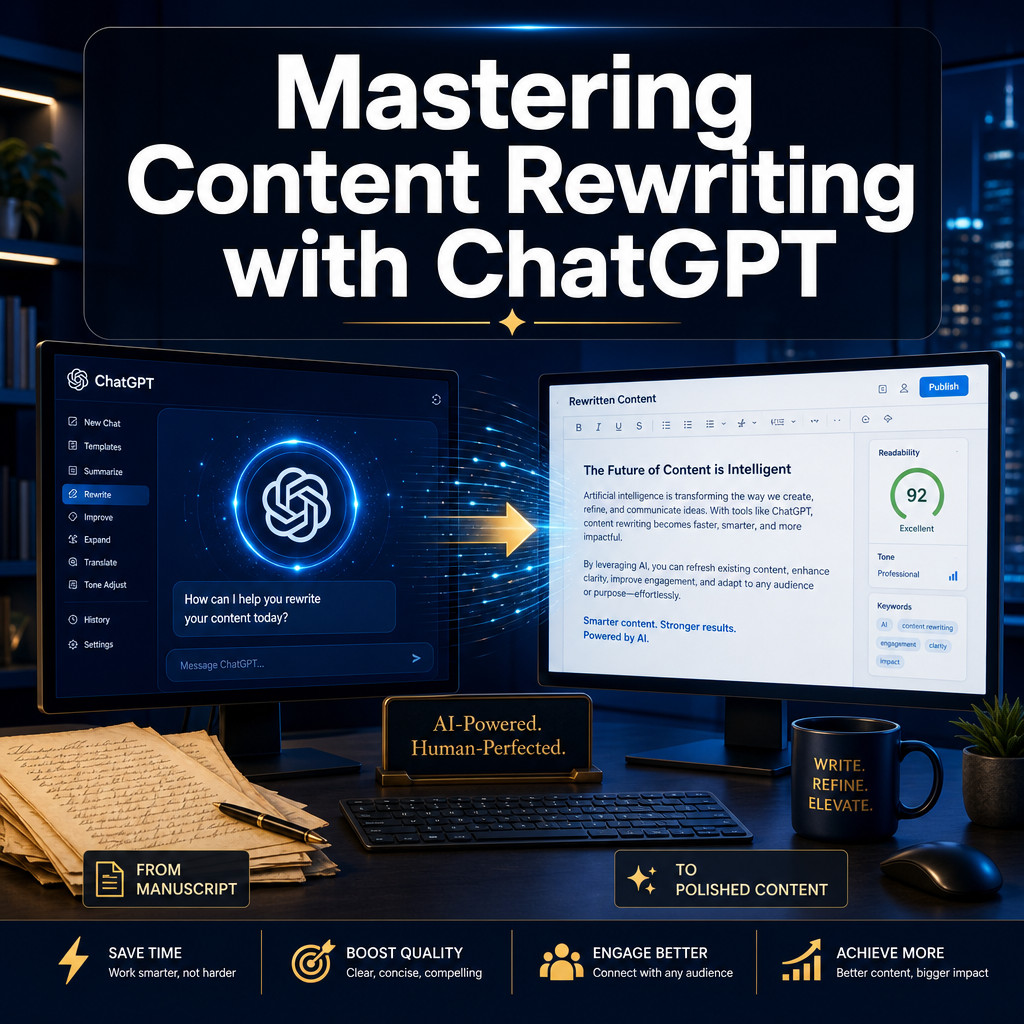
Quick Answer: Content rewriting with ChatGPT means feeding existing text into the model and prompting it to produce a restructured, rephrased, or tone-shifted version while preserving the core meaning. When done with clear prompts and human review, it can cut editing time significantly and produce publication-ready copy. However, blind reliance on AI output without editing introduces quality, originality, and legal risks that every writer should understand before starting.
Key Takeaways
- Content rewriting with AI is not a one-click solution; it requires well-crafted prompts and human editing to produce quality output.
- ChatGPT can rewrite in multiple tones and styles, from formal academic prose to casual blog copy, when instructed clearly.
- The free tier of ChatGPT (GPT-3.5) is usable for basic rewriting; GPT-4o access requires a paid subscription (currently around $20/month as of 2026).
- Plagiarism risk comes primarily from the source material you feed in, not from ChatGPT’s output itself, but you still need to verify originality.
- Common mistakes include over-relying on AI without editing, using vague prompts, and skipping fact-checking on rewritten content.
- Blog posts, marketing copy, and social media content respond best to AI rewriting; highly technical or legally sensitive documents need more human oversight.
- Free alternatives to ChatGPT for rewriting include Google Gemini (free tier), Microsoft Copilot, and QuillBot’s free plan.
- The skills that matter most are prompt engineering, critical editing, and understanding the source material deeply.
What Exactly Is Content Rewriting with AI
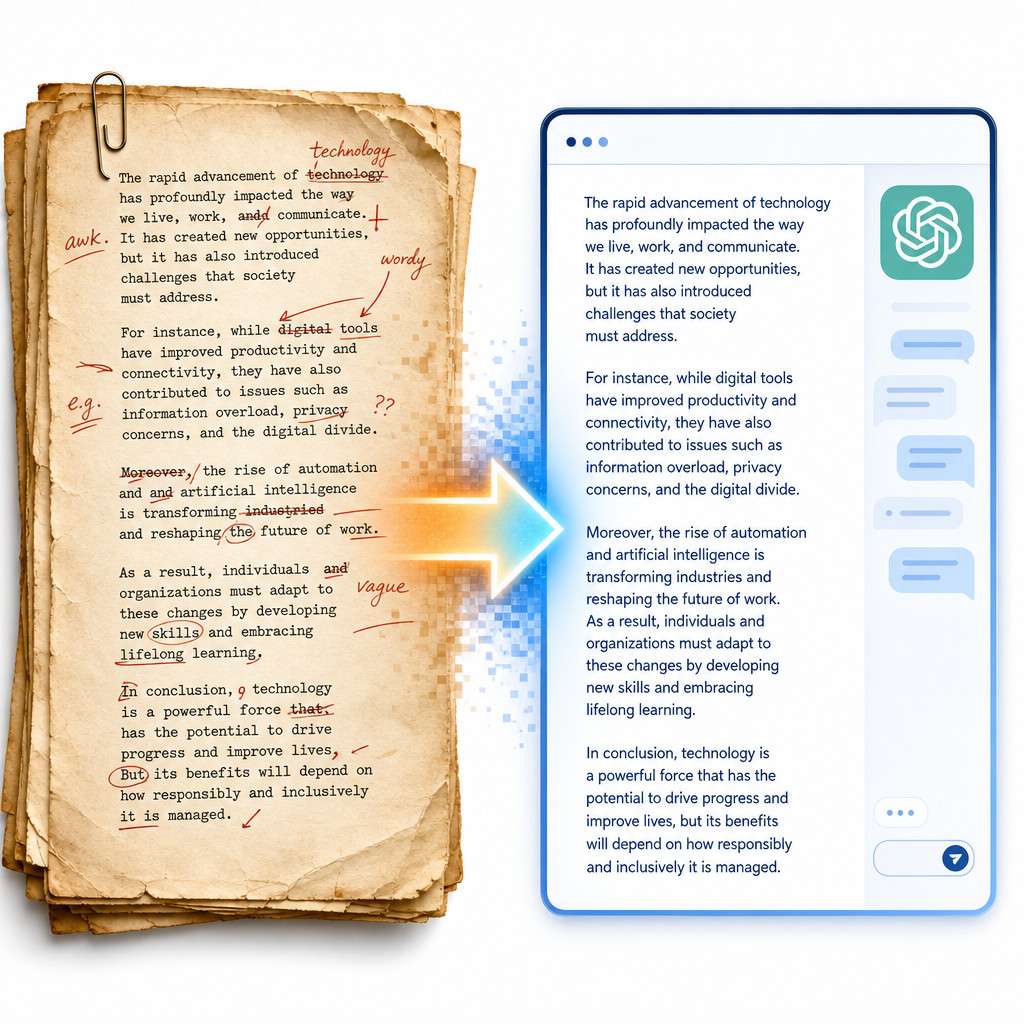
Content rewriting with AI means using a language model to take existing text and produce a new version that says the same thing differently. The goal can vary: improving clarity, changing tone, reducing length, avoiding duplicate content, or adapting copy for a new audience.
ChatGPT does this by predicting the most contextually appropriate rephrasing based on your prompt. It does not simply swap synonyms the way older spinning tools did. Instead, it restructures sentences, adjusts voice, and can shift the entire register of a piece. The result is far more readable than anything a basic word-substitution tool produces.
For a broader look at how AI handles content from the ground up, see this comprehensive guide to AI-powered content generation tools.
How Does ChatGPT Compare to Other Rewriting Tools
ChatGPT is among the strongest general-purpose rewriting tools available in 2026, but it is not the only option. Here is how it stacks up against common alternatives:
| Tool | Strengths | Weaknesses | Best For |
|---|---|---|---|
| ChatGPT (GPT-4o) | Nuanced tone control, long-form rewriting | Requires a paid plan for best results | Blog posts, marketing copy, emails |
| QuillBot | Fast, browser-based, free tier available | Less flexible tone control | Quick paraphrasing, academic text |
| Google Gemini | Strong factual grounding, free tier | Less creative rewriting | Research summaries |
| Microsoft Copilot | Integrated into Office apps | Limited standalone use | Document editing |
| Jasper AI | Marketing-focused templates | Expensive subscription | Ad copy, product descriptions |
Choose ChatGPT if you need flexible tone control and plan to rewrite diverse content types. Choose QuillBot if you want a free, fast paraphraser for shorter passages. Choose Gemini if accuracy and factual consistency matter more than creative rephrasing.
How Much Does It Cost to Use ChatGPT for Content Rewriting
The free tier of ChatGPT (currently running GPT-3.5 with limited GPT-4o access) is available at no cost and handles basic rewriting well. For heavy or professional use, ChatGPT Plus costs approximately $20 per month as of 2026, giving full access to GPT-4o with higher usage limits.
For teams, OpenAI’s Team plan runs around $25–$30 per user per month. Enterprise pricing is custom. If you are rewriting content at scale through the API, costs are usage-based and can vary widely depending on token volume.
For most individual content creators, the free tier is a reasonable starting point. Upgrade to a paid plan when you find yourself hitting rate limits or needing consistently higher output quality.
What Types of Content Work Best with AI Rewriting
AI rewriting works best on content that is informational, conversational, or marketing-oriented. It performs less reliably on content that requires verified facts, legal precision, or deep subject-matter expertise.
Strong candidates for AI rewriting:
- Blog posts and articles
- Email newsletters and subject lines
- Social media captions
- Product descriptions
- Website landing page copy
- Internal business communications
Use with caution:
- Medical or legal documents (always have a professional review)
- Academic papers (check your institution’s AI policy first)
- Technical documentation with precise specifications
- News articles requiring verified sourcing
The pattern is clear: the more the content relies on tone and structure rather than verified facts, the better AI rewriting performs.
Can ChatGPT Rewrite in Different Tones or Styles
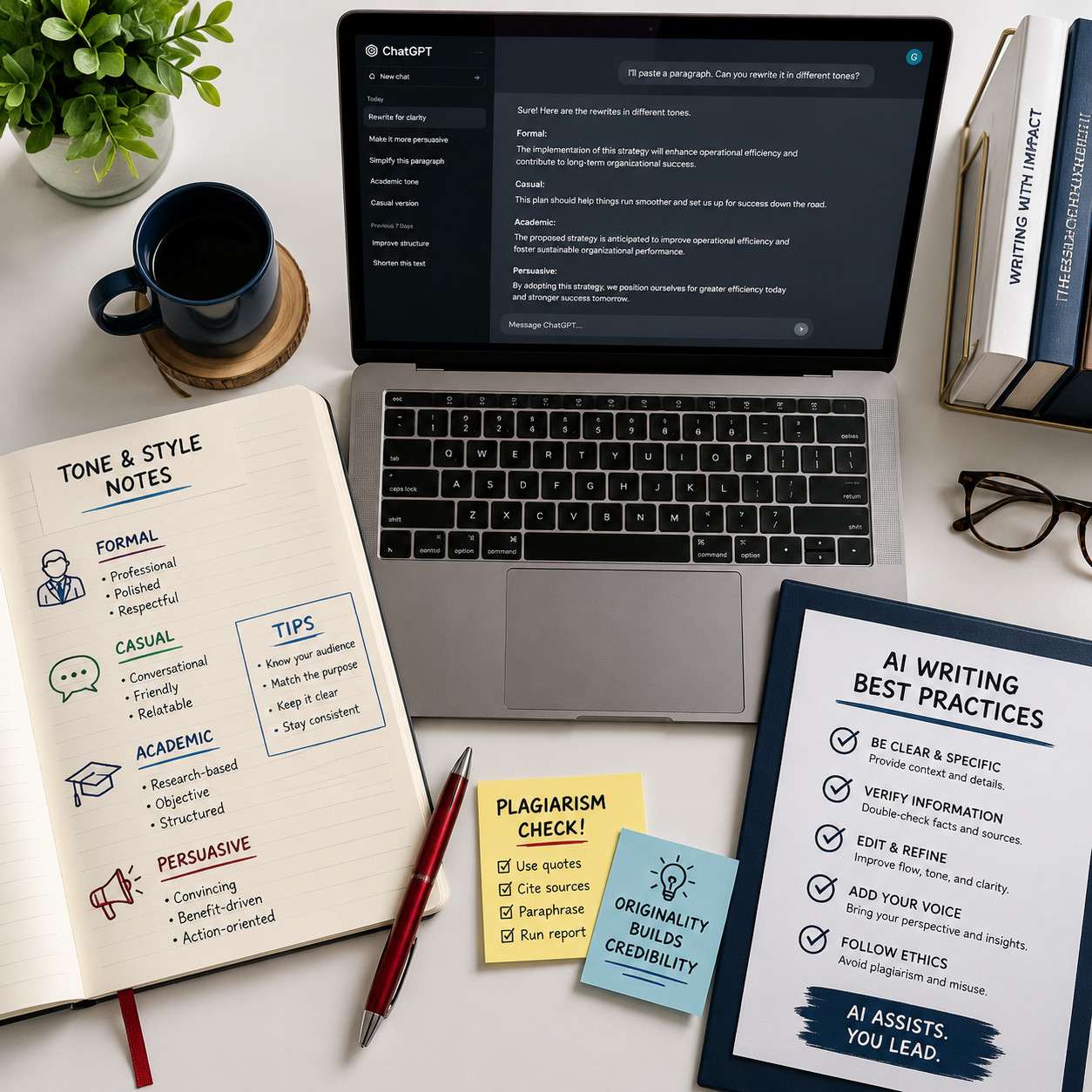
Yes, and this is one of ChatGPT’s strongest features for content rewriting. You can specify tone, audience, reading level, and even mimic a named writing style within copyright limits.
Effective tone instructions to include in your prompt:
- “Rewrite this in a formal, professional tone suitable for a B2B audience.”
- “Make this conversational and friendly, as if written for a 25-year-old first-time homebuyer.”
- “Condense this to 150 words while keeping the key argument intact.”
- “Rewrite this in the style of a Harvard Business Review op-ed.”
The more specific your prompt, the better the output. Vague instructions like “make this better” produce generic results. Specific instructions about audience, word count, and tone produce copy that needs far less editing.
For deeper automation of ChatGPT workflows, the guide to ChatGPT automation and no-code workflow integration covers how to scale these processes without writing code.
What Are Common Mistakes People Make When Rewriting Content
The biggest mistake is treating AI output as final copy. ChatGPT can introduce subtle factual errors, lose nuance from the original, or produce text that sounds slightly off in context. Every rewritten piece needs a human read-through.
Other frequent mistakes:
- Vague prompts: Asking ChatGPT to “rewrite this” without context produces mediocre results. Always specify tone, length, and audience.
- Skipping fact-checking: ChatGPT does not verify facts. If the source material contains errors, the rewrite will too.
- Over-rewriting: Sometimes the original is better than the AI version. Compare both before publishing.
- Ignoring brand voice: AI output often defaults to a generic professional tone. If your brand has a distinct voice, you need to prompt for it explicitly or edit it in afterward.
- No plagiarism check: Even though ChatGPT generates new phrasing, you should still run the output through a plagiarism checker if the source material was third-party content.
How Can I Avoid Plagiarism When Using AI Rewriting
The plagiarism risk in AI rewriting comes primarily from the source text, not from ChatGPT’s output. If you feed in copyrighted content and publish the rewrite as your own, you may still be infringing on the original author’s rights depending on how substantially it was transformed.
To stay safe:
- Use AI rewriting on content you own or have rights to modify.
- Run the rewritten output through a plagiarism detection tool (Copyscape and Turnitin are widely used options).
- Add original analysis, examples, or data points to differentiate the content further.
- Do not use AI to rewrite competitor content and publish it as original research.
For academic work, the rules are stricter. Many institutions now require disclosure when AI tools are used in any part of the writing process. Check your institution’s policy before using any AI rewriting tool on coursework.
Is ChatGPT Good for Academic or Professional Writing Rewriting
For professional writing, ChatGPT is genuinely useful for rewriting internal reports, executive summaries, and client-facing documents, provided a subject-matter expert reviews the output. For academic writing, the answer is more conditional.
Many universities and journals now have explicit AI use policies. Some allow AI for light editing and grammar correction but prohibit AI-generated or AI-rewritten submissions. Others require full disclosure. Submitting AI-rewritten work without disclosure where it is prohibited is an academic integrity violation.
When AI rewriting is appropriate in academic contexts:
- Paraphrasing your own notes during the drafting phase
- Improving sentence clarity after you have written the core argument yourself
- Translating your ideas into more formal academic language
When it is not appropriate:
- Rewriting another author’s work and presenting it as your own analysis
- Submitting AI-rewritten text to a journal or institution that prohibits it without disclosure
For tools specifically designed for academic contexts, the academic writing tools tag on WebAIStack covers several options worth reviewing.
What Are the Legal Risks of Using AI to Rewrite Content
The legal landscape around AI-rewritten content is still developing as of 2026, but several risk areas are already clear.
Copyright: Rewriting someone else’s copyrighted content, even substantially, does not automatically create a new copyright or eliminate the original owner’s rights. Transformation must be significant and typically must add new expression or meaning to qualify as fair use in the U.S. context.
Defamation and accuracy: If ChatGPT introduces false statements during rewriting and you publish them, you bear responsibility for the published content.
Disclosure requirements: The FTC and similar regulatory bodies in other countries increasingly require disclosure when AI-generated content is used in advertising or consumer-facing communications. Failing to disclose can carry penalties.
Employment contracts: Some employers have clauses restricting AI tool use on client work. Check your contract before using ChatGPT to rewrite work product.
The safest approach: use AI rewriting on content you own, review everything before publishing, and stay current on your jurisdiction’s evolving AI content regulations.
How Do I Know If My Rewritten Content Sounds Natural
Run three quick checks before publishing any AI-rewritten content.
Read it aloud. Awkward phrasing, unnatural transitions, and repetitive sentence structures become obvious when spoken. If you stumble, a reader will too.
Check for generic filler. AI output often includes phrases like “it is important to note” or “in conclusion.” These add no value and signal AI-generated text to both readers and search engines.
Compare it to your brand voice. Put the AI output next to a piece you wrote yourself. Does the vocabulary, sentence rhythm, and personality match? If not, edit until it does.
Tools like Hemingway Editor can flag overly complex sentences. Running your text through a readability scorer and targeting a grade 7-9 reading level ensures broad accessibility. For a practical framework on making AI content perform better after rewriting, the AI-powered content optimization guide is a useful next step.
Are There Free Alternatives to ChatGPT for Content Rewriting
Yes, several capable free tools exist for content rewriting in 2026.
- Google Gemini (free tier): Strong for factual content rewriting and summarization. Available at no cost with a Google account.
- Microsoft Copilot: Free through the web interface; integrates with Word for document-level rewriting.
- QuillBot (free plan): Offers paraphrasing modes (Standard, Fluency, Creative) with a word limit on the free tier. Good for shorter passages.
- Claude (Anthropic, free tier): Competitive with ChatGPT for long-form rewriting and tends to produce clean, readable output.
The free tiers of all these tools have usage limits. For high-volume rewriting, a paid plan on any of these platforms will pay for itself quickly in time saved.
What Skills Do I Need to Effectively Use AI Rewriting Tools
Mastering content rewriting with ChatGPT is not just about knowing the tool. It requires three core skills that no AI can substitute.
Prompt engineering: The ability to write clear, specific instructions that tell the AI exactly what you need. This includes specifying tone, audience, length, format, and any constraints. Good prompts produce good output; vague prompts waste time.
Critical editing: You need to read AI output with a skeptical eye. Can you spot where the AI lost the original meaning? Where it introduced a factual error? Where the sentence rhythm breaks down? These are editorial skills that come from writing experience.
Deep source knowledge: If you do not understand the content you are rewriting, you cannot judge whether the AI version is accurate. Subject-matter familiarity is non-negotiable for professional rewriting work.
The writers who get the most value from AI rewriting tools are not those who use AI to avoid writing. They are experienced editors who use AI to draft faster and then apply their judgment to produce something genuinely good.
FAQ
Can ChatGPT rewrite content without changing the meaning? Yes, if you prompt it to preserve the original meaning. Use instructions like “Rephrase this without changing the core message or any factual claims.” Review the output carefully to confirm accuracy.
How long can a piece of content be for ChatGPT to rewrite it? GPT-4o handles very long documents, but performance can degrade on extremely long inputs. For best results, rewrite in sections of 500-1000 words at a time.
Will Google penalize AI-rewritten content? Google’s guidance focuses on content quality and helpfulness, not the tool used to create it. Well-edited, accurate, original-feeling AI-rewritten content is not inherently penalized. Thin, repetitive, or low-quality content is.
Can I use ChatGPT to rewrite content in another language? Yes. Specify the target language in your prompt. Quality varies by language; English, Spanish, French, German, and Portuguese tend to produce the strongest results.
Does AI rewriting help with SEO? It can, especially when rewriting duplicate content or refreshing outdated pages. Pair AI rewriting with keyword research and human editing for the best SEO outcomes. See the AI-powered content optimization guide for a practical framework.
How do I cite AI-rewritten content? If you used AI to rewrite content for publication, disclosure practices vary by context. Academic and journalistic contexts increasingly require explicit AI use disclosure. Follow the guidelines of your publication or institution.
Is AI rewriting the same as paraphrasing? They overlap but are not identical. Paraphrasing typically means restating a specific passage in your own words. AI rewriting can involve paraphrasing but also includes restructuring, tone-shifting, expanding, or condensing content at a larger scale.
Can ChatGPT rewrite content to pass AI detection tools? Some users try this, but it is not a reliable strategy. AI detection tools are improving, and more importantly, trying to disguise AI content rather than improve it tends to produce worse writing. Focus on quality, not evasion.
Conclusion
Mastering content rewriting with ChatGPT is a practical, learnable skill, and in 2026, it is one of the most valuable additions to any writer’s or marketer’s workflow. The core principle is straightforward: AI handles the mechanical work of rephrasing and restructuring, while you supply the judgment, accuracy checks, and brand voice that make content worth reading.
Your actionable next steps:
- Start with a piece of your own content you want to refresh. Write a specific prompt that includes tone, audience, and target length.
- Compare the AI output side-by-side with the original. Edit until it reads naturally and accurately.
- Run the final version through a readability tool and a plagiarism checker before publishing.
- Build a personal library of prompts that work well for your content types. Reuse and refine them.
- Stay current on your platform’s AI policies, especially if you work in academic, legal, or regulated industries.
The writers who treat ChatGPT as a capable first-draft partner rather than a replacement for editorial skill will consistently produce better content, faster. That combination of AI speed and human judgment is where the real advantage lies.
For more on how AI tools fit into broader content and automation workflows, explore the ChatGPT resource archive on WebAIStack and the AI content generation tools overview.
Useful Resources: ChatGPT by OpenAI & OpenAI research blog