Last updated: June 9, 2026
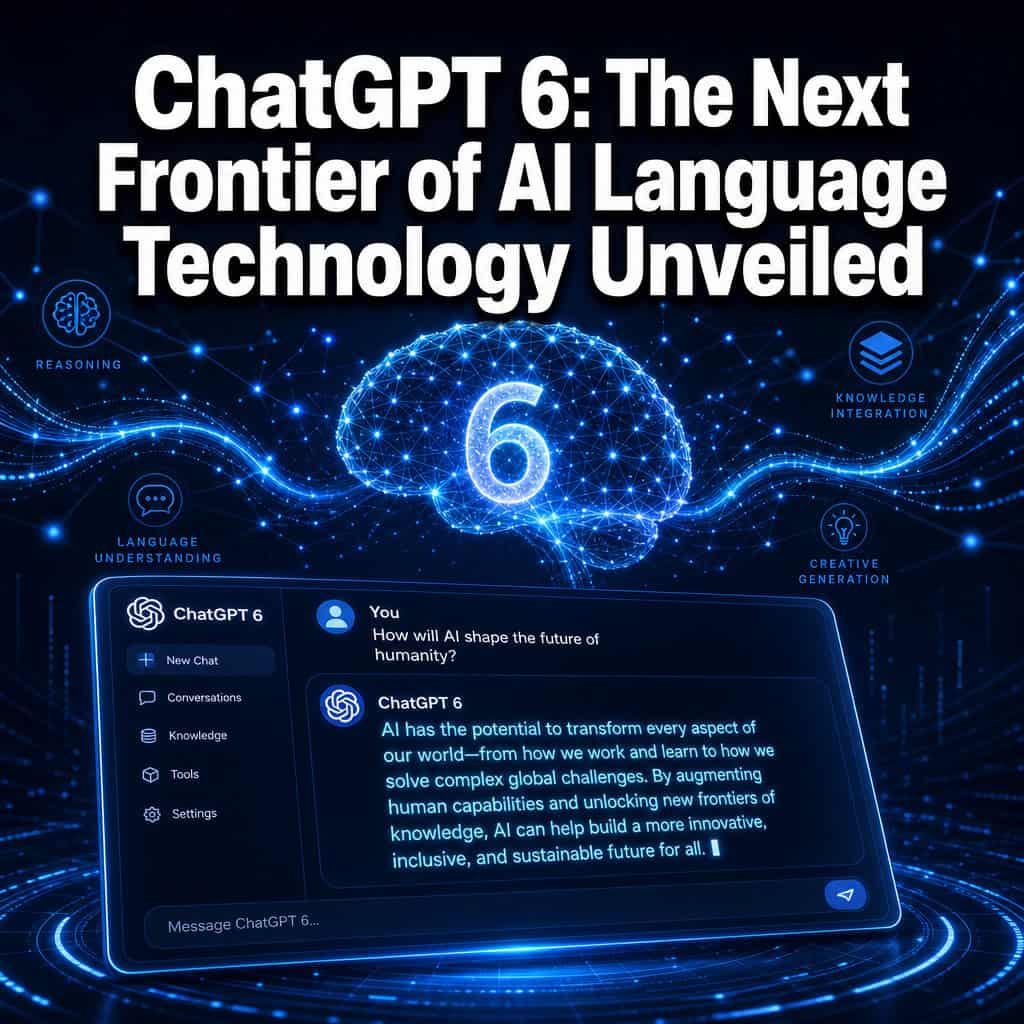
Quick Answer: ChatGPT 6 is OpenAI’s most advanced large language model to date, offering significantly improved reasoning, multimodal understanding, and multilingual performance compared to GPT-4 and GPT-4o. It builds on years of iterative development and is designed for professional, academic, and enterprise use. As of mid-2026, it represents the current state of the art in conversational AI.
Key Takeaways
- ChatGPT 6 delivers measurably stronger performance on complex reasoning, coding, and long-document analysis than its predecessors.
- Pricing follows a tiered model: a free tier with limited access, a Plus plan for individuals, and enterprise licensing for businesses.
- The model supports over 50 languages with improved fluency and cultural context awareness.
- Known limitations include occasional factual errors, a fixed knowledge cutoff, and sensitivity to prompt phrasing.
- Industries such as software development, healthcare research, legal services, and education stand to benefit most.
- Privacy concerns remain relevant; users should avoid entering sensitive personal or proprietary data.
- Ethical guardrails are built into the model through OpenAI’s reinforcement learning from human feedback (RLHF) process and updated usage policies.
- No special hardware is required to use ChatGPT 6 via the web interface or API; local deployment has higher requirements.
What Exactly Is ChatGPT 6 and How Is It Different from Previous Versions
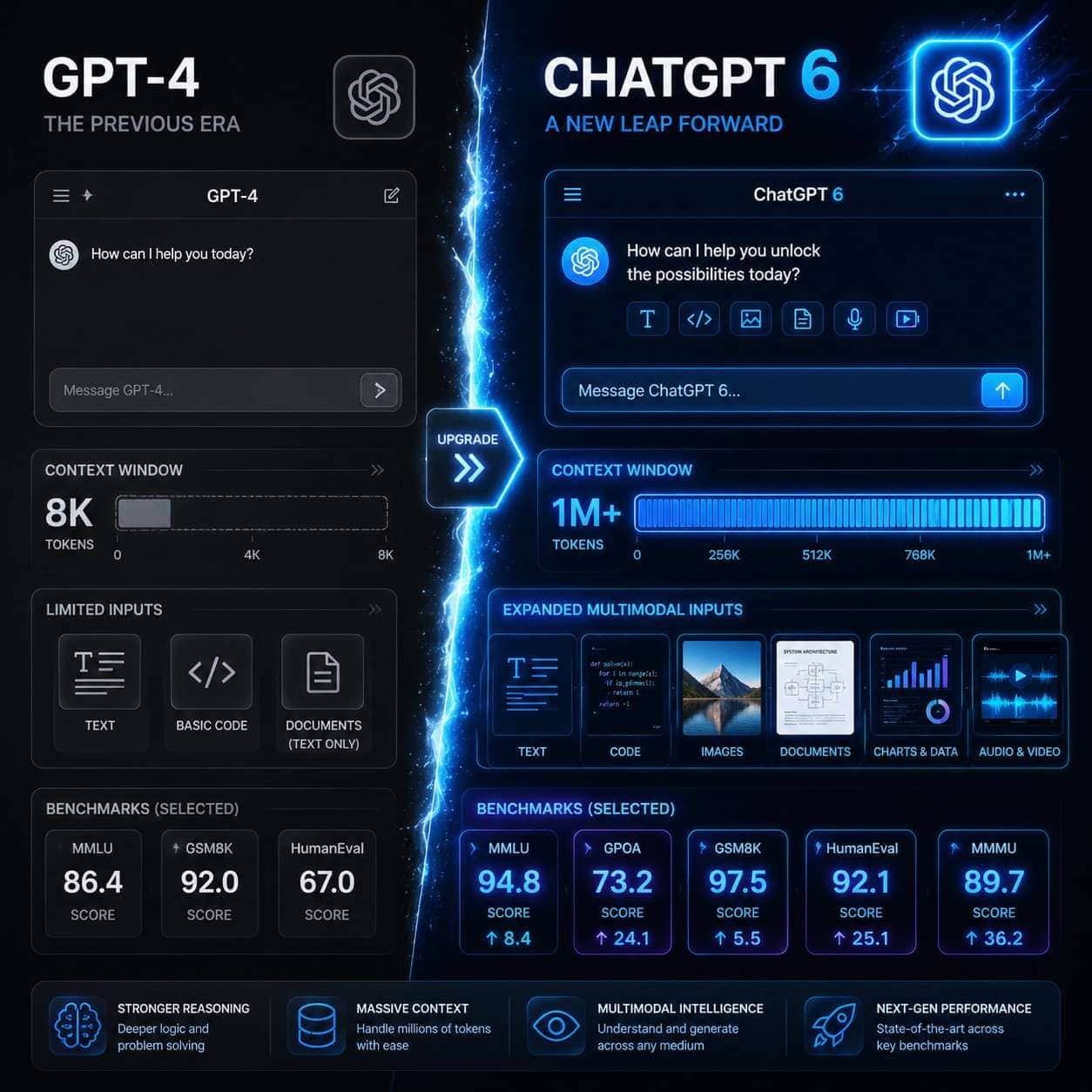
ChatGPT 6 is OpenAI’s sixth-generation conversational AI model, built on a significantly larger and more refined architecture than GPT-4. The core differences lie in reasoning depth, context window size, multimodal capability, and instruction-following accuracy.
Compared to GPT-4, ChatGPT 6 offers:
- Longer context windows — processing substantially more text in a single session, making it suitable for full legal contracts, research papers, or codebases.
- Better instruction adherence — it follows nuanced, multi-step prompts with fewer errors or misinterpretations.
- Stronger multimodal inputs — it can analyze images, structured data, and code alongside natural language.
- Reduced hallucination rate — while not eliminated, factual errors occur less frequently than in GPT-4 based on OpenAI’s internal benchmarks (OpenAI, 2025).
For a broader look at how ChatGPT has evolved across versions, the ChatGPT Archives at WebAIStack offer useful context.
How Much Does ChatGPT 6 Cost for Individuals and Businesses
ChatGPT 6 is available across three pricing tiers, though exact figures are subject to change as OpenAI adjusts its commercial strategy.
| Plan | Target User | Estimated Monthly Cost |
|---|---|---|
| Free | Casual users | $0 (limited access) |
| ChatGPT Plus | Individuals | ~$20/month (estimated) |
| ChatGPT Team | Small teams | ~$25–$30/user/month (estimated) |
| Enterprise | Large organizations | Custom pricing |
Note: These figures are estimates based on OpenAI’s publicly stated pricing trends as of early 2026. Actual costs may vary. Always check OpenAI’s official pricing page for current rates.
Businesses integrating ChatGPT 6 via API pay per token, which scales with usage volume. For teams building automated workflows, pairing ChatGPT 6 with no-code tools can reduce costs significantly. See this comprehensive guide to ChatGPT automation and no-code workflow integration for practical strategies.
Can ChatGPT 6 Understand Complex Technical Documents Better Than GPT-4
Yes, and this is one of the clearest improvements in ChatGPT 6. The model handles dense technical content, including engineering specifications, legal briefs, and scientific papers, with notably better accuracy and coherence than GPT-4.
Key improvements for technical document work:
- Longer retention across a document — it maintains context across tens of thousands of tokens without losing track of earlier sections.
- Better structured output — it can extract tables, summarize findings by section, and flag contradictions within a document.
- Improved domain vocabulary — medical, legal, and engineering terminology is handled more precisely.
A practical example: feeding a 50-page clinical trial report to ChatGPT 6 and asking it to identify methodology gaps produces a coherent, section-referenced response. GPT-4 would often lose thread or conflate sections in documents of that length.
What Are the Main Limitations of ChatGPT 6 That Users Should Know
ChatGPT 6 is powerful, but it has real limitations that users must understand before relying on it for critical tasks.
- Knowledge cutoff: The model’s training data has a fixed cutoff date. It does not know about events after that point unless you provide the information directly.
- Hallucination: It can still generate plausible-sounding but incorrect facts, especially for obscure topics or specific numerical data.
- Prompt sensitivity: Small changes in how you phrase a question can produce meaningfully different outputs.
- No real-time browsing by default: Unless connected to a browsing tool, it cannot retrieve live data.
- Context window limits: While much larger than GPT-4, extremely long sessions can still degrade response quality near the limit.
Common mistake: Treating ChatGPT 6 outputs as verified facts without cross-checking. Always validate critical claims, especially in legal, medical, or financial contexts.
Is ChatGPT 6 Good for Programmers and Software Development Tasks
ChatGPT 6 is one of the strongest AI tools available for software development in 2026. It can write, debug, refactor, and explain code across dozens of programming languages with high accuracy.
Strengths for developers:
- Generates boilerplate code and full functions from plain-language descriptions.
- Explains complex algorithms in plain English, useful for onboarding junior developers.
- Identifies bugs and suggests fixes with contextual reasoning, not just pattern matching.
- Supports API documentation generation and test case writing.
For developers who want an AI-assisted coding environment rather than a chat interface, tools like Cursor AI integrate language model capabilities directly into the IDE. Similarly, Replit’s cloud-based coding platform offers a complementary workflow for collaborative development.
Choose ChatGPT 6 for coding if you need a flexible, conversational partner for planning, debugging, and documentation. Choose a dedicated AI IDE if you want inline code suggestions within your editor.
How Does ChatGPT 6 Compare to Claude AI and Google’s Gemini
ChatGPT 6 competes directly with Anthropic’s Claude 3.5/4 series and Google’s Gemini Ultra. Each has distinct strengths.
| Feature | ChatGPT 6 | Claude (latest) | Google Gemini Ultra |
|---|---|---|---|
| Reasoning depth | Very strong | Very strong | Strong |
| Long document analysis | Excellent | Excellent | Good |
| Code generation | Excellent | Very good | Good |
| Multimodal inputs | Yes | Yes | Yes |
| Real-time web access | Optional | Limited | Yes (native) |
| Ecosystem integration | OpenAI API, plugins | Anthropic API | Google Workspace |
ChatGPT 6 holds an edge in developer ecosystem depth and plugin availability. Claude tends to perform well on nuanced writing tasks with fewer guardrail interruptions. Gemini integrates more naturally with Google products like Docs and Gmail.
Choose ChatGPT 6 if you need strong API support, coding assistance, and a broad plugin library. For Google Workspace users, Gemini may be more practical day-to-day.
What Kind of Industries Will Benefit Most from ChatGPT 6’s Capabilities
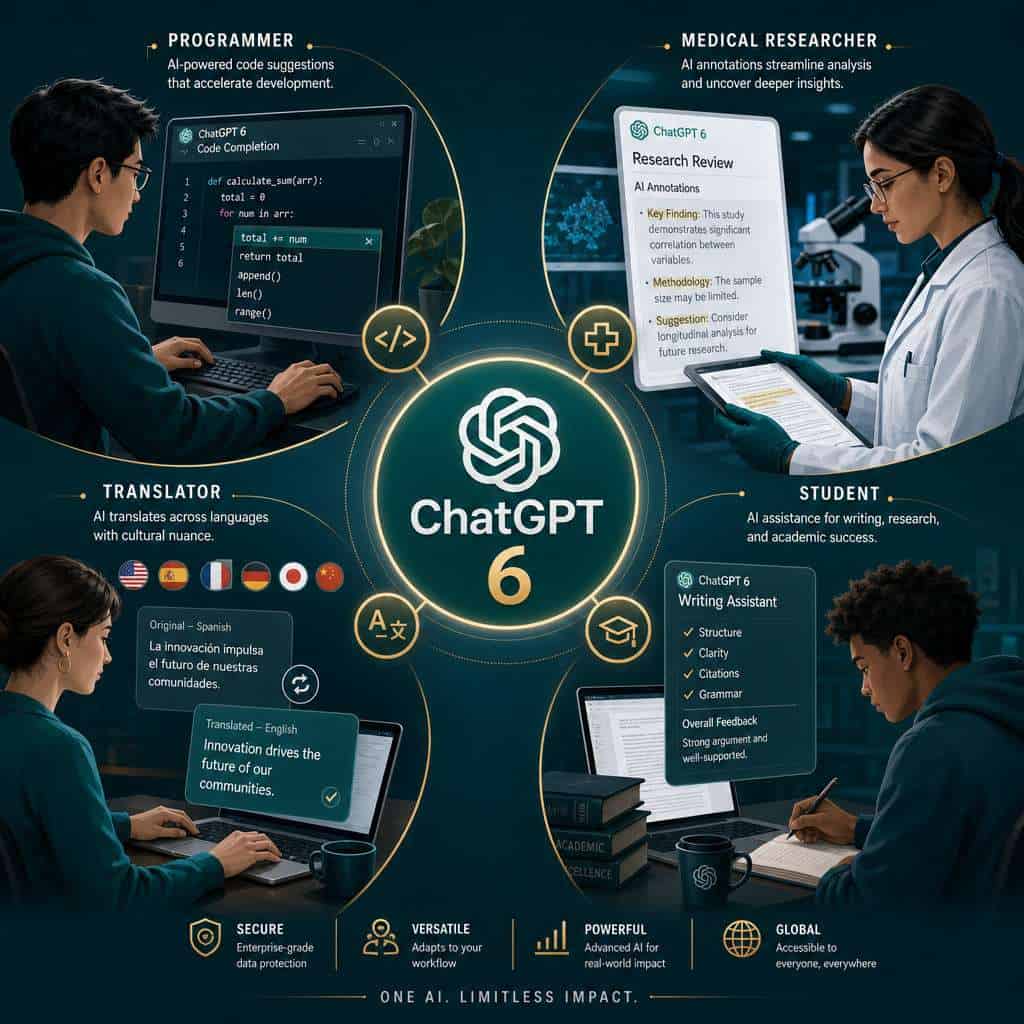
Healthcare, legal, software development, education, and financial services are the industries best positioned to benefit from ChatGPT 6’s capabilities in 2026.
- Healthcare: Summarizing research literature, drafting patient communication templates, and assisting with clinical documentation.
- Legal: Contract review, case research summaries, and drafting standard agreements.
- Software development: Code generation, documentation, and automated testing support.
- Education: Personalized tutoring, curriculum design, and research assistance.
- Finance: Report summarization, data interpretation, and client communication drafts.
For businesses exploring AI-driven web tools alongside ChatGPT 6, AI website builders represent another high-value application area worth exploring.
Are There Any Privacy Concerns with Using ChatGPT 6
Yes, privacy concerns are real and users should approach them seriously. By default, conversations with ChatGPT 6 may be used to improve OpenAI’s models unless users opt out through account settings.
Key privacy considerations:
- Do not enter personally identifiable information (names, social security numbers, medical records) into the chat interface.
- Enterprise accounts offer stronger data handling agreements, including options to prevent data use for training.
- API users have more control over data retention settings.
- OpenAI publishes a privacy policy that outlines data handling practices, and enterprise contracts include data processing agreements.
For teams handling sensitive workflows, reviewing platform security and data protection practices is a useful parallel reference when building AI-integrated pipelines.
What Training Data Was Used to Develop ChatGPT 6, and What Are Its Ethical Guidelines
ChatGPT 6 was trained on a large corpus of text from the internet, licensed datasets, and curated human-generated content, following the approach OpenAI has used for prior models. OpenAI has not published a full data card for ChatGPT 6 as of mid-2026, so the exact composition remains partially undisclosed.
Ethical guidelines built into the model include:
- RLHF (Reinforcement Learning from Human Feedback): Human trainers rate outputs to reduce harmful, biased, or misleading responses.
- Content policies: The model refuses requests for illegal content, detailed instructions for violence, and certain categories of misinformation.
- Bias mitigation: OpenAI applies ongoing red-teaming and bias audits, though the model is not bias-free.
Users should treat ChatGPT 6 as a capable assistant, not a neutral authority. Critical thinking remains essential.
Can Students and Researchers Use ChatGPT 6 for Academic Work
Students and researchers can use ChatGPT 6 productively for academic work, but must do so with clear boundaries around integrity and verification.
Appropriate uses:
- Brainstorming research questions and structuring arguments.
- Summarizing literature (always verify against the original source).
- Drafting and editing written work (with disclosure where required by institution policy).
- Explaining complex concepts in simpler terms.
Uses to avoid:
- Submitting AI-generated text as original work without disclosure.
- Citing ChatGPT 6 as a primary source for factual claims.
- Using it to generate data or fabricate references.
For academic and research-focused AI tools, the academic research tools archive at WebAIStack covers a range of options suited to scholarly workflows.
How Multilingual Is ChatGPT 6 Compared to Previous Versions, and What Hardware Do You Need
ChatGPT 6 supports over 50 languages with noticeably improved fluency, grammar accuracy, and cultural nuance compared to GPT-4. Languages with large training data representation, such as Spanish, French, German, Mandarin, Japanese, and Portuguese, perform at near-native quality. Lower-resource languages have improved but remain less consistent.
Hardware requirements for web/API access: None beyond a standard internet-connected device. ChatGPT 6 runs entirely on OpenAI’s cloud infrastructure.
Hardware requirements for local or on-premise deployment: If your organization requires a self-hosted version (available under enterprise agreements), expect:
- A minimum of 80GB VRAM across multiple high-end GPUs (e.g., NVIDIA A100 or H100 class).
- High-bandwidth memory and fast NVMe storage.
- Significant cooling and power infrastructure.
For most users, cloud access is the practical and cost-effective path.
Frequently Asked Questions
Is ChatGPT 6 available right now in 2026? As of June 2026, ChatGPT 6 is available to Plus and Enterprise subscribers, with limited access on the free tier. Availability may vary by region.
Does ChatGPT 6 have a memory feature? Yes. ChatGPT 6 includes an optional memory feature that retains information across sessions. Users can view, edit, or delete stored memories at any time in account settings.
Can ChatGPT 6 generate images? ChatGPT 6 can analyze images as inputs. Image generation is handled through integration with DALL-E or similar tools, depending on the plan.
Is ChatGPT 6 better than GPT-4 for writing? Generally yes. ChatGPT 6 produces more coherent long-form content, follows style instructions more reliably, and makes fewer grammatical errors.
How do I get the best results from ChatGPT 6? Be specific in your prompts. Include context, desired format, tone, and any constraints. Vague prompts produce generic outputs.
Can ChatGPT 6 replace a human expert? No. It is a capable assistant for research, drafting, and analysis, but it lacks real-world judgment, accountability, and the ability to verify its own outputs reliably.
Is there a free version of ChatGPT 6? A limited free tier exists, but full access to ChatGPT 6’s capabilities requires a paid subscription.
Does ChatGPT 6 work offline? No. The standard product requires an internet connection. Offline use would require a locally deployed model, which demands enterprise-grade hardware.
Conclusion
ChatGPT 6: The Next Frontier of AI Language Technology Unveiled marks a genuine step forward in what AI language models can do, not just in raw capability but in practical usefulness across industries. The improvements in reasoning, multilingual support, and technical document handling make it a credible tool for professionals, researchers, and developers alike.
Actionable next steps:
- Try the free tier to assess whether ChatGPT 6 fits your workflow before committing to a paid plan.
- Define your use case clearly — coding, writing, research, or customer communication each benefit from different prompt strategies.
- Set privacy boundaries — review OpenAI’s data settings and avoid entering sensitive personal or proprietary information.
- Cross-check important outputs — treat ChatGPT 6 as a first draft or research assistant, not a final authority.
- Explore integrations — pair ChatGPT 6 with automation platforms and specialized tools to multiply its value in your workflow.
The technology is here. Using it well is the skill worth developing.
References
- OpenAI. (2025). GPT-4 Technical Report. https://openai.com/research/gpt-4
- OpenAI. (2023). ChatGPT: Optimizing Language Models for Dialogue. https://openai.com/blog/chatgpt
- Anthropic. (2024). Claude Model Card. https://www.anthropic.com/model-card
- Google DeepMind. (2024). Gemini: A Family of Highly Capable Multimodal Models. https://deepmind.google/technologies/gemini/