Last updated: June 9, 2026
Quick Answer: ChatGPT can translate text across more than 50 languages with strong accuracy for everyday and business content, often outperforming basic machine translation tools on nuance and tone. However, it is not a certified human translator and carries real risks for legal, medical, or highly literary content. This guide covers what ChatGPT translation does well, where it falls short, and how to use it effectively in 2026.
Key Takeaways
- ChatGPT handles conversational, business, and technical translation well across major world languages
- It generally outperforms Google Translate on tone, context, and idiomatic phrasing for common language pairs
- Free users can access translation via GPT-4o; paid plans unlock higher usage limits and API access
- ChatGPT translation is not suitable for certified legal, medical, or sworn document translation
- Cultural adaptation requires explicit prompting — the model does not automatically localize content
- You can use ChatGPT as a language learning companion while translating, which adds real educational value
- Common mistakes include over-trusting output for rare languages and skipping review of technical terminology
- Industries like e-commerce, content marketing, and customer support benefit most from AI translation at scale
What Exactly Can ChatGPT Do for Translation Right Now
ChatGPT can translate written text between dozens of language pairs, adjust tone and formality, explain idiomatic expressions, and localize content for specific cultural contexts — all in a single conversation. As of 2026, GPT-4o handles translation tasks across more than 50 languages, including less common ones like Swahili, Catalan, and Welsh, though quality varies by language pair.
Here is what ChatGPT translation can do in practice:
- Direct translation: Paste text, specify the target language, and get an immediate result
- Tone adjustment: Ask for formal, casual, or technical registers in the same translation
- Back-translation check: Request a reverse translation to spot accuracy issues
- Idiomatic explanation: Ask why a phrase was translated a certain way
- Batch translation: Handle multiple short strings or paragraphs in one prompt
- Localization notes: Ask for cultural context alongside the translated text
For deeper automation of translation workflows, pairing ChatGPT with no-code tools is increasingly common. See our guide on mastering ChatGPT automation and no-code workflow integration for practical setup examples.
How Accurate Is ChatGPT Compared to Google Translate
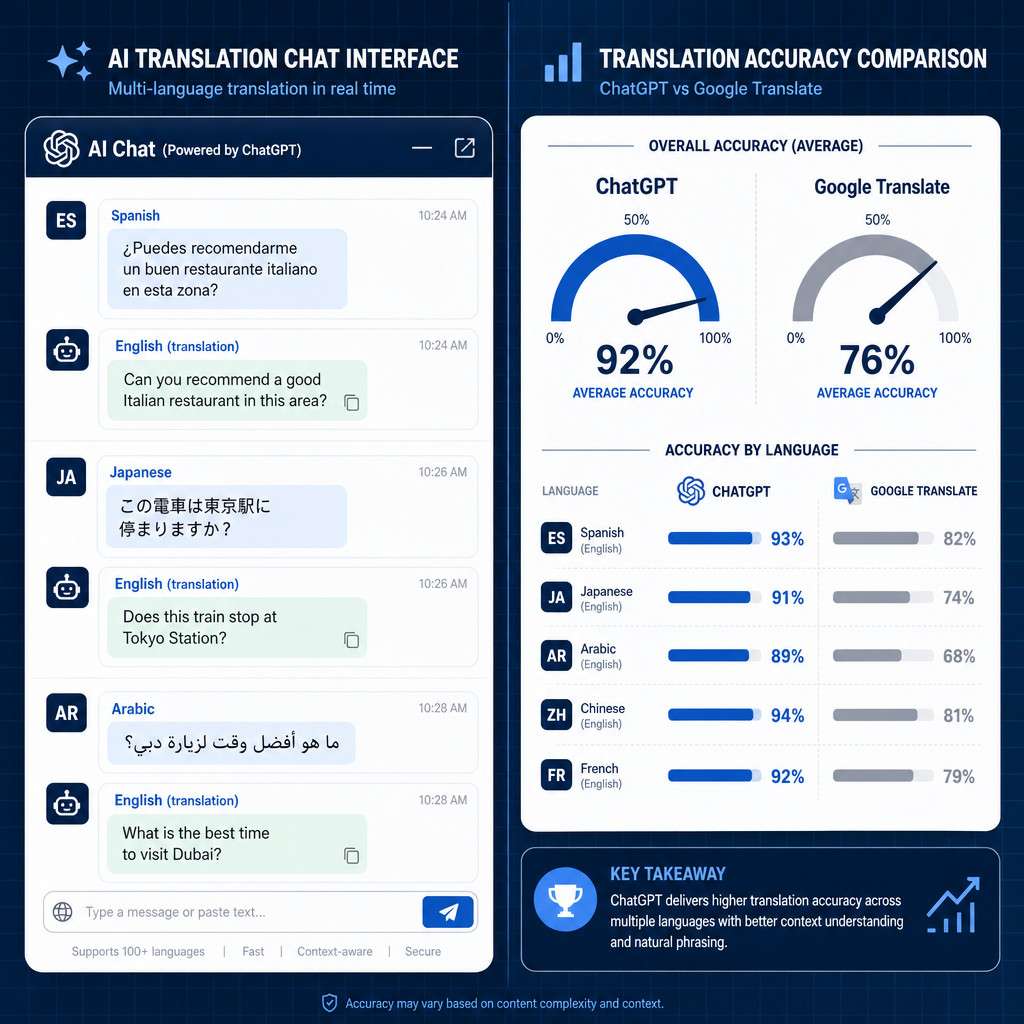
For major language pairs (English to Spanish, French, German, Japanese, Chinese), ChatGPT consistently produces more natural-sounding output than Google Translate, particularly for longer sentences, idiomatic phrases, and context-dependent meaning. Google Translate remains faster for quick single-word lookups and performs better on some lower-resource languages where it has more training data.
A practical comparison for common use cases:
| Feature | ChatGPT (GPT-4o) | Google Translate |
|---|---|---|
| Idiomatic phrasing | Strong | Moderate |
| Formal document tone | Strong | Moderate |
| Speed (single word) | Slower | Faster |
| Rare language pairs | Moderate | Moderate to strong |
| Cultural context | Strong (with prompting) | Weak |
| Explanation of choices | Yes | No |
| Free access | Yes (limited) | Yes (unlimited) |
Decision rule: Choose ChatGPT if you need nuanced, readable output for marketing copy, emails, or business documents. Choose Google Translate if you need a fast, free lookup for a single word or phrase in a language ChatGPT handles less reliably.
How Much Does ChatGPT Translation Cost
ChatGPT translation is free for casual use through the GPT-4o interface at chat.openai.com, with usage limits that reset periodically. ChatGPT Plus costs $20/month as of 2026 and removes most rate limits for personal use. For developers building translation pipelines, the OpenAI API charges per token — costs vary by model, but GPT-4o mini is significantly cheaper than GPT-4o for high-volume translation tasks.
For context: translating a 500-word document via the API using GPT-4o mini costs a fraction of a cent. Professional human translators typically charge $0.10 to $0.25 per word (source: American Translators Association rate surveys), making AI translation orders of magnitude cheaper for volume work.
Common mistake: Many users pay for ChatGPT Plus when the free tier is sufficient for occasional translation. Upgrade only if you hit usage caps regularly.
What Languages Does ChatGPT Translate Best
ChatGPT performs best on high-resource languages — those with large amounts of training data in English, Spanish, French, German, Portuguese, Italian, Dutch, Japanese, Korean, and Mandarin Chinese. Quality drops noticeably for low-resource languages like Tigrinya, Lao, or Sindhi.
Top-performing language pairs for ChatGPT translation:
- English to/from Spanish, French, German, Italian, Portuguese
- English to/from Japanese, Korean, Mandarin Chinese
- English to/from Arabic, Russian, Polish
- English to/from Dutch, Swedish, Norwegian
Edge case: Even within a well-supported language like Arabic, ChatGPT may struggle with regional dialects (Egyptian Arabic vs. Modern Standard Arabic vs. Levantine). Always specify the dialect or region in your prompt.
Common Mistakes People Make When Using ChatGPT for Translation
The biggest mistake is treating ChatGPT output as final without any review. Other frequent errors include under-specifying the prompt, ignoring dialect differences, and using ChatGPT for document types that require certified human translation.
Specific mistakes to avoid:
- Not specifying formality level — “Translate this email” gives different results than “Translate this formal business email for a Japanese executive”
- Ignoring regional variation — Spanish in Mexico differs from Spanish in Spain; always name the target region
- Skipping back-translation — A quick reverse check catches major errors in seconds
- Over-trusting rare language output — For languages outside the top 20, have a native speaker review the result
- Pasting sensitive data — Avoid entering confidential client or patient information into any AI chat interface without checking your organization’s data policy
For a broader look at how AI tools handle content quality, our comprehensive guide to AI-powered content generation tools covers related pitfalls worth knowing.
Is ChatGPT Translation Good for Professional Documents
ChatGPT translation is suitable for internal business documents, marketing materials, product descriptions, and customer communications. It is not appropriate as a standalone solution for certified legal documents, sworn translations, medical records, or any content requiring a licensed human translator’s signature.
Use ChatGPT for professional documents if:
- The document is internal (not legally binding)
- A bilingual team member will review the output
- You need a fast first draft before human editing
- The content is marketing or communications-focused
Do not use ChatGPT as the final step if:
- The document will be submitted to a court, immigration authority, or regulatory body
- Medical accuracy is life-critical
- The contract carries financial or legal liability
What Kind of Translations Should I Not Use ChatGPT For
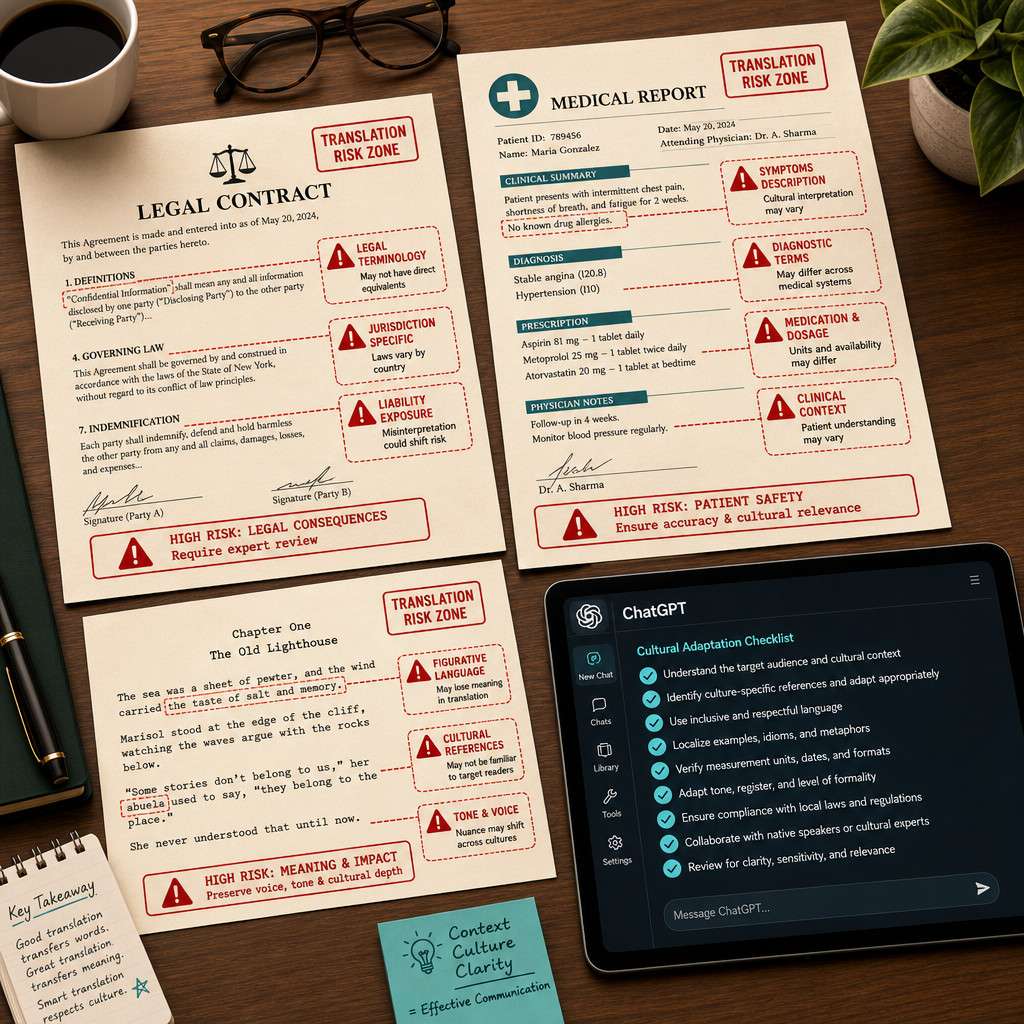
Avoid relying on ChatGPT translation alone for legal contracts, medical instructions, sworn affidavits, patent filings, and highly literary or poetic works where cultural and artistic nuance is central to the meaning. These categories require either certified human translators or, at minimum, expert human review of any AI draft.
Categories to handle with extra caution:
- Legal: Contracts, court documents, immigration paperwork
- Medical: Prescription instructions, clinical trial consent forms, diagnostic reports
- Literary: Poetry, novels, culturally specific humor or wordplay
- Religious texts: Theological precision matters enormously in these translations
- Safety-critical technical content: Engineering manuals, aviation instructions
This is not a limitation unique to ChatGPT — it applies to all current AI translation systems.
How Do I Make Sure My Translations Are Culturally Appropriate
Cultural appropriateness does not happen automatically. You must prompt ChatGPT explicitly to consider cultural context, local idioms, and regional sensitivities. A translation that is linguistically accurate can still be culturally tone-deaf.
Steps to improve cultural accuracy:
- Specify the target country or region, not just the language (“Brazilian Portuguese for a São Paulo audience”)
- Ask ChatGPT to flag any phrases that may not translate culturally, not just linguistically
- Request alternative phrasings for idioms rather than direct translations
- Ask: “Are there any cultural sensitivities in this content I should know about for [target region]?”
- Have a native speaker from the target region do a final read
Quick example: The English phrase “knock it out of the park” translates literally in many languages but loses all meaning. Prompting ChatGPT to “adapt idioms for a German business audience” produces far better results than a straight translation.
Can ChatGPT Help Me Learn a New Language While Translating
Yes, and this is one of the most underused features of ChatGPT for language learners. Instead of just receiving a translation, you can ask ChatGPT to explain grammar rules, break down sentence structure, highlight vocabulary, and quiz you on what you just translated.
Practical ways to use ChatGPT as a language learning tool:
- Ask “Why did you use this verb tense?” after a translation
- Request a word-by-word breakdown of a translated sentence
- Ask for three alternative ways to express the same idea in the target language
- Use the translation as a reading exercise, then ask comprehension questions
- Ask ChatGPT to correct your own attempts before showing you the polished version
For more on how AI tools are expanding into education and productivity, explore the AI websites guide covering groundbreaking digital platforms.
What Are the Limitations of AI Translation Right Now
The core limitation of all AI translation in 2026, including ChatGPT, is that it lacks true cultural lived experience and cannot guarantee accuracy for low-resource languages, highly specialized terminology, or content where a single mistranslation carries serious consequences.
Current limitations include:
- Hallucination risk: ChatGPT can confidently produce a plausible-sounding but incorrect translation, especially for rare languages
- No real-time knowledge of new slang or terminology without updated training data
- Inconsistency across long documents — tone and terminology can drift in longer texts
- No certification: AI output cannot replace a certified human translator for official purposes
- Context blindness in isolation: Without surrounding context, ambiguous words may be translated incorrectly
Which Industries Benefit Most from ChatGPT Translation
E-commerce, content marketing, customer support, software localization, and travel are the industries that get the most practical value from ChatGPT translation at scale. These sectors need fast, readable translation across many language pairs without always requiring certified human translators.
| Industry | Primary Use Case | Benefit Level |
|---|---|---|
| E-commerce | Product descriptions, reviews | High |
| Content marketing | Blog posts, social media | High |
| Customer support | Email and chat responses | High |
| Software/SaaS | UI strings, help docs | High |
| Legal | Contract drafts (review required) | Medium |
| Medical | Patient communications (review required) | Medium |
| Literary publishing | First drafts only | Low |
Teams using AI-powered content tools alongside translation workflows can find relevant strategies in our AI-powered content optimization guide.
How Do I Fix Weird Translations from ChatGPT
When a ChatGPT translation sounds off, the fix is almost always in the prompt, not in the model. Vague prompts produce vague translations. Specific, context-rich prompts produce accurate, natural-sounding output.
Troubleshooting steps:
- Add context: Tell ChatGPT who the audience is, what the document is for, and the desired tone
- Specify dialect and region: “Formal Castilian Spanish” vs. “Casual Mexican Spanish” yields very different results
- Ask for alternatives: “Give me three different ways to translate this sentence”
- Request explanation: “Why did you choose this phrasing? Is there a more natural option?”
- Use back-translation: Translate the output back to English to spot meaning drift
- Break up long texts: Translate in shorter chunks to maintain consistency
For those building automated translation pipelines, the ChatGPT Archives on WebAIStack contain workflow-specific guides worth bookmarking.
Is ChatGPT Translation Better for Technical or Literary Content
ChatGPT translation performs better on technical content than literary content, as a general rule. Technical documents have precise, consistent terminology and less reliance on cultural subtext, rhythm, or wordplay — areas where AI still struggles significantly.
For technical content: ChatGPT handles software documentation, user manuals, and business reports well, especially when you provide a glossary of preferred terminology in the prompt.
For literary content: Poetry, fiction, and culturally rich prose require a human translator with deep cultural knowledge. ChatGPT can produce a useful rough draft, but the artistic and emotional layers of literary translation are beyond what any current AI system reliably delivers.
Decision rule: Use ChatGPT as the primary tool for technical translation with human review. Use ChatGPT only as a starting draft for literary translation, then hand it to a professional.
Frequently Asked Questions
Does ChatGPT support real-time translation in conversations? Not natively in a live voice call format, but you can paste spoken transcripts or use the voice mode in the ChatGPT app to get near-real-time translation assistance in a back-and-forth conversation.
Can ChatGPT translate images or scanned documents? Yes. With GPT-4o’s vision capability, you can upload an image of text and ask ChatGPT to translate the visible content. Accuracy depends on image quality and text clarity.
Is ChatGPT translation GDPR-compliant for business use? OpenAI offers a data processing agreement for API users, but standard ChatGPT chat sessions may use inputs for model improvement unless you opt out. Businesses handling personal data should review OpenAI’s current privacy settings and consult legal counsel before using the chat interface for sensitive translations.
How many words can ChatGPT translate at once? GPT-4o supports a context window of 128,000 tokens, which is roughly 90,000 to 100,000 words. In practice, very long documents may show consistency drift, so translating in sections of 1,000 to 2,000 words is advisable.
Can I use ChatGPT to translate audio or video content? Not directly. You would need to transcribe audio first (using a tool like Whisper), then paste the transcript into ChatGPT for translation. For video content, tools like HeyGen handle multilingual dubbing — see our HeyGen creator plan guide for details.
Is ChatGPT better than DeepL for translation? DeepL is widely regarded as the strongest dedicated machine translation tool for European languages. ChatGPT is more flexible and context-aware but less specialized. For pure translation of European language pairs, DeepL is often the better default. For tasks requiring context, explanation, or cultural adaptation, ChatGPT has the edge.
Can ChatGPT translate legal contracts accurately? ChatGPT can produce a readable draft translation of a legal contract, but the output must be reviewed by a qualified legal translator or bilingual attorney before use. Legal terminology varies significantly by jurisdiction, and errors carry real liability.
Does ChatGPT maintain consistent terminology across a long document? Not automatically. You can improve consistency by providing a glossary in the prompt and translating in sections with the glossary included each time. For large-scale projects, a dedicated translation memory tool is a better long-term solution.
Conclusion
ChatGPT translation is one of the most practical applications of large language models available today. For everyday business content, marketing materials, customer communications, and technical documentation, it delivers fast, readable translations that would have required significant budget or time just a few years ago.
The key is knowing where it excels and where it does not. Use it confidently for high-resource language pairs, business writing, and content that will receive human review. Treat its output as a draft, not a final product, for anything legally binding, medically critical, or artistically complex.
Actionable next steps:
- Test ChatGPT on a real translation task you currently outsource or handle manually — compare the output quality and time saved
- Build a standard prompt template for your most common translation use case, including audience, tone, dialect, and any required terminology
- Set up a simple review workflow: AI draft, native speaker check, final approval
- Explore API-based translation pipelines if you handle volume work — the cost savings at scale are substantial
- Use ChatGPT’s explanation features to build your own language knowledge alongside your translation work
For teams looking to extend these capabilities further, our AI-powered content generation tools guide and the ChatGPT automation workflow guide are natural next reads.
References
- American Translators Association. (2023). Translation industry rates and compensation survey. https://www.atanet.org
- OpenAI. (2024). GPT-4o system card. https://openai.com/research/gpt-4o-system-card
- OpenAI. (2025). ChatGPT pricing and plans. https://openai.com/pricing