Last updated: May 10, 2026
Quick Answer: Replit is a browser-based coding platform where you can write and run Python without installing anything on your computer. To get started, go to replit.com, sign up with Google, GitHub, or email, create a new Python Repl, and start coding immediately. The free tier is enough for beginners, and the whole process takes under two minutes.
Key Takeaways
- Replit requires zero local setup — you code Python directly in your browser on any device.
- You can log in using Google, GitHub, Apple, or a standard email/password combination.
- Creating your first Python project (called a “Repl”) takes about 30 seconds after login.
- The free plan includes enough compute for learning and small projects; paid plans start at $7/month for more power and private Repls.
- Replit now has over 35 million users across 200+ countries, with more than 200,000 classrooms using it for Python education [10].
- Real-time collaboration lets multiple people code in the same Repl simultaneously.
- The platform includes an AI assistant that can help debug and write Python code.
- In March 2026, Replit experienced brief Google and SSO login outages, which were resolved [8]. If login fails, check status.replit.com.
Over 35 million people have used Replit to write code, and a huge portion of them started with Python [10]. That number isn’t surprising when you consider what Replit eliminates: no downloading Python, no configuring PATH variables, no fighting with your terminal. You open a browser tab and start coding. This complete guide to logging in and getting started with Python on Replit walks you through every step, from creating your account to running your first program, so you can skip the setup headaches and focus on actually learning Python.

How Do You Create a Replit Account and Log In?
Replit offers four login methods: Google, GitHub, Apple, or email with a password. The fastest option for most people is Google sign-in, which takes one click after you reach the site.

Step-by-step account creation
- Go to replit.com in any modern browser (Chrome, Firefox, Safari, Edge all work).
- Click “Sign Up” in the top-right corner.
- Choose your login method:
- Google — fastest, one click if you’re already signed into Google
- GitHub — good if you already have a GitHub account and want to connect repositories later
- Apple — available for Apple ID users
- Email — enter your email, create a password, and verify via a confirmation link
- Complete your profile — pick a username and agree to the terms of service.
- You’re in. Replit drops you into the dashboard, ready to create your first project.
Common mistake: Using a school or work email that blocks third-party OAuth. If Google login fails, try a personal Gmail account or use the email/password method instead. Replit experienced Google and SSO login outages in March 2026 [8], so if you hit errors, check status.replit.com before troubleshooting on your end.
Choose Google login if you want the fastest setup. Choose GitHub if you plan to push code to repositories later. Choose email if you prefer not to link any external accounts.
What Is Replit and Why Use It for Python?
Replit is a cloud-based integrated development environment (IDE) that runs entirely in your browser. It supports over 50 programming languages, but Python is by far its most popular — you can start a Python 3 environment instantly without any downloads [4].
Why beginners choose Replit over local Python installs
- No installation required. Python runs on Replit’s servers. You don’t need to install Python, pip, or a code editor.
- Works on any device. Chromebook, tablet, old laptop — if it has a browser, it works.
- Built-in package management. Need
requestsornumpy? Replit auto-installs packages when you import them. - Instant sharing. Send someone a link and they can see (or fork) your code immediately.
- AI coding assistant. Replit’s built-in AI can explain errors, suggest fixes, and generate code snippets.
For context, Replit’s CEO noted in a May 2026 TechCrunch interview that the platform reached a billion-dollar run rate, largely driven by Python beginners using its instant workspaces [10]. If you’re exploring other no-code and low-code platforms, Replit sits in a unique spot: it’s a real coding environment, but with the ease of a no-code tool.
How Do You Create and Run Your First Python Project on Replit?
After logging in, click the blue “+ Create Repl” button on your dashboard, select Python as the language, name your project, and click “Create Repl.” You’ll have a working Python editor in seconds [3].

Walking through the Replit workspace
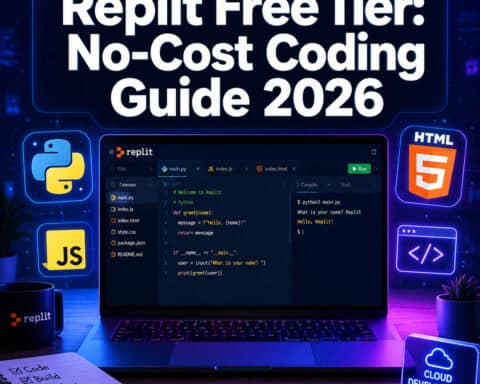
Once your Repl opens, you’ll see three main panels:
| Panel | Location | Purpose |
|---|---|---|
| File Explorer | Left sidebar | Shows all your project files (starts with main.py) |
| Code Editor | Center | Where you write Python code |
| Console/Shell | Right side | Shows output when you run code; also has a terminal |
Your first Python program
Type this into main.py:
<code class="language-python">print("Hello, Replit!")
</code>
Click the green Run button at the top. The console on the right will display:
<code>Hello, Replit!
</code>
That’s it. No configuration files, no build steps, no virtual environments. The code runs on Replit’s servers and streams the output to your browser.
Installing Python packages
If your project needs external libraries, you have two options:
- Auto-install: Just write
import requestsin your code and run it. Replit detects the missing package and installs it automatically. - Manual install: Open the Shell tab and type
pip install package-name.
This auto-detection feature is one reason Replit works well for beginners who might not know how pip works yet. If you’re also interested in how AI tools can speed up your workflow beyond coding, our guide on AI-powered content generation tools covers similar productivity gains in the content space.
What Are the Free vs. Paid Plans for Python on Replit?
The free plan is enough for learning Python basics. You get public Repls, limited compute, and access to the core editor. Paid plans add private projects, more CPU/RAM, and faster AI features.
| Feature | Free | Hacker ($7/mo) | Teams ($15/user/mo) |
|---|---|---|---|
| Public Repls | Unlimited | Unlimited | Unlimited |
| Private Repls | No | Yes | Yes |
| Compute (CPU/RAM) | Basic | 4x more | 4x more + admin tools |
| AI Assistant | Limited | Full access | Full access |
| Always-on Repls | No | Yes | Yes |
| Collaboration | Basic | Enhanced | Full team features |
Choose the free plan if you’re learning Python, following tutorials, or building small projects you don’t mind being public. Upgrade to Hacker if you need private code or your programs require more memory (like data analysis with pandas). Go with Teams if you’re teaching a class or managing a group project [3].
In April 2026, Replit also launched private publishing for all users and external access tokens for Private Deployments, adding more security options for paid users.
How Does Replit Compare to Other Online Python Environments?
Replit is the fastest to start for general Python coding, but it’s not the only option. GitHub Codespaces and Google Colab serve different needs.

| Criteria | Replit | GitHub Codespaces | Google Colab |
|---|---|---|---|
| Setup time | ~30 seconds | 2-5 minutes | ~1 minute |
| Best for | General Python, web apps | Professional development | Data science, ML |
| Login required | Google/GitHub/Email | GitHub account | Google account |
| Free GPU access | No | No | Yes (limited) |
| Real-time collaboration | Yes (multiplayer) | Via Live Share | Limited |
| AI assistant | Built-in | Copilot (separate) | Gemini integration |
| Cost | Free / $7+ | Free / $4+ | Free / $10+ |
Choose Replit if you’re a beginner learning Python or building web apps. Choose Codespaces if you’re already comfortable with VS Code and need Git integration. Choose Colab if you’re doing machine learning and need free GPU access.
For web development projects specifically, you might also want to explore how tools like Webflow handle SEO optimization or how AI website creators let you build sites without code — Replit can complement these tools when you need custom Python backends.
What Are Common Login and Setup Problems (and How to Fix Them)?
Most issues fall into three categories: OAuth failures, browser compatibility, and account verification delays. Here’s how to handle each.
- Google/GitHub login not working: Check status.replit.com first. Replit had SSO outages in March 2026 [8]. If the platform is up, try clearing your browser cookies or using an incognito window.
- “Account already exists” error: You may have previously signed up with a different method. Try logging in with email if Google isn’t working, or vice versa.
- Verification email not arriving: Check your spam folder. If using a school email, the domain may block Replit’s emails. Switch to a personal email address.
- Repl won’t run: Make sure you selected “Python” (not Python 2 or another language) when creating the Repl. Also check that your code is in
main.py, not a different file. - Slow performance: Free-tier Repls share server resources. If your program is sluggish, try running it during off-peak hours or upgrading your plan.
If you’re working on design projects alongside your Python learning, tools like Figma for beginners and Canva’s AI design assistant can handle the visual side while Replit handles the code.
What Should You Build After Your First Python Program?
Once “Hello, Replit!” is running, here are practical next steps organized by difficulty:
- Calculator app — Practice variables, input(), and basic math operations.
- To-do list — Learn lists, loops, and file I/O by saving tasks to a text file.
- Web scraper — Use the
requestsandBeautifulSouplibraries to pull data from websites. - Flask web app — Build a simple website with Python’s Flask framework. Replit handles the hosting automatically.
- Discord bot — Use
discord.pyto create a bot that responds to commands in a server.
Each of these projects teaches different Python concepts and takes advantage of Replit’s instant package installation and built-in hosting [4]. If you’re also building a web presence, consider pairing your Python skills with a WordPress site using AI plugins to automate parts of your workflow.
FAQ
Can I use Replit on my phone or tablet? Yes. Replit works in mobile browsers, and there’s a dedicated mobile app for iOS and Android. The experience is better on a tablet than a phone due to screen size, but it’s fully functional on both.
Is Replit free for learning Python? Yes. The free tier gives you unlimited public Repls with enough compute for learning exercises, tutorials, and small projects. You only need to pay if you want private code or more processing power.
Do I need to install Python on my computer to use Replit? No. Python runs on Replit’s cloud servers. Your browser is the only software you need.
Can multiple people code together on Replit? Yes. Replit’s multiplayer feature lets multiple users edit the same Repl in real time, similar to Google Docs. Share the Repl link and collaborators can join instantly after logging in [3].
Is my code on Replit private? On the free plan, all Repls are public. Anyone with the link can view your code. Paid plans ($7/month and up) unlock private Repls.
What Python version does Replit use? Replit runs Python 3 by default (currently Python 3.10+). Python 2 is not supported for new Repls [4].
Can I deploy a Python web app from Replit? Yes. Replit can host Flask, Django, and FastAPI apps. Free Repls go to sleep after inactivity, but paid “Always-on” Repls stay running 24/7.
How do I save my work on Replit? Replit auto-saves your code as you type. There’s no manual save button needed. Your projects persist in your account across sessions.
Can I connect Replit to GitHub? Yes. You can import repositories from GitHub and push changes back. This is available on both free and paid plans.
What happens if Replit goes down while I’m coding? Your code is saved automatically. When the service comes back, your work will be intact. Check status.replit.com for real-time outage information [8].
Conclusion
Getting started with Python on Replit is genuinely one of the lowest-friction ways to begin coding in 2026. You create an account in under a minute, open a Python Repl in seconds, and start writing code immediately — no downloads, no configuration, no terminal commands.
Here’s what to do right now:
- Go to replit.com and sign up with Google for the fastest start.
- Create a Python Repl and run
print("Hello, Replit!")to confirm everything works. - Try installing a package — add
import requeststo your code and watch Replit handle the rest. - Pick a beginner project from the list above and start building something real.
- Bookmark status.replit.com so you know where to check if login ever fails.
The best way to learn Python isn’t reading about it — it’s writing code. Replit removes every barrier between you and that first line of Python. Open a tab and start.
References
[3] Guides – https://replit.com/guides [4] Python3 – https://replit.com/languages/python3 [8] March – https://status.replit.com/history/2026/march [10] Replit – https://www.distillintelligence.com/news/replit