Last updated: May 11, 2026
Quick Answer: Cursor AI, the AI-powered code editor built by Anysphere, has grown from a small startup to a company reportedly seeking a $50 billion valuation in under three years. Its funding trajectory—from a $400M Series A to a potential $2B raise in April 2026—reflects both investor confidence in AI-assisted coding and the broader race to own developer tooling. Understanding inside Cursor AI’s funding journey means tracking how capital, proprietary model development, and enterprise adoption intersect to map the future of AI development.
Key Takeaways
- Cursor’s valuation tripled from ~$9.4B to $29.3B in just five months during its Series D [2]
- A $2B+ raise at $50B pre-money valuation was reportedly in advanced talks as of April 2026, led by Thrive and Andreessen Horowitz [3]
- SpaceX reportedly secured an option to acquire Cursor for $60B after Microsoft passed on the deal
- Cursor shifted to proprietary “Composer” models based on DeepSeek, Kimi, and Qwen, reducing reliance on Anthropic and OpenAI [8]
- Revenue split has shifted to approximately 60% business-derived, signaling enterprise traction [4]
- Cursor Composer 2 scores 73.7% on SWE-Bench, outperforming GitHub Copilot’s 56% in complex tasks [9]
- The company reached gross margin profitability through its Composer model and cheaper inference costs [1]
- Major competitors include GitHub Copilot, Claude Code, OpenAI Codex, and open-source alternatives like Cline
How Did Cursor AI’s Funding Journey Begin?
Cursor started as a fork of VS Code with AI capabilities baked in, built by a small team at Anysphere. The company’s early funding rounds were modest by today’s standards but signaled strong investor interest in AI-native developer tools.
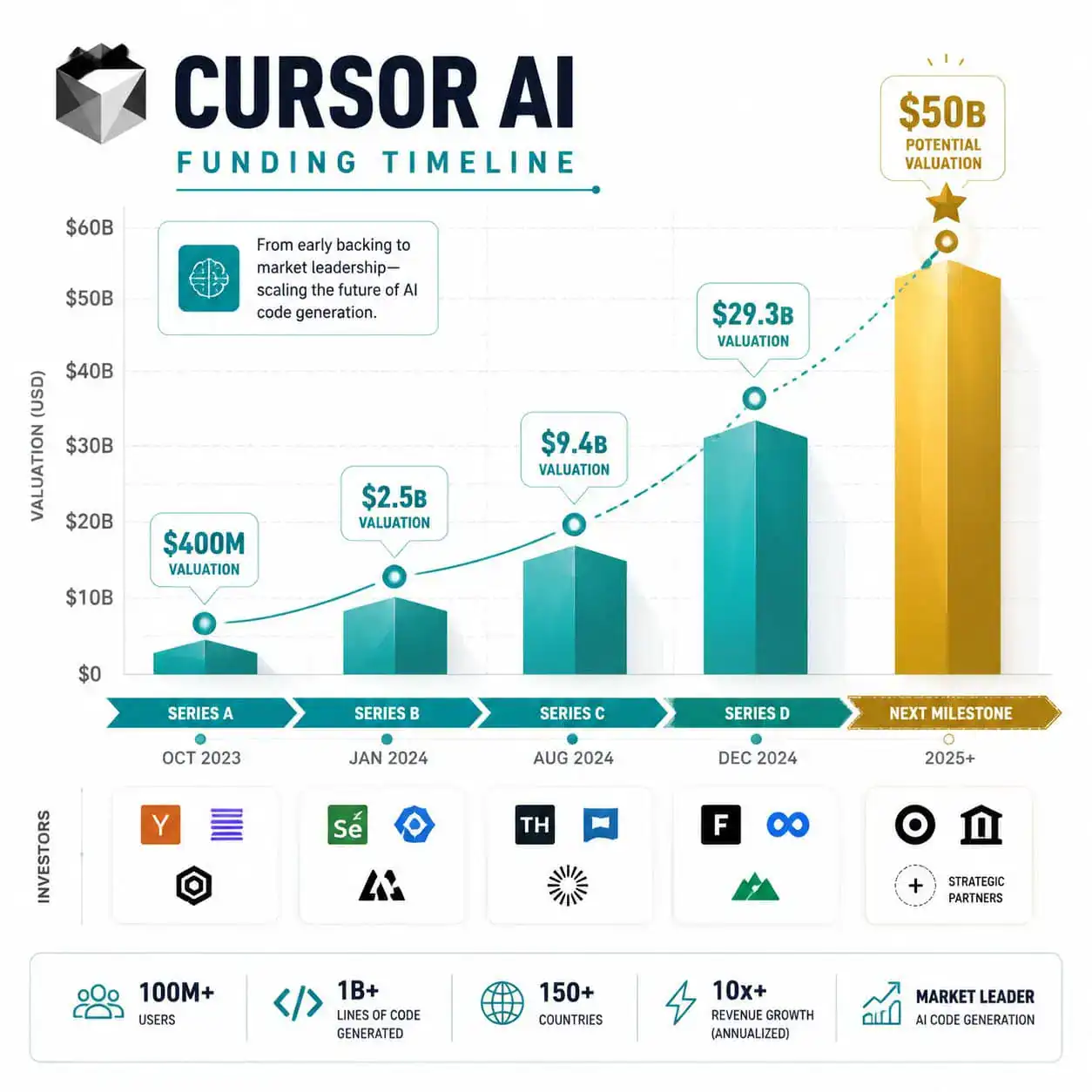
The trajectory accelerated fast:
| Round | Approximate Valuation | Key Detail |
|---|---|---|
| Series A | $400M | Initial institutional backing |
| Series B | $2.5B | Growth-stage validation |
| Series C | ~$9.4B | Rapid user adoption |
| Series D | $29.3B | Valuation tripled in 5 months [2] |
| Reported Series E | $50B pre-money | $2B+ raise, oversubscribed [3] |
What makes this unusual isn’t just the speed—it’s the compression. Most companies take 7-10 years to reach a $50B valuation. Cursor did it in roughly three. The key driver: Cursor proved that developers would pay for an AI tool that understood their entire codebase, not just the file they had open.
For context on how AI tools are reshaping development workflows, see our comprehensive guide to AI-powered content generation tools.
What’s Driving Cursor’s $50 Billion Valuation?
Three factors explain the valuation leap: proprietary model development, enterprise revenue growth, and competitive positioning.
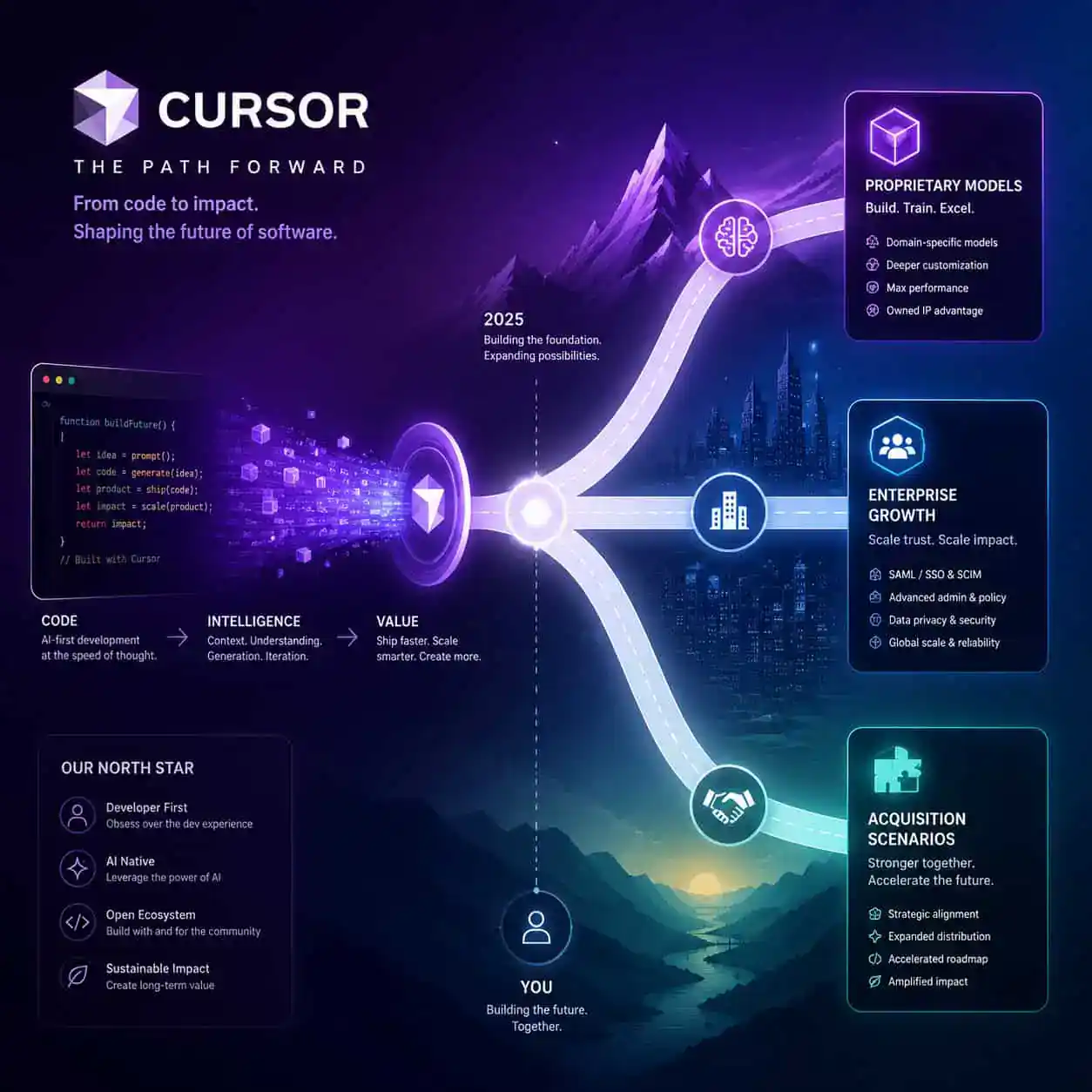
Proprietary models cut costs and increase control. Forbes reported in March 2026 that Cursor deployed 20 AI researchers to build its own Composer models based on DeepSeek, Kimi, and Qwen [8]. Composer 1.5 became the second most-used model on the platform, and Composer 2 now scores 61.3 on CursorBench—37% higher than its predecessor. This shift away from expensive Anthropic and OpenAI APIs directly improved margins.
Enterprise adoption is real. Fortune noted that Cursor’s revenue split moved to roughly 60% from business clients [4]. The company lost only 1-2 enterprise clients during its growth phase, suggesting strong retention. TechCrunch confirmed the company reached gross margin profitability [1].
The market is enormous. Every developer is a potential user. GitHub Copilot proved the market exists; Cursor argues it can serve it better through deeper codebase understanding and more complex refactoring capabilities.
Who Are Cursor’s Major Investors and What Do They See?
The reported $2B raise at $50B valuation was led by Thrive Capital and Andreessen Horowitz, with Nvidia and potentially Battery Ventures joining [3][6]. The round was oversubscribed, meaning more investors wanted in than there was room for.
Why these investors specifically:
- Thrive Capital has deep ties to AI infrastructure plays and developer tooling
- Andreessen Horowitz has been aggressive in AI coding tools, viewing them as the next platform shift
- Nvidia benefits directly from increased AI inference demand—more Cursor usage means more GPU consumption
The SpaceX acquisition option at $60B adds another dimension. While unconfirmed by Cursor, the report suggests that major tech players view AI coding tools as strategic assets, not just products. If developers increasingly rely on AI to write code, owning that layer gives you influence over how software gets built.
If you’re interested in how AI integrates with existing development platforms, our guide on AI plugins for WordPress automation covers practical applications.
How Does Cursor Compare to GitHub Copilot and Other Competitors?
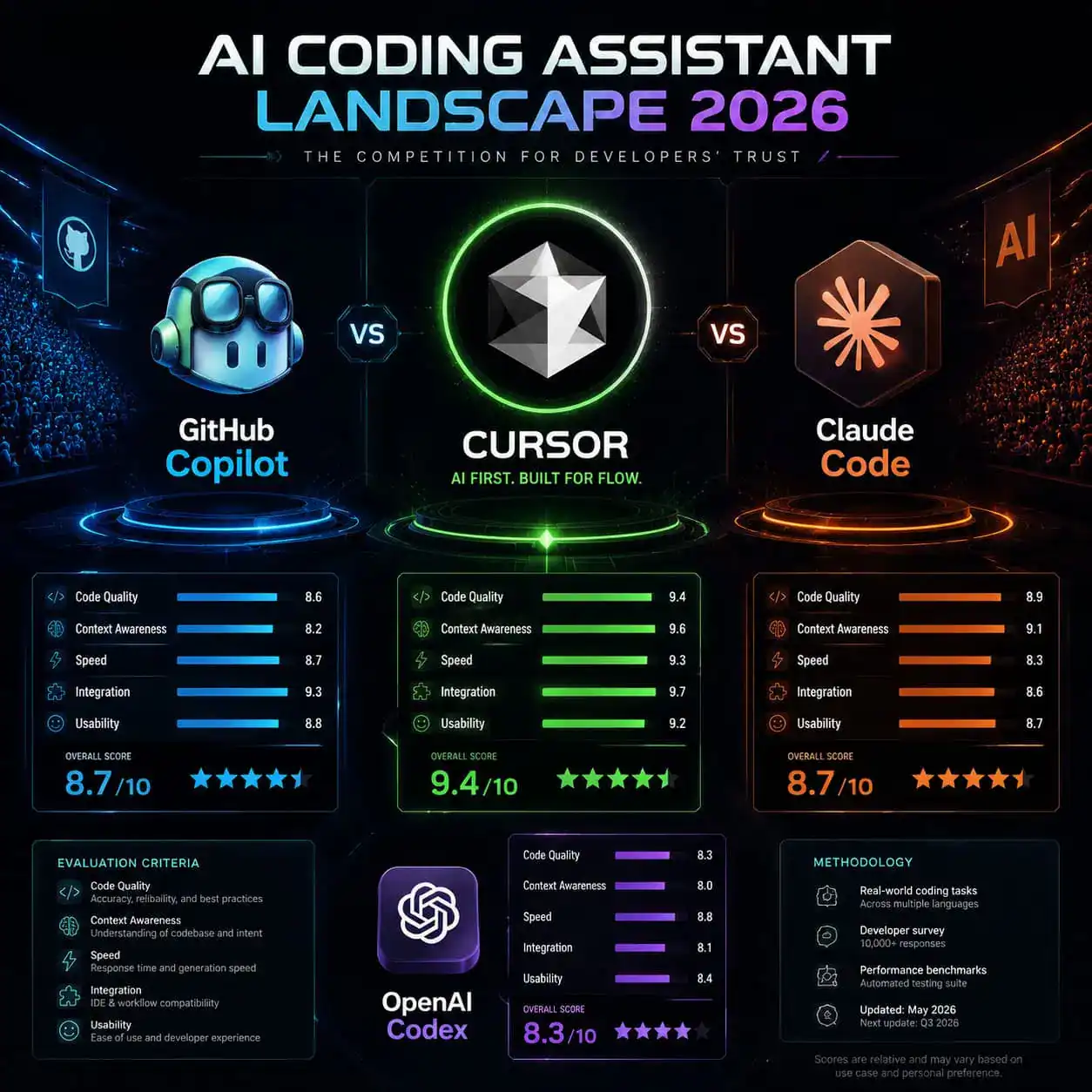
Cursor outperforms GitHub Copilot on complex coding tasks but faces growing competition from multiple directions. Here’s how the landscape breaks down in 2026:
| Tool | Strength | Weakness | Price |
|---|---|---|---|
| Cursor | Full codebase context, complex refactors | Inconsistent output, UI clutter [7] | $20/mo Pro |
| GitHub Copilot | IDE integration, massive user base | Weaker on multi-file tasks | $10-19/mo |
| Claude Code | Terminal-based, strong reasoning | No GUI, steep learning curve | $20/mo |
| Cline | Open-source, pay-per-model | Requires setup, no managed infra | Variable |
| Zed | Fast, user-owned models | Smaller ecosystem | $10/mo + usage |
Benchmark comparison (April 2026):
- Cursor Composer 2: 73.7% on SWE-Bench
- GitHub Copilot: 56% on SWE-Bench
- GPT-5.4 (standalone): 75.1% on SWE-Bench
- Initial output speed: Cursor at 62.9s vs. Copilot at 89.9s [9]
Choose Cursor if you work on large codebases with complex multi-file refactoring needs. Choose Copilot if you want the lowest-friction integration with existing GitHub workflows. Choose Claude Code if you’re comfortable in the terminal and want strong reasoning without a dedicated IDE.
For developers working across design and code, our Figma to code plugins guide explores how AI bridges that gap.
Inside Cursor AI’s Funding Journey: What Does It Mean for AI Development’s Future?
Cursor’s funding trajectory signals three broader shifts in how software will be built.
1. AI-native tools will replace AI-augmented ones. Cursor didn’t add AI to an existing editor—it built the editor around AI. This approach gives it architectural advantages that bolt-on solutions can’t match. Expect more startups to follow this pattern across other development categories.
2. Proprietary models become a moat. By building Composer rather than relying solely on third-party APIs, Cursor controls its costs, performance, and differentiation [8]. This is a template for any AI-powered product: eventually, you need your own models to survive margin pressure.
3. The developer tool market is consolidating around AI. The potential SpaceX acquisition, Microsoft’s reported pass, and the oversubscribed funding round all point to developer AI tools becoming strategic infrastructure—not just productivity software.
However, uncertainty remains. Fortune’s March 2026 analysis noted Cursor’s “uncertain future” despite its growth [4]. The company depends on AI models continuing to improve. If progress stalls, or if a competitor achieves a breakthrough, Cursor’s valuation premium could compress quickly.
Reddit discussions from April 2026 reflect this tension: developers praise Cursor’s efficiency while worrying about job displacement and noting that local LLMs offer affordable alternatives for simpler tasks [7].
What Are the Risks and Criticisms of Cursor’s Approach?
No funding story is complete without examining what could go wrong.
Common criticisms:
- Inconsistent AI output quality — Users report that suggestions vary significantly in accuracy depending on the task [7]
- UI complexity — As features pile up, some developers find the interface cluttered compared to leaner alternatives
- Model dependency — Despite proprietary efforts, Cursor still relies on external model architectures (DeepSeek, Qwen) that could face licensing or geopolitical complications
- Valuation risk — A $50B valuation requires sustained hypergrowth; any slowdown could trigger a down round
Edge case to watch: If open-source alternatives like Cline mature enough to offer 80% of Cursor’s capability at near-zero cost, the paid market could shrink faster than expected. This is the classic “good enough” disruption pattern.
For teams evaluating AI tools across their workflow, our AI-powered content optimization guide provides a framework for measuring actual ROI.
What Recent Updates Has Cursor Shipped?
As of May 2026, Cursor continues shipping at a rapid pace. The May 6 release included:
- New PR review experience — AI-assisted code review directly in the editor
- Parallel agent execution via
/multitask— Run multiple AI agents simultaneously on different parts of your codebase - Quick-action pills — One-click shortcuts for common AI-assisted tasks
These updates reinforce Cursor’s strategy of making AI integral to every part of the development workflow, not just code completion. The /multitask feature in particular suggests Cursor is moving toward an “AI team” model where multiple agents collaborate on complex projects.
Developers interested in how AI tools integrate with web development should also explore our guide on integrating AI-powered chatbots into WordPress and our AI website creator overview.
Conclusion
Inside Cursor AI’s funding journey, we see a company that has moved from scrappy startup to potential $50B+ acquisition target in roughly three years. The speed is remarkable, but the underlying logic is straightforward: developers need better tools, AI can provide them, and whoever owns the developer workflow owns significant influence over how software gets built.
Actionable next steps if you’re evaluating Cursor:
- Try the free tier first — Test it on a real project with multiple files before committing to Pro
- Compare against your current setup — Run the same refactoring task in Cursor and your existing IDE with Copilot; measure time and accuracy
- Watch the enterprise pricing — If your team is 5+ developers, contact Cursor’s sales team; business plans offer better context sharing
- Monitor the acquisition situation — If SpaceX or another acquirer closes a deal, expect product direction to shift
- Keep alternatives ready — Tools like Cline and Claude Code provide fallback options if Cursor’s direction changes post-acquisition
The funding numbers are impressive, but what matters for individual developers is whether the tool actually makes them more productive today. Start there, and let the valuation headlines sort themselves out.
FAQ
How much funding has Cursor AI raised in total? Cursor has raised multiple rounds culminating in a reported $2B+ raise at $50B pre-money valuation as of April 2026 [3]. Including earlier rounds at valuations of $400M through $29.3B, total funding likely exceeds $4B across all rounds.
Who founded Cursor AI? Cursor was built by Anysphere, a small team of engineers who forked VS Code and rebuilt it as an AI-native code editor. The founding team prioritized deep codebase understanding over simple autocomplete.
Is Cursor AI profitable? Cursor reached gross margin profitability through its proprietary Composer models, which reduced dependence on expensive third-party APIs [1][8]. Full net profitability status hasn’t been publicly confirmed.
What is Cursor’s main competitive advantage? Full codebase context. Unlike tools that only see the current file, Cursor indexes your entire project and uses that context for suggestions, refactoring, and code generation. This matters most for large, complex codebases.
Will SpaceX actually acquire Cursor? As of May 2026, the reported $60B acquisition option remains unconfirmed by Cursor. The deal reportedly emerged after Microsoft passed on the opportunity. No official announcement has been made.
Is Cursor better than GitHub Copilot? For complex multi-file tasks and large codebase refactoring, benchmarks show Cursor outperforming Copilot (73.7% vs. 56% on SWE-Bench) [9]. For simple autocomplete in a familiar IDE, Copilot remains easier to adopt.
What models does Cursor use? Cursor uses a mix of third-party models (Claude, GPT) and its proprietary Composer models based on DeepSeek, Kimi, and Qwen architectures [8]. Users can select which model to use for different tasks.
How much does Cursor cost? Cursor offers a free tier with limited AI usage, a Pro plan at $20/month, and business plans with team features. Enterprise pricing is custom.
What are the best free alternatives to Cursor? Cline (open-source, bring your own API key) and Zed (partially free with usage-based AI) are the strongest free or low-cost alternatives. VS Code with Copilot’s free tier is another option for basic needs.
Is Cursor safe for proprietary code? Cursor offers a privacy mode that doesn’t send code to external servers. Enterprise plans include additional security controls. Check their current data handling policies before using with sensitive codebases.
References
[1] Series D – https://cursor.com/blog/series-d [2] Yrebryk Cursor Just Raised 23b At A 293b Valuation Activity 7395060677394042880 Lz8i – https://www.linkedin.com/posts/yrebryk_cursor-just-raised-23b-at-a-293b-valuation-activity-7395060677394042880-lz8i [3] Sources Cursor In Talks To Raise 2b At 50b Valuation As Enterprise Growth Surges – https://techcrunch.com/2026/04/17/sources-cursor-in-talks-to-raise-2b-at-50b-valuation-as-enterprise-growth-surges/ [4] The Rise And Uncertain Future Of 29 Billion Ai Coding Startup Cursor – https://fortune.com/2026/03/24/the-rise-and-uncertain-future-of-29-billion-ai-coding-startup-cursor/ [6] Ai Coding Startup Cursor Seeks 115735149 – https://finance.yahoo.com/sectors/technology/articles/ai-coding-startup-cursor-seeks-115735149.html [7] Cursor After 60 Days Where It Excels And Where It – https://www.reddit.com/r/cursor/comments/1k8w7hr/cursor_after_60_days_where_it_excels_and_where_it/ [8] Cursor Goes To War For Ai Coding Dominance – https://www.forbes.com/sites/annatong/2026/03/05/cursor-goes-to-war-for-ai-coding-dominance/ [9] Ai Coding Assistants Copilot Vs Cursor 2 Free Alternatives – https://aimlapi.com/comparisons/ai-coding-assistants-copilot-vs-cursor-2-free-alternatives