Last updated: May 10, 2026
Quick Answer
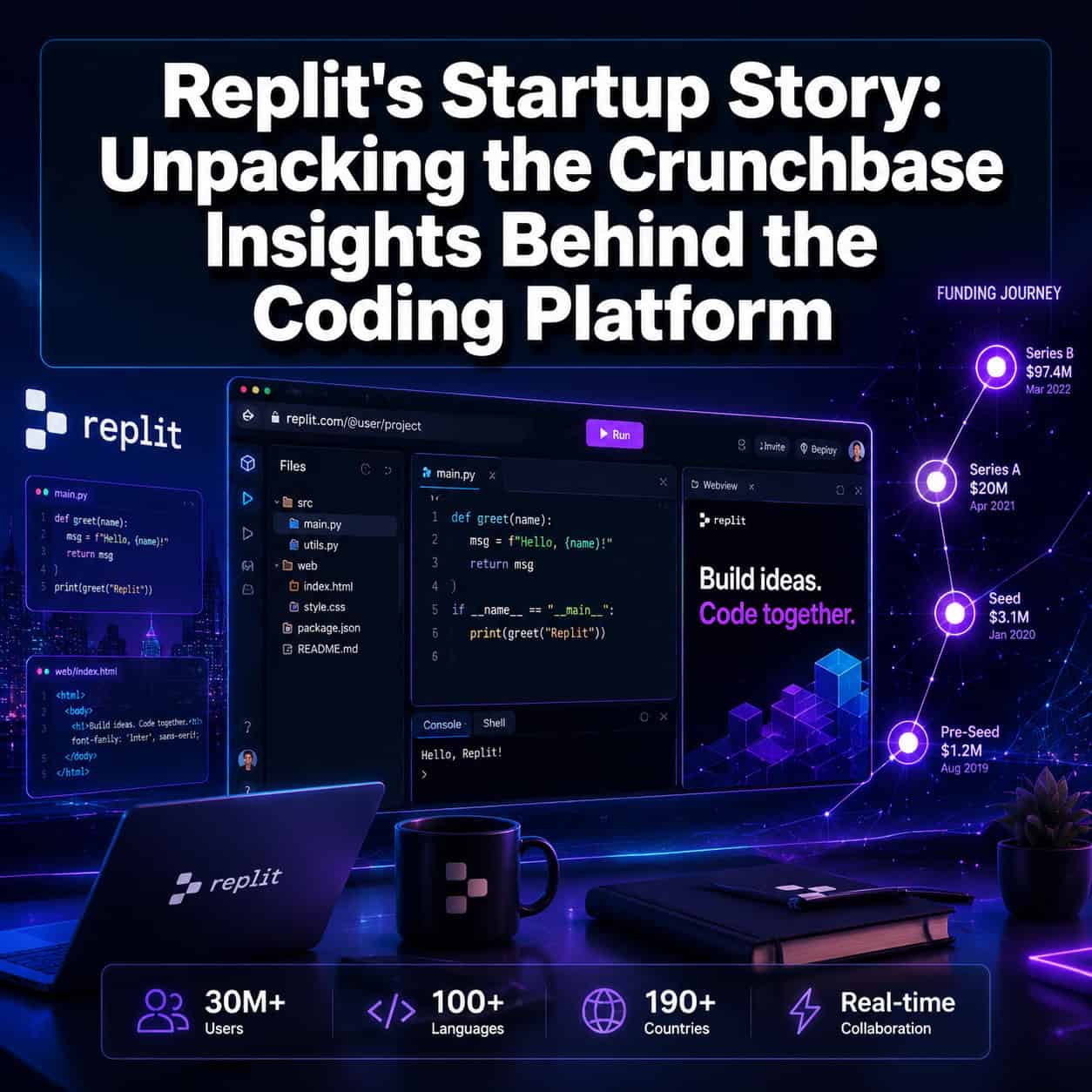
Replit is a browser-based coding platform that raised $400 million in a March 2026 Series D at a $9 billion valuation, tripling its worth in just six months [1][3]. Founded by Amjad Masad after being rejected by Y Combinator three times, the company now tracks toward $1 billion in annual recurring revenue with over 50 million users [10]. Replit’s Startup Story: Unpacking the Crunchbase Insights Behind the Coding Platform reveals how persistence, AI-first product development, and consumption-based pricing turned a simple browser REPL into one of the most valuable developer tools companies in the world.
Key Takeaways
- Replit raised $400M in Series D funding (March 2026) at a $9B valuation, up from $3B just six months earlier [1][4]
- The company was rejected by Y Combinator three times before being accepted
- CEO Amjad Masad told TechCrunch the company tracks toward $1B ARR, up from $2.8M in 2024 [10]
- Agent 4 (launched March 2026) runs 10x faster than its predecessor and supports multi-artifact output [1]
- Sacra estimates Replit hit $150M annualized revenue by September 2025
- Net revenue retention sits at 300%, meaning existing customers spend 3x more over time [10]
- The platform requires zero local setup, running entirely in the browser [8]
- Key competitors include Cursor, GitHub Codespaces, and Taskade Genesis

How Did Replit Get Started and What Were Its Early Struggles?
Replit’s origin traces back to 2011 when Amjad Masad built JSRepl, a JavaScript interpreter that Udacity later used for its online courses. The formal company launched in 2016 with a simple premise: let anyone write and run code directly in a browser without installing anything.
The path wasn’t smooth. According to Contrary Research, Masad applied to Y Combinator three times and was rejected each time before finally gaining acceptance. That persistence shaped the company’s DNA. The early product was basic—a browser-based REPL (Read-Eval-Print Loop) supporting a handful of programming languages [6].
Key early milestones:
- 2011: JSRepl built, adopted by Udacity
- 2016: Replit formally founded
- 2018: Y Combinator acceptance after three rejections
- 2019-2021: Rapid user growth among students and hobbyists
The lesson here is instructive for founders: rejection from top accelerators doesn’t determine a startup’s ceiling. Masad kept building, kept iterating, and eventually created a product that outgrew the accelerator’s initial assessment.
What Does Replit’s Funding History Look Like?
Replit has raised over $700 million in total funding across multiple rounds, with its most recent being a $400 million Series D in March 2026 at a $9 billion valuation [1][3]. This represented a 3x increase from its previous $3 billion valuation just six months prior [4].
| Round | Amount | Valuation | Year |
|---|---|---|---|
| Seed | ~$2.5M | Undisclosed | 2018 |
| Series A | $20M | ~$150M | 2021 |
| Series B | $97.4M | $800M | 2022 |
| Series C | $250M | $3B | 2025 |
| Series D | $400M | $9B | 2026 |
The jump from $3B to $9B in six months is remarkable, but it tracks with the revenue growth. When a company demonstrates 300% net revenue retention and a clear path to $1B ARR, investors respond aggressively [10][1].
If you’re interested in how AI is reshaping development tools broadly, our guide to AI-powered content generation tools covers the wider landscape.
What Makes Replit Different From Other Coding Platforms?
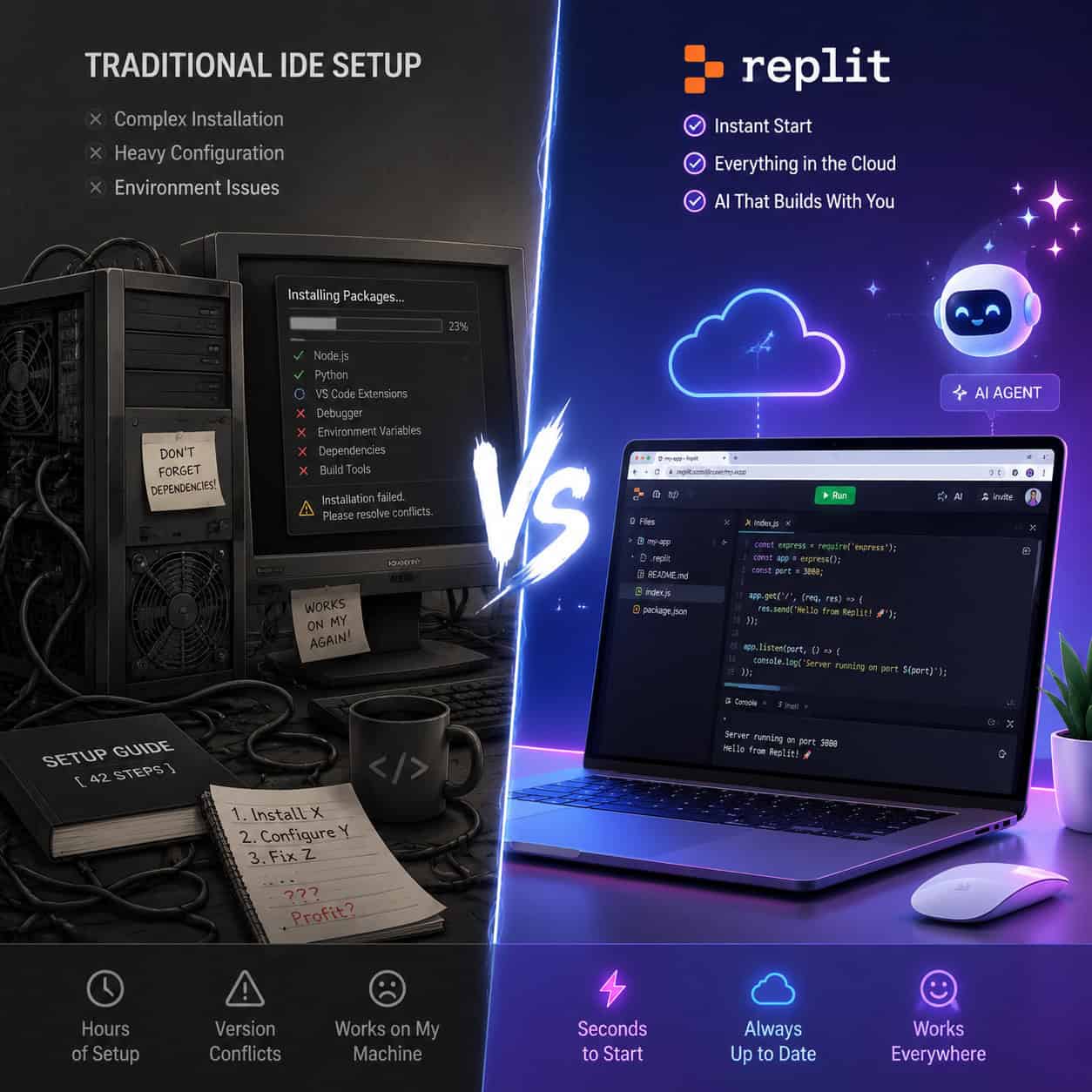
Replit is a fully browser-based development environment that requires zero local setup, combines multiplayer editing with an integrated terminal, and now layers AI agents on top of everything [8]. This makes it fundamentally different from local IDEs like VS Code or even cloud-based alternatives.
Core differentiators:
- No local setup: Everything runs in the browser. No installing dependencies, no environment configuration.
- Multiplayer editing: Multiple developers can code in the same file simultaneously, similar to Google Docs.
- AI-native: Agent 4 can build entire applications from natural language prompts, shipping apps, slides, and videos in parallel [1].
- Consumption pricing: Beyond subscriptions, users pay based on compute consumption, which drives the high net revenue retention.
Till Freitag described Replit in March 2026 as the “all-in-one” platform for AI development, noting its integrated terminal, multiplayer editing, and elimination of local setup requirements [8].
For those exploring no-code and low-code alternatives, check out our list of 11 best no-coding website design software platforms to see how Replit fits into the broader ecosystem.
How Does Replit Compare to Its Main Competitors?
Replit competes with several platforms, each serving slightly different needs. Choose Replit if you want an all-in-one browser environment with AI agents. Choose Cursor if you prefer a local IDE with AI assistance. Choose GitHub Codespaces if you’re already deep in the GitHub ecosystem.
| Platform | Type | Starting Price | Best For |
|---|---|---|---|
| Replit | Browser IDE + AI agents | Free / $25/mo | Full-stack AI-assisted development |
| Cursor | Local AI IDE | $20/mo | Codebase-aware AI editing |
| GitHub Codespaces | Cloud VS Code | $9+/mo + Copilot | GitHub-native workflows |
| Taskade Genesis | No-code AI apps | $6/mo | Non-developers building apps |
| CodeSandbox | Browser dev | Free / $9/mo | Frontend prototyping |
Common mistake: Developers often compare Replit only to traditional IDEs and miss that its real value proposition is the AI agent layer. Agent 4 doesn’t just autocomplete code—it builds entire multi-artifact projects from prompts [1].
If you’re evaluating tools for design-to-development workflows, our Figma to code plugins guide covers another approach to bridging that gap.
What Is Agent 4 and Why Does It Matter?
Agent 4, launched in March 2026, is Replit’s latest AI coding agent that runs 10x faster than Agent 3 and can generate multiple outputs simultaneously—apps, pitch decks, videos, and more [1]. It represents the company’s bet that the future of software development is conversational, not just code-assisted.
Agent 4 capabilities:
- Fluid design canvas for visual development
- Multi-output shipping (apps, slides, videos from a single prompt)
- Team task management built in
- Parallel agent execution for complex projects
- Real-time app monitoring with uptime checks and status bars [7]
The April 2026 changelog enabled updating legacy projects to Agent 4, and by May 2026, the platform added enhanced artifact support for multiple outputs like mobile apps and pitch decks [7].
Ali Ghodsi, CEO of Databricks, praised Replit’s enterprise data integration via Lakebase on March 10, 2026, noting it accelerates the path from idea to production [1].
This AI-first approach connects to broader trends in AI-powered content optimization and AI website creation without code.
What’s Driving Replit’s Revenue Growth?
Replit’s revenue model combines subscriptions with consumption-based pricing, and this dual approach is what drives its extraordinary 300% net revenue retention [10]. Users pay a base subscription, then pay more as their AI agents consume compute resources.
According to Sacra’s April 2026 estimates, Replit hit $150M in annualized revenue by September 2025. CEO Amjad Masad told TechCrunch on May 1, 2026, that the company now tracks toward $1B ARR [10]. For context, the company reported just $2.8M in revenue in 2024.
Revenue growth drivers:
- AI agent consumption pricing (users pay per compute cycle)
- Enterprise adoption via Lakebase data integration [1]
- 50M+ user base converting from free to paid
- Multi-artifact output increasing per-session compute usage
Masad has stated he prefers not to sell the company and is actively suing Apple over App Store-related issues [10].

Who Should Use Replit in 2026?
Choose Replit if:
- You want to go from idea to deployed app without any local setup
- You’re a non-developer who wants AI to build software for you
- Your team needs real-time collaborative coding
- You want one platform for apps, presentations, and prototypes
Replit may not be ideal if:
- You need full control over your development environment
- You’re working on large enterprise codebases with strict security policies
- You prefer offline development capability
- You need specialized IDE features for languages like Rust or C++
For teams already using design tools and looking to streamline their workflows, our no-code platform archives and automation guides offer complementary strategies.
Conclusion
Replit’s Startup Story: Unpacking the Crunchbase Insights Behind the Coding Platform shows a company that turned repeated rejection into a $9 billion valuation through relentless iteration and an early bet on AI-native development. The numbers tell a clear story: from $2.8M to a projected $1B ARR in roughly two years, powered by a consumption model that makes customers spend more as they get more value.
Actionable next steps:
- Try Replit’s free tier to test Agent 4’s capabilities on a small project
- Compare it against Cursor or Codespaces if you’re evaluating AI coding tools for your team
- Watch the enterprise play—Lakebase integration signals Replit is moving upmarket
- Track the $1B ARR milestone—if achieved by end of 2026, expect another valuation jump
Whether you’re a founder studying growth patterns, a developer choosing tools, or an investor tracking the AI infrastructure space, Replit’s trajectory offers concrete lessons about timing, persistence, and the power of platform-level AI integration.
FAQ
How much total funding has Replit raised? Over $700 million across all rounds, with the most recent being a $400M Series D in March 2026 [1][3].
What is Replit’s current valuation? $9 billion as of the March 2026 Series D, up 3x from $3 billion six months prior [4].
Who founded Replit? Amjad Masad founded Replit. He previously built JSRepl in 2011 and formally launched the company in 2016 [6].
Is Replit profitable? Replit has not publicly confirmed profitability. The company tracks toward $1B ARR but is still in growth-investment mode [10].
What is Agent 4? Agent 4 is Replit’s March 2026 AI coding agent that runs 10x faster than its predecessor and can generate multiple outputs (apps, decks, videos) simultaneously [1].
How much does Replit cost? Replit offers a free tier, with paid plans starting at approximately $25/month. Additional costs come from consumption-based compute pricing.
Can non-developers use Replit? Yes. Agent 4 accepts natural language prompts and can build complete applications without the user writing code directly.
What is Replit’s net revenue retention? 300%, meaning existing customers spend 3x more over time on average [10].
How many users does Replit have? Over 50 million users as of 2026, according to Sacra estimates.
Is Replit planning an IPO? CEO Amjad Masad told TechCrunch in May 2026 that he prefers not to sell the company, but has not confirmed specific IPO plans [10].
References
[1] Replit Raises 400 Million Dollars – https://blog.replit.com/replit-raises-400-million-dollars [3] Funding Announcement – https://replit.com/news/funding-announcement [4] Replit Raises 400m At 9b Valuation – https://fnex.com/replit-raises-400m-at-9b-valuation/ [6] The History Of Replit – https://rpltbldrs.com/p/the-history-of-replit [7] Replit – https://releasebot.io/updates/replit [8] Replit 2026 Platform En – https://till-freitag.com/blog/replit-2026-platform-en [10] Replits Amjad Masad On The Cursor Deal Fighting Apple And Why Hed Rather Not Sell – https://techcrunch.com/2026/05/01/replits-amjad-masad-on-the-cursor-deal-fighting-apple-and-why-hed-rather-not-sell/