Last updated: May 7, 2026
Quick Answer: Character AI apps are software tools that use artificial intelligence to generate, animate, and give personality to digital characters — cutting design time from weeks to minutes. As of 2026, platforms like Character.ai report over 25 million active users and 18 million chatbot personalities [6], making AI-assisted character creation one of the fastest-growing areas in digital design. Whether you’re a game developer, content creator, or marketer, these tools are now accessible without a professional art background.
Key Takeaways
- Character AI apps let anyone create detailed digital characters using text prompts, style selectors, and AI generation — no drawing skills required.
- Character.ai, built by former Google LaMDA engineers, hosts over 18 million unique chatbot personalities and serves 25 million active users [6].
- AI character design tools have reduced creation time from weeks to minutes, according to multiple platform reports [5].
- Top tools in 2026 include Character.ai, Midjourney, Adobe Firefly, Artbreeder, Ready Player Me, and Reallusion.
- These apps serve game developers, filmmakers, educators, marketers, and social media creators.
- Key features to compare: style range, consistency across outputs, animation support, export formats, and pricing.
- Ethical considerations — including consent, copyright, and deepfake risk — are real concerns that users must understand before deploying AI characters commercially.
- Character.ai’s official roadmap includes enhanced memory, improved character consistency, and more immersive storytelling features [3].

What Are Character AI Apps and Why Are They Growing So Fast?
Character AI apps are digital tools that use machine learning models to create, customize, and animate characters — from chatbot personas to fully rendered 3D avatars. They’re growing fast because they dramatically lower the skill and time barrier for character creation.
Before AI tools, building a believable digital character required concept artists, 3D modelers, riggers, and animators working across weeks or months. Now, a single creator can generate a consistent, expressive character in minutes using a text prompt or a few slider adjustments.
The numbers back this up. Character.ai alone — one of the most prominent platforms in this space — was built by Noam Shazeer and Daniel de Freitas, the engineers behind Google’s LaMDA conversational AI [1]. That pedigree helped it scale to 25 million active users and 18 million distinct chatbot personalities [6]. That’s not just a chatbot platform — it’s a character creation ecosystem.
The broader market includes image-based character generators (Midjourney, Adobe Firefly), 3D avatar tools (Ready Player Me, Reallusion), and personality-driven chatbot builders (Character.ai, Replika). Each solves a different part of the character creation problem, and together they represent the full scope of what “Character AI Apps: Revolutionizing Digital Character Creation” actually means in practice.
Why the growth? Three factors:
- Accessibility: You don’t need a design degree.
- Speed: Iterations that took days now take seconds.
- Cost: Many tools offer free tiers or low monthly subscriptions versus hiring a full creative team.
How Do the Top Character AI Apps Compare in 2026?
The best tool depends entirely on what you’re building. Here’s a direct comparison of the leading platforms:
| App | Best For | Key Strength | Free Tier | Starting Price (est.) |
|---|---|---|---|---|
| Character.ai | Chatbot personas, roleplay | Personality depth, 18M+ characters [6] | Yes | ~$9.99/mo (c.ai+) |
| Midjourney | Concept art, 2D characters | Visual quality, style range | No | ~$10/mo |
| Adobe Firefly | Brand-safe commercial use | Licensed training data, Creative Cloud integration | Limited | Included in CC plans |
| Artbreeder | Portrait blending, variation | Genetic-style mixing of traits | Yes | ~$8.99/mo |
| Ready Player Me | Cross-platform 3D avatars | Game/metaverse compatibility | Yes | Free + API pricing |
| Reallusion | Animated 3D characters | Full animation pipeline | Trial only | ~$299 one-time |
Choose Character.ai if you need a character that can hold a conversation, maintain a personality, and interact with users in real time.
Choose Midjourney or Adobe Firefly if you need high-quality visual character art for marketing, publishing, or concept work.
Choose Ready Player Me or Reallusion if you’re building a game, VR experience, or animated video that needs a rigged, moveable character.
For teams already using design tools, it’s worth exploring how AI graphic design tools fit into broader creative workflows — character generation is often just one piece of a larger visual production pipeline.

How Does the Character AI App Creation Process Actually Work?
Creating a character with an AI app typically follows five stages, regardless of which platform you use.
Step 1: Define your character’s purpose Before opening any app, decide: Is this a visual character (for art, games, marketing)? A conversational character (chatbot, virtual assistant)? Or both? This determines which tool you need.
Step 2: Write a prompt or fill a profile Most tools start with text input. For visual tools like Midjourney, you describe appearance, style, and mood. For Character.ai, you write a character description, personality traits, and example dialogue [9].
Step 3: Generate and review The AI produces an initial output. Expect to iterate — first generations are starting points, not final products.
Step 4: Customize and refine Adjust sliders, add style modifiers, tweak personality settings, or use inpainting (for image tools) to fix specific elements. Character.ai’s roadmap specifically targets improved character consistency and reduced repetition at this stage [3].
Step 5: Export and deploy Export in the format your project needs — PNG/SVG for 2D art, GLB/FBX for 3D models, or embed code for chatbot characters.
Common mistake: Skipping Step 1. Users who jump straight into generation without a clear purpose end up with characters that look good but don’t serve a function — which means starting over.
This workflow mirrors how Canva’s AI design tools handle visual creation: prompt, generate, refine, export. The mental model transfers well across platforms.
What Are the Real Benefits of Character AI Apps: Revolutionizing Digital Character Creation?
The core benefits are speed, cost reduction, and democratization of creative work. But there are also less obvious advantages worth knowing.
Speed: Character design time has dropped from weeks to minutes with AI tools [5]. For indie developers or solo content creators, this is the difference between shipping a project and abandoning it.
Cost: Hiring a concept artist for a single character can cost $500–$5,000+ depending on complexity and revisions. Most AI character tools cost under $30/month for unlimited generations.
Consistency: AI tools can maintain visual consistency across a character’s expressions, outfits, and poses — something that’s genuinely hard to achieve manually across a large project.
Iteration speed: You can test 20 visual directions in the time it used to take to brief a single one. This changes how creative decisions get made.
Accessibility for non-designers: Educators building course materials, marketers creating brand mascots, and developers prototyping game characters can now do this work themselves. For teams building digital content at scale, this connects directly to broader AI-powered content generation strategies.
Less obvious benefit — rapid localization: AI character tools can quickly adapt a character’s appearance for different cultural markets, adjusting skin tone, clothing, and style without starting from scratch.

What Are the Limitations and Risks You Should Know?
Character AI apps have real limitations. Knowing them upfront saves time and avoids costly mistakes.
Visual consistency across sessions: Most image-based AI tools struggle to reproduce the exact same character twice without careful prompting or reference images. This is a known challenge that platforms like Character.ai are actively addressing in their roadmap [3].
Copyright and ownership ambiguity: The legal status of AI-generated character art is still unsettled in most jurisdictions as of 2026. Adobe Firefly is currently the clearest option for commercial use because it’s trained on licensed content.
Personality drift in chatbots: Conversational AI characters can give inconsistent responses over long sessions. Character.ai’s roadmap lists increased memory and context limits as a priority fix [3].
Ethical concerns:
- AI characters can be used to impersonate real people.
- Deepfake-adjacent risks exist when characters are made to look like specific individuals.
- Some platforms have faced scrutiny over user interactions with AI personas, particularly involving minors [4].
The learning curve is real: Free tiers often produce mediocre results without prompt engineering skills. Getting good outputs consistently takes practice.
Edge case: If you’re building a character for a regulated industry (healthcare, finance, education for minors), check each platform’s terms of service carefully. Some AI character tools prohibit commercial use in specific sectors.
Who Should (and Shouldn’t) Use Character AI Apps?
Good fit:
- Indie game developers who need character assets without a full art team
- Content creators building YouTube or social media personas
- Marketers creating brand mascots or explainer video characters
- Educators developing interactive learning materials
- Writers and worldbuilders visualizing fictional characters
- Developers building customer-facing chatbots with distinct personalities
Poor fit:
- Projects requiring legally defensible IP ownership (consult a lawyer first)
- High-fidelity character animation for AAA games or major film productions (AI tools still can’t match a dedicated animation studio)
- Anyone needing guaranteed visual consistency across hundreds of scenes without significant manual oversight
For teams building web-based character experiences, integrating an AI character into a website is a related challenge — see this guide on integrating AI-powered chatbots into WordPress for the technical side of deployment.

How Are Character AI Apps: Revolutionizing Digital Character Creation Across Industries?
The impact of character AI apps extends well beyond gaming and entertainment. Here’s where the shift is most visible in 2026:
🎮 Gaming: Indie studios use AI character generators to prototype and populate game worlds faster. Tools like Ready Player Me create cross-platform avatars that work in multiple game engines simultaneously.
🎬 Film and animation: Pre-visualization teams use AI character tools to concept characters before committing to expensive production assets. This shortens pre-production timelines significantly.
📚 Education: Educators build interactive AI tutors and historical figures that students can “talk to.” This is one of the fastest-growing use cases on platforms like Character.ai [4].
🛒 E-commerce and marketing: Brands create AI brand ambassadors — consistent visual characters that appear across ads, social posts, and websites. This is especially useful for social media graphic design where visual consistency matters.
🧑💻 UX and product design: Product teams build onboarding characters and virtual assistants with distinct personalities to improve user engagement. This connects to broader AI website creation trends where personality-driven interfaces are becoming standard.
Mental health and companionship apps: Several platforms use AI character technology to build supportive companions. This is also the most ethically complex application, with ongoing debate about appropriate boundaries and user safety [4].
What Does the Future of AI Character Creation Look Like?
The next 12–24 months will bring significant improvements to character AI apps, based on announced roadmaps and current development trends.
Character.ai’s official roadmap [3] includes:
- Increased memory and context limits — characters will remember longer conversation histories
- More immersive conversations and stories — richer narrative capabilities
- Improved character consistency — less drift in personality and visual representation
- Reduced repetition — better response variety over long interactions
Beyond Character.ai, the broader industry is moving toward:
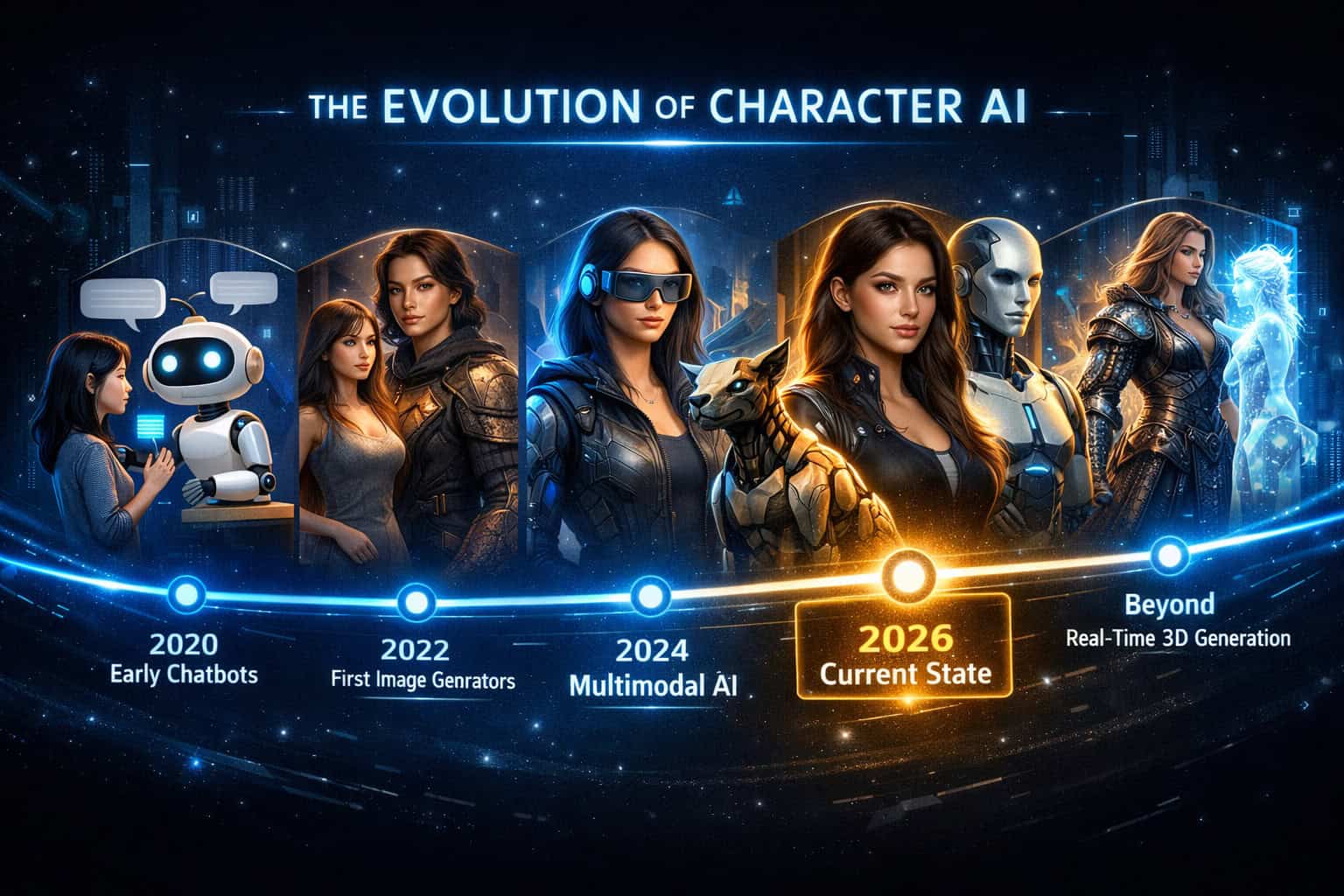
- Real-time 3D generation — creating fully rigged, animatable characters from a single text prompt
- Multimodal characters — characters that can see, hear, and respond to video input, not just text
- Cross-platform character portability — one character definition that works across games, web apps, and social platforms
- Tighter IP controls — clearer ownership frameworks as legal standards catch up to the technology
The convergence of visual generation, conversational AI, and animation is the defining trend. Within a few years, “creating a character” may mean generating a complete interactive entity — visuals, voice, personality, and memory — in a single workflow.
Frequently Asked Questions
Q: Is Character.ai free to use? Yes, Character.ai has a free tier. The paid plan (c.ai+) removes wait times and adds priority access. The free version is functional for most casual users [7].
Q: Can I use AI-generated characters commercially? It depends on the platform. Adobe Firefly is currently the safest choice for commercial use because it’s trained on licensed content. Always check each platform’s terms of service before using generated characters in paid work.
Q: Who built Character.ai? Character.ai was created by Noam Shazeer and Daniel de Freitas, the engineers who originally developed Google’s LaMDA conversational AI technology [1].
Q: How many characters exist on Character.ai? As of the most recent data, Character.ai hosts over 18 million chatbot personalities created by users and the platform itself, with 25 million active users [6].
Q: What’s the difference between a character AI app and a regular chatbot? A regular chatbot is typically designed for a specific task (customer service, FAQ answering). A character AI app lets you define a specific personality, backstory, and communication style — the character feels like a distinct entity, not a generic assistant.
Q: Can AI character apps create 3D models? Some can. Ready Player Me and Reallusion specialize in 3D character creation. Most image-based tools (Midjourney, Firefly) produce 2D art that can be used as reference for 3D modeling but don’t output 3D files directly.
Q: How do I keep my AI character visually consistent across multiple images? Use the same detailed prompt, seed number (where available), and reference images. Some tools like Midjourney offer a “character reference” feature specifically for this. Consistency is still one of the harder problems in AI image generation.
Q: Are there age restrictions for using Character.ai? Character.ai requires users to be 13 or older, with additional restrictions for users under 18. The platform has faced scrutiny over safety measures for younger users [4].
Q: What file formats do AI character tools export? It varies by tool. Image generators export PNG, JPG, or SVG. 3D tools export GLB, FBX, or OBJ. Chatbot characters are typically deployed via API or embed code rather than exported as files.
Q: How much does it cost to create a professional AI character? For a visual character, expect $0–$30/month using AI tools versus $500–$5,000+ for a commissioned human artist. For a conversational character with a custom personality, most platforms are free to start with paid plans under $20/month.
Conclusion: Where to Start With Character AI Apps
Character AI apps have genuinely changed what’s possible for individual creators and small teams. The combination of speed, accessibility, and improving quality means there’s no longer a strong argument for avoiding these tools — only for choosing the right one for your specific need.
Actionable next steps:
- Define your use case first. Visual character? Conversational persona? 3D avatar? This determines your tool.
- Start with a free tier. Character.ai, Artbreeder, and Ready Player Me all offer free access. Test before committing to a paid plan.
- Learn prompt engineering basics. The quality gap between a weak prompt and a strong one is significant. Spend 30 minutes reading each platform’s prompting guide.
- Check commercial terms before publishing. If you’re using AI characters in paid work, verify the platform’s licensing terms.
- Plan for consistency from the start. Save your prompts, seeds, and reference images in a project file. Rebuilding a character from scratch later is frustrating and time-consuming.
- Stay current on the roadmap. Character.ai and other platforms are updating rapidly [3]. Features that don’t exist today may solve your current problems in 3–6 months.
The tools covered here are the best available in 2026, but the space is moving fast. The creators who build the strongest workflows now will have a real advantage as the technology continues to improve.
References
[1] Character – https://en.wikipedia.org/wiki/Character.ai [2] Ai Character Design 2026 – https://digitalsynopsis.com/design/ai-character-design-2026/ [3] Roadmap – https://blog.character.ai/roadmap/ [4] Character Ai – https://www.elegantthemes.com/blog/business/character-ai [5] Best Ai Character Generator – https://ltx.studio/blog/best-ai-character-generator [6] Character Ai Statistics – https://www.businessofapps.com/data/character-ai-statistics/ [7] Details – https://play.google.com/store/apps/details?id=ai.character.app&hl=en_US [9] blog.character.ai – https://blog.character.ai