Last updated: May 11, 2026
Quick Answer
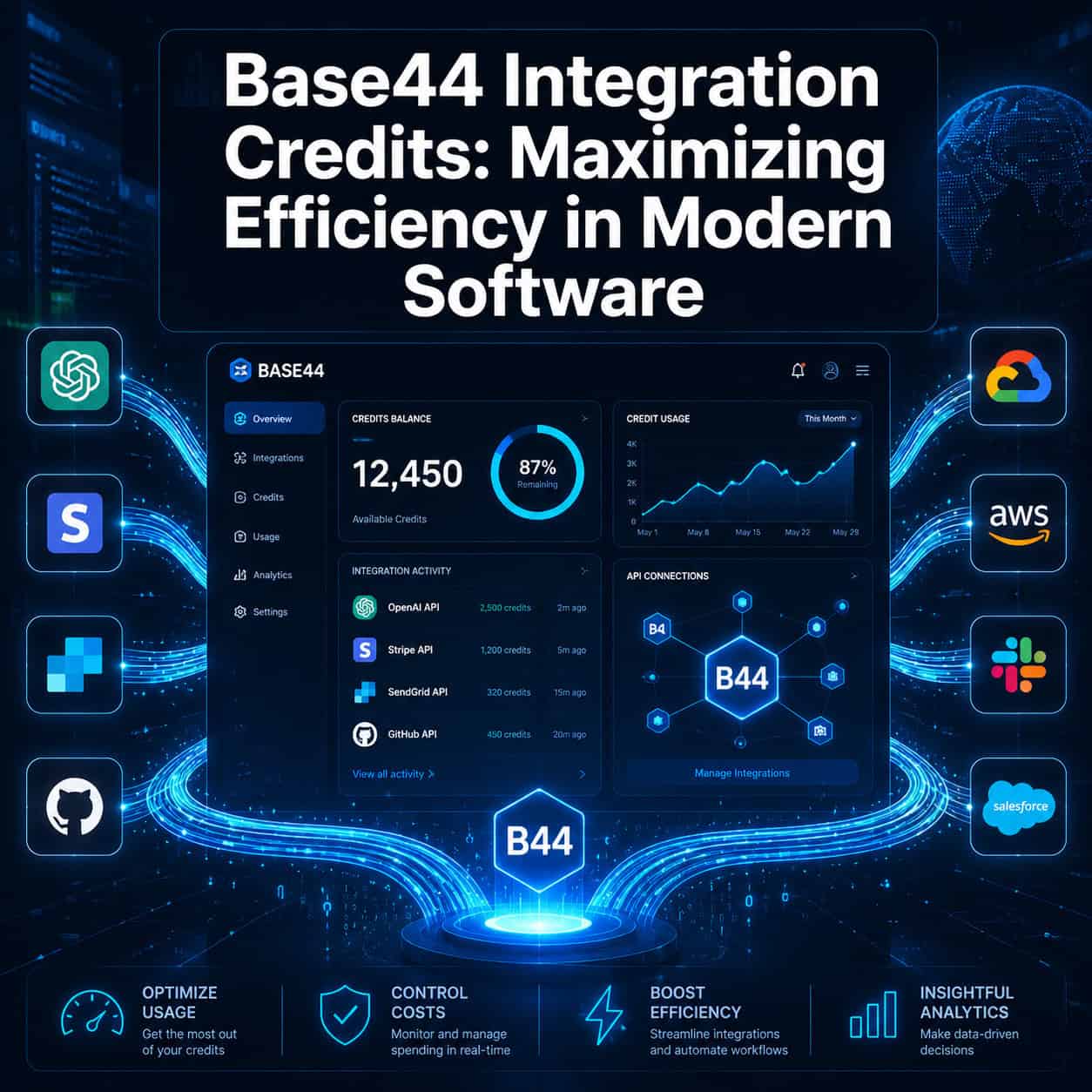
Base44 integration credits are consumption units that power advanced functionality like LLM calls, file operations, and PDF generation within the Base44 no-code platform. Each integration action costs 1 credit by default, though complex operations may consume more [4]. Understanding how these credits work—and how to conserve them—is the difference between a project that scales smoothly and one that hits a wall mid-month.
Key Takeaways
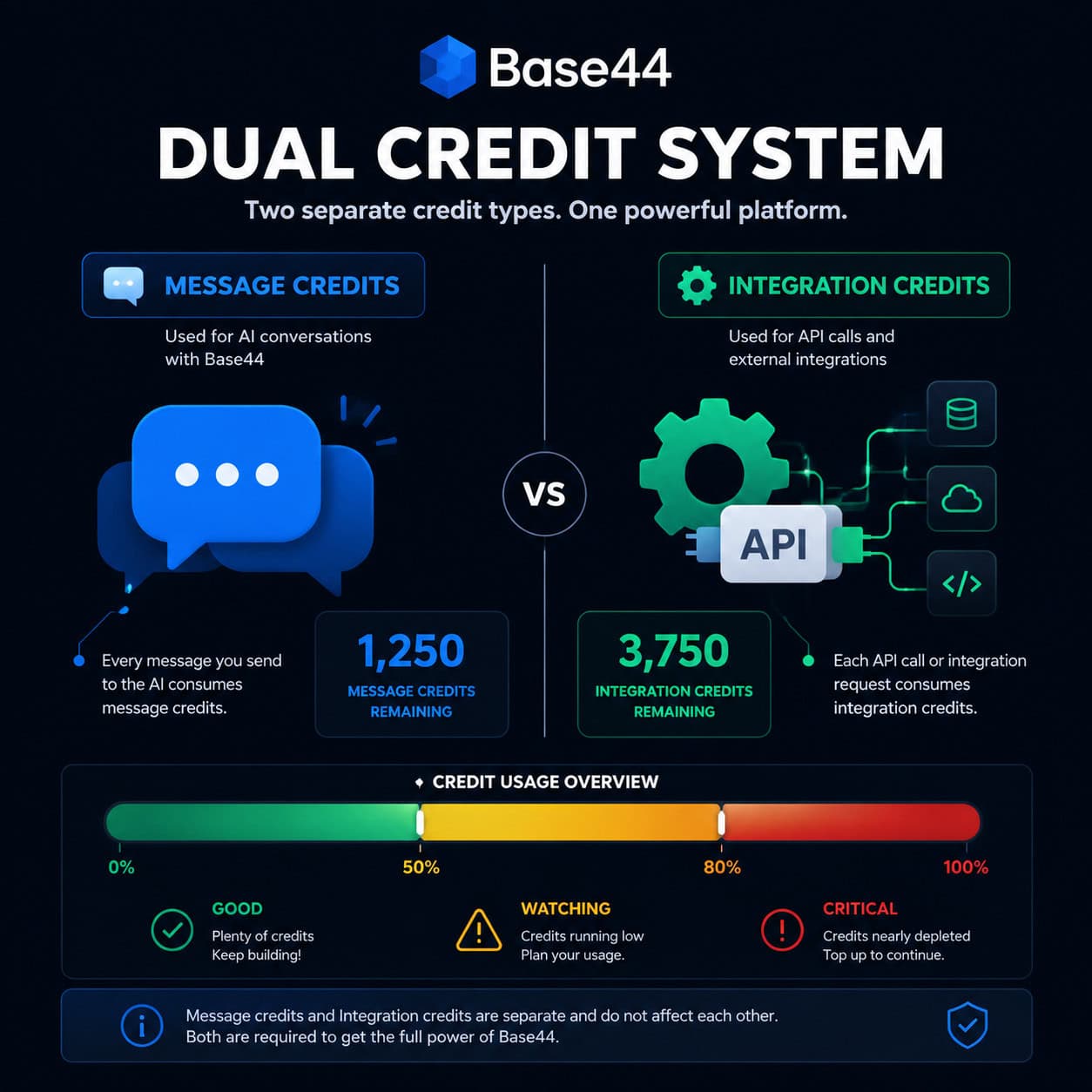
- Integration credits are separate from message credits. Base44 uses a dual-credit system: message credits for AI-assisted building, integration credits for runtime operations [7].
- Each integration action (LLM call, file operation, external API request) costs at least 1 credit [4].
- Complex AI generations consume more credits due to underlying token abstraction [7].
- Teams share a workspace credit pool, which means one heavy builder can drain credits for everyone [8].
- You can earn 20 free credits by sharing Base44 on LinkedIn or X [1].
- Backend functions for custom services can bypass credit consumption entirely [4].
- Real-time tracking is available on the Base44 dashboard, and monitoring it regularly prevents surprise overages [8].
- Alternatives like Zite and Glide avoid per-integration credit costs but trade off other capabilities [6].
- No option currently exists to buy one-time credit top-ups without upgrading your plan (as of May 2026).
- Prompt discipline directly reduces credit drain—vague or overly complex prompts cost more [7].
What Are Base44 Integration Credits and How Do They Work?
Integration credits are the currency Base44 charges for runtime actions your app performs after it’s built. Every time your application calls an LLM, generates a PDF, processes a file, or hits an external API, it spends integration credits from your monthly allocation [4].
This is distinct from message credits, which you spend during the building phase when interacting with Base44’s AI assistant to generate or modify your app. The dual-credit system means you need to budget for both development and production separately [7].
How credits are consumed:
| Action Type | Approximate Credit Cost | Notes |
|---|---|---|
| LLM call (simple) | 1 credit | Basic text generation [4] |
| LLM call (complex) | 2-4+ credits | Multi-step or long-context prompts [7] |
| File operation | 1 credit | Upload, transform, or store [4] |
| PDF generation | 2-4 credits | Per user interaction [2] |
| External API request | 1 credit | Each outbound call [4] |
Common mistake: Assuming all actions cost the same. Complex AI generations use more tokens under the hood, which translates to higher credit consumption even if the dashboard shows a single action [7].
Why Does Base44 Use a Credit System Instead of Unlimited Access?
The credit system exists to ensure fair resource distribution across users sharing the same infrastructure [4]. Without consumption limits, a single user running thousands of LLM calls could degrade performance for everyone else on the platform.
Base44 positions this as a scalability feature rather than a restriction. The Cybernews review from May 2026 called it a “strength for scaling” because it forces developers to think about efficiency from day one [3]. But it’s also a business model choice—credits create predictable revenue and prevent abuse of expensive AI model calls.
Choose credits if: You’re building apps with moderate, predictable integration usage and want the speed of Base44’s AI-assisted development.
Avoid credits if: Your app requires high-volume, unpredictable API calls in production. In that case, platforms like Zite ($15/month with no per-integration costs) or self-hosted alternatives may be more cost-effective [6].
For teams exploring no-code website design platforms, understanding these trade-offs early prevents costly migrations later.
How Can You Track and Monitor Your Credit Usage?
Base44 provides real-time credit tracking through its dashboard [8]. You can see how many credits remain in your monthly allocation, which actions consumed the most, and how your team’s shared pool is being distributed.
Steps to monitor effectively:
- Check the dashboard daily during active development sprints
- Set informal thresholds (e.g., if you’ve used 50% of credits by mid-month, audit your integrations)
- Identify high-cost actions by reviewing which app features trigger the most credit consumption
- Track per-team-member usage since workspace pools are shared [8]
Edge case: The May 6, 2026 Reddit thread reported temporary platform downtime that affected credit monitoring visibility. While resolved quickly, this highlights why you should screenshot or export usage data periodically rather than relying solely on real-time dashboards [2].
If you’re also managing AI-powered content generation tools, tracking consumption across multiple platforms becomes even more critical.
What Strategies Reduce Integration Credit Consumption?
The most effective strategy is prompt discipline combined with architectural choices that bypass the credit system where possible.
Proven credit-saving techniques:
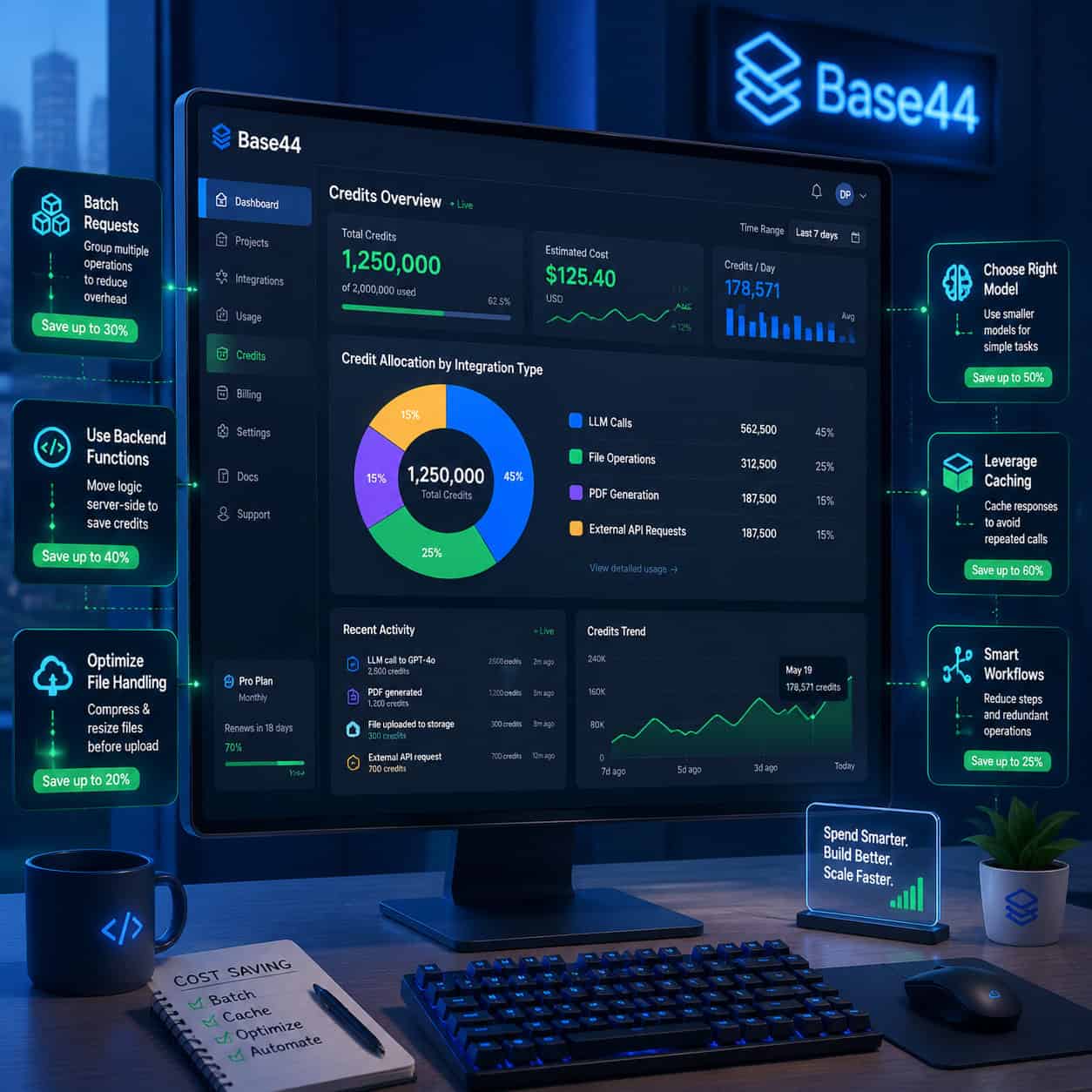
- Write specific, constrAIned prompts. Vague prompts force the AI to generate longer, more complex responses that consume more tokens (and therefore more credits) [7].
- Use backend functions for custom services. Certifiedcode.us specifically recommends this approach to bypass credit consumption entirely for operations you can handle with your own code [4].
- Batch operations where possible. Instead of making five separate LLM calls, structure your logic to combine them into fewer, more efficient requests.
- Cache responses. If multiple users trigger the same integration with identical inputs, store the result and serve it without spending another credit.
- Choose the right plan tier. Higher-tier plans offer more credits per month, and the per-credit cost decreases at scale [9].
Decision rule: If an integration action happens more than 100 times per day with similar inputs, build a caching layer or backend function instead of consuming credits each time.
Teams working on AI-powered content optimization will recognize this pattern—the same efficiency principles apply across AI-consumption platforms.
How Do You Earn Free Integration Credits?
Base44 offers 20 free credits (including integration types) when you share the platform on LinkedIn or X [1]. This is a minor incentive, but it’s worth claiming during the early stages of a project when you’re still testing integration patterns.
Current ways to earn credits (as of May 2026):
- Share Base44 on LinkedIn: up to 20 credits [1]
- Share Base44 on X (Twitter): up to 20 credits [1]
- Referral programs (check current terms on Base44’s pricing page) [9]
What’s not available yet: One-time credit purchases without a plan upgrade. User feedback from May 5, 2026 specifically requested this feature, but Base44 hasn’t implemented it [2]. If you hit your limit mid-month, your only current option is upgrading to a higher plan tier.
How Does Base44’s Credit System Compare to Alternatives?
Base44’s credit model is consumption-based, which contrasts sharply with platforms offering flat-rate or unlimited approaches.
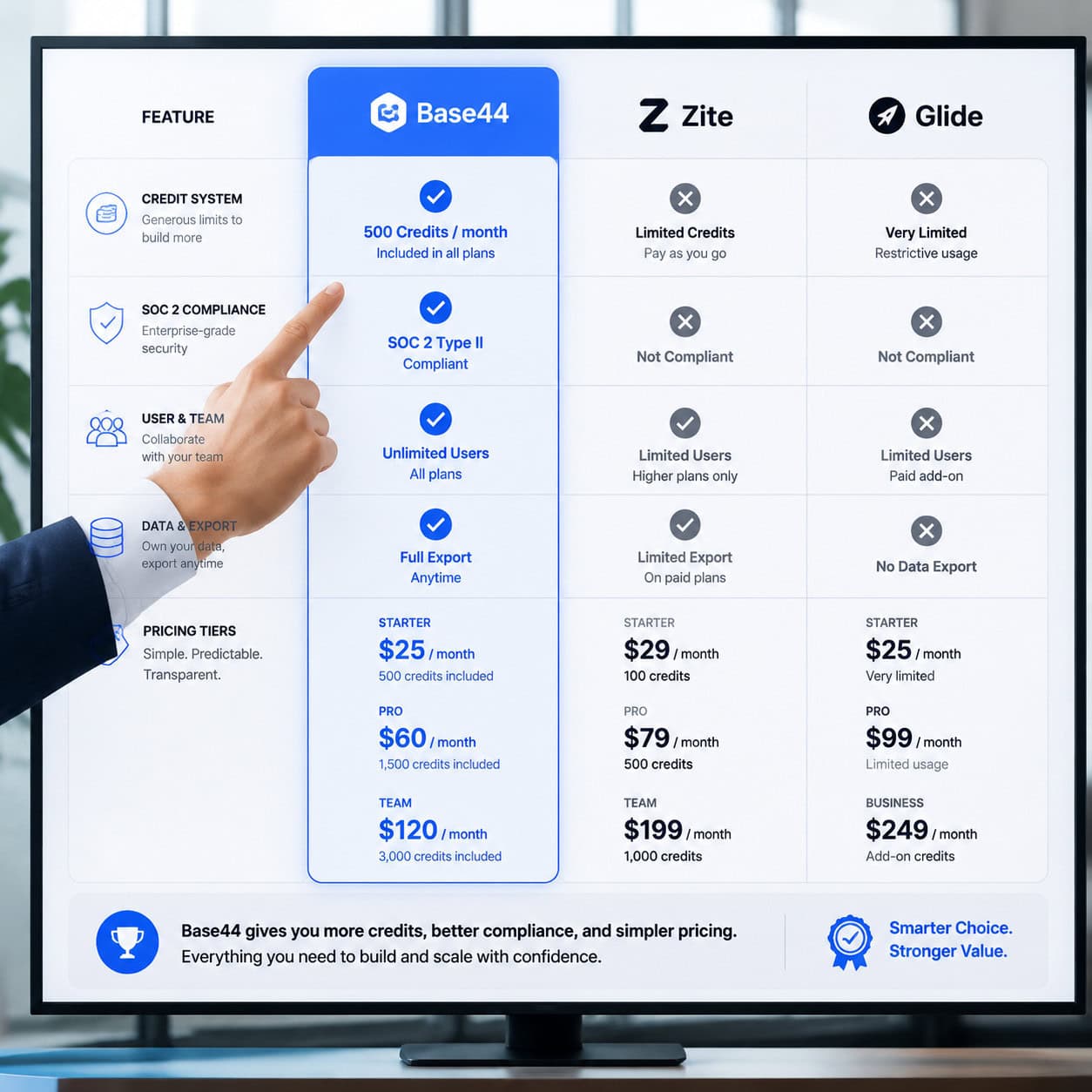
| Platform | Pricing Model | Integration Limits | Best For |
|---|---|---|---|
| Base44 | Monthly credits (tiered) | Per-action consumption [4] | AI-heavy apps with moderate usage |
| Zite | $15/month flat | No per-integration costs | Production-ready apps needing SOC 2 [6] |
| Glide | Subscription-based | No credit limits | Business apps needing predictable costs |
| Self-hosted | Infrastructure costs | Unlimited (you pay for compute) | High-volume, custom applications |
Key differences:
- Zite offers SOC 2 compliance and multi-source data handling without consumption fees, making it stronger for enterprise use cases [6].
- Glide avoids what they call “fragile prompts or credit limits,” giving developers more control over business logic without AI dependency [6].
- Base44 excels when you want rapid AI-assisted development and your production usage stays within predictable bounds [8].
For those building with Webflow or similar platforms, the credit model may feel unfamiliar. Traditional web builders charge for hosting and bandwidth, not per-feature-execution.
What Are the Biggest Mistakes Teams Make with Integration Credits?
Mistake #1: Ignoring the shared workspace pool. When multiple team members build simultaneously, credits drain faster than any individual expects [8]. Assign credit budgets per project or feature to prevent conflicts.
Mistake #2: Not distinguishing message credits from integration credits. Teams often burn through message credits during development and then realize they’ve underestimated integration credit needs for production [7].
Mistake #3: Over-relying on AI for operations that don’t need it. Not every database query or file operation needs to pass through Base44’s AI layer. Use direct integrations or backend functions when the AI adds no value [4].
Mistake #4: Failing to test credit consumption before launch. Run your app through realistic usage scenarios and multiply by expected user count. A feature costing 3 credits per interaction with 500 daily users means 1,500 credits per day—just for that one feature.
If you’re integrating AI chatbots into WordPress or similar systems, the same principle applies: estimate per-interaction costs before going live.
Who Should and Shouldn’t Use Base44’s Credit-Based System?
Good fit:
- Solo developers or small teams building MVPs
- Apps with predictable, moderate integration usage
- Projects where AI-assisted development speed outweighs per-action costs
- Prototypes that may migrate to self-hosted infrastructure later
Poor fit:
- High-volume production apps with thousands of daily API calls
- Teams requiring SOC 2 or enterprise compliance (consider Zite) [6]
- Projects where per-action cost unpredictability creates budget risk
- Apps where users trigger integrations frequently (e.g., real-time chat with AI)
Teams exploring advanced WordPress automation strategies or AI SEO tools may find that combining Base44 for rapid prototyping with a more predictable platform for production offers the best of both worlds.
FAQ
Q: How many integration credits do I get per month on Base44? A: It depends on your plan tier. Check Base44’s pricing page for current allocations, as these change with plan updates [9].
Q: Can I buy extra credits without upgrading my plan? A: Not currently. As of May 2026, users have requested this feature but it hasn’t been implemented [2].
Q: Do integration credits roll over to the next month? A: Base44’s standard policy does not include rollover. Unused credits expire at the end of your billing cycle [1].
Q: What happens when I run out of integration credits? A: Your app’s integration-dependent features stop working until credits refresh or you upgrade your plan [8].
Q: Are integration credits shared across team members? A: Yes. Teams share a workspace credit pool, so one member’s heavy usage affects everyone [8].
Q: Can I reduce credit usage by using my own API keys? A: In some cases, using backend functions with your own API keys bypasses Base44’s credit system entirely [4].
Q: Do all LLM calls cost the same number of credits? A: No. Complex prompts with longer outputs consume more credits due to token-based pricing underneath [7].
Q: Is there a way to see which specific actions used my credits? A: Base44’s dashboard provides real-time tracking with action-level detail [8].
Q: How do free credits from social sharing work? A: Share Base44 on LinkedIn or X to earn up to 20 free credits. These are one-time bonuses [1].
Q: Are integration credits the same as API rate limits? A: No. Credits are a billing mechanism, not a rate limit. You can use credits as fast as the platform allows, but once they’re gone, they’re gone until renewal [4].
Conclusion
Maximizing efficiency with Base44 integration credits comes down to three actions: understand the dual-credit system, monitor usage proactively, and architect your app to minimize unnecessary credit consumption.
Your next steps:
- Audit your current usage on the Base44 dashboard today
- Identify your top 3 credit-consuming features and evaluate whether backend functions or caching could reduce costs
- Claim your free 20 credits via social sharing if you haven’t already
- Set a mid-month usage threshold and review it weekly
- Evaluate whether your production needs justify Base44’s model or if an alternative like Zite better fits your scale
The credit system isn’t inherently good or bad—it’s a constraint that rewards efficient design. Teams who plan for it from the start build better, leaner applications. Those who ignore it hit walls at the worst possible time.
References
[1] Credits – https://docs.base44.com/Account-and-billing/Credits [2] Whats The Purpose Of Integration Credits – https://www.reddit.com/r/Base44/comments/1okz4l3/whats_the_purpose_of_integration_credits/ [3] Watch – https://www.youtube.com/watch?v=SjO3oqSwksE [4] What Are Integration Credits In Base44 And How Do They Work – https://www.certifiedcode.us/resources/article/what-are-integration-credits-in-base44-and-how-do-they-work [6] Base44 Explained How It Works Key Features And Top Alternatives 84l – https://dev.to/nithya_iyer/base44-explained-how-it-works-key-features-and-top-alternatives-84l [7] Base44 Pricing And Credits – https://www.banani.co/blog/base44-pricing-and-credits [8] Base44 Credits Explained – https://www.lowcode.agency/blog/base44-credits-explained [9] Pricing – https://base44.com/pricing