Last updated: May 30, 2026
Quick Answer: ElevenLabs is a voice AI company that produces some of the most realistic synthetic speech available in 2026, supporting up to 74 languages across multiple model families. With an estimated $500M in annual recurring revenue and an $11B valuation after its Series D round, ElevenLabs has grown from a text-to-speech API into a full conversational AI platform used by over 41% of Fortune 500 companies [7][10].
Key Takeaways
- ElevenLabs offers text-to-speech, voice cloning, and conversational AI agents with synthesis latency as low as ~75 milliseconds
- The company closed a $500M Series D in February 2026 at an $11B valuation, led by Sequoia Capital [7]
- Models range from English-only Flash v2 (~75 ms) to the multilingual Eleven v3 covering 74 languages
- A free tier exists, so you can test the platform before paying anything
- IBM integrated ElevenLabs TTS and STT into watsonx Orchestrate for enterprise agentic AI workflows [6]
- ElevenLabs launched ElevenMusic, an iOS app for AI music generation competing with Suno and Udio [4]
- The company is expanding into government, legal, and telecom sectors across multiple continents [1][2]
- Common alternatives include Amazon Polly, Google Cloud TTS, Microsoft Azure Speech, Murf AI, and PlayHT
What Exactly Is ElevenLabs and What Do They Do?
ElevenLabs is an AI audio company founded in 2022 that builds voice synthesis, voice cloning, and conversational AI agent tools. It started as a text-to-speech API and has since grown into what Sacra describes as a “broader conversational AI platform with voice at the core” [5].
The company’s core products include:
- Text-to-Speech API with multiple model tiers (Flash, Turbo, and v3)
- Voice cloning from short audio samples
- ElevenAgents, a conversational AI platform for building voice-powered agents [8]
- ElevenMusic, an AI music generation app released in April 2026 [4]
- Speech-to-text capabilities integrated into enterprise workflows
I first tried ElevenLabs in early 2025 for a podcast project. The difference between their output and the robotic TTS I’d been using was immediately obvious — the pacing, breath sounds, and emotional inflection felt genuinely human.

How Does ElevenLabs’ Voice AI Compare to Other Text-to-Speech Services?
ElevenLabs consistently ranks among the most natural-sounding TTS services available in 2026, particularly for English-language content. Its key differentiator is emotional expressiveness — voices don’t just read text, they interpret it with appropriate tone shifts, pauses, and emphasis.
Here’s how the main options stack up:
| Feature | ElevenLabs | Google Cloud TTS | Amazon Polly | Microsoft Azure Speech |
|---|---|---|---|---|
| Naturalness | Very high | High | Medium-high | High |
| Languages | Up to 74 | 40+ | 30+ | 100+ |
| Lowest latency | ~75 ms | ~100 ms | ~80 ms | ~100 ms |
| Voice cloning | Yes (from short samples) | Limited | No | Custom Neural Voice |
| Free tier | Yes | Yes (limited) | Yes (12 months) | Yes (limited) |
| Music generation | Yes (ElevenMusic) | No | No | No |
| Conversational agents | Yes (ElevenAgents) | Dialogflow | Lex | Bot Framework |
The IBM partnership announced in March 2026 is a strong signal of enterprise credibility. IBM specifically chose ElevenLabs to power voice in watsonx Orchestrate because the models “can render nuanced, emotional speech in about 70 languages, with enterprise-grade security and scalability” [6].
If you’re building AI-powered content and need voice that sounds human rather than synthetic, ElevenLabs is currently the strongest standalone option.
What Are the Different Pricing Plans and Can I Try It for Free?
Yes, you can try ElevenLabs for free. The free tier gives you a limited number of characters per month to test voice generation and explore the platform’s features before committing to a paid plan.
As of 2026, ElevenLabs offers several tiers:
- Free: Limited character quota, basic voices, watermarked output
- Starter: Entry-level paid plan for individuals and small projects
- Pro: Higher character limits, voice cloning, commercial licensing
- Scale: Designed for teams and businesses with higher volume needs
- Enterprise: Custom pricing with dedicated support, SLAs, and security features
Choose Free if you just want to hear the voice quality before building anything. Choose Pro or Scale if you’re producing content commercially — podcasts, audiobooks, or video narration. Choose Enterprise if you need compliance guarantees, custom model fine-tuning, or integration support.
Pricing changes periodically, so check the ElevenLabs pricing page directly for current numbers. The ElevenMusic app also has its own pricing: free users get up to seven songs per day, while the $9.99/month Pro tier allows up to 500 tracks monthly [4].
What Kind of Voices Can ElevenLabs Synthesize?
ElevenLabs can synthesize a wide range of voices, from pre-built library voices to custom clones of real people’s voices. The platform supports multiple accents, ages, speaking styles, and emotional tones.
The model families break down like this:
- Eleven Flash v2: English-only, ~75 ms latency, optimized for real-time conversational agents
- Eleven Flash v2.5: Supports 32 languages with similar low latency, the default for voice agents
- Eleven Turbo v2.5: 32 languages, slightly higher quality than Flash at a small latency cost
- Eleven v3: Up to 74 languages, highest quality, 5,000-character request limit
Voice agents automatically switch to multilingual models when the conversation requires it. For most English-language use cases, Flash v2 or v2.5 handles the job with the fastest response times.
Common mistake: Picking the highest-quality model (v3) for a real-time chatbot. The 5,000-character limit and slightly higher latency make it better suited for pre-rendered content like audiobooks, not live conversation.
What Are Some Common Use Cases for ElevenLabs’ Technology?
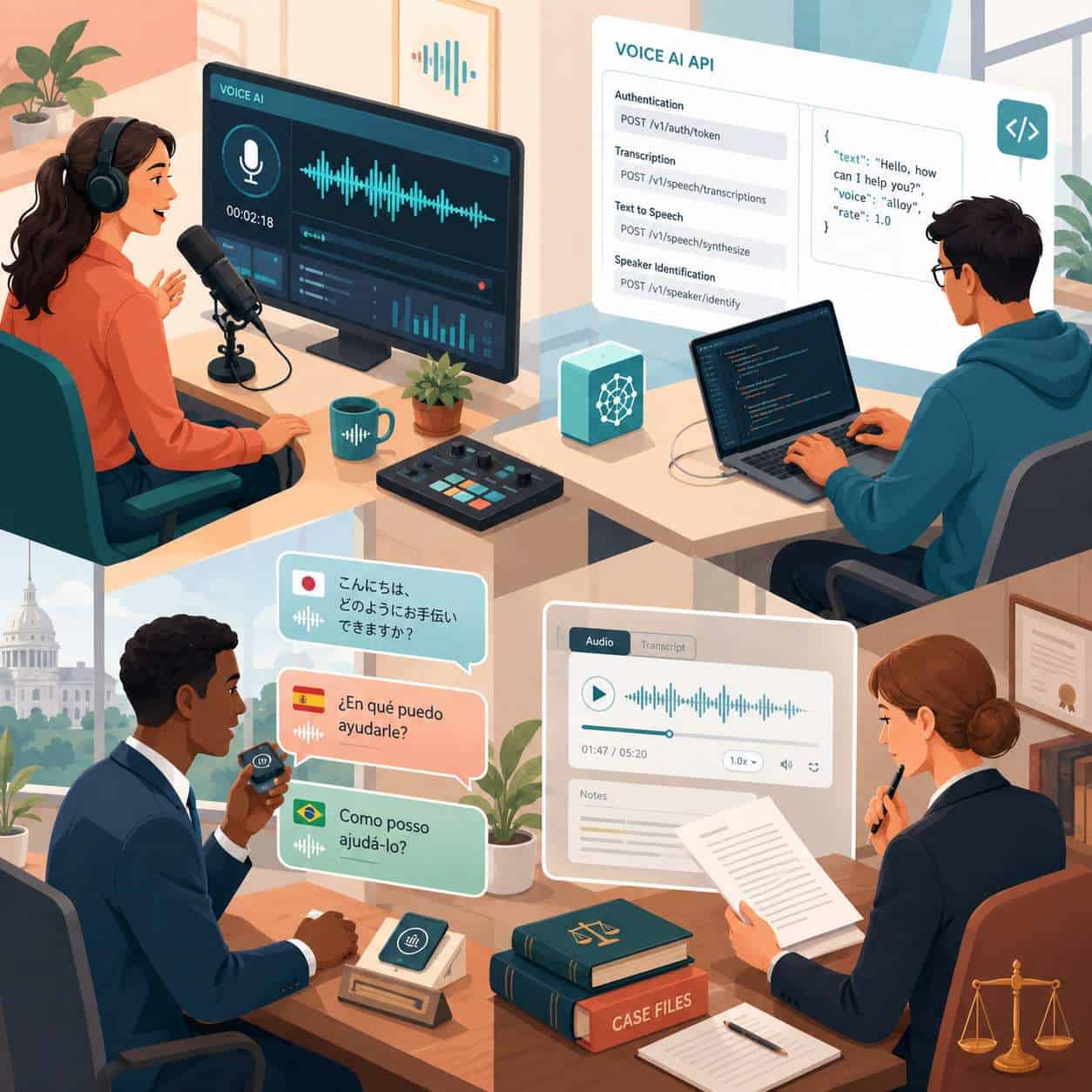
ElevenLabs’ technology serves content creators, enterprises, developers, and government agencies across dozens of applications. The most common use cases include audiobook narration, podcast production, video voiceovers, real-time customer service agents, and multilingual content localization.
Specific examples from 2026:
- Enterprise AI agents: IBM’s watsonx Orchestrate uses ElevenLabs for voice-enabled agentic workflows [6]
- Government services: ElevenLabs partnered with Ukraine to build “the first agentic government” using voice AI [1]
- Legal services: A partnership with legal AI company Harvey gives lawyers multilingual voice capabilities [1]
- Telecom: Liberty Global and Deutsche Telekom use ElevenLabs to power AI-driven podcasts and European expansion [1]
- Music creation: ElevenMusic lets users generate original songs from text prompts [4]
- Content marketing: Brands convert blog posts and articles into audio for accessibility and engagement
If you’re working on AI-powered content optimization, adding voice narration to written content is one of the fastest ways to increase time-on-page and reach audiences who prefer audio.
Who Is ElevenLabs’ Voice AI Best Suited For?
ElevenLabs works best for creators and businesses who need high-quality, natural-sounding voice output at scale. It’s less ideal for casual users who only need occasional TTS.
Best for:
- Content creators producing podcasts, audiobooks, or YouTube videos
- Developers building voice-enabled applications or chatbots
- Enterprises needing multilingual customer service agents
- Media companies localizing content across markets
- Government agencies digitizing citizen services
Not ideal for:
- Users who need only a few sentences converted to speech occasionally (free tools suffice)
- Projects requiring 100% accuracy in low-resource languages where model quality varies
- Organizations that can’t use cloud-based AI due to strict data residency laws (though enterprise options may address this)
What Are the Technical Requirements to Use ElevenLabs?
You need very little to get started. ElevenLabs runs in the cloud, so there are no local hardware requirements beyond a modern web browser for the web app or an API key for programmatic access.
For basic use:
- A web browser (Chrome, Firefox, Safari, Edge)
- An ElevenLabs account (free or paid)
For developer integration:
- API key from your ElevenLabs dashboard
- HTTP client or one of the official SDKs (Python, JavaScript/TypeScript, and others)
- For real-time agents: WebSocket support in your application
The ElevenAgents platform provides detailed analytics APIs, WebSocket events, and secret dependency tooling for enterprise governance [8]. If you’re building a professional website without code, you can embed ElevenLabs audio players using simple HTML or third-party integrations without touching the API directly.
Are There Ethical Concerns with Advanced Voice Synthesis?
Yes, and they’re significant. The same technology that makes voice AI useful also makes it possible to clone someone’s voice without consent, create deepfake audio, or impersonate public figures.
ElevenLabs has implemented several safeguards:
- Voice verification: Users must confirm they have rights to clone a voice
- Content moderation: Automated detection of misuse attempts
- Trust and source-attribution controls: Enterprise governance features added in 2026 [8]
- Watermarking: Audio output can include imperceptible markers identifying it as AI-generated
Edge case to watch: Even with safeguards, bad actors can record someone’s voice from public sources and attempt cloning on other platforms. The ethical burden isn’t only on ElevenLabs — it extends to the broader ecosystem of voice AI tools and the regulations governing them.
If you’re using voice cloning for commercial purposes, always get explicit written consent from the voice owner. This isn’t just ethical best practice; it’s increasingly a legal requirement in multiple jurisdictions.
What’s the Difference Between Voice Cloning and Voice Synthesis?
Voice synthesis generates speech from text using pre-built or model-generated voices. Voice cloning creates a digital replica of a specific person’s voice from audio samples, then uses that replica to synthesize new speech.
Think of it this way:
- Voice synthesis = choosing a voice from a library and having it read your text
- Voice cloning = uploading recordings of a specific voice and having the AI learn to replicate it
ElevenLabs supports both. Their voice library has dozens of pre-made voices for synthesis, while their cloning feature can create a usable voice model from as little as a few minutes of clean audio. Professional Voice Cloning (available on higher tiers) produces even more accurate results with more training data.
What If the Synthesized Voice Doesn’t Sound Natural Enough?
Start by adjusting the stability and similarity settings, switching models, or improving your input text. Most “unnatural” output comes from poor text formatting, wrong model selection, or default settings that don’t match the use case.
Troubleshooting steps:
- Check your text: Remove unusual punctuation, abbreviations, or formatting that confuses the model
- Adjust stability slider: Lower stability = more expressive but less consistent; higher = more monotone but predictable
- Try a different model: Flash v2.5 is fast but may sound less nuanced than Turbo v2.5 or v3
- Switch voices: Some pre-built voices handle certain content types better than others
- Add SSML tags: Use speech markup to control pauses, emphasis, and pronunciation
- For cloned voices: Provide cleaner, longer training audio — background noise degrades clone quality
Common mistake: Using a conversational voice model for long-form narration, or vice versa. Match the voice and model to the content type.

What Are Some Alternatives to ElevenLabs?
If ElevenLabs doesn’t fit your budget or needs, several strong alternatives exist. The right choice depends on whether you prioritize price, language coverage, integration ecosystem, or voice quality.
- Amazon Polly: Good for AWS-native projects, pay-per-character pricing, solid but less expressive
- Google Cloud TTS: Strong multilingual support, integrates well with Google Cloud services
- Microsoft Azure Speech: Widest language coverage (100+), Custom Neural Voice for cloning
- Murf AI: User-friendly interface, good for marketing videos and presentations
- PlayHT: Competitive quality, generous free tier, good API
- Coqui TTS (open source): Self-hosted option for teams with ML expertise and data privacy needs
Choose Amazon Polly or Google Cloud TTS if you’re already deep in those cloud ecosystems. Choose Murf AI if you want a simpler UI without API complexity. Choose PlayHT if you need a direct ElevenLabs competitor at a lower price point.
For broader AI tool comparisons and workflows, we maintain a running list of platforms across content generation, design, and automation categories.
How Difficult Is It to Integrate ElevenLabs into an Existing Application?
Not very. ElevenLabs provides a REST API and official SDKs for Python and JavaScript, so most developers can get a basic integration running in under an hour.
A minimal Python integration looks like this:
- Install the SDK (
pip install elevenlabs) - Set your API key
- Call the text-to-speech endpoint with your text and voice ID
- Receive audio as a stream or file
For conversational agents, the ElevenAgents platform handles more complex scenarios: WebSocket connections for real-time audio streaming, pre-tool-speech modes, response-complete events, and analytics APIs [8]. This is more involved but well-documented.
Quick example decision: If you’re adding narration to a WordPress site, you can use a plugin or embed audio files generated via the web app — no API coding needed. If you’re building a real-time voice chatbot, plan for WebSocket integration and latency testing.
What Are the Biggest Mistakes People Make with Voice AI Synthesis?
The most common mistake is treating voice AI as a “set and forget” tool. Good output requires thoughtful input — from text preparation to model selection to post-processing.
Top mistakes I see:
- Not formatting input text properly: Acronyms, numbers, and special characters often get mispronounced. Spell out “Dr.” as “Doctor” if the model stumbles.
- Using the wrong model for the task: Real-time agents need Flash; audiobooks benefit from v3’s higher quality.
- Ignoring licensing terms: Free-tier output often has restrictions on commercial use. Check before publishing.
- Skipping quality review: Always listen to the full output. AI voices occasionally produce artifacts, mispronunciations, or awkward pauses.
- Over-cloning without consent: Cloning a celebrity or colleague’s voice without permission creates legal and ethical risk.
- Not testing across devices: Voice output can sound different on phone speakers versus studio headphones. Test where your audience actually listens.
For teams producing content at scale, building a content optimization workflow that includes audio QA as a standard step saves significant rework later.
FAQ
How much does ElevenLabs cost per month? Plans range from free to enterprise-level custom pricing. Paid tiers start at a low monthly fee for individuals and scale up based on character usage and features. Check ElevenLabs.io for current pricing.
Is ElevenLabs’ free tier good enough for testing? Yes. The free tier provides enough characters to test voice quality, try different models, and evaluate whether the platform fits your needs before paying.
Can ElevenLabs clone my voice? Yes. You upload audio samples of your voice, and ElevenLabs creates a digital model that can generate new speech in your voice. Higher-tier plans offer more accurate Professional Voice Cloning.
How many languages does ElevenLabs support? Up to 74 languages with the Eleven v3 model. The faster Flash and Turbo models support 32 languages. English has the broadest model support and highest quality.
Is ElevenLabs safe to use for commercial projects? Yes, on paid plans that include commercial licensing. Free-tier output may have restrictions. Always review the terms of service for your specific plan.
What’s the fastest ElevenLabs model? Eleven Flash v2.5 is the current fastest model, with approximately 75 ms synthesis latency across 32 languages. It’s the default for conversational agents.
Does ElevenLabs work offline? No. ElevenLabs is a cloud-based service requiring an internet connection. If you need offline TTS, consider open-source alternatives like Coqui TTS.
Can I use ElevenLabs for audiobook production? Yes. Many publishers and independent authors use ElevenLabs for audiobook narration. The Eleven v3 model provides the highest quality for long-form content.
What is ElevenMusic? ElevenMusic is an iOS app released in April 2026 that generates original songs from text prompts. Free users get up to seven songs per day; the $9.99/month Pro tier allows up to 500 tracks [4].
How does ElevenLabs handle data privacy? ElevenLabs offers enterprise-grade security features, including trust controls and source-attribution governance tools [8]. For specific compliance requirements (GDPR, HIPAA), contact their enterprise sales team.
Conclusion
ElevenLabs has moved well beyond its origins as a text-to-speech API. In 2026, it’s a full-stack audio AI platform — voice synthesis, voice cloning, conversational agents, and now music generation — used by startups and Fortune 500 companies alike [7][10].
Here’s what to do next:
- Try the free tier at elevenlabs.io. Generate a few samples and compare them to your current TTS solution.
- Pick the right model for your use case: Flash for real-time agents, v3 for pre-rendered content like audiobooks.
- Start small with a single project — a podcast intro, a product demo voiceover, or a multilingual landing page — before committing to a paid plan.
- Review ethical guidelines and get consent before cloning anyone’s voice.
- Explore the API if you’re a developer. The SDKs make integration straightforward, and the automation tools ecosystem continues to expand.
The voice AI space is moving fast. ElevenLabs is currently leading on quality and breadth, but the landscape will keep shifting. Test now, build incrementally, and stay current on model updates.
References
[1] Blog – https://elevenlabs.io/blog [4] Elevenlabs Releases A New Ai Powered Music Generation App – https://techcrunch.com/2026/04/02/elevenlabs-releases-a-new-ai-powered-music-generation-app/ [5] Elevenlabs – https://en.wikipedia.org/wiki/ElevenLabs [6] 2026 03 25 Enterprise Ai Finds Its Voice Elevenlabs And Ibm Bring Premium Voice Capabilities To Agentic Ai – https://newsroom.ibm.com/2026-03-25-enterprise-ai-finds-its-voice-elevenlabs-and-ibm-bring-premium-voice-capabilities-to-agentic-ai [7] Series D – https://elevenlabs.io/blog/series-d [8] Changelog – https://elevenlabs.io/docs/changelog [10] Elevenlabs Funding – https://exa.ai/websets/directory/elevenlabs-funding