Last updated: May 31, 2026
Quick Answer: Open source voice AI now matches or exceeds commercial platforms like ElevenLabs in speech realism, voice cloning accuracy, and multilingual support. In Q1 2026, open-source text-to-speech models crossed a performance threshold where they began outperforming closed-source systems in blind listening tests [5]. Developers and creators can now run these models locally on consumer GPUs, often for free, with options ranging from lightweight 0.6B-parameter models to full 3.5B-parameter systems.
Key Takeaways
- Open source TTS models like VoxCPM2, Fish Speech, and Qwen3-TTS now rival or beat ElevenLabs on voice similarity benchmarks [5].
- You can run capable voice AI models on a single consumer GPU with 8-12 GB of VRAM, though larger models need 24 GB+.
- Python is the dominant language for voice AI development, with PyTorch as the primary framework.
- The EU AI Act requires transparency labeling on synthetic audio starting August 2026 [7][10].
- Voice cloning raises serious ethical and legal concerns around consent, identity theft, and deepfakes.
- Multilingual support has expanded dramatically, with models covering 30+ languages at near-native quality.
- Running open source voice AI locally costs nothing beyond hardware and electricity, compared to $5-$330/month for commercial APIs [4].
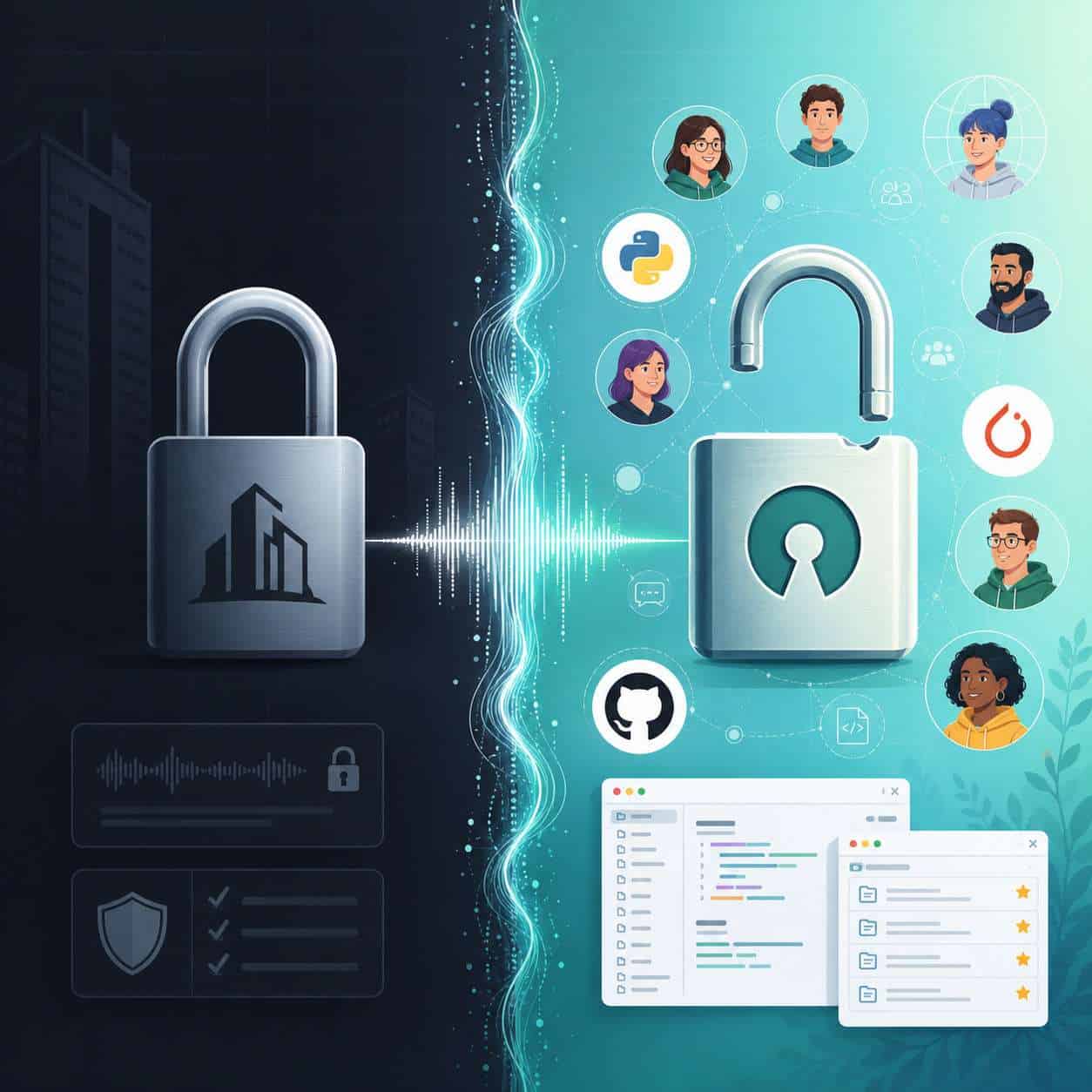
What Exactly Is Open Source Voice AI and How Does It Work?
Open source voice AI refers to text-to-speech (TTS) and voice cloning systems whose model weights, training code, and inference pipelines are publicly available under permissive licenses like Apache 2.0 or MIT. Anyone can download, modify, and deploy these systems without paying licensing fees.
The core technology works in stages:
- Text analysis — The system parses input text into phonemes, handling punctuation, numbers, and abbreviations.
- Acoustic modeling — A neural network (typically a transformer or diffusion model) predicts audio features like mel spectrograms from the phoneme sequence.
- Vocoding — A separate model converts those acoustic features into actual audio waveforms you can hear.
- Voice conditioning — For cloning, the system takes a short reference audio clip and extracts speaker characteristics (pitch, timbre, cadence) to condition the output.
Modern systems like Fish Audio’s S2-Pro use natural-language tags such as [laugh] and [whispers] to control emotion and prosody, giving users fine-grained creative control [5]. VoxCPM2 takes a different approach with tokenizer-free continuous-space audio modeling, producing 48 kHz output across 30 languages.
Common mistake: Many beginners assume voice AI is just “text-to-speech.” In 2026, these systems handle dialogue generation, emotion control, accent shifting, and real-time streaming, far beyond simple TTS.
If you’re exploring how AI tools can enhance your broader creative workflow, our guide to AI-powered content generation tools covers the wider ecosystem.
How Do ElevenLabs Voice Cloning Models Compare to Other AI Voice Technologies?
ElevenLabs set the commercial standard for voice cloning quality between 2023 and 2025, but open source alternatives have closed the gap and, by some measures, surpassed it. VoxCPM2 scored 85.4% on English voice similarity in the Minimax-MLS benchmark versus 61.3% for ElevenLabs, a roughly 24-point gap favoring the open-source, Apache-licensed model [5].
Here’s how the landscape breaks down in 2026:
| Feature | ElevenLabs | Top Open Source Models |
|---|---|---|
| Voice similarity (MLS benchmark) | ~61% | ~85% (VoxCPM2) [5] |
| Languages supported | 32 | 30+ (VoxCPM2, CosyVoice2) |
| Emotion/prosody control | Yes | Yes (S2-Pro, LongCat) |
| Cost | $5-$330/month [4] | Free (self-hosted) |
| Latency (streaming) | Low | Varies by hardware |
| Zero-shot cloning | Yes | Yes (GPT-SoVITS v3, LongCat) [6][9] |
| License | Proprietary | Apache 2.0, MIT, etc. |
Choose ElevenLabs if you need a plug-and-play API with zero infrastructure management and don’t mind recurring costs. Choose open source if you need full control over your data, want to fine-tune models for specific voices, or need to avoid vendor lock-in.
Meituan’s LongCat-AudioDiT-3.5B, released in May 2026, claims the most accurate voice cloning in the open-source domain, with particular strength in preserving tonal and emotional nuances [5]. GPT-SoVITS v3, a 407M-parameter model, offers zero-shot voice cloning that works well even with just a few seconds of reference audio [6][9].
What Are the Top Open Source Alternatives to ElevenLabs?
Several open source models now deliver production-quality voice synthesis. Here are the most capable options as of mid-2026:
- Qwen3-TTS (0.6-1.7B parameters) — Released January 2026 under Apache 2.0, it quickly became the most widely adopted open-source TTS solution thanks to models optimized for on-device and edge deployment [8].
- VoxCPM2 (2B parameters) — A tokenizer-free system supporting 30 languages at 48 kHz, with strong voice cloning performance [5].
- Fish Speech V1.5 / S2-Pro — Fish Audio’s models offer emotion control via natural-language tags and an SGLang-based streaming inference engine [5].
- CosyVoice2-0.5B — A lightweight model ranked among the top performers for hosted open-source TTS APIs.
- GPT-SoVITS v3 (407M) — Excellent for zero-shot voice cloning with minimal reference audio [6][9].
- LongCat-AudioDiT-3.5B — Meituan’s May 2026 release focusing on tonal accuracy and emotional preservation.
- Dia TTS — A dialogue-focused model created by a small team, demonstrating that even modest resources can produce high-fidelity results [8].
- IndexTTS-2 — Ranked alongside Fish Speech and CosyVoice2 as a top-tier option [5].
For creators building content across platforms, pairing voice AI with visual tools creates a powerful production pipeline. See our overview of the best AI graphic design tools for creative workflows to round out your toolkit.
How Much Does It Cost to Run an Open Source Voice AI Model on My Own Hardware?
The direct software cost is zero. You download the model weights and code from GitHub or Hugging Face and run them locally. The real costs are hardware and electricity.
Hardware cost estimates (one-time):
- Entry level (GPT-SoVITS v3, Qwen3-TTS 0.6B): A used NVIDIA RTX 3060 12GB ($200-$300) handles these smaller models comfortably.
- Mid-range (Fish Speech, CosyVoice2, VoxCPM2): An RTX 4070 Ti or RTX 3090 with 24GB VRAM ($500-$900 used) is ideal.
- High-end (LongCat-AudioDiT-3.5B, batch processing): An RTX 4090 or A100 ($1,200-$5,000+) for the fastest inference and largest models.
Electricity costs are minimal for inference (generating speech), typically under $0.10/hour even on a high-end GPU. Training or fine-tuning costs more but is still far cheaper than commercial API subscriptions over time.
Cloud alternative: If you don’t own suitable hardware, cloud GPU instances on providers like RunPod or Lambda cost roughly $0.40-$2.50/hour depending on the GPU tier. SiliconFlow and other platforms also offer hosted open-source TTS APIs at competitive per-character rates.
Decision rule: If you generate more than ~100,000 characters of speech per month, self-hosting on your own GPU typically pays for itself within 2-3 months compared to ElevenLabs pricing [4].
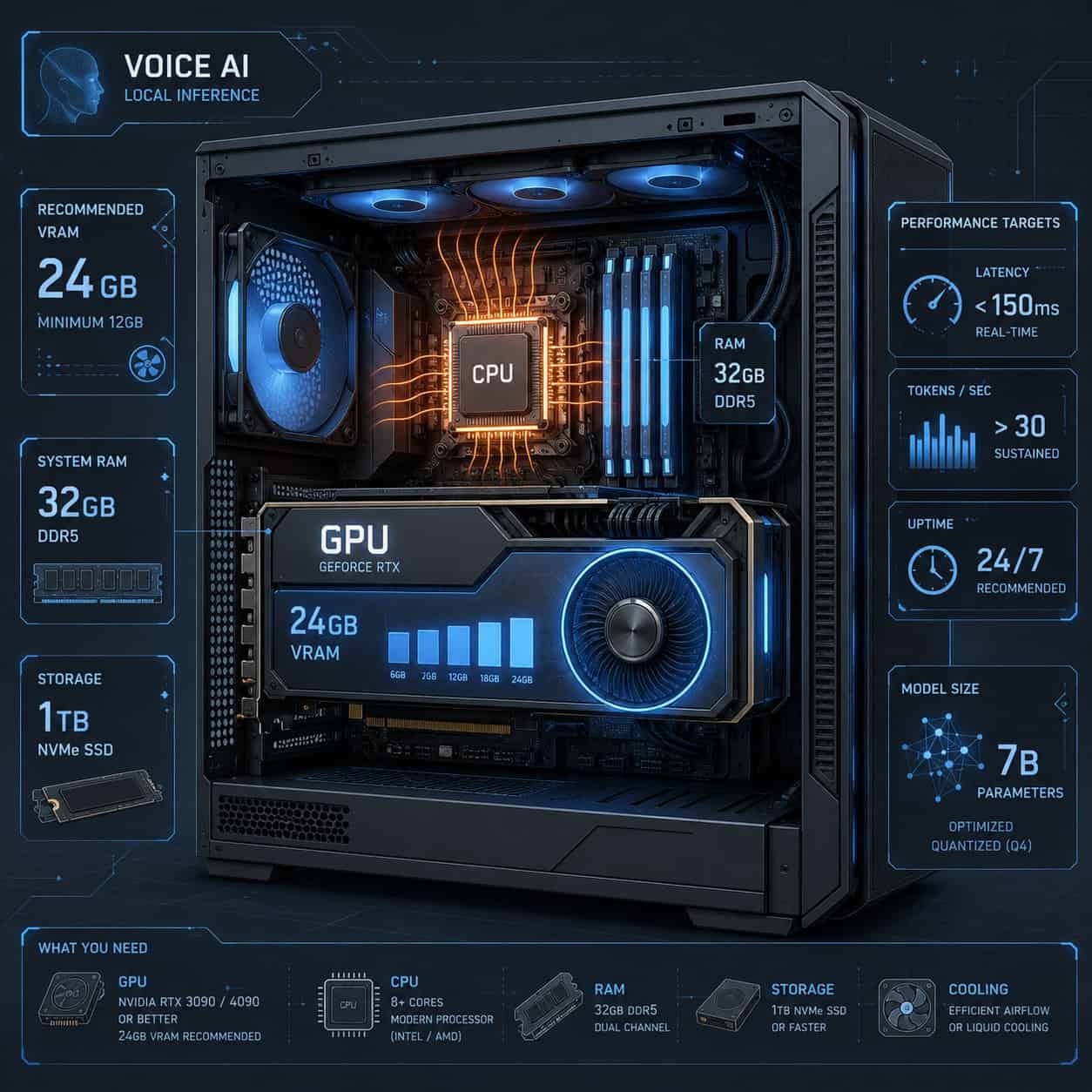
What Kind of Computer Specs Do I Need to Run Voice AI Models Locally?
At minimum, you need a dedicated NVIDIA GPU with at least 8 GB of VRAM, 16 GB of system RAM, and a modern multi-core CPU. Here’s a more detailed breakdown:
| Model Size | GPU VRAM | System RAM | Storage | CPU |
|---|---|---|---|---|
| Small (< 1B params) | 8 GB | 16 GB | 20 GB SSD | 4+ cores |
| Medium (1-2B params) | 12-16 GB | 32 GB | 40 GB SSD | 6+ cores |
| Large (2-4B params) | 24 GB | 32-64 GB | 60 GB SSD | 8+ cores |
Edge case: AMD GPUs can work with ROCm support, but NVIDIA CUDA remains far better supported across voice AI frameworks. Apple Silicon Macs (M2 Pro and above) can run some models via MLX or CoreML, but performance and compatibility lag behind NVIDIA setups.
Common mistake: Underestimating VRAM needs. If your model barely fits in VRAM, you’ll hit out-of-memory errors during longer generations. Always leave at least 2 GB of headroom.
Which Programming Languages and Frameworks Work Best for Voice AI Development?
Python is the dominant language for voice AI, used by virtually every major open source TTS project. PyTorch is the primary deep learning framework, with most models providing PyTorch-native code.
Key tools and frameworks:
- Python 3.10+ — Required by nearly all current voice AI projects.
- PyTorch 2.x — The default framework for model inference and training.
- SGLang — Used by Fish Audio’s S2-Pro for efficient streaming inference.
- Hugging Face Transformers — For loading and running many TTS models.
- ONNX Runtime — For optimized inference, especially on edge devices.
- Gradio / Streamlit — For building quick web interfaces around voice models.
If you’re a web developer looking to integrate voice AI into applications, understanding the design-to-development workflow can help bridge the gap between your UI and backend AI services.
Choose PyTorch if you want maximum compatibility and community support. Choose ONNX if you need to deploy on varied hardware or optimize for latency.
Who Can Realistically Use Open Source Voice AI: Developers or Anyone?
Both, but with different paths. Developers with Python experience can set up and run models within an hour. Non-technical users need more accessible tools, which now exist.
For developers: Clone a GitHub repo, install dependencies via pip, download model weights, and run inference scripts. Most top projects include clear README files and example notebooks.
For non-developers: Several projects now ship with one-click installers or web-based interfaces:
- GPT-SoVITS includes a Gradio web UI that runs locally [6][9].
- Fish Audio offers a hosted playground for its open models.
- Community-built tools like voice-generation wrappers on Hugging Face Spaces require zero local setup.
Realistic assessment: If you can install software and follow a tutorial, you can use open source voice AI. If you want to fine-tune models on custom voices or integrate them into production applications, you’ll need programming skills.
For those building websites or digital products that might incorporate voice features, our list of no-coding website design platforms shows how non-developers are already building sophisticated digital experiences.
Can Open Source Voice AI Handle Multiple Languages and Accents?
Yes. The best open source models in 2026 support 30+ languages with accent and dialect awareness. VoxCPM2 covers 30 languages at 48 kHz quality. Qwen3-TTS handles major world languages with strong cross-lingual voice cloning, meaning you can clone a voice in English and have it speak Mandarin while retaining the speaker’s characteristics.
Languages with the strongest support: English, Mandarin Chinese, Japanese, Korean, Spanish, French, German, Portuguese, Arabic, Hindi, and Russian.
Accent handling varies by model. Fish Speech and CosyVoice2 handle regional accents within supported languages reasonably well, but niche dialects may require fine-tuning with custom data.
Edge case: Tonal languages like Mandarin and Vietnamese are harder for voice cloning because pitch carries meaning. LongCat-AudioDiT specifically targets tonal accuracy, making it a better choice for these languages.
How Accurate Are Current Voice AI Models at Mimicking Human Speech?
Current open source models produce speech that is frequently indistinguishable from human recordings in blind tests. The April 2026 analysis noted that open-source TTS crossed a “structural threshold” where models no longer merely imitate commercial systems but outperform them in realism and controllability [5].
Specific benchmarks:
- VoxCPM2 achieved 85.4% voice similarity on the Minimax-MLS English benchmark [5].
- In blind A/B tests, listeners could not reliably distinguish top open source models from human speech at rates above chance.
Where models still struggle:
- Very long-form generation (10+ minutes) can drift in prosody.
- Highly emotional or sarcastic speech remains inconsistent.
- Background noise in reference clips degrades cloning quality.
What Are the Common Challenges When Implementing Open Source Voice Synthesis?
The biggest challenges are dependency management, hardware compatibility, and audio quality tuning. Here are the most frequent issues and how to address them:
- CUDA version conflicts — Different models require specific CUDA versions. Use conda environments to isolate dependencies.
- Insufficient VRAM — Quantize models to FP16 or INT8 to reduce memory usage, or choose smaller model variants.
- Poor clone quality — Use clean, 10-30 second reference clips recorded in quiet environments. Avoid music or background noise.
- Latency in real-time applications — Use streaming inference engines like SGLang, or pre-generate audio for non-interactive use cases.
- Reproducibility issues — A March 2026 arXiv paper systematically assessed open TTS architectures and found significant gaps in documentation and data provenance across projects [8].
For tips on optimizing digital content performance more broadly, see our guide on AI-powered content optimization.

What Are the Ethical Concerns Around Voice Cloning Technology?
Voice cloning raises three primary ethical concerns: consent, identity fraud, and misinformation. Anyone’s voice can potentially be cloned from publicly available audio, creating risks of impersonation, scam calls, and fabricated statements attributed to real people.
Key ethical principles to follow:
- Always obtain explicit consent before cloning someone’s voice.
- Never use cloned voices to deceive, defraud, or impersonate without disclosure.
- Label synthetic audio clearly when distributing it publicly.
- Consider downstream harm — even well-intentioned voice clones can be repurposed maliciously.
The IBA concluded that transparency labeling alone will not fully mitigate synthetic audio harms without additional national rules and strong corporate governance [7]. The open source community is increasingly building consent verification and watermarking directly into model pipelines.
Are There Legal Restrictions on Creating Synthetic Voices?
Yes, and they’re tightening. The EU AI Act classifies generative TTS and voice-cloning tools as “limited-risk” systems subject to strict transparency obligations. Article 50 enforcement begins in August 2026, requiring that synthetic audio outputs be clearly marked as artificial [7][10].
Legal landscape by region:
- EU: The Code of Practice on Transparency of AI-Generated Content was being finalized in early 2026, with specific focus on audio and deepfake labeling.
- United States: No federal law specifically governs voice cloning, but state laws (Tennessee’s ELVIS Act, California’s AB 2602) restrict unauthorized use of a person’s voice.
- China: Requires consent for voice synthesis and mandates labeling of AI-generated content.
Decision rule: If you’re deploying voice AI commercially, consult a lawyer familiar with AI regulation in your target markets. Open source licenses cover the software, not the legality of what you generate with it.
For those building AI-integrated websites, understanding compliance requirements is essential. Our resource on AI plugins for WordPress discusses integration considerations.
Conclusion
Open source voice AI has moved from an interesting experiment to a genuine alternative to commercial platforms like ElevenLabs. The performance gap has not just closed — it has reversed in several key benchmarks [5]. Models like VoxCPM2, Qwen3-TTS, and LongCat-AudioDiT give developers and creators access to production-quality voice synthesis without recurring API costs.
Your next steps:
- Start small. Try GPT-SoVITS v3 or Qwen3-TTS 0.6B on whatever GPU you already have.
- Test quality. Generate samples and compare them against ElevenLabs’ free tier for your specific use case.
- Respect consent. Only clone voices you have permission to use, and label synthetic audio clearly.
- Stay current. The field moves fast — follow Hugging Face trending models and the repositories mentioned above.
- Plan for regulation. Build transparency labeling into your workflow now, before August 2026 EU enforcement begins.
The technology is here. The tools are free. The only real barrier is learning to use them responsibly.
FAQ
Q: Can I clone my own voice with open source tools? A: Yes. Most open source voice AI models support zero-shot cloning from a 10-30 second audio sample. GPT-SoVITS v3 and LongCat-AudioDiT are particularly strong for this [6][9].
Q: Is open source voice AI really free? A: The software is free. You pay for hardware (or cloud GPU rental) and electricity. There are no licensing fees for Apache 2.0 or MIT-licensed models.
Q: How long does it take to generate speech? A: On an RTX 4070 Ti, most models generate speech faster than real-time, meaning a 10-second clip takes less than 10 seconds to produce. Smaller models on edge devices achieve similar speeds.
Q: Can I use open source voice AI for commercial products? A: Most top models use Apache 2.0 licenses, which permit commercial use. Always verify the specific license of the model and training data you’re using.
Q: Do I need training data to use these models? A: No. Zero-shot models clone voices from a short reference clip without any training. Fine-tuning for higher quality does require more data (typically 5-30 minutes of clean audio).
Q: How do I avoid creating deepfakes accidentally? A: Add watermarks to generated audio, clearly label outputs as synthetic, and never distribute cloned voices without the speaker’s consent. Several models now include built-in watermarking.
Q: Which model is best for real-time applications like chatbots? A: Qwen3-TTS (0.6B variant) and Fish Speech with SGLang streaming are optimized for low-latency, real-time use cases.
Q: Will open source voice AI keep improving? A: Based on the trajectory from 2024 to 2026, yes. Model quality has roughly doubled every 12 months, and community investment continues to accelerate [5].
References
[2] Open Source Ai Voice – https://nerdynav.com/open-source-ai-voice/ [4] Elevenlabs Alternatives – https://www.goodcall.com/voice-ai/elevenlabs-alternatives [5] Open Source Tts 2026 Eight Models Making Elevenlabs Sweat Tentenco Ehtpc – https://www.linkedin.com/pulse/open-source-tts-2026-eight-models-making-elevenlabs-sweat-tentenco-ehtpc [6] Realistic Voice Cloning Gpt Sovits Curtis Ge 1vzxc – https://www.linkedin.com/pulse/realistic-voice-cloning-gpt-sovits-curtis-ge-1vzxc [7] Deepfakes Can The Ai Act Protect Europe – https://www.ibanet.org/deepfakes-can-the-ai-act-protect-europe [8] Exploring The World Of Open Source Text To Speech Models – https://www.bentoml.com/blog/exploring-the-world-of-open-source-text-to-speech-models [9] Gptsovits V3 Tts 407m Release 0shot Voice Cloning – https://www.reddit.com/r/LocalLLaMA/comments/1jbyg29/gptsovits_v3_tts_407m_release_0shot_voice_cloning/ [10] Highlight 50 2025 Deepfakes And Human Rights Why The Eu Ai Act Is Becoming The Global Standard For Ethical Ai Regulation – https://www.meig.ch/highlight-50-2025-deepfakes-and-human-rights-why-the-eu-ai-act-is-becoming-the-global-standard-for-ethical-ai-regulation/