Last updated: May 11, 2026
Quick Answer: Base44 refers to two distinct things in 2026: a niche data encoding scheme that packs information more densely than Base64 (especially useful for QR codes), and a popular AI-powered no-code app builder that lets you create full-stack web applications from plain English prompts. This guide covers both, including how the encoding works, what the platform does well, where it falls short, and the security risks you need to know about.
Key Takeaways
- Base44 encoding maps binary data to a 44-character alphabet optimized for QR code alphanumeric mode, producing shorter output than Base64 in that context [1].
- Base44 AI is a full-stack no-code platform that generates React/Node.js/PostgreSQL apps from conversational prompts, compressing weeks of development into hours [3].
- The platform excels at prototypes and simple apps (under 8 pages, 5 database entities) but degrades with complexity [3].
- A May 2026 WIRED investigation found roughly 380,000 publicly accessible “vibe-coded” apps, with about 5,000 exposing sensitive corporate data, and Base44 was named among the contributing platforms.
- Base44 AI is not a developer replacement; it generates scaffolding that still requires professional hardening for production use [3].
- Competitors like Bubble offer more configurability, Lovable provides better GitHub integration, and Cursor gives full code ownership [3].
- Base44 is web-only as of 2026; it cannot build native iOS or Android apps.
What Is Base44 Encoding and How Does It Differ from Base64?
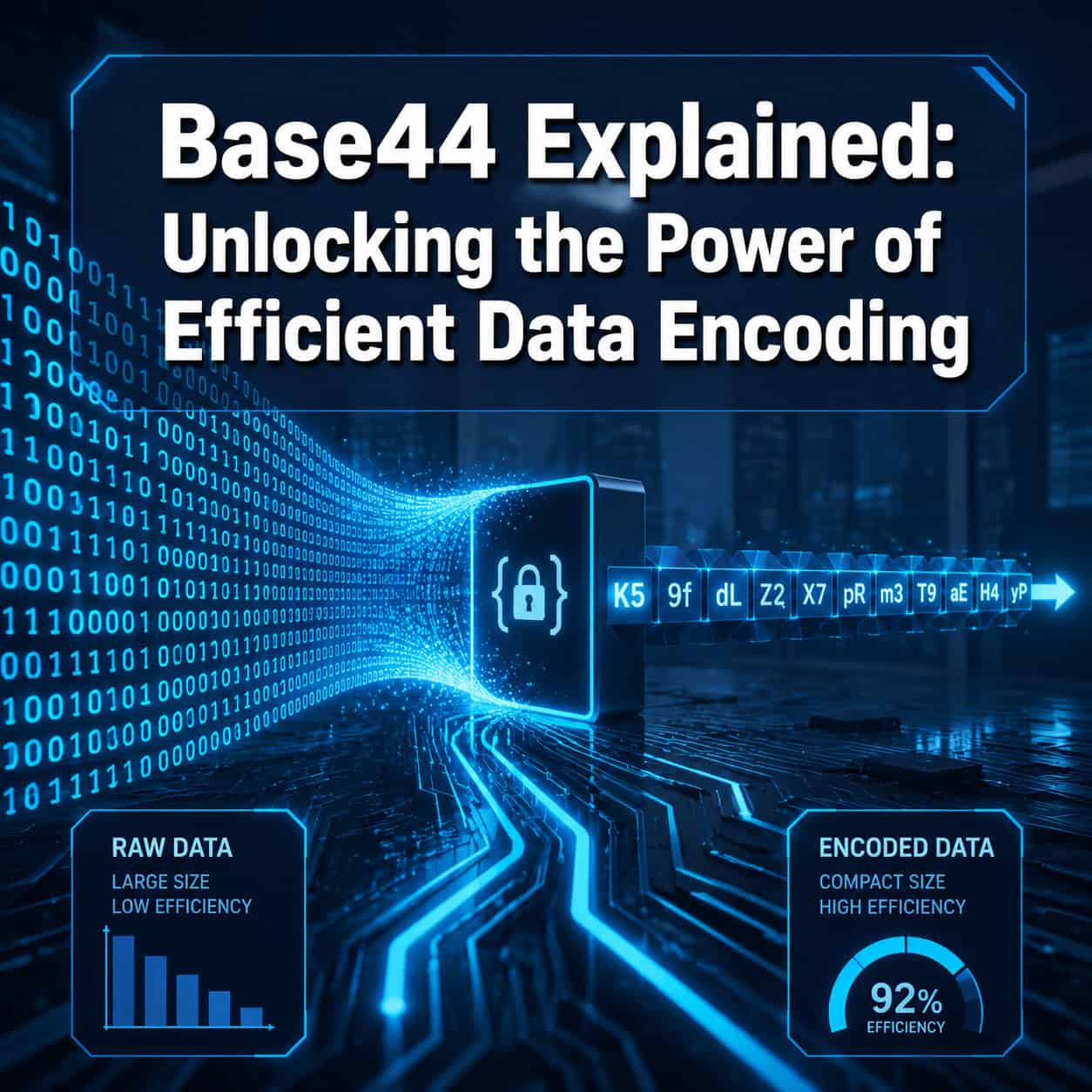
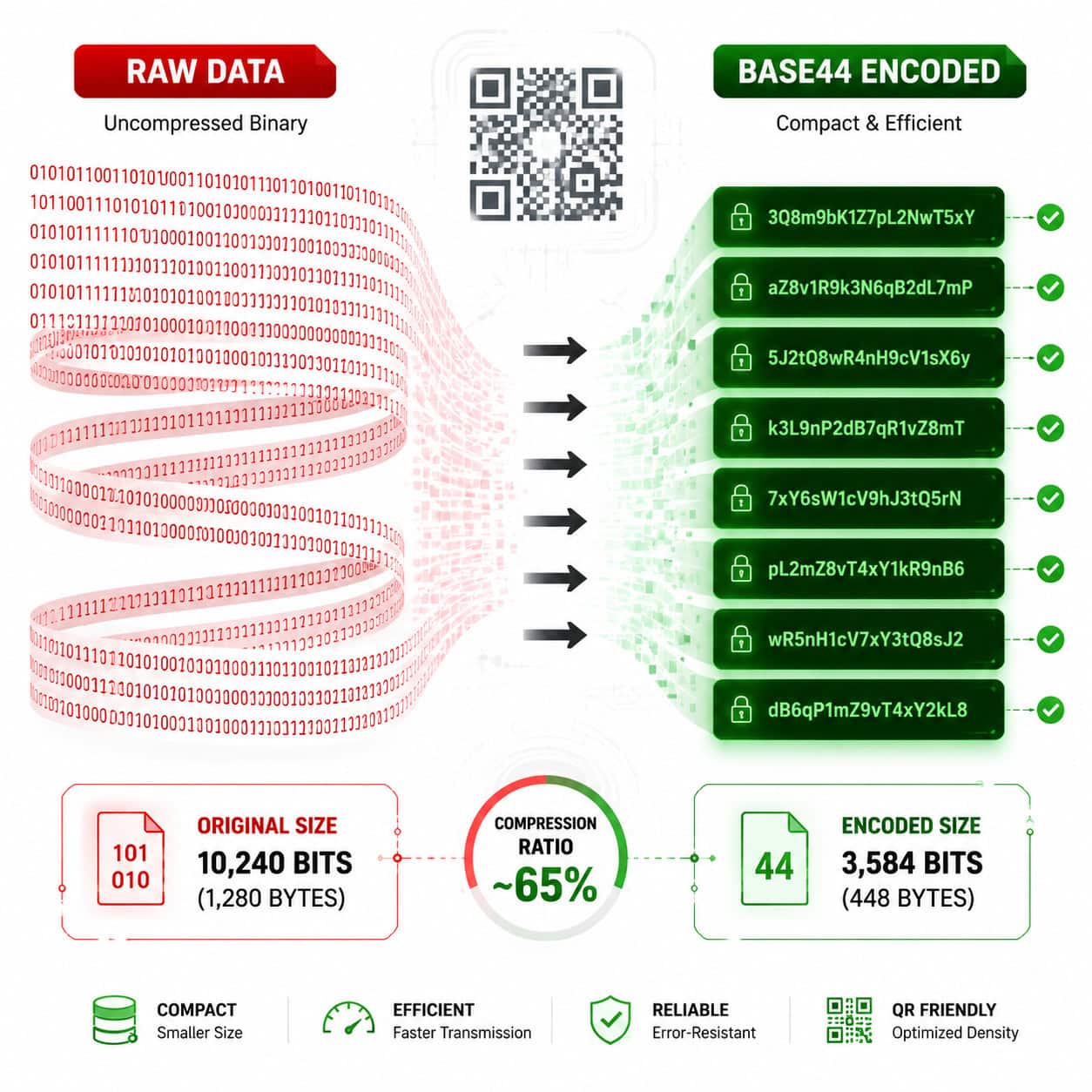
Base44 encoding is a binary-to-text encoding scheme that uses a 44-character alphabet, specifically chosen to fit within QR code alphanumeric mode. Base64, by contrast, uses 64 characters and typically requires QR codes to fall back to less efficient byte mode [1].
Here’s why that matters:
- QR code density: QR alphanumeric mode stores more characters per module than byte mode. Because Base44’s character set stays within the alphanumeric range, the encoded data produces smaller QR codes for the same input [1].
- General use: Outside QR codes, Base64 remains the standard for embedding binary data in text-based formats like JSON, HTML, and email (MIME). It’s widely supported across every major programming language and framework [4][5].
- Trade-off: Base44 encoding produces slightly longer text strings than Base64 when measured in raw characters, but the QR code that represents that string ends up physically smaller because of mode efficiency.
| Feature | Base44 | Base64 |
|---|---|---|
| Character set size | 44 | 64 |
| QR code mode | Alphanumeric (efficient) | Byte (less efficient) |
| Primary use case | QR code data density | General binary-to-text |
| Ecosystem support | Niche | Universal |
| Output string length | Longer per byte | Shorter per byte |
Choose Base44 encoding if your primary output is QR codes and you need to minimize physical code size. Stick with Base64 for everything else, including web development workflows and API data transfer.
Understanding data encoding is foundational for anyone working with content optimization and performance, since how data is represented directly affects payload sizes and load times.
What Is Base44 AI and How Does the No-Code Platform Work?
Base44 AI is a conversational no-code platform that builds full-stack web applications from plain English descriptions. You describe what you want, and it generates a working app with a React frontend, Node.js backend, and PostgreSQL database, all hosted and managed [7][3].
The workflow is straightforward:
- Describe your app in natural language (e.g., “Build me an inventory tracker with user login and a dashboard”).
- Base44 generates the full application code, database schema, and hosting configuration.
- Review and iterate by giving follow-up prompts to adjust features, layout, or logic.
- Deploy directly from the platform with zero infrastructure setup.
According to LowCode Agency’s analysis, this process compresses what would typically be a 2-to-4-week development timeline into roughly one day for simple applications [3]. The platform integrated GPT-5.5 and ChatGPT 5.4 models in April 2026, improving its code generation quality [10].
Common mistake: Treating Base44 AI output as production-ready. The generated code is scaffolding. For anything handling real user data or business logic, you’ll need a developer to review authentication flows, error handling, and database security.
If you’re exploring the broader landscape of AI-powered building tools, our guide to no-coding website design platforms covers the major options side by side.

Who Should Use Base44 AI (and Who Shouldn’t)?
Base44 AI works best for non-technical founders, product managers, and small teams who need to validate an idea quickly without hiring a development team. It’s a prototyping tool first and a production platform second.
Good fit:
- Internal business tools (under 8 pages)
- MVP prototypes for investor demos
- Simple CRUD apps (create, read, update, delete)
- Solo entrepreneurs testing a concept
Poor fit:
- Apps requiring complex business logic or custom authentication [3]
- Projects needing real-time features (chat, live updates)
- Native mobile apps (Base44 is web-only)
- Enterprise software requiring SOC2 compliance (consider Zite at $15/month instead)
- Teams that need full code ownership (use Cursor or Lovable with GitHub export)
Decision rule: If your app has more than 5 database entities or 8 pages, expect quality to degrade noticeably [3]. At that point, you’re better off with Bubble for configurability or a traditional development approach.
How Does Base44 Compare to Other No-Code and AI Builders?
Base44 sits in a crowded field. Here’s how it stacks up against the main alternatives in 2026:
| Platform | Best For | Backend Included | Code Export | Mobile Apps | Pricing Model |
|---|---|---|---|---|---|
| Base44 | Fast prototypes | Yes (managed) | Limited | No | Credit-based |
| Bubble | Complex web apps | Yes | No | Via wrapper | Subscription |
| Lovable | Dev-friendly export | Via Supabase | GitHub export | No | Subscription |
| Replit | Full-stack + mobile | Yes | Yes | Yes | Subscription |
| Cursor | Developer control | BYO | Full ownership | Via framework | Subscription |
| Zite | Enterprise compliance | Yes | Limited | No | $15/month |
| v0 (Vercel) | Design-heavy frontends | Via Vercel | Yes | No | Usage-based |
Base44’s main advantage is speed: prompt-to-working-app in minutes with zero infrastructure decisions. Bubble offers a far more mature plugin ecosystem and finer control. Lovable is the better choice if your team includes developers who want to own and extend the codebase [3].
For teams already working in design tools, the Figma to code workflow may be a more controlled path from design to development.
What Are the Security Risks with Base44 and Vibe-Coded Apps?
This is the most important section of this article. In May 2026, WIRED reported that cybersecurity firm RedAccess found approximately 380,000 publicly accessible apps built with “vibe-coding” platforms, including Base44, Lovable, Replit, and Netlify. Roughly 5,000 of those apps were exposing sensitive corporate data.
The root cause: insecure defaults. Many of these platforms connect to Supabase for database services but don’t enable Row Level Security (RLS) by default. That means anyone who finds the database URL can read or modify records.

Specific risks to watch for:
- Exposed API keys hardcoded in frontend JavaScript
- Missing authentication on database endpoints
- No input validation on user-submitted data
- Default admin credentials left unchanged after deployment
- Public database URLs discoverable through client-side code
What to do about it:
- Enable Row Level Security on every Supabase table immediately after deployment.
- Move API keys to server-side environment variables; never expose them in frontend code.
- Add authentication before any app handles real user data.
- Run a security audit before going live, even for internal tools.
- Monitor access logs for unexpected queries or data access patterns.
If you’re building on WordPress instead, our guide to AI plugins for WordPress covers tools with more established security practices.
What Are the Practical Limits of Base44 AI?
Base44 AI has a clear ceiling, and understanding it early saves frustration.
Known limitations as of 2026:
- Complexity cap: Performance degrades beyond 8 pages and 5 database entities [3]
- No real-time features: WebSocket connections, live chat, and collaborative editing aren’t supported
- Web-only: No native iOS or Android app generation (Replit handles this better)
- Limited custom logic: Edge cases, complex conditional workflows, and custom auth require manual coding
- Credit-based pricing: Costs scale unpredictably compared to flat-rate competitors
- No mature plugin ecosystem: Unlike Bubble, you can’t extend functionality through third-party integrations
Edge case worth noting: If you need to migrate away from Base44 later, the process isn’t straightforward. The platform manages hosting and infrastructure, so extracting your app for self-hosting requires significant rework. This is a common trade-off in managed no-code platforms.
For teams considering advanced automation strategies, it’s worth evaluating whether Base44’s constraints will become blockers within your first few months.
How Can You Get Started with Base44 Responsibly?
If Base44 fits your use case, here’s a practical checklist for getting started without the common pitfalls:
- Define scope first. Write down every feature, page, and data entity before opening Base44. If your list exceeds 8 pages or 5 entities, reconsider.
- Start with a throwaway prototype. Use your first project to learn the platform’s quirks, not to build your actual product.
- Enable security from day one. Configure Supabase RLS, move secrets server-side, and add authentication before entering any real data.
- Plan your exit. Document your data schema and business logic separately so you can rebuild on another platform if needed.
- Budget for a developer review. Even a 2-hour code review by an experienced developer can catch critical security gaps.
- Test on real devices. Base44 generates responsive web apps, but test thoroughly on mobile browsers since there’s no native app output.
For content and design assets to accompany your app, AI-powered content generation tools can speed up that parallel workflow.
Conclusion
Base44 in 2026 means two things: a specialized encoding scheme for QR code efficiency, and a fast AI no-code platform for building simple web apps from plain English. The encoding has a narrow but valid use case. The platform is genuinely impressive for prototyping but comes with real limits and serious security considerations.
Your next steps:
- If you need QR code optimization: Research Base44 encoding libraries for your language and compare output sizes against Base64 for your specific data.
- If you want to prototype an app: Try Base44 AI for a non-sensitive internal tool first. Keep it under 8 pages, enable all security settings, and treat the output as a starting point rather than a finished product.
- If you need production software: Pair Base44 prototypes with professional development review, or choose a platform like Bubble or Cursor that gives you more control from the start.
The speed is real. The convenience is real. But so are the risks. Go in with clear expectations, and Base44 can be a useful tool in your stack rather than a liability.
FAQ
Is Base44 encoding the same as Base44 AI? No. Base44 encoding is a data encoding scheme for compact QR code representation. Base44 AI is a no-code app-building platform. They share a name but serve completely different purposes [1].
Is Base44 AI free to use? Base44 offers a free tier with limited credits. Beyond that, it uses credit-based pricing that scales with usage. Compare this to competitors like Zite ($15/month flat) or Bubble (subscription tiers).
Can Base44 AI build mobile apps? No. As of 2026, Base44 generates web applications only. For native iOS or Android apps, Replit is a better option among AI-powered builders.
Is Base44 AI safe for handling user data? Not by default. The platform’s default configurations have been linked to data exposure incidents. You must manually enable Row Level Security, move API keys server-side, and add proper authentication [3].
What programming languages does Base44 AI generate? Base44 produces React (frontend), Node.js (backend), and PostgreSQL (database) code, which are mainstream, well-documented technologies [3].
How does Base44 compare to Bubble? Base44 is faster for initial app creation via prompts. Bubble offers significantly more configurability, a mature plugin ecosystem, and better support for complex applications [3].
Can I export my Base44 app’s code? Code export is limited. If full code ownership matters to your team, Lovable (with GitHub export) or Cursor are stronger choices.
What happened with the Base44 security leak? In May 2026, WIRED reported that cybersecurity researchers found thousands of vibe-coded apps, including those built on Base44, exposing sensitive data due to insecure default configurations.
Does Base44 support real-time features like chat? No. Real-time functionality (WebSockets, live collaboration) is not currently supported on the platform [3].
What’s the maximum app complexity Base44 can handle well? LowCode Agency’s testing suggests quality degrades beyond 8 pages and 5 database entities [3]. For anything larger, consider alternatives with higher complexity ceilings.
References
[1] Decoding Base44 The Ai The Encoding And The Red Herring – https://skywork.ai/blog/decoding-base44-the-ai-the-encoding-and-the-red-herring/ [3] Base44 Pros And Cons – https://www.lowcode.agency/blog/base44-pros-and-cons [4] Base64 – https://en.wikipedia.org/wiki/Base64 [5] What Is Base 64 Encoding Used For – https://stackoverflow.com/questions/201479/what-is-base-64-encoding-used-for [7] The Power Of Plain English Build Professional Apps With Base44 – https://www.pcmag.com/articles/the-power-of-plain-english-build-professional-apps-with-base44 [10] Update Smarter Building With Automatic Optimization – https://base44.com/blog/update-smarter-building-with-automatic-optimization