Last updated: June 9, 2026This article explores the ChatGPT vs Claude AI Language Model Showdown, comparing the strengths and features of both advanced AI tools.
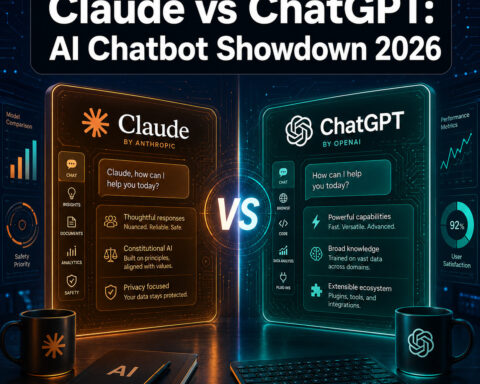
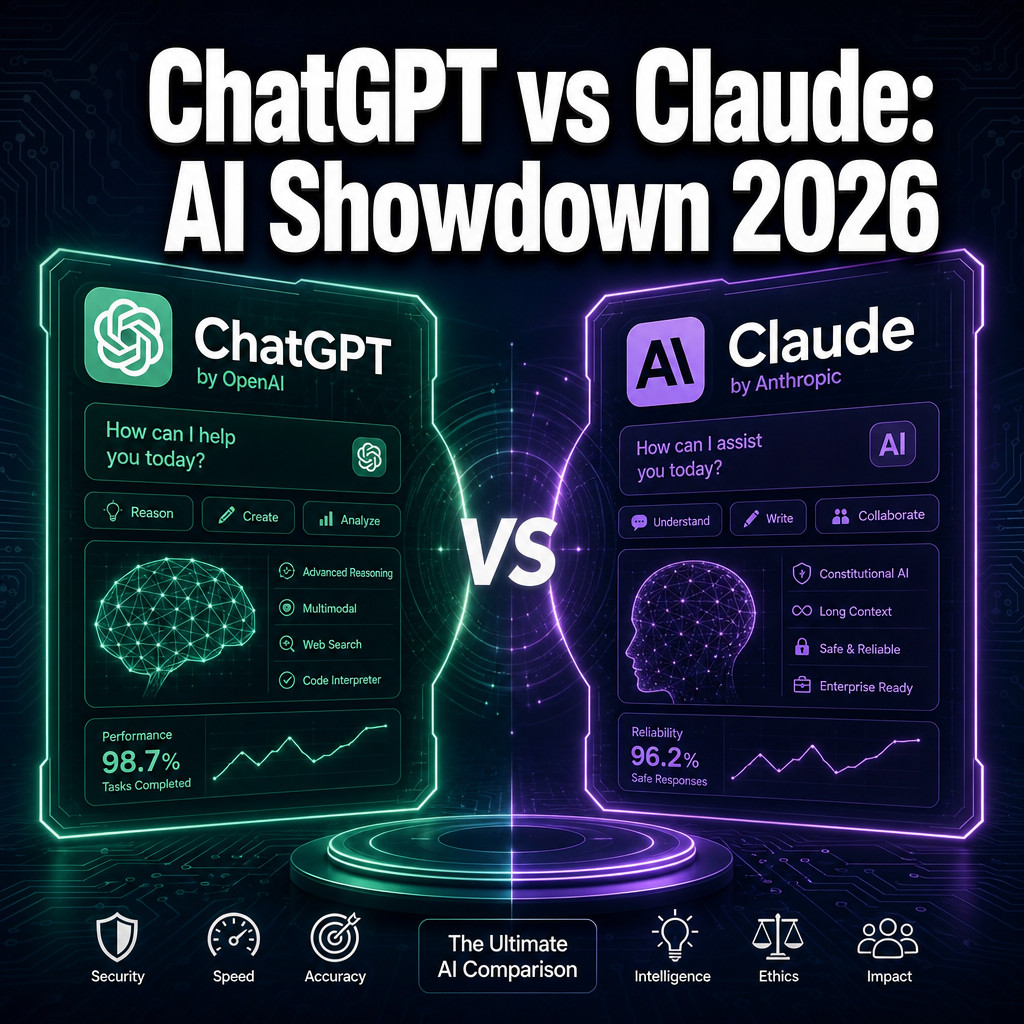
Quick Answer: ChatGPT (by OpenAI) and Claude (by Anthropic) are the two most widely used large language models in 2026. ChatGPT leads in integrations, plugin support, and general versatility, while Claude consistently outperforms in long-document analysis, nuanced writing, and safety-conscious outputs. Neither is universally better — the right choice depends on your specific task.
Key Takeaways
- ChatGPT and Claude are built by different companies with different design philosophies: OpenAI prioritizes capability breadth; Anthropic prioritizes safety and honesty.
- Claude handles longer documents and context windows better than most ChatGPT tiers.
- ChatGPT has a larger ecosystem of plugins, integrations, and third-party tools.
- Both offer free tiers, but paid plans unlock significantly better performance.
- For academic writing and research, Claude tends to produce more careful, citation-aware prose.
- For coding tasks, ChatGPT (especially GPT-4o) has a slight edge in speed and debugging support.
- Claude is generally considered more conservative in its outputs, which can be a feature or a limitation depending on your use case.
- Privacy policies differ meaningfully between the two platforms — worth reading before sharing sensitive data.
- Students on a budget can use both free tiers effectively for most coursework.
- Professional researchers report that neither AI matches human expert accuracy on specialized topics.
What Exactly Are ChatGPT and Claude, and How Do They Differ?
ChatGPT is a conversational AI built by OpenAI, first released publicly in late 2022. Claude is a conversational AI built by Anthropic, a company founded by former OpenAI researchers. Both are large language models (LLMs), meaning they generate text by predicting what words logically follow based on training data.
The core difference is in their design priorities:
- ChatGPT is optimized for broad capability — it handles text, images, code, data analysis, and voice through a growing ecosystem of tools. You can explore the full ChatGPT archives at webaistack.com for a deeper look at its evolving features.
- Claude is optimized for safety, honesty, and handling long, complex documents. Anthropic built Claude around a framework called “Constitutional AI,” which trains the model to follow a set of ethical principles. Browse the Claude archives at webaistack.com for detailed breakdowns of its capabilities.
Both models are transformer-based neural networks, but they differ in training methods, safety guardrails, and the company cultures behind them.
Which AI Is Better for Writing Essays and Research Papers?
For academic writing and research, Claude generally produces more careful, structured prose with fewer confident-sounding errors. ChatGPT is faster and more flexible, but can occasionally state inaccuracies with unwarranted confidence.
Here is a practical breakdown:
| Task | ChatGPT | Claude |
|---|---|---|
| Essay drafting | Strong, fast | Strong, more nuanced |
| Summarizing long PDFs | Limited by context window (varies by tier) | Excellent — handles very long documents |
| Citation awareness | Will remind you to verify; does not auto-cite | Similar caution; more explicit about uncertainty |
| Argumentative writing | Good | Slightly more balanced and measured |
| Creative nonfiction | Very good | Very good |
Choose Claude if you are summarizing a 50-page report or writing a research-heavy piece that requires careful hedging of claims. Choose ChatGPT if you need fast drafts with easy revision loops or want to use browser plugins to pull live sources.
For a broader look at AI writing tools, see this comprehensive guide to AI-powered content generation tools.
How Much Do Claude and ChatGPT Cost Right Now?
As of 2026, both platforms offer free and paid tiers. Pricing has shifted since the original 2024 launches, so treat the figures below as approximate — always check the official sites for current rates.
ChatGPT:
- Free tier: Access to GPT-4o mini with usage limits
- ChatGPT Plus: Approximately $20/month (access to GPT-4o, advanced tools)
- ChatGPT Pro: Higher-tier plan for power users at a premium price
Claude:
- Free tier: Access to Claude with daily message limits
- Claude Pro: Approximately $20/month (priority access, larger context windows)
- Claude for Teams/Enterprise: Custom pricing
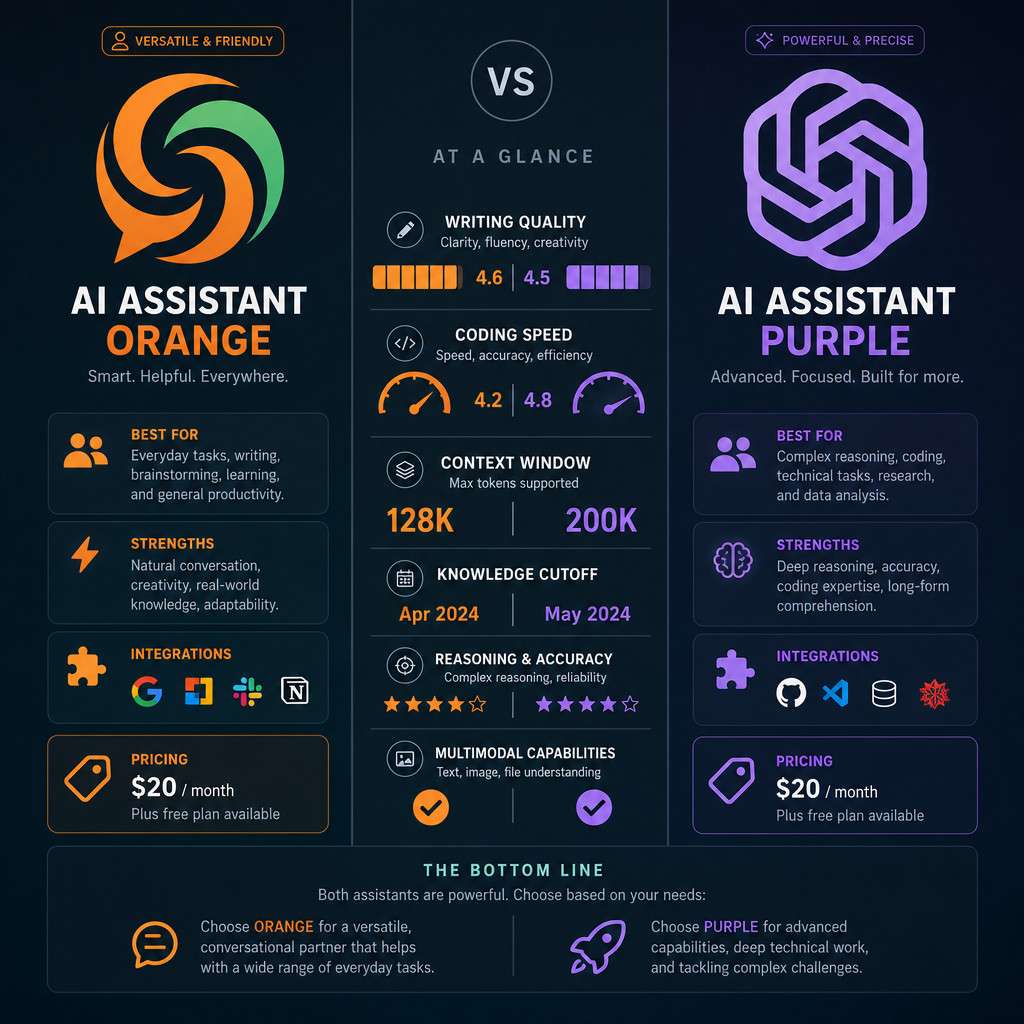
Both free tiers are usable for everyday tasks. The paid tiers are worth it if you work with long documents, need faster responses, or use AI daily for professional work.
Can Claude Do Coding Better Than ChatGPT?
For most coding tasks, ChatGPT (GPT-4o) has a slight practical edge — particularly in debugging, explaining error messages, and working within popular IDEs. Claude is a strong coder but tends to be more verbose in its explanations, which some developers find helpful and others find slow.
That said, Claude’s longer context window is a real advantage when you need to paste an entire codebase for review. For a direct comparison of AI coding platforms, the Replit vs Claude Code showdown covers this in detail.
Quick rule:
- Debugging a specific function: ChatGPT
- Reviewing a large file for architectural issues: Claude
- Generating boilerplate quickly: Either works well
What Are the Biggest Limitations of Each AI Model?
Every AI has real weaknesses, and knowing them saves you time.
ChatGPT limitations:
- Can confidently state incorrect facts (a problem called hallucination)
- Free tier has significant usage caps
- Image and file analysis requires the paid tier
- Plugin quality varies widely across third-party tools
Claude limitations:
- More likely to decline tasks it considers sensitive, even when the request is reasonable
- Fewer third-party integrations compared to ChatGPT
- Can be overly cautious in creative writing involving conflict or mature themes
- Web browsing and real-time data access are more limited on lower tiers
Neither model should be trusted as a sole source for medical, legal, or financial decisions.
Is Claude More Ethical Than ChatGPT?
Claude is designed with a more explicit ethical framework — Anthropic’s Constitutional AI approach trains the model to evaluate its own outputs against a defined set of principles. This makes Claude more likely to flag potential harms and decline certain requests.
ChatGPT also has safety guardrails, but OpenAI’s approach has historically allowed slightly more flexibility in edge cases.
Practical difference: If you ask both models to write a morally ambiguous story or generate persuasive content on a sensitive topic, Claude is more likely to add caveats or decline. Whether that is more “ethical” or just more restrictive depends on your perspective and use case.
Which AI Should I Use If I’m a Student?
Students should start with the free tiers of both tools and use them for different tasks. Claude is better for reading comprehension, summarizing textbooks, and writing careful arguments. ChatGPT is better for quick explanations, math walkthroughs, and coding help.

Recommended student workflow:
- Use Claude to summarize assigned readings and draft essay outlines.
- Use ChatGPT to explain difficult concepts in plain language or debug code for CS courses.
- Always verify AI-generated claims against your course materials or academic sources.
- Never submit AI-generated text as your own work without disclosure — check your institution’s policy.
Students interested in AI automation for productivity might also find value in mastering ChatGPT automation for no-code workflow integration.
Can I Use Claude or ChatGPT for Free?
Yes — both platforms offer free access with limitations. ChatGPT’s free tier gives access to GPT-4o mini, which is capable for most everyday tasks. Claude’s free tier provides access to its standard model with daily message limits.
Free tier restrictions to know:
- Slower response times during peak hours
- Lower priority in queues
- Limited or no access to advanced features (file uploads, image analysis, longer context)
- Message caps that reset daily or weekly
For most students and casual users, the free tiers are sufficient. Heavy professional use will likely require a paid plan.
What Kind of Tasks Is Claude Not Good At?
Claude struggles most with tasks that require real-time information, complex multi-step tool use, or highly creative content involving mature themes. It is also less integrated with external services compared to ChatGPT.
Specific weak spots:
- Accessing live web data (limited compared to ChatGPT with browsing enabled)
- Generating images (Claude does not have a native image generation tool as of 2026)
- Agentic tasks that require chaining multiple tools — see our overview of agent mode capabilities for context
- Responding to requests it interprets as potentially harmful, even when the intent is benign
How Do ChatGPT and Claude Handle Complex Math Problems?
Both models handle algebra, calculus, and statistics at a solid undergraduate level, but neither is a substitute for a dedicated math tool like Wolfram Alpha for high-precision computation.
ChatGPT has a code interpreter tool (available on paid tiers) that can run Python to solve math problems step by step — this gives it a meaningful advantage for numerical computation. Claude can reason through math problems well in prose but does not execute code in the same way on all tiers.
Bottom line: For symbolic math reasoning and explanation, both are comparable. For computation-heavy problems, ChatGPT’s code interpreter wins.
Are There Privacy Concerns With Using These AIs?
Yes, and this matters more than most users realize. Both OpenAI and Anthropic collect conversation data by default to improve their models, unless you opt out or use an enterprise plan with different data terms.
Key privacy points:
- Do not share personally identifiable information, passwords, or confidential business data in either tool.
- Both platforms offer opt-out options for training data use — check account settings.
- Enterprise and API tiers typically offer stronger data privacy guarantees.
- Neither platform is HIPAA-compliant by default, so avoid sharing patient or health data.
If privacy is a top concern, review each company’s current privacy policy before use.
What Do Professional Researchers Say About Claude vs ChatGPT? How Accurate Are These AIs Compared to Human Experts?
Professional researchers consistently note that both models are useful as first-draft tools and brainstorming partners, but neither matches domain expert accuracy on specialized topics. Studies and practitioner reports from 2024 and 2025 have found that LLMs produce plausible-sounding but occasionally incorrect information in fields like medicine, law, and advanced science.
Claude tends to score higher on honesty benchmarks — it is more likely to say “I’m not sure” rather than fabricate a confident answer. ChatGPT, particularly with browsing enabled, can pull more current information but still requires fact-checking.
The professional consensus: Use these tools to accelerate research, not replace it. Treat every AI output as a draft that needs verification. For a broader comparison of AI research tools, the NotebookLM vs Gemini research tool showdown offers useful context on how different AI platforms serve research workflows.
FAQ
Q: Is Claude smarter than ChatGPT? Neither is definitively smarter. Claude performs better on long-document tasks and tends to be more honest about uncertainty. ChatGPT performs better on tool-integrated tasks and real-time information retrieval.
Q: Can I switch between ChatGPT and Claude easily? Yes. Both run in a browser and require only an account to access. You can use both on the same day for different tasks.
Q: Which AI is better for creative writing? ChatGPT is generally more flexible and willing to explore edgy or unconventional creative prompts. Claude produces more polished prose but may add caveats on sensitive themes.
Q: Do these AIs remember past conversations? ChatGPT has a memory feature (opt-in) that retains information across sessions. Claude’s memory capabilities vary by version and tier — check current settings in your account.
Q: Which is better for non-English languages? ChatGPT has broader multilingual training data and generally performs better across a wider range of languages. Claude is strong in English and major European languages but may lag on less common languages.
Q: Can I use these AIs for business tasks? Yes, both are used widely in business for drafting emails, summarizing reports, and generating content. Enterprise plans from both companies offer better privacy terms and higher usage limits.
Q: Which AI hallucinates less? Claude is generally considered to hallucinate less and is more likely to express uncertainty. However, both models can produce incorrect information, so verification is always necessary.
Q: Is there a free trial for the paid tiers? Occasionally, both platforms offer promotional access. Check their official websites for current offers — these change frequently.
Conclusion
The ChatGPT vs Claude comparison in 2026 does not have a single winner. ChatGPT is the better choice if you need a broad ecosystem, coding support, real-time browsing, and tool integrations. Claude is the better choice if you prioritize long-document analysis, careful writing, and a model that is more upfront about what it does not know.
Actionable next steps:
- Sign up for both free tiers this week and run the same task through each — you will immediately feel the difference in tone and approach.
- If you write, research, or summarize documents regularly, try Claude Pro for one month.
- If you code, automate workflows, or need live data, test ChatGPT Plus.
- Set a reminder to review your privacy settings on both platforms after signing up.
- Bookmark a reliable AI comparison resource so you stay current as both models continue to evolve rapidly.
The best AI is the one that fits your actual workflow — and the only way to find that out is to use both.
Useful Resources: ChatGPT by OpenAI & OpenAI research blog