Last updated: June 9, 2026
Quick Answer: ChatGPT can write, refine, and personalize email newsletters in a fraction of the time traditional drafting takes. By using structured prompts with clear objectives, audience details, and formatting requirements, marketers can produce high-quality newsletter content in under 30 minutes per issue. The key is treating ChatGPT as a writing partner, not a vending machine — your editorial judgment still drives the final result.
Key Takeaways
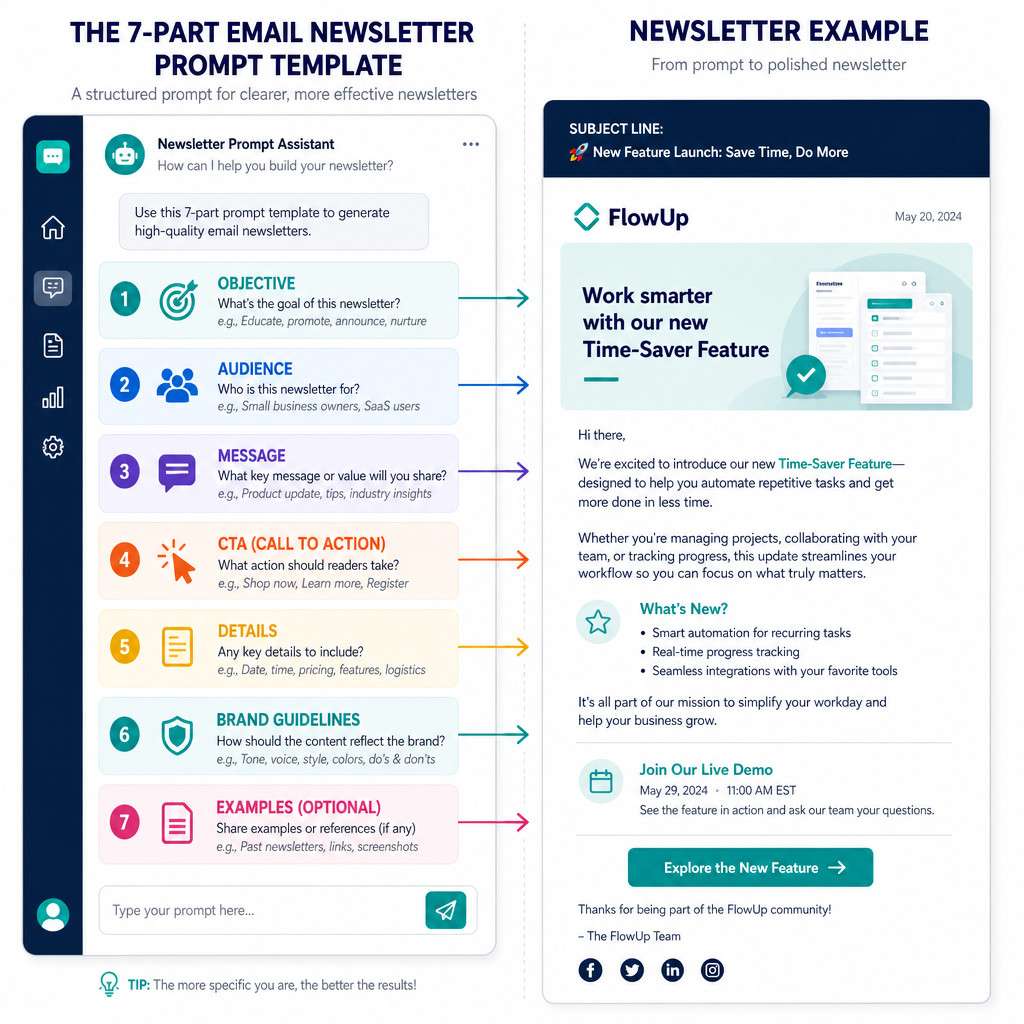
- Structured prompts with seven specific components (objective, audience, key message, CTA, details, brand guidelines, and examples) produce significantly better output than vague requests [1]
- A fully automated newsletter pipeline combining ChatGPT, Python, and delivery APIs can reduce creation time from 5-7 hours to under 30 minutes [4]
- Newsletters with human refinement on top of AI drafts retain readers at higher rates than purely AI-generated content [10]
- Feeding ChatGPT subscriber demographic data can identify multiple audience segments, increasing click-through rates by 22-38% in documented cases [6]
- Specifying exact structural parameters (word count, tone, CTA placement, reading level) consistently outperforms vague instructions [9]
- Iterating through 3-4 rounds of specific feedback improves final output quality substantially compared to single-prompt approaches [10]
- Legal and ethical risks are manageable with proper disclosure practices and human review before sending
- Most major email platforms (Mailchimp, Beehiiv, ConvertKit) work well alongside AI content generation with minimal friction
What Exactly Is ChatGPT and How Can It Help with Email Newsletters
ChatGPT is a large language model developed by OpenAI that generates human-readable text based on conversational prompts. For newsletter creation specifically, it functions as an on-demand writing assistant that can draft subject lines, body copy, CTAs, and even full multi-section issues in seconds.
The practical value for email marketers is speed and consistency. Instead of staring at a blank page, you give ChatGPT a detailed brief and receive a structured draft you can edit and send. It handles the heavy lifting of initial composition, freeing you to focus on strategy, brand voice, and audience insight.
For a broader look at what ChatGPT can do across marketing workflows, the ChatGPT resource archive at WebAIStack covers a wide range of applications worth exploring.
How Much Time Can ChatGPT Really Save in Newsletter Writing
In documented cases, a fully automated AI newsletter system reduced creation time from 5-7 hours per issue to under 30 minutes [4]. Even without full automation, most marketers report cutting their drafting time by 60-70% when using structured prompts.
The time savings break down across several tasks:
- Subject line generation: 10-15 options in under a minute versus 20-30 minutes of manual brainstorming
- Body copy drafting: A 500-word newsletter section in 2-3 minutes versus 45-60 minutes
- Segment variations: Three audience-specific versions of the same email in 10 minutes versus 2-3 hours
- CTA testing: Multiple CTA phrasings generated instantly for A/B testing
The caveat: you still need to review, edit for brand voice, and fact-check. Budget 15-20 minutes for human refinement per issue. The net result is still a dramatic reduction in total production time.
What Are the Best Prompts to Use with ChatGPT for Newsletter Content
The most effective prompts for newsletter creation include seven specific components: a clear objective, target audience description, key message or theme, call to action, relevant details, brand guidelines, and optional examples [1]. Vague prompts like “write me a newsletter” produce generic output. Specific prompts produce usable drafts.
A strong prompt template looks like this:
“Write a 400-word email newsletter for [audience: small business owners in retail]. The goal is [objective: drive attendance to our webinar on inventory management]. Key message: [managing stock manually costs time and money]. CTA: [Register now, 3-4 words, last line]. Tone: [friendly but professional]. Format: [two-sentence intro, three bullet points, one closing paragraph]. Reading level: 8th grade.”
Providing concrete examples in your prompt also matters. Including a sample newsletter format you like yields substantially better results than abstract instructions alone [2].
Additional prompt tactics that work well:
- Ask ChatGPT to generate 5 subject line options with different emotional angles (curiosity, urgency, benefit-led)
- Request a “P.S.” line separately — these often drive clicks and ChatGPT writes them well with specific guidance
- Use the instruction “avoid jargon” explicitly if your audience is non-technical
- Specify paragraph length: “no paragraph longer than 3 sentences”
For teams building more complex workflows around AI content, mastering ChatGPT automation with no-code integrations can extend these prompting techniques into repeatable systems.
Is Using AI for Newsletters Considered Ethical or Spammy
Using AI to assist in newsletter creation is widely accepted in the marketing industry as of 2026, provided the content is accurate, relevant, and reviewed by a human before sending. The ethical line is crossed when AI-generated content is misleading, factually wrong, or used to flood inboxes with irrelevant bulk messages.
Key ethical guidelines to follow:
- Always review AI output for accuracy — ChatGPT can confidently state incorrect facts
- Do not use AI to fabricate testimonials, case studies, or statistics
- Some audiences and jurisdictions expect disclosure when content is AI-assisted; check your local regulations
- Personalization done responsibly (using data subscribers knowingly provided) is not spammy — it is good marketing
The short answer: AI-assisted newsletters are ethical when a human is accountable for what gets sent.
How Do Professional Marketers Currently Use ChatGPT for Email Campaigns
Professional marketers in 2026 use ChatGPT primarily as a first-draft engine, not a final-draft machine. The most documented use pattern involves a “mega prompt” approach where a detailed brief covering topic parameters, formatting requirements, and tone guidelines is submitted once, producing an 80% complete draft that a human editor refines [8].
Other common professional applications include:
- Re-engagement campaigns: Prompting ChatGPT to write sequences for dormant subscribers with escalating urgency
- Welcome sequences: Generating 5-7 email onboarding flows from a single product brief
- A/B test variants: Producing two or three versions of the same email with different emotional hooks
- Campaign calendars: Using ChatGPT to plan 30-day newsletter themes based on product launches or seasonal events
Industry leaders also recommend using ChatGPT’s “reasoning” settings for complex campaigns. Higher reasoning settings produce more accurate and nuanced content for sophisticated campaigns, though they take longer to process [8].
What Are the Limitations of Using ChatGPT for Newsletter Creation
ChatGPT has real limitations that every email marketer should understand before relying on it heavily. The most significant: it does not know your brand, your audience’s history, or recent events unless you tell it explicitly in the prompt.
Specific limitations to plan around:
- No real-time data: ChatGPT cannot pull live stats, trending news, or current pricing without integrations
- Generic tone by default: Without brand voice guidelines in the prompt, output sounds like every other AI-written email
- Factual errors: It can generate plausible-sounding but incorrect claims, especially about statistics or product details
- Repetition over time: Without prompt variation, newsletters from the same template start sounding formulaic after several issues
- No send-time optimization: ChatGPT writes content; it does not analyze open rates or recommend send times
Newsletters with purely AI-generated content show lower reader retention compared to those with meaningful human refinement, despite similar initial open rates [10]. The tool is a collaborator, not a replacement for editorial judgment.
Can ChatGPT Help Personalize Newsletters for Different Audience Segments
Yes, and this is one of its strongest applications. By feeding ChatGPT subscriber demographic data and engagement patterns, marketers can generate tailored content for multiple audience segments from a single brief. Documented cases show this approach can increase click-through rates by 22-38% [6].
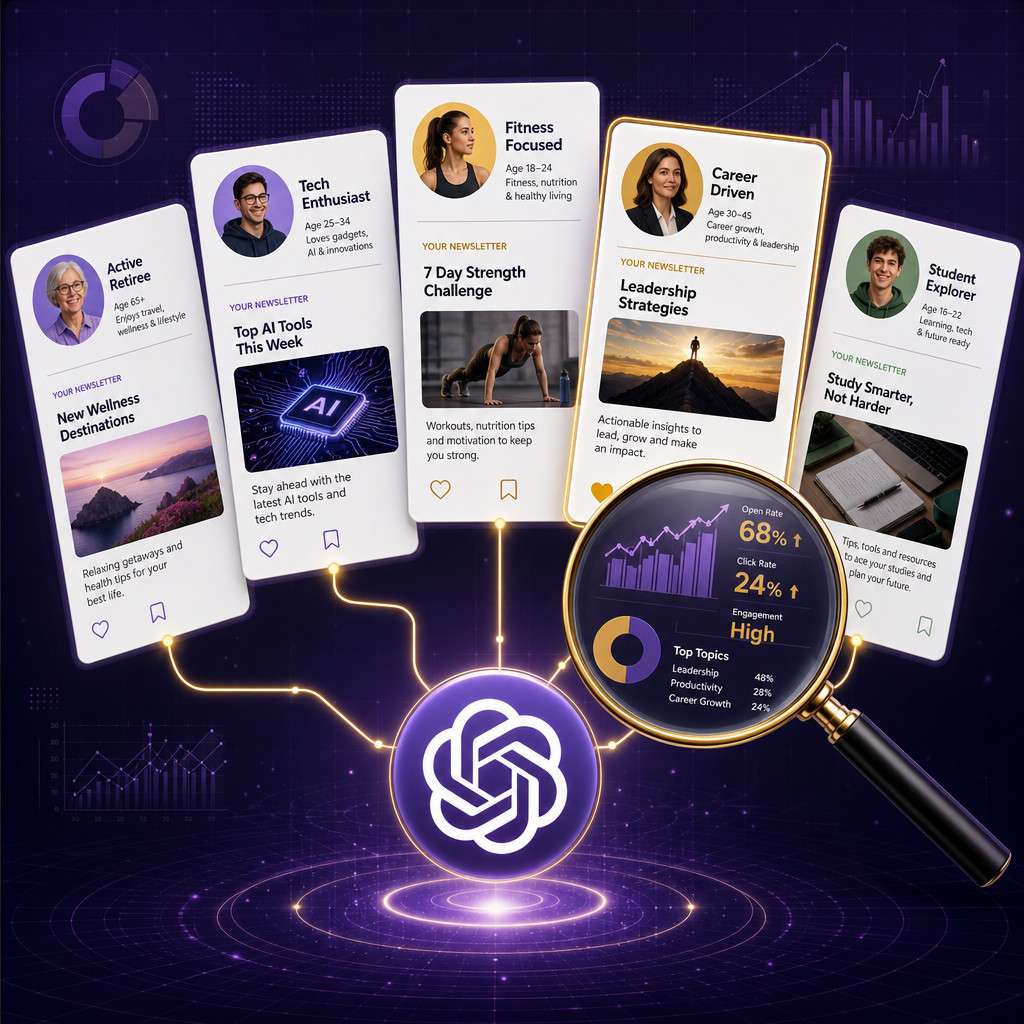
A practical segmentation workflow:
- Define your segments (by industry, purchase history, engagement level, geography, etc.)
- Write one master newsletter brief covering the core message
- Prompt ChatGPT: “Rewrite this for [segment: enterprise buyers who have already purchased once]. Emphasize [upsell value]. Adjust tone to [more formal].”
- Repeat for each segment, adjusting one or two variables per version
- Review each version for accuracy and brand consistency before scheduling
For teams managing large subscriber lists, pairing this approach with automated email workflows amplifies the impact. The comprehensive guide to n8n email automation covers how to build the delivery infrastructure around AI-generated content.
How Much Does It Cost to Integrate AI Tools into an Email Marketing Workflow
The cost depends on which tools you combine. ChatGPT access through OpenAI’s API is priced per token (roughly per word processed), making it cost-effective for most newsletter volumes. As of 2026, ChatGPT Plus costs $20/month for individual use, while API access scales with usage.
Typical cost breakdown for a small to mid-size newsletter operation:
| Tool | Estimated Monthly Cost |
|---|---|
| ChatGPT Plus or API | $20-$50 |
| Email platform (Mailchimp, Beehiiv, ConvertKit) | $15-$100+ depending on list size |
| Automation layer (n8n, Make.com) | $0-$50 (self-hosted n8n is free) |
| Image generation (optional) | $10-$30 |
| Total estimate | $45-$230/month |
For most businesses, this is a fraction of the cost of a freelance copywriter for the same volume of content. The n8n automation mastery guide is a useful resource for building low-cost automation pipelines around your AI content workflow.
What Are Common Mistakes People Make When Using ChatGPT for Newsletters
The most common mistake is treating ChatGPT as a one-shot solution. Marketers submit a vague prompt, get mediocre output, and conclude AI does not work for email. The actual problem is the prompt, not the tool.
Other frequent mistakes:
- Skipping the editing step: Sending AI drafts without human review leads to factual errors and off-brand tone
- No brand voice guidance: Without specific tone instructions, every newsletter sounds the same
- Ignoring iterative refinement: A single prompt rarely produces the best result. Three to four rounds of specific feedback (“make this more direct,” “cut the second paragraph”) improve output quality substantially [10]
- Over-relying on AI for CTAs: Generic CTA prompts produce weak results. Specifying exact word count (3-4 words), the target audience, and the desired action generates CTAs that perform significantly better [6]
- Not specifying reading level: Campaigns targeting general consumers perform better at an 8th-10th grade reading level. Without this instruction, ChatGPT often defaults to more formal, complex language [5]
Which Types of Businesses Benefit Most from AI-Generated Newsletter Content
Businesses with high newsletter frequency and limited writing resources benefit most. This includes solo operators, small marketing teams, content agencies managing multiple client newsletters, and e-commerce brands sending weekly product updates.
Best-fit use cases:
- E-commerce brands with frequent product launches or promotions
- SaaS companies sending weekly feature updates or tips
- Consultants and coaches building thought leadership through regular newsletters
- Agencies managing 5+ client newsletters simultaneously
- Media companies producing daily or weekly roundup newsletters
Businesses with highly regulated content (financial advice, medical information, legal guidance) should use AI for structural drafting only and require thorough expert review before sending. The risk of an AI-generated factual error in a regulated context is too high to skip that step.
How to Make Sure ChatGPT-Generated Newsletters Don’t Sound Robotic
The single most effective fix is adding your own voice in the editing pass. Industry analysis shows newsletters with human refinement retain readers at higher rates than purely AI-generated versions [10]. The AI gives you structure and speed; you add the personality that makes readers stay.
Practical techniques to humanize AI drafts:
- Add one personal anecdote or observation per issue that only you could write
- Replace filler transitions (“Furthermore,” “In conclusion,”) with direct, conversational connectors
- Read the draft aloud — anything that sounds unnatural to say will sound unnatural to read
- Vary sentence length manually — AI tends toward consistent sentence rhythm, which reads as flat
- Include a specific, current reference (a recent event, a client story, a product update) that grounds the content in reality
Also, specify tone explicitly in your prompts. “Write like a knowledgeable friend, not a press release” produces noticeably different output than a generic tone instruction.
What Email Marketing Platforms Work Best with AI Content Generation
Most major platforms work well with AI-generated content because the workflow is simple: generate in ChatGPT, paste into your platform’s editor, format, and schedule. No special integration is required for basic use.
Platform compatibility overview:
| Platform | AI Integration Notes |
|---|---|
| Beehiiv | Has built-in AI writing tools; also works with external ChatGPT drafts |
| Mailchimp | Supports AI-generated content via its own Content Optimizer; external drafts paste cleanly |
| ConvertKit (Kit) | No native AI; external ChatGPT drafts work well in its visual editor |
| ActiveCampaign | Strong segmentation tools pair well with AI-generated segment variants |
| Klaviyo | E-commerce focus; AI-generated product-focused emails integrate smoothly |
For teams wanting to automate the entire pipeline from content generation to delivery, pairing ChatGPT with an automation layer is worth the setup time. The Gmail automation guide using n8n and the email template design guide for Canva cover the production and design sides of this workflow.
Are There Any Legal Risks to Using AI-Generated Newsletter Content
Yes, though the risks are manageable with proper practices. The main legal considerations in 2026 are copyright, disclosure requirements, and accuracy liability.
- Copyright: Content generated by ChatGPT is generally not copyright-protected in most jurisdictions, meaning you own the output but cannot prevent others from generating similar content with similar prompts. Do not use AI to reproduce copyrighted material from other sources.
- Disclosure: Some jurisdictions and platforms are beginning to require disclosure of AI-generated content in commercial communications. Check the rules for your market.
- Accuracy liability: If your newsletter makes factual claims (pricing, health benefits, financial projections) that turn out to be wrong because ChatGPT hallucinated them, you bear the legal responsibility. Human review is not optional in regulated industries.
- Data privacy: If you feed subscriber data into ChatGPT prompts for segmentation, ensure you are compliant with GDPR, CAN-SPAM, and any applicable local data protection laws. Avoid including personally identifiable information in prompts sent to third-party AI services without proper data processing agreements.
Frequently Asked Questions
Can ChatGPT write a full newsletter from scratch? Yes. With a detailed prompt covering audience, objective, tone, structure, and CTA, ChatGPT can produce a complete newsletter draft in under two minutes. Human editing is still recommended before sending.
How do I stop ChatGPT from repeating the same phrases across issues? Include an instruction in your prompt: “Do not use the phrases [list phrases from previous issues].” Rotating your prompt templates every 4-6 issues also prevents formulaic repetition.
Does ChatGPT know my brand voice? Not automatically. You need to describe your brand voice in the prompt or paste in examples of past newsletters and ask ChatGPT to match that style. The more examples you provide, the closer the output will be to your actual voice.
What reading level should I target for newsletter content? For most general consumer audiences, an 8th-10th grade reading level produces the best engagement. Specify this explicitly in your prompt: “Write at an 8th grade reading level.” [5]
Can I use ChatGPT to write subject lines? Yes, and it does this well. Ask for 5-10 subject line options with different angles (curiosity, urgency, benefit, question-based) and A/B test the top two.
How many prompting rounds does it typically take to get a good draft? Three to four rounds of specific refinement feedback consistently produces better results than a single prompt. Treat it as a conversation, not a one-time request [10].
Is ChatGPT better than hiring a copywriter for newsletters? For high-volume, time-sensitive newsletter production, AI is faster and cheaper. For brand-defining, high-stakes campaigns where voice and nuance matter most, a skilled copywriter still adds value that AI cannot fully replicate. Many successful teams use both.
Can I automate the entire newsletter creation process with ChatGPT? Partially. A documented system combining Python scripts, ChatGPT, and a delivery API can handle 80% of the process automatically [4]. Final human review before sending remains best practice.
What is a “mega prompt” for newsletters? A mega prompt is a single, comprehensive brief that includes all parameters — topic, audience, tone, format, word count, CTA, and examples — submitted at once. It reduces the number of back-and-forth refinement rounds needed [8].
Does ChatGPT work for newsletters in languages other than English? Yes. ChatGPT performs well in most major languages. Output quality is strongest in English, Spanish, French, German, and Portuguese. For less common languages, additional human editing is advisable.
Conclusion
The case for using ChatGPT in your newsletter workflow is straightforward: it cuts drafting time dramatically, handles structural work reliably, and scales across audience segments without proportional effort. The path to making it work is equally straightforward — write specific prompts, iterate through a few rounds of feedback, and always apply a human editing pass before you hit send.
Actionable next steps to start this week:
- Write your first structured prompt using the seven-component framework: objective, audience, message, CTA, details, brand guidelines, and an example
- Generate three subject line options for your next issue and A/B test two of them
- Create one segment-specific version of your next newsletter for your highest-value subscriber group
- Read the AI draft aloud and replace anything that sounds flat or generic with your own voice
- If you send weekly, build a simple prompt template you can reuse and refine each issue
To go further, explore how no-code automation tools can integrate ChatGPT into a repeatable email workflow so the production process runs with minimal manual effort each week.
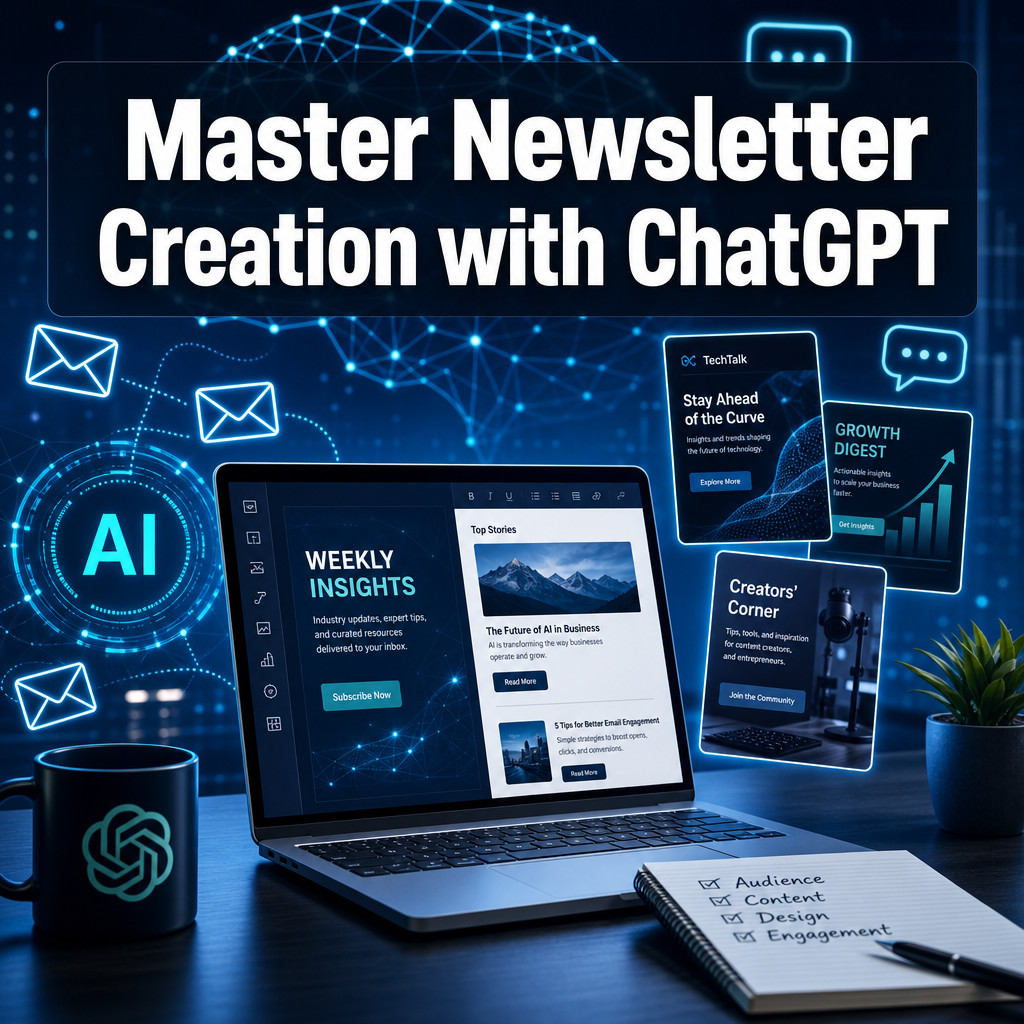
The goal of Revolutionize Your Email Marketing: Mastering Newsletter Creation with ChatGPT is not to remove the human from the process. It is to remove the friction so the human can focus on what actually matters: knowing the audience, shaping the message, and building the relationship that keeps subscribers reading.
References
[1] 50 Chat Gpt Prompts That Make Your Life As An Email Marketer Easier – https://flexmail.be/en/knowledge-center/50-chat-gpt-prompts-that-make-your-life-as-an-email-marketer-easier [2] Watch – https://www.youtube.com/watch?v=NFbHohQtugg [3] Revolutionize Email Marketing With Chatgpt Real Experiment Reveals The Surprising Results 2670 – https://www.ppspy.com/shopify/revolutionize-email-marketing-with-chatgpt-real-experiment-reveals-the-surprising-results-2670 [4] How To Create A Fully Automated Ai Newsletter – https://www.allabtai.com/how-to-create-a-fully-automated-ai-newsletter/ [5] Watch – https://www.youtube.com/watch?v=BCbHW7n4yk0 [6] How To Use Chatgpt For Email Marketing – https://www.beehiiv.com/blog/how-to-use-chatgpt-for-email-marketing [7] Watch – https://www.youtube.com/watch?v=MxBXe6w8gBw [8] Charlie Hills How To Write A Good Newsletter With Chatgpt Activity 7289235627403796480 Vbfg – https://www.linkedin.com/posts/charlie-hills_how-to-write-a-good-newsletter-with-chatgpt-activity-7289235627403796480-VbfG [9] Watch – https://www.youtube.com/watch?v=xzOX-hbnybQ [10] Watch – https://www.youtube.com/watch?v=EKPUgp8vupU