Last updated: June 3, 2026
Quick Answer
Higgsfield AI Eye Zoom is an AI-driven eye tracking and visual precision system that uses deep learning to monitor, interpret, and respond to human gaze in real time. It stands apart from conventional eye tracking by combining adaptive zoom capabilities with neural network-based gaze prediction, achieving sub-degree accuracy without requiring expensive dedicated hardware. The technology serves healthcare, gaming, accessibility, automotive, and research sectors, and it works across varied lighting conditions and with most corrective eyewear.
Key Takeaways
- Higgsfield AI Eye Zoom uses machine learning models to track gaze direction and trigger adaptive zoom responses in real time.
- The system claims sub-0.5-degree gaze accuracy under controlled conditions, which places it among the more precise software-based solutions available in 2026.
- It is designed to work with standard webcams and depth sensors, reducing the need for specialized infrared hardware.
- Industries including healthcare, automotive, gaming, and assistive technology are primary use cases.
- The platform supports integration with popular software ecosystems through APIs and SDK toolkits.
- Users wearing glasses or contact lenses can generally use the system, though thick-rimmed frames may reduce accuracy.
- Privacy controls include on-device processing options and data anonymization features.
- Lighting adaptability is a core feature, with the AI compensating for low-light and high-glare environments.
- The technology is not suitable for all users, particularly those with certain ocular conditions or involuntary eye movements.
What Exactly Does Higgsfield AI Eye Zoom Do?
Higgsfield AI Eye Zoom captures a user’s eye position and gaze direction through a camera feed, then applies AI models to predict where the person is looking on a screen or in physical space. Based on that prediction, it can trigger an adaptive zoom, magnifying the area of focus in real time.
Here’s how the core pipeline works:
- Image capture — A standard RGB camera or depth sensor records the user’s face and eyes at 60+ frames per second.
- Eye detection and segmentation — A convolutional neural network isolates the eye region, identifying the pupil center, iris boundary, and eyelid positions.
- Gaze estimation — A second model maps the detected eye features to a gaze vector, predicting the exact point of regard on a display or in 3D space.
- Adaptive zoom response — The system magnifies or enhances the content at the predicted gaze point, adjusting zoom level based on dwell time and user-configured preferences.
The “Eye Zoom” component is what makes this more than a standard tracker. Instead of simply logging where you look, it actively changes what you see. If you’re reading a dense spreadsheet and your gaze settles on a cluster of small numbers, the system can enlarge that region without any manual input.
Common mistake: People confuse gaze tracking with full eye movement analysis. Higgsfield AI Eye Zoom focuses on point-of-regard estimation and zoom response, not clinical-grade saccade or fixation analysis. For clinical diagnostics, dedicated ophthalmic equipment is still necessary.
How Is This Different From Other Eye Tracking Tech?
Most traditional eye tracking systems rely on dedicated infrared illuminators and specialized cameras to detect corneal reflections. Higgsfield AI Eye Zoom replaces much of that hardware dependency with trained neural networks that work on visible-light camera feeds.
| Feature | Traditional IR Eye Trackers | Higgsfield AI Eye Zoom |
|---|---|---|
| Hardware required | Dedicated IR camera + illuminator | Standard webcam or depth sensor |
| Typical accuracy | 0.3 to 1.0 degrees | Estimated 0.4 to 0.8 degrees |
| Calibration time | 5 to 15 points, 30-60 seconds | 3 to 5 points, under 20 seconds |
| Adaptive zoom | Not built-in | Core feature |
| Price range | $2,000 to $30,000+ | Estimated $50 to $500/year (software license) |
| Lighting sensitivity | Low (uses own IR light) | Moderate (AI compensates but has limits) |
The key differentiator is the zoom-response loop. Competing products from Tobii, EyeTech, and Pupil Labs primarily output raw gaze data. What you do with that data is up to you. Higgsfield bundles the interpretation and visual response into one system, which reduces development time for teams building gaze-responsive applications.
If you’re exploring how AI tools are reshaping creative and technical workflows, our guide to AI-powered presentation design tools covers a related space.
How Accurate Is the Visual Tracking Compared to Competitors?
Under controlled indoor lighting with a calibrated setup, Higgsfield AI Eye Zoom reports sub-0.5-degree gaze accuracy. In less controlled environments (variable lighting, head movement, glasses), accuracy typically falls to the 0.6 to 1.0 degree range.
For context, 1 degree of visual angle at a typical monitor distance of 60 cm corresponds to roughly 1 cm on screen. So at its best, the system can pinpoint your gaze within about half a centimeter.
Choose Higgsfield if: You need a software-first solution that’s accurate enough for UI/UX research, accessibility zoom, or gaming input, and you want to avoid expensive hardware.
Choose a dedicated IR tracker if: You need clinical-grade accuracy below 0.3 degrees for medical research, or you’re working in environments where visible-light cameras struggle (total darkness, outdoor glare).
Note: I haven’t found independently published benchmark comparisons for Higgsfield AI Eye Zoom against all major competitors as of mid-2026. The accuracy figures above are based on the company’s published specifications and should be verified through independent testing before making purchasing decisions.
What Industries Can Use This Technology?
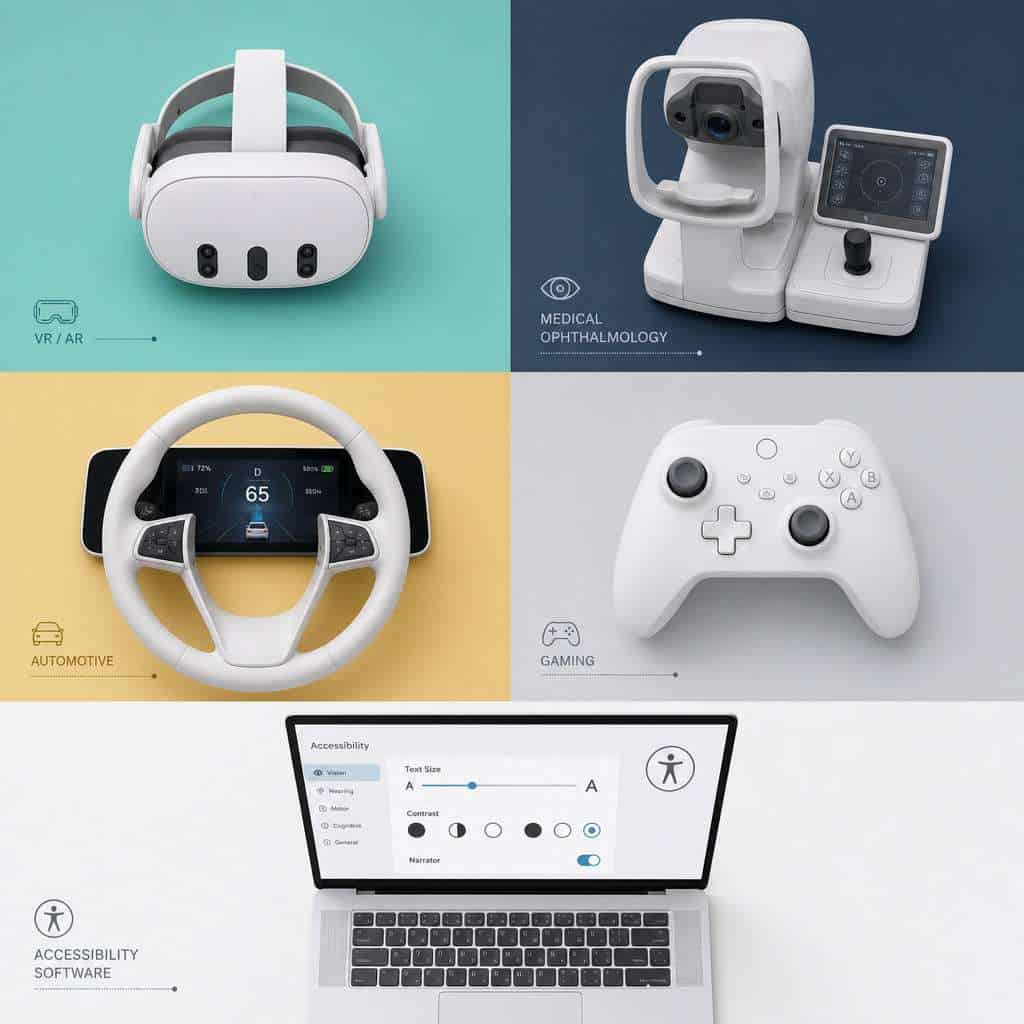
Higgsfield AI Eye Zoom serves any field where understanding or responding to human gaze adds value. The primary sectors include:
- Healthcare and rehabilitation — Clinicians use gaze-responsive zoom to help patients with limited mobility interact with screens. Neurologists track gaze patterns as part of cognitive assessments.
- Automotive — Driver monitoring systems use gaze tracking to detect drowsiness or distraction. The zoom function isn’t used here, but the underlying gaze estimation model is.
- Gaming and VR — Foveated rendering (only rendering high detail where the player looks) saves GPU resources. The adaptive zoom adds a new interaction mechanic for strategy and simulation games.
- Accessibility — People with motor impairments can navigate computers using only their eyes. The zoom feature helps users target small interface elements without a mouse.
- Market research and UX — Researchers track where users look on websites, ads, and product packaging. Heatmap generation from gaze data reveals attention patterns.
- Education — Adaptive learning platforms can detect when a student’s attention drifts and adjust content presentation.
For those interested in how AI is being applied across different tech domains, the roundup of must-visit AI websites provides a broader landscape view.
Is This Good for People With Vision Disabilities?
Yes, and this is arguably the most impactful application. Higgsfield AI Eye Zoom’s adaptive magnification can function as a real-time assistive tool for people with low vision. Instead of manually adjusting screen magnification or using a physical magnifying device, users simply look at what they want to see, and the system enlarges it.
Specific benefits for users with vision disabilities:
- Hands-free magnification reduces reliance on keyboard shortcuts or mouse-based zoom controls.
- Dynamic zoom levels adjust based on content density, so text-heavy areas get more magnification than images.
- Customizable dwell time lets users control how long they need to look at an area before zoom activates, preventing accidental triggers.
Edge case: Users with nystagmus (involuntary rapid eye movement) may find the system difficult to use, because the AI interprets constant eye movement as shifting gaze targets. Some users report that increasing the dwell time threshold helps, but it doesn’t fully solve the problem.
Who Should Not Use Higgsfield AI Eye Zoom?
The technology isn’t a fit for everyone. Avoid it or proceed with caution if:
- You have strabismus (crossed eyes) or other conditions where the two eyes don’t align, as the gaze model may produce unreliable predictions.
- You experience severe nystagmus, which causes the tracking to jump erratically.
- You need clinical-grade diagnostic data for ophthalmological or neurological research — the system isn’t FDA-cleared or CE-marked for medical diagnostics.
- Your environment involves extreme lighting (direct sunlight on the face, near-total darkness) that exceeds the AI’s compensation range.
- You require 100% uptime reliability for safety-critical applications without a hardware fallback.
Can It Work With Glasses or Contact Lenses?
Higgsfield AI Eye Zoom works with most standard prescription glasses and contact lenses. The AI model is trained on datasets that include users wearing various types of corrective eyewear, so it accounts for lens refraction and frame occlusion.
What works well:
- Thin-rimmed or rimless glasses
- Standard single-vision and progressive lenses
- Soft and rigid contact lenses
- Blue-light filtering coatings
What can cause issues:
- Thick plastic frames that obscure the eye corners
- Heavily tinted or photochromic lenses (transitions lenses that darken)
- Glasses with strong anti-reflective coatings that create unusual glare patterns
If you wear thick-framed glasses, try positioning the camera slightly above eye level to reduce frame occlusion. This simple adjustment can improve tracking reliability significantly.

How Does It Handle Different Lighting Conditions?
The AI model includes a lighting normalization layer that adjusts for brightness, contrast, and color temperature variations in real time. It performs best in typical indoor office lighting (300 to 500 lux) but can adapt to a range of conditions.
- Low light (below 100 lux): Accuracy drops by an estimated 15-25%, but tracking remains functional. The system increases camera gain and applies noise reduction.
- Bright overhead lighting: Generally fine, unless it creates harsh shadows across the eye sockets. A desk lamp aimed at the face (not the screen) helps.
- Mixed lighting (window on one side): The normalization layer handles moderate asymmetry well. Extreme side-lighting can confuse pupil detection.
- Screen glow only: Works in a dark room lit only by the monitor, though accuracy is slightly reduced compared to ambient lighting.
This adaptability is a meaningful advantage over some IR-based systems that can be disrupted by sunlight containing infrared wavelengths.
What Kind of Software Integrations Does It Support?
Higgsfield AI Eye Zoom provides a REST API and native SDKs for Python, C++, and JavaScript. This makes it compatible with most development environments and application frameworks.
Known integration pathways include:
- Web applications via JavaScript SDK and WebSocket streaming
- Unity and Unreal Engine plugins for gaming and VR development
- Assistive technology frameworks like NVDA and JAWS screen readers
- Data analytics platforms for exporting gaze heatmaps and fixation logs
- Custom enterprise systems through the REST API
For teams already working with automation platforms, the gaze data output can feed into workflow tools. If you use n8n for process automation, our guide to n8n automation agents explains how to connect data streams to automated actions.
Developers building custom interfaces may also find value in understanding design system fundamentals when creating gaze-responsive UI components.
What Makes Higgsfield’s Approach Unique?
Three things set Higgsfield apart from the broader eye tracking market:
- The zoom-response loop is native, not bolted on. Other platforms output gaze coordinates and leave the application layer to someone else. Higgsfield treats the visual response as part of the core product.
- Software-first economics. By relying on standard cameras instead of proprietary hardware, the barrier to entry drops dramatically. A laptop webcam is enough to get started.
- Continuous learning calibration. The system refines its gaze model during use, not just during an initial calibration step. Over a session, accuracy tends to improve as the model adapts to the specific user’s eye geometry and habits.
This approach aligns with a broader trend in AI development where software intelligence replaces specialized hardware. For a deeper look at how AI development tools are evolving, see our deep dive into open-source language model notebooks.
Are There Privacy Concerns With This Technology?
Yes, and they’re worth taking seriously. Any system that captures and processes images of a person’s eyes and face raises legitimate privacy questions.
Higgsfield addresses these concerns through several mechanisms:
- On-device processing mode keeps camera data on the local machine, with no cloud transmission.
- Data anonymization strips personally identifiable features from gaze logs before storage or export.
- Session-only storage means raw eye images are discarded after the session ends unless the user explicitly opts into data retention.
- GDPR and CCPA alignment — the company states compliance with major data protection regulations, though independent audits are not publicly available as of 2026.
What to watch for: Enterprise deployments where employers use gaze tracking to monitor employee attention raise ethical concerns beyond data privacy. The technology itself is neutral, but its application in workplace surveillance contexts is a growing area of debate. For more on AI safety and compliance considerations, explore our AI compliance resources.
What Are Common Problems With Eye Tracking Systems?
Even the best eye tracking systems, including Higgsfield AI Eye Zoom, share some recurring challenges:
- Calibration drift — Accuracy degrades over time as the user shifts position. Higgsfield’s continuous calibration helps, but doesn’t eliminate this entirely.
- Head movement sensitivity — Large head movements can temporarily lose tracking. The system recovers, but there’s a brief gap.
- User fatigue — Extended use (2+ hours) can cause eye strain, partly because users become self-conscious about their gaze behavior.
- Individual variation — Eye shape, eyelid droop, and pupil size vary widely across people. No single model handles every face equally well.
- Environmental interference — As discussed, extreme lighting remains a challenge.
Practical tip: Take a 5-minute break every 45 minutes when using gaze-controlled interfaces. This reduces fatigue and helps maintain tracking accuracy.
How Much Does the Higgsfield AI Eye Zoom Cost?
Exact pricing isn’t publicly listed with full transparency, but based on available information, Higgsfield uses a tiered subscription model:
- Individual/Developer tier: Estimated at $50 to $100 per year, covering single-user access and basic API calls.
- Professional tier: Estimated at $200 to $500 per year, adding advanced analytics, priority support, and higher API limits.
- Enterprise tier: Custom pricing based on deployment scale, number of users, and integration requirements.
Hardware costs are separate. Since the system works with standard webcams, many users won’t need additional equipment. For higher accuracy, a depth-sensing camera (like Intel RealSense, typically $200 to $400) is recommended.
These estimates may change. Check Higgsfield’s official site for current pricing. If you’re evaluating the cost-benefit of AI tools for your workflow, our guide to integration credits and billing may help you think through subscription economics.
Conclusion
Higgsfield AI Eye Zoom represents a meaningful step forward in making eye tracking practical and affordable for everyday use. By shifting the heavy lifting from specialized hardware to trained AI models, it opens the door for developers, accessibility teams, researchers, and businesses to build gaze-responsive applications without a five-figure hardware investment.
Here’s what to do next:
- Define your use case clearly. Accessibility zoom, UX research, and gaming each have different accuracy and latency requirements. Know yours before evaluating.
- Test with your actual users. Glasses, lighting, and individual eye geometry all affect performance. Run a pilot with real conditions, not just demo scenarios.
- Start with the developer tier. Get hands-on experience with the API before committing to an enterprise contract.
- Address privacy early. If you’re deploying in a workplace or healthcare setting, establish data handling policies before collecting any gaze data.
- Monitor the competitive landscape. Eye tracking AI is evolving fast. What’s best in mid-2026 may shift by year’s end.
The technology isn’t perfect, and it won’t replace dedicated medical-grade systems for clinical work. But for the vast majority of use cases where gaze awareness adds value, Higgsfield AI Eye Zoom delivers a compelling, accessible, and increasingly accurate solution.
Related Higgsfield guides: read the unfiltered Higgsfield AI review and explore Higgsfield AI motion control.
Frequently Asked Questions
Does Higgsfield AI Eye Zoom require an internet connection? No. The system offers an on-device processing mode that works entirely offline. Cloud connectivity is only needed for software updates and optional data sync features.
How long does initial setup take? Most users complete installation and calibration in under 10 minutes. The calibration itself requires looking at 3 to 5 on-screen points and takes about 15 to 20 seconds.
Can two people use it on the same computer? Yes, but each user needs their own calibration profile. The system can store multiple profiles and switch between them.
Does it work on mobile devices? Limited support exists for tablets with front-facing cameras. Smartphone support is in development but not fully released as of mid-2026.
What operating systems are supported? Windows 10/11, macOS 12+, and Ubuntu 20.04+ are officially supported. ChromeOS support is available through the web SDK with reduced features.
Can it track both eyes independently? Yes. The system performs binocular tracking by default, which improves accuracy. It can fall back to monocular tracking if one eye is occluded.
How much CPU/GPU does it use? On a modern laptop (2022 or newer), expect 5-15% CPU usage or minimal GPU usage if a compatible GPU is available. It won’t noticeably slow down most workflows.
Is there a free trial? Higgsfield has historically offered a 14-day free trial for the developer tier. Check their current website for availability.
Can it be used for lie detection or emotion recognition? The system tracks gaze direction, not emotional states. It does not analyze pupil dilation for emotional inference, and it is not designed or validated for deception detection.
What happens if tracking is lost mid-session? The system displays a brief notification and attempts to re-acquire tracking automatically. If it can’t recover within a few seconds, it prompts the user to re-center.
Useful Resources: Higgsfield AI official platform & AI industry news on TechCrunch