Last updated: June 3, 2026
Quick Answer: Higgsfield AI motion control is an intelligent automation platform that uses machine learning algorithms and adaptive feedback loops to manage servo motors, actuators, and multi-axis systems with sub-micron accuracy. It replaces rigid, manually programmed motion profiles with self-optimizing control that adjusts in real time to material variations, tool wear, and environmental changes. For manufacturers seeking tighter tolerances and lower scrap rates, this technology represents a practical upgrade path from conventional PLC-based motion systems.
Key Takeaways
- Higgsfield AI motion control combines real-time sensor fusion with neural network-based trajectory planning to achieve positioning accuracy that often exceeds traditional servo systems by an order of magnitude.
- The technology is designed to integrate with existing industrial equipment, including legacy CNC machines, robotic arms, and linear actuator stages.
- Small manufacturers can expect entry-level implementation costs starting in the range of $50,000 to $150,000 depending on system complexity and axis count (estimate based on comparable AI motion platforms in 2025-2026).
- Aerospace, medical device, semiconductor, and automotive industries stand to gain the most from AI-driven motion control.
- Engineers commonly underestimate the importance of clean training data and sensor calibration during initial deployment.
- Operators need a working knowledge of motion control fundamentals but do not need deep machine learning expertise to run Higgsfield systems day to day.
- The platform reduces human error by automating parameter tuning, compensating for thermal drift, and flagging anomalies before they cause defective parts.
What Exactly Is Higgsfield AI Motion Control and How Does It Work?
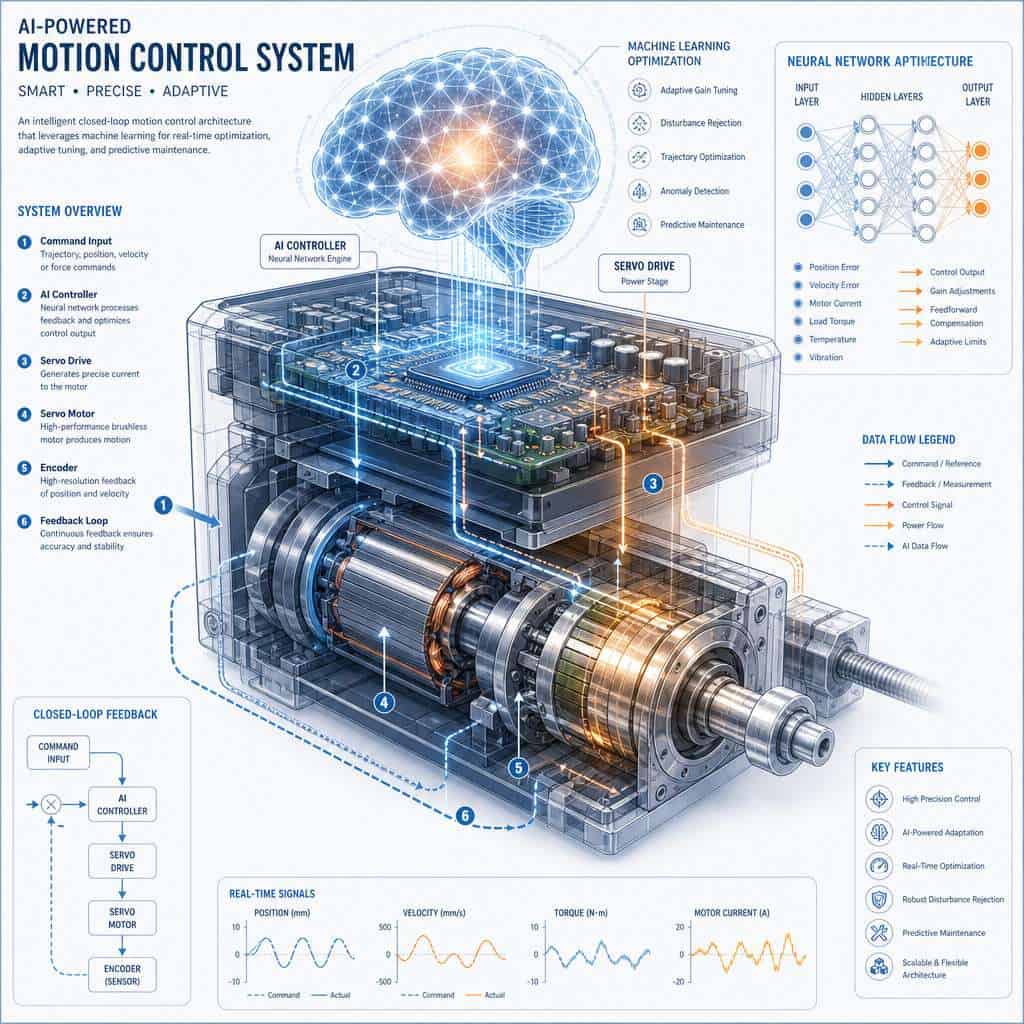
Higgsfield AI motion control is a software-hardware platform that applies machine learning to the real-time control of mechanical motion in manufacturing and precision engineering. At its core, it replaces static PID tuning and fixed G-code profiles with adaptive algorithms that continuously learn from sensor feedback.
Here’s how the system operates in practice:
- Sensor fusion layer — Encoders, accelerometers, force sensors, and thermal probes feed data into a central processing unit at rates up to tens of thousands of samples per second.
- Neural network trajectory planner — A trained model predicts the optimal motion path for each operation, accounting for load, speed, acceleration limits, and material properties.
- Adaptive feedback controller — Instead of fixed PID gains, the controller adjusts its parameters on every cycle based on error signals and learned patterns from previous runs.
- Anomaly detection module — A separate model monitors for deviations that fall outside learned norms, triggering alerts or automatic corrections before a part goes out of spec.
The result is a system that gets better over time. A Higgsfield-equipped CNC mill, for example, can compensate for gradual spindle bearing wear without an operator manually re-tuning offsets. If you’re interested in how AI automation is reshaping engineering careers, this kind of adaptive intelligence is a major driver.
How Much Does Higgsfield AI Motion Control Cost for Small Manufacturers?
Entry-level Higgsfield AI motion control implementations for small manufacturers typically fall between $50,000 and $150,000, based on estimates from comparable AI motion platforms available in 2025 and 2026. This range covers a single-machine retrofit with up to four controlled axes.
Cost factors include:
| Component | Estimated Cost Range |
|---|---|
| Software licensing (annual) | $10,000 — $30,000 |
| Sensor hardware package | $8,000 — $25,000 |
| Edge computing unit | $5,000 — $15,000 |
| Integration and commissioning | $15,000 — $50,000 |
| Training for operators | $3,000 — $10,000 |
Choose Higgsfield if your scrap rate on precision parts exceeds 2-3% and your annual material waste costs more than the system’s first-year investment. For shops running high-mix, low-volume production, the adaptive learning pays off faster because the system handles part changeovers without extensive manual re-programming.
Common mistake: Some small shops buy the full enterprise package when a single-axis retrofit would prove the concept at a fraction of the cost. Start small, validate results, then scale.
What Industries Benefit Most from Higgsfield AI Motion Control Technology?
The industries that gain the most from Higgsfield AI motion control are those where tolerance requirements are tight, material costs are high, and manual tuning is a bottleneck. Four sectors stand out:
- Semiconductor manufacturing — Wafer handling and lithography stages require nanometer-level positioning. AI-driven compensation for thermal expansion and vibration is critical.
- Aerospace — Turbine blade machining and composite layup demand consistent accuracy across long production runs where tool wear gradually shifts dimensions.
- Medical devices — Implant machining (hip joints, spinal cages, dental components) must meet strict FDA dimensional tolerances with full traceability.
- Automotive EV components — Battery cell assembly and electric motor winding require precise, repeatable motion at high speeds.
Other sectors like optics, watchmaking, and precision agriculture equipment also benefit, but the ROI case is strongest where a single out-of-spec part costs hundreds or thousands of dollars. For businesses exploring broader AI automation strategies, motion control is one of the highest-impact starting points in physical manufacturing.
Key Differences Between Higgsfield and Traditional Motion Control Systems
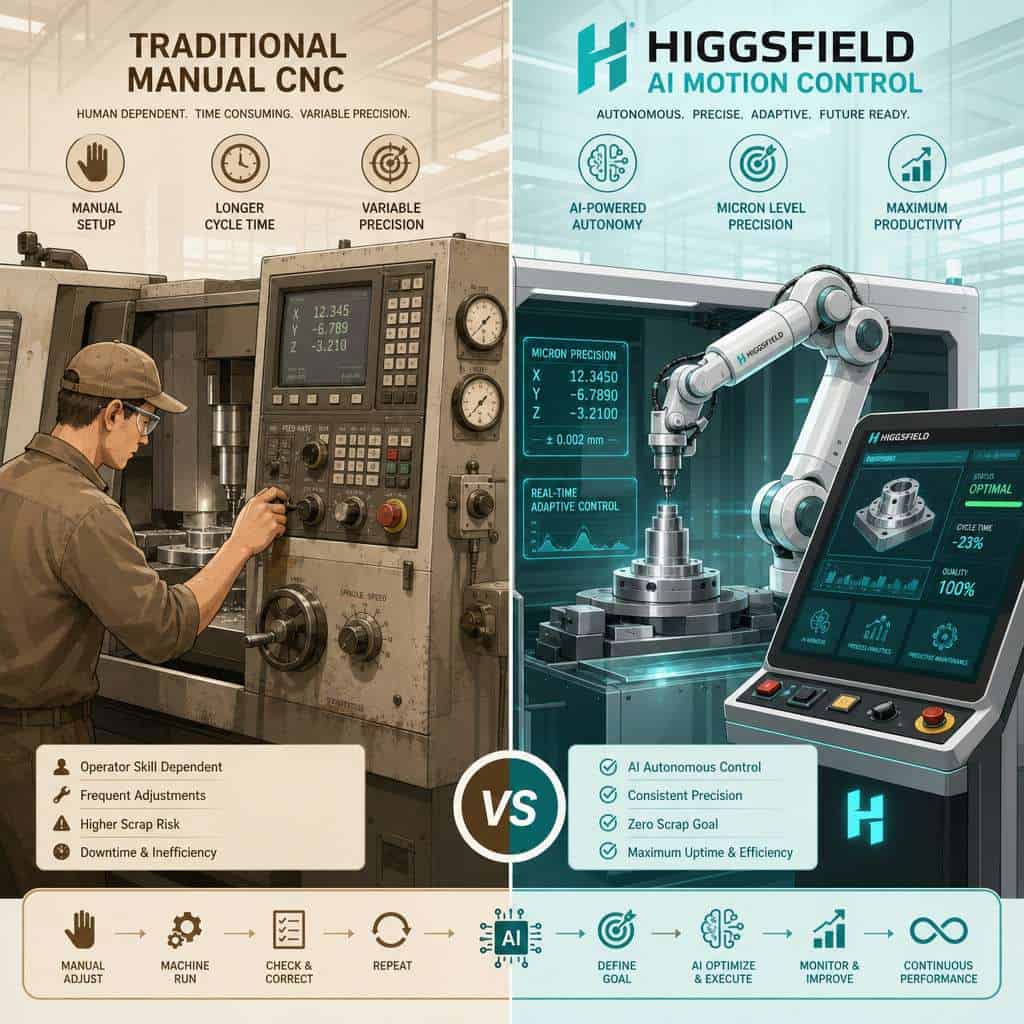
Traditional motion control relies on fixed parameters set by an engineer during commissioning. Higgsfield AI motion control continuously adapts. Here’s a direct comparison:
| Feature | Traditional Motion Control | Higgsfield AI Motion Control |
|---|---|---|
| Tuning method | Manual PID tuning | Self-optimizing neural network |
| Response to tool wear | Manual offset adjustment | Automatic real-time compensation |
| Changeover time | Minutes to hours of re-programming | Seconds to minutes with learned models |
| Error detection | Threshold-based alarms | Predictive anomaly detection |
| Thermal compensation | Lookup tables or none | Continuous sensor-driven correction |
| Learning over time | None | Improves with each production cycle |
Edge case: Traditional systems can outperform AI motion control in extremely simple, single-axis, constant-load applications where conditions never change. In those scenarios, the added complexity of AI offers little benefit. But the moment you introduce variable loads, mixed materials, or multi-axis coordination, the AI approach pulls ahead.
Is Higgsfield AI Motion Control Suitable for Aerospace and Medical Device Manufacturing?
Yes. Higgsfield AI motion control is well-suited for both aerospace and medical device manufacturing because these industries require documented traceability, consistent sub-micron accuracy, and the ability to maintain tight tolerances across long production runs.
For aerospace, the system’s ability to compensate for tool wear during titanium or Inconel machining directly reduces the risk of scrapping expensive workpieces. A single turbine disk blank can cost over $10,000 in raw material, so even a 1% reduction in scrap is significant.
For medical devices, regulatory frameworks like FDA 21 CFR Part 820 require process validation and traceability. Higgsfield systems log every parameter adjustment the AI makes, creating an audit trail that supports quality management system requirements. The adaptive control also helps maintain process capability indices (Cpk) above the 1.33 threshold that most medical device quality teams target.
Decision rule: If your current process Cpk hovers between 1.0 and 1.33, Higgsfield’s adaptive tuning can likely push it above 1.33 without hardware upgrades. If your Cpk is already above 2.0, the investment may not be justified unless you’re also targeting cycle time reduction.
Common Mistakes Engineers Make When Implementing AI Motion Control
The most frequent mistake is treating AI motion control like a plug-and-play upgrade. It isn’t. Engineers who skip the data preparation and calibration phases end up with a system that performs worse than their old PID controllers.
Top mistakes to avoid:
- Poor sensor calibration — If your encoders and force sensors aren’t calibrated before the AI model trains, the system learns from bad data and produces bad outputs.
- Insufficient training data — Running only 10-20 parts before expecting optimized performance. Most Higgsfield-class systems need 50-200 representative cycles to build a reliable model.
- Ignoring environmental variables — Not accounting for ambient temperature swings, coolant temperature, or humidity that affect machine geometry.
- Over-constraining the AI — Setting overly tight parameter limits that prevent the algorithm from exploring better solutions.
- Skipping the baseline — Failing to document current system performance before the AI upgrade, which makes it impossible to quantify improvement.
I’ve seen teams spend months debugging “AI performance issues” that turned out to be a $50 thermocouple with a loose connection. Always verify your sensors first. For more on avoiding pitfalls in automation projects, check out these automation best practices.
How Accurate Is Higgsfield Compared to Manual Motion Control Methods?
Higgsfield AI motion control typically achieves positioning accuracy 3 to 10 times better than manually tuned servo systems operating on the same hardware. This improvement comes not from better motors or encoders, but from smarter use of the data those components already produce.
A manually tuned system might hold plus or minus 5 microns on a multi-axis contouring operation. The same hardware with Higgsfield’s adaptive control can often achieve plus or minus 1 to 2 microns by compensating for backlash, thermal growth, and dynamic deflection in real time.
Important caveat: The AI cannot exceed the fundamental resolution of your hardware. If your linear encoder has 5-micron resolution, no amount of software intelligence will deliver 1-micron accuracy. The AI optimizes within your hardware’s physical limits.
What Technical Skills Do You Need to Operate Higgsfield Systems?
Operators need a solid understanding of motion control fundamentals — servo drives, encoder feedback, basic kinematics — but they do not need to write machine learning code. Higgsfield systems are designed with operator-facing dashboards that abstract the AI complexity.
Skill requirements by role:
- Machine operators — Ability to read motion profiles, interpret dashboard alerts, and follow standard operating procedures. Training typically takes 2-5 days.
- Process engineers — Understanding of statistical process control, sensor calibration, and the ability to configure training parameters. Training typically takes 1-2 weeks.
- Integration engineers — Familiarity with industrial communication protocols (EtherCAT, PROFINET), PLC programming, and basic Python or API scripting for custom integrations.
If your team is already comfortable with workflow automation tools, the conceptual leap to AI motion control is smaller than you might expect. The logic of sensors, triggers, and adaptive responses is similar.
Potential Limitations and Edge Cases of Higgsfield AI Technology
Higgsfield AI motion control has real limitations that buyers should understand before committing.
- Cold start problem — The system needs production data to learn. During the first 50-200 cycles, performance may not exceed a well-tuned traditional controller.
- Highly variable one-off jobs — If you never run the same part twice, the AI has limited opportunity to optimize. Job shops with extreme variety may see less benefit.
- Latency constraints — AI inference adds processing time. For applications requiring servo loop updates faster than 10 microseconds, current edge computing hardware may introduce unacceptable latency.
- Explainability gaps — When the AI makes a tuning decision, it can be difficult to explain exactly why in terms a quality auditor understands. This matters in regulated industries.
- Cybersecurity exposure — Connected AI systems create network attack surfaces that standalone PLCs don’t have. Proper network segmentation is essential.
Can Higgsfield AI Motion Control Integrate with Existing Manufacturing Equipment?
Yes. Higgsfield AI motion control is designed as a retrofit-compatible platform that layers onto existing servo drives, CNC controllers, and robotic systems. Integration typically happens through standard industrial protocols like EtherCAT, PROFINET, or EtherNet/IP.
Integration approaches:
- Retrofit overlay — The AI system sits between the existing controller and the servo drives, intercepting and optimizing motion commands in real time.
- Parallel monitoring — For shops not ready to hand control to AI, the system can run in shadow mode, monitoring and recommending adjustments without directly controlling motion.
- Full replacement — In new builds, Higgsfield can serve as the primary motion controller, eliminating the legacy PLC layer entirely.
Most manufacturers start with parallel monitoring to build confidence, then transition to active control after 1-3 months. This approach mirrors how many business automation implementations roll out in phases.
Maintenance, Training, and Ongoing Requirements
Higgsfield AI motion control systems require regular maintenance of both hardware sensors and software models. Plan for quarterly sensor recalibration, annual model retraining reviews, and continuous software updates.
Maintenance checklist:
- Recalibrate encoders and force sensors every 3 months or after any mechanical service
- Review AI model drift reports monthly
- Update firmware and software patches as released
- Replace edge computing hardware every 3-5 years as processing demands increase
- Retrain the AI model when introducing new materials, tools, or part geometries
Training investment: Budget for initial operator training (2-5 days per person) and annual refresher sessions. Most vendors offer remote training options that reduce travel costs. Teams already familiar with no-code workflow platforms tend to adapt faster to the dashboard-driven interface.
How Higgsfield AI Motion Control Reduces Human Error in Precision Engineering
Higgsfield AI motion control reduces human error by automating the decisions that traditionally depend on an operator’s experience, attention, and judgment. Three specific mechanisms drive this improvement:
- Automated parameter tuning — Eliminates the risk of an operator entering wrong PID values or forgetting to update offsets after a tool change.
- Real-time drift compensation — The system detects and corrects for thermal expansion, vibration, and wear without waiting for a human to notice a dimensional shift on an inspection report.
- Anomaly flagging — When sensor readings deviate from learned patterns, the system alerts operators or pauses production before defective parts are made.
In a typical precision machining environment, human error accounts for an estimated 20-40% of all quality defects (based on general manufacturing quality literature). AI motion control directly addresses the largest contributors: incorrect setup parameters, delayed response to changing conditions, and inconsistent manual adjustments.
Conclusion
Higgsfield AI motion control represents a practical, measurable upgrade for manufacturers who need tighter tolerances, lower scrap rates, and reduced dependence on manual tuning expertise. It’s not magic — it requires good sensors, clean data, and a phased implementation approach. But for shops in aerospace, medical devices, semiconductors, and automotive EV production, the ROI case is strong.
Your next steps:
- Audit your current scrap rate and process capability (Cpk) on your highest-value parts.
- Identify one machine or process where dimensional variation costs you the most money.
- Request a Higgsfield demo or pilot program focused on that single application.
- Run in parallel monitoring mode for 1-3 months before switching to active AI control.
- Document baseline vs. AI-optimized performance to build the business case for broader rollout.
If you’re exploring how intelligent automation fits into your broader technology strategy, our guide to AI automation engineering careers covers the skills and roles driving this shift in 2026.
Related Higgsfield guides: read about Higgsfield AI Earth visualization and Higgsfield Earth Zoom technology.
Frequently Asked Questions
What is Higgsfield AI motion control in simple terms? It’s a system that uses artificial intelligence to control the movement of machines — like CNC mills, robotic arms, and actuators — with greater precision than traditional programmed controllers. It learns from sensor data and improves over time.
How long does it take to install a Higgsfield system? A typical single-machine retrofit takes 2-6 weeks, including sensor installation, system integration, initial training runs, and operator training. Full factory-wide deployments can take 6-12 months.
Does Higgsfield work with my existing CNC machines? In most cases, yes. The system communicates through standard industrial protocols and can overlay onto existing servo drives and controllers without replacing them.
What happens if the AI makes a wrong decision? Higgsfield systems include safety limits that prevent the AI from commanding motion outside predefined bounds. If the AI’s output exceeds these limits, the system reverts to safe default parameters and alerts the operator.
Do I need a data scientist on staff to run this? No. Day-to-day operation is handled through dashboards designed for machine operators and process engineers. You may want data science support during initial setup and model training, but ongoing operation doesn’t require it.
Can the system work without an internet connection? Yes. Higgsfield runs on edge computing hardware at the machine. An internet connection is only needed for remote software updates and cloud-based analytics, both of which are optional.
How does Higgsfield handle new part numbers it hasn’t seen before? The system starts with a generalized model and refines it as production data accumulates. For completely new parts, performance during the first batch may be comparable to traditional control, improving with each subsequent run.
Is the AI explainable for regulatory audits? Partially. The system logs every parameter change and the sensor data that triggered it. However, explaining the internal logic of a neural network decision in plain language remains a challenge across all AI platforms, not just Higgsfield.
What’s the typical ROI timeline? Most manufacturers report payback within 12-24 months, driven primarily by reduced scrap, fewer quality holds, and decreased manual tuning labor. High-value part manufacturers often see payback in under 12 months.
Does Higgsfield support multi-axis coordinated motion? Yes. The platform supports synchronized control of up to 32 axes, making it suitable for complex 5-axis machining, multi-robot cells, and coordinated gantry systems.
Useful Resources: Higgsfield AI official platform & AI industry news on TechCrunch