Last updated: May 11, 2026
Quick Answer: Base44 uses a dual-credit system: message credits power AI-driven building conversations, while integration credits fuel backend actions like API calls, database operations, and third-party connections. The free plan includes 25 message credits and 100 integration credits per month, neither of which rolls over [1][3]. Understanding how both pools work, and when each gets consumed, is the single most important factor in avoiding unexpected workflow interruptions on the platform.
Key Takeaways
- Base44 operates on two independent credit pools: message credits and integration credits. Running out of either one halts functionality, even if the other pool has credits remaining [8].
- The free tier provides 25 message credits (capped at 5 per day) and 100 integration credits monthly [3].
- There is no credit calculator available, so you can’t predict exactly how many credits a prompt will consume before running it [3].
- Credits do not roll over month to month, which is a frequent pain point among users [3].
- One-time integration credit purchases are not yet available; upgrading your plan is currently the only way to get more credits mid-cycle [5].
- Keeping the AI model on “Automatic” rather than selecting a specific model manually helps conserve credits [1].
- Detailed per-action breakdowns for integration credits are not yet supported; you can only see overall consumption [9].
- A hybrid workflow (finalizing UI designs in external tools before entering Base44) can significantly reduce wasted building credits [3].

What Are Base44 Integration Credits and How Do They Work?
Integration credits are the currency Base44 charges when your app performs backend operations. Every time your project triggers a database query, sends an email, calls an external API, or executes a scheduled automation, integration credits get deducted from your monthly pool [1].
This is separate from message credits, which are consumed when you interact with Base44’s AI builder through prompts. The distinction matters because:
- Message credits = building and modifying your app via AI conversation
- Integration credits = running your app’s live backend functions
A common mistake is assuming one credit pool covers everything. It doesn’t. You could have 50 message credits left but zero integration credits, and your app’s automations will stop working until the next billing cycle [8]. Think of it like a car with two fuel tanks: one for the engine, one for the air conditioning. Both need fuel independently.
Base44 redesigned its credits dashboard in April 2026 to provide clearer separation between these two pools, making it easier to monitor consumption at a glance [1].
How Many Credits Does Each Base44 Plan Include?
Here’s a breakdown of what each tier offers as of 2026:
| Feature | Free Plan | Paid Plans (vary by tier) |
|---|---|---|
| Message credits/month | 25 | Scales with plan level |
| Daily message cap | 5 per day | Higher or uncapped |
| Integration credits/month | 100 | Scales with plan level |
| Credit rollover | No | No |
| One-time credit purchase | Not available | Not available |
The free plan’s 5-credit daily cap on messages is particularly restrictive. Even if you have remaining monthly message credits, you can’t use more than 5 in a single day [3]. This forces you to spread your building sessions across multiple days.
Choose the free plan if you’re exploring Base44 for a small personal project or proof of concept. Upgrade if you’re building anything with regular backend activity, because 100 integration credits can deplete quickly with database-heavy apps.
Why Can’t I See Exactly Where My Integration Credits Go?
As of early 2026, Base44’s Credit Usage page shows your overall integration credit consumption but does not provide line-item logs for individual actions [9]. You won’t see “API call to Stripe: 2 credits” or “database write: 1 credit” in a detailed breakdown.
This is a known gap. The community has formally requested detailed integration credit reports through Base44’s feedback portal [9]. Until this feature ships, you’re essentially working with a gas gauge but no trip computer.
Workaround: Monitor your credit balance before and after testing specific integrations. Run one integration at a time during testing phases so you can roughly estimate per-action costs. It’s manual, but it’s the best option available right now.
If you’re building apps that rely heavily on automations and backend logic, this lack of transparency makes budgeting difficult. For projects where AI-powered content generation tools or automated workflows are central, plan conservatively and check your dashboard frequently.
How Does Base44’s Credit System Compare to Alternatives?
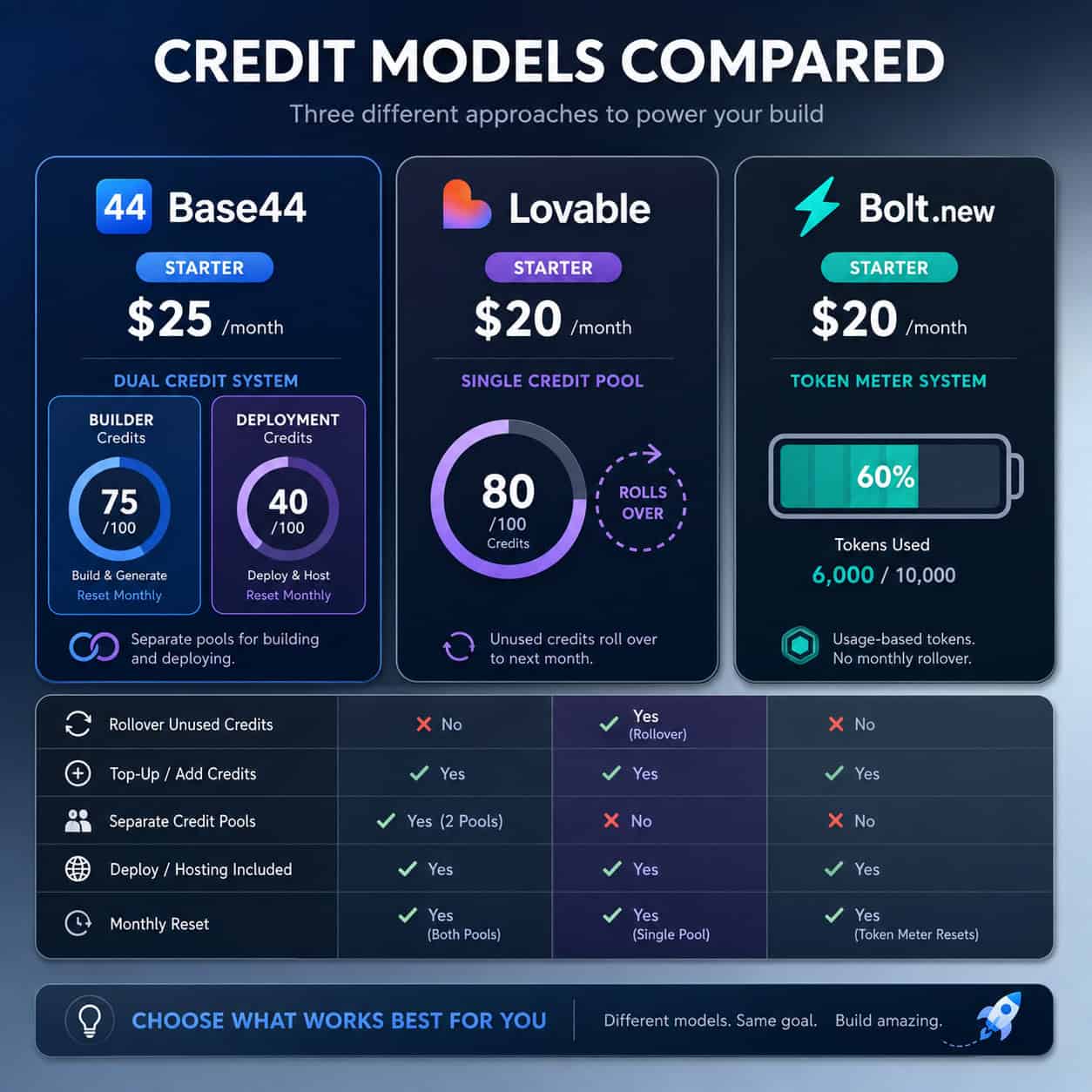
The dual-credit model is unusual among no-code AI builders. Here’s how Base44 stacks up against two major competitors:
| Platform | Credit Model | Starting Price (Annual) | Rollover | On-Demand Top-ups |
|---|---|---|---|---|
| Base44 | Dual (message + integration) | $16/month | No | No |
| Lovable | Single credit pool | $21/month | Limited | Yes |
| Bolt.new | Token-based (1M free/month) | $18/month | Varies | Yes |
Lovable offers on-demand credit top-ups and limited rollover, which directly addresses the two biggest complaints about Base44’s system [3]. If mid-month credit exhaustion is a recurring problem for you, Lovable’s flexibility may justify the higher price.
Bolt.new uses a token-based system (1 million tokens free monthly) that simplifies tracking. Instead of juggling two credit types, you manage a single token balance [3]. At $18/month annually for 10 million tokens, consumption tracking is more straightforward.
Choose Base44 if you want the lowest entry price and your project has modest backend requirements. Choose Lovable if you need the ability to buy more credits without waiting for a billing cycle reset. Choose Bolt.new if you prefer a simpler single-resource model.
For teams evaluating no-code website design platforms, the credit model should be a key decision factor alongside features and UI quality.
What Strategies Help Conserve Base44 Credits?
Credit conservation isn’t about being stingy; it’s about being strategic. Here are proven approaches:
Keep AI model selection on “Automatic.” Manual model selection is less predictable and can consume more credits, especially for complex tasks [1].
Finalize your UI before entering Base44. Experts recommend using dedicated design tools like Figma or Banani to lock down your visual design first, then bring the finalized design into Base44 for development [3]. This eliminates wasted message credits on UI experimentation. Our guide on Figma UI kits and design systems covers how to prepare production-ready designs.
Write detailed, specific prompts. Vague prompts lead to more back-and-forth iterations, each consuming a message credit. One well-crafted prompt beats three vague ones.
Batch your building sessions. On the free plan, you’re capped at 5 message credits per day [3]. Plan your daily building goals so each prompt counts.
Test integrations individually. Since you can’t see per-action credit costs [9], isolate each integration during testing to estimate its credit impact.
Avoid rebuilding from scratch. Use Base44’s revision capabilities rather than starting over when something goes wrong. Each new build attempt costs fresh credits.
If you’re working with design-to-development workflows, converting finalized designs from tools like Figma can save significant credits. Check out our Figma to Webflow conversion guide for workflow inspiration that applies to similar handoff processes.

What Happens When You Run Out of Credits Mid-Month?
Your options are limited. Currently, Base44 does not offer one-time credit purchases [5]. When either credit pool hits zero:
- Out of message credits: You can’t interact with the AI builder to modify or create app features until your next billing cycle.
- Out of integration credits: Your app’s backend functions (API calls, database operations, automations) stop working, even though the app itself remains accessible [8].
The only current solution is upgrading to a higher-tier plan, which resets your credit allocation. Community feedback strongly favors adding standalone credit purchases [5], but this feature hasn’t shipped yet as of May 2026.
Edge case: If you’re on the free plan and hit your daily cap of 5 message credits, you’ll need to wait until the next day even if your monthly balance has credits remaining. This catches many new users off guard.
For teams managing multiple projects, this constraint makes it worth exploring AI-powered automation strategies that minimize unnecessary credit consumption through better planning.
Should You Use Base44’s Credit System for Production Apps?
This depends on your app’s backend activity level. For simple apps with light database usage and few integrations, Base44’s credit allocation on paid plans can be sufficient. For apps with heavy automation, frequent API calls, or high user traffic generating constant backend operations, the lack of on-demand top-ups and credit rollover creates real operational risk.
Red flags that Base44’s credit model may not fit your project:
- Your app processes user-generated data continuously
- You rely on multiple third-party API integrations running on schedules
- You can’t tolerate any downtime from credit exhaustion
- You need predictable monthly costs with usage spikes
If your project involves significant WordPress plugin integrations or complex backend workflows, evaluate whether Base44’s credit ceiling accommodates your expected volume before committing.
FAQ
How many integration credits does the Base44 free plan include? The free plan includes 100 integration credits per month, with no daily cap on integration usage [3].
Do unused Base44 credits roll over to the next month? No. Both message credits and integration credits reset at the start of each billing cycle. Unused credits are lost [3].
Can I buy extra integration credits without upgrading my plan? Not currently. One-time credit purchases have been requested by the community but are not yet available [5].
What consumes integration credits? Backend operations including database reads/writes, API calls to external services, email sends, and automated workflows all consume integration credits [1].
Why did my app stop working even though I have message credits left? Base44’s dual-credit system means each pool operates independently. If your integration credits are depleted, backend functions stop regardless of your message credit balance [8].
Is there a way to see which specific actions used my integration credits? Not yet. Base44 shows overall consumption but does not provide per-action breakdowns. This feature has been formally requested [9].
Does choosing a specific AI model use more credits? It can. Base44 recommends keeping the AI model on “Automatic” because manual selection is less predictable and may consume more credits for complex work [1].
How does Base44’s pricing compare to Lovable? Base44 starts at $16/month (annual) while Lovable starts at $21/month (annual). Lovable offers on-demand top-ups and limited rollover, which Base44 does not [3].
What’s the best way to reduce message credit waste? Finalize your designs in external tools before using Base44, write specific and detailed prompts, and keep the AI model on Automatic [1][3].
Can I monitor my credit usage in real time? Base44 redesigned its credits dashboard in April 2026 to show clearer separation between message and integration credit usage, but real-time per-action tracking is not available [9].
Conclusion
Base44’s dual-credit system is straightforward in concept but requires careful management in practice. The separation between message credits (for AI building) and integration credits (for backend operations) means you need to monitor two independent resource pools, and exhausting either one disrupts your workflow.
Here are your actionable next steps:
- Audit your project’s backend needs before choosing a plan. Count expected API calls, database operations, and automations to estimate integration credit consumption.
- Adopt a design-first workflow. Use Figma or another UI tool to finalize your designs before spending message credits in Base44.
- Set a mid-month credit check habit. Without per-action reporting, regular dashboard checks are your only defense against unexpected depletion.
- Vote for missing features. If one-time credit purchases [5] or detailed usage reports [9] matter to you, add your voice on Base44’s feedback portal.
- Compare alternatives honestly. If credit flexibility is critical for your use case, evaluate Lovable’s top-up model or Bolt.new’s token system before locking in.
The credit system will almost certainly evolve as Base44 matures, but in 2026, informed planning is the best tool you have.
References
[1] Credits – https://docs.base44.com/Account-and-billing/Credits [3] Base44 Pricing And Credits – https://www.banani.co/blog/base44-pricing-and-credits [5] One Time Purchase Of Integration Credits – https://feedback.base44.com/p/one-time-purchase-of-integration-credits [8] Base44 Pricing – https://www.zite.com/blog/base44-pricing [9] Integration Credit Detailed Reports – https://feedback.base44.com/p/integration-credit-detailed-reports