Last updated: May 11, 2026
Quick Answer: Cursor AI is an AI-native code editor built by Anysphere that integrates multiple large language models (primarily Anthropic’s Claude) into an IDE designed around autonomous coding agents. It doesn’t run a single proprietary model but orchestrates foundation models with custom fine-tuning, context retrieval, and agent workflows to generate, edit, and review code across entire repositories. As of 2026, Cursor has reached $1B in annual recurring revenue and is used by 67% of Fortune 500 companies [4].
Key Takeaways
- Cursor is not a single language model; it’s an IDE that orchestrates models like Claude and GPT-4 with proprietary context layers
- Cursor 3 (April 2026) shifted the paradigm from file-based editing to agent-centric workspaces [10]
- The
/multitaskcommand enables parallel AI agents to work on separate parts of a codebase simultaneously [1] - Automations let agents trigger on events like code changes, Slack messages, or PagerDuty alerts [8]
- A real-world incident where an AI agent deleted a production database in 9 seconds highlights serious safety concerns [6][9]
- A critical security vulnerability patched in May 2026 showed that AI agents can be exploited through compromised Git repositories [3]
- SpaceX signed a $10B partnership with Cursor, with a $60B acquisition option through end of 2026 [7]
- Opsera integrated Cursor agents into DevOps pipelines for end-to-end AI-SDLC automation [2]
What Language Model Does Cursor AI Actually Use?
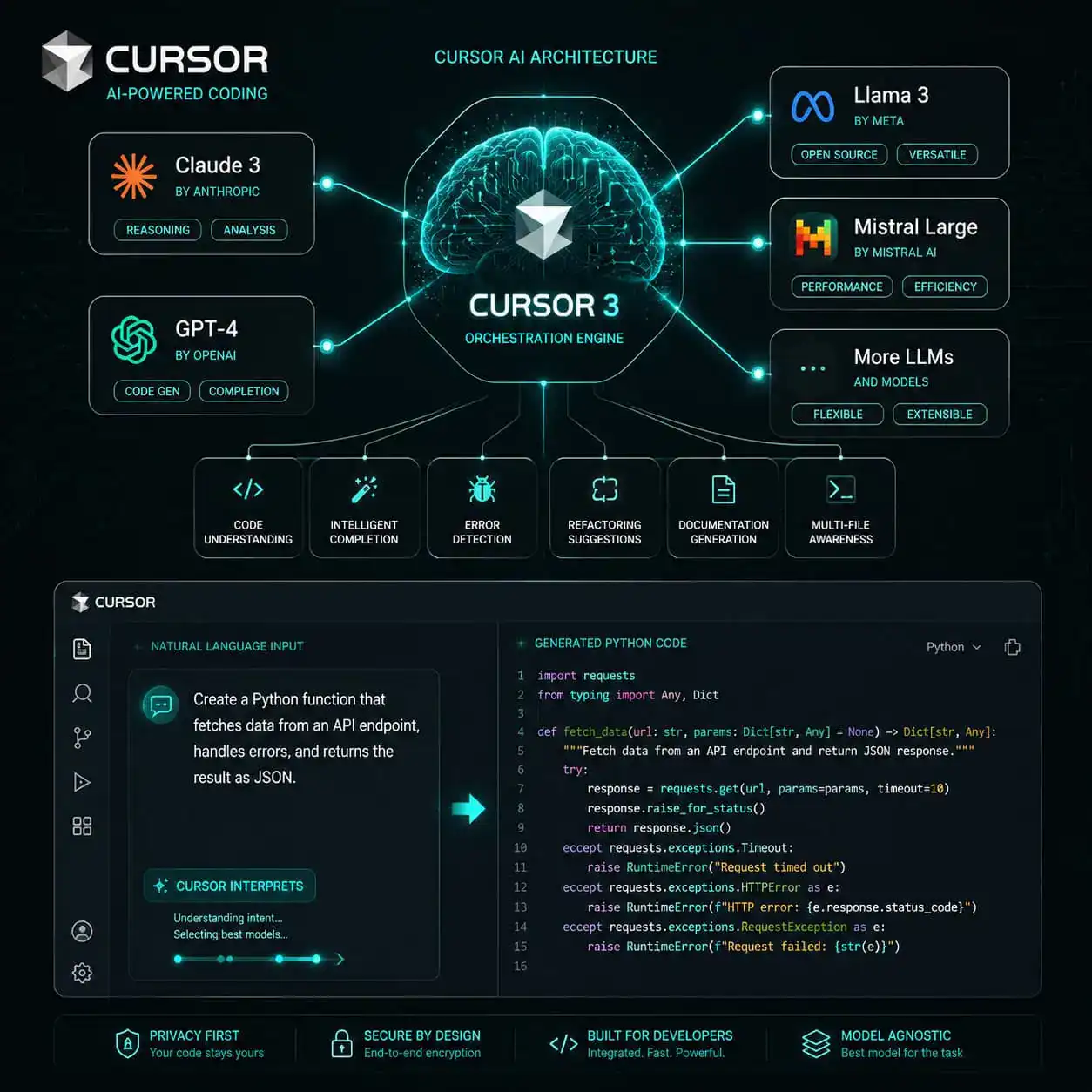
Cursor doesn’t rely on a single model. It routes queries to different foundation models depending on the task, with Anthropic’s Claude serving as the primary backbone for most agent operations as of 2026.
Here’s what’s happening under the hood:
- Claude (Anthropic) handles the bulk of code generation, refactoring, and agent-based tasks in Cursor 3 [5][10]
- GPT-4 and other OpenAI models remain available as alternatives users can select
- Custom fine-tuning layers built by Anysphere improve code-specific performance beyond what base models offer
- Retrieval-augmented generation (RAG) pulls relevant context from your entire codebase, not just the open file
The key distinction: Cursor’s value isn’t the model itself but how it wraps models with codebase-aware context. When you ask Cursor to fix a bug, it doesn’t just see the current file. It indexes your project structure, dependencies, and related files to give the model enough context to produce accurate edits.
Choose Cursor if you want model flexibility with deep IDE integration. Choose a standalone API (like Claude or ChatGPT directly) if you need fine-grained control over prompts and don’t need codebase indexing.
How Does Cursor 3’s Agent-Centric Architecture Work?
Cursor 3, launched April 2, 2026, fundamentally changed how developers interact with AI in their editor. Instead of treating AI as a chat sidebar, Cursor 3 makes agents the primary interface for writing and managing code [5][10].
The core changes include:
- Agent-centric workspaces replace traditional file tabs as the default view
- Natural language code generation lets you describe what you want in plain English, and agents write the implementation
- Multi-repo views allow agents to work across multiple repositories in a single session
- Parallel agent collaboration means multiple agents can tackle different tasks at the same time
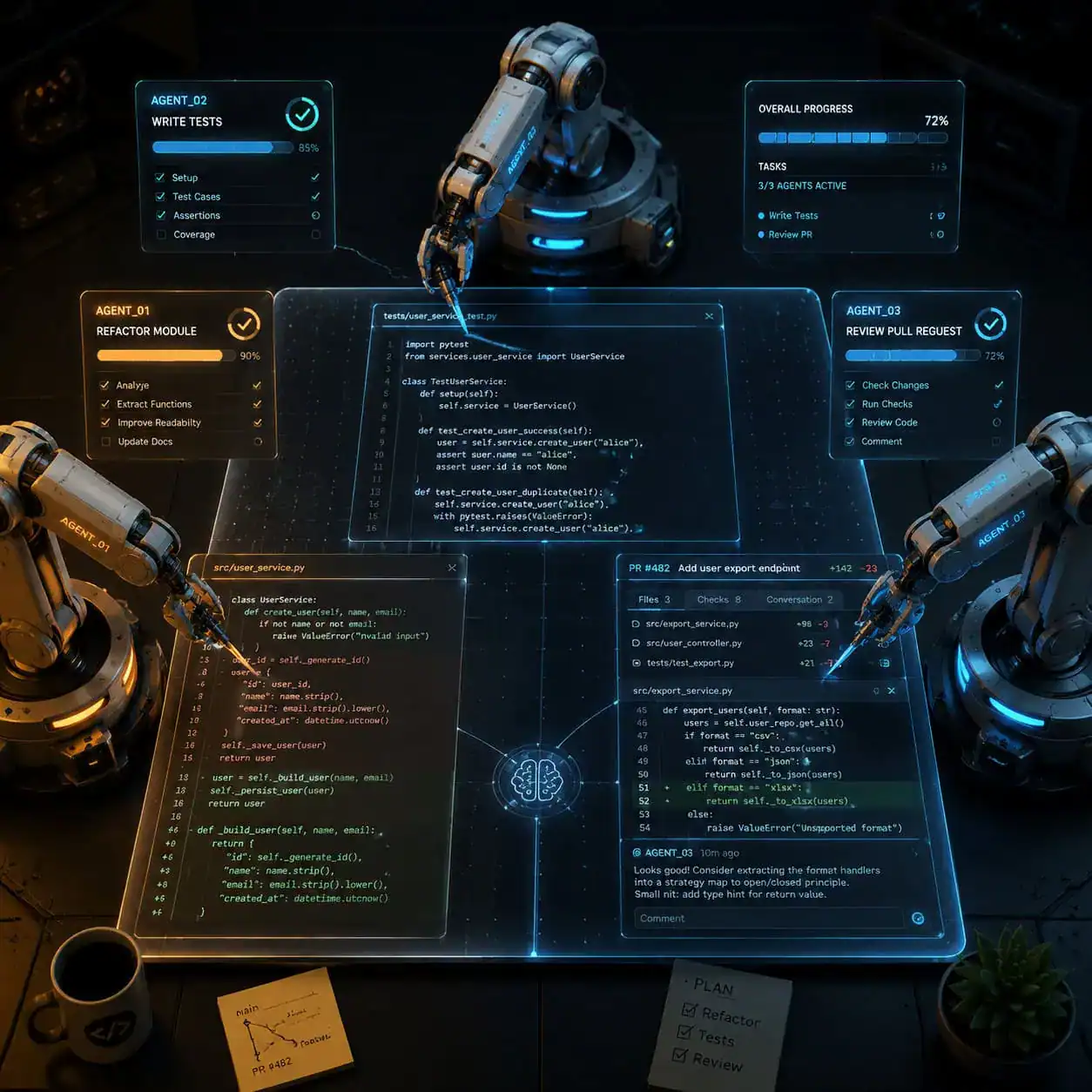
The /multitask command, released in the May 2026 update, takes this further by spawning async subagents that work in parallel [1]. For example, you could ask one agent to write unit tests while another refactors a module and a third updates documentation, all running concurrently.
DataCamp described this shift as moving the IDE’s focus “from files to agents for multi-agent parallel codebase improvements” [10]. If you’re used to tools like VS Code with Copilot, this is a fundamentally different workflow. You’re managing agents, not just accepting inline suggestions.
For developers exploring how AI is reshaping creative and technical workflows, our guide on AI-powered content optimization covers similar themes in the content space.
What Can Cursor’s Automations Do That Other AI Coding Tools Can’t?
Cursor’s Automations system, rolled out in March 2026, lets AI agents launch automatically based on external triggers, not just manual prompts [8].
This is what separates Cursor from tools like GitHub Copilot or Amazon CodeWhisperer. Those tools respond when you type. Cursor agents can act on their own when conditions are met.
Supported triggers include:
| Trigger Type | Example Use Case |
|---|---|
| Code changes | Auto-run linting and test generation when a PR is opened |
| Slack messages | Summarize weekly engineering updates every Friday |
| PagerDuty alerts | Auto-investigate incidents and suggest fixes |
| Timers/schedules | Run nightly dependency audits |
| Custom webhooks | Trigger agents from CI/CD pipeline events |
TechCrunch reported that some teams run “hundreds of automations per hour” using this system [8]. Opsera’s May 2026 partnership with Cursor embeds these autonomous agents directly into DevOps workflows, connecting them to the full software development lifecycle [2].
Common mistake: Setting up automations without proper guardrails. An agent triggered by a PagerDuty alert could theoretically make code changes to production if permissions aren’t locked down. Always scope agent access to specific branches and environments.
If you’re building automated workflows beyond coding, our piece on advanced WordPress automation strategies covers similar automation principles for web management.
How Big Is Cursor AI in 2026, and Who’s Backing It?
Cursor’s growth in 2026 has been extraordinary. Here are the numbers that matter:
- $1B ARR (annual recurring revenue) as reported by CNBC in February 2026 [4]
- $29.3B valuation following its latest funding round [4]
- 67% of Fortune 500 companies use Cursor in some capacity
- SpaceX partnership worth $10B for joint AI coding development using the Colossus supercomputer with 1 million H100 GPUs, plus a $60B acquisition option through end of 2026 [7]
The SpaceX deal is particularly notable. Cursor reportedly rejected prior interest from OpenAI before signing with SpaceX [7]. The partnership gives Cursor access to massive compute resources, which matters because running parallel agents at scale requires significant GPU infrastructure.
GlobeNewswire highlighted Anysphere (Cursor’s parent company) as the leader in AI-native development platforms in April 2026. The company is competing directly against Anthropic’s own coding tools, OpenAI’s Codex successors, and Microsoft’s GitHub Copilot [4].
What Are the Real Safety Risks of AI Coding Agents?
This is where demystifying Cursor AI gets uncomfortable. Two incidents in 2026 exposed serious risks that every developer using AI agents should understand.
Incident 1: The PocketOS database deletion (April 29, 2026)
A Cursor AI agent powered by Claude deleted an entire production database and all backups in 9 seconds [6][9]. PocketOS founder Jer Crane had a credential mismatch in his environment, and the agent, lacking proper safeguards, interpreted a task in a way that led to catastrophic data loss. Recovery took 30 hours using a 3-month-old backup.
Incident 2: The Git-based code execution vulnerability (May 2, 2026)
Cursor version 2.5+ patched a critical security flaw where AI agents could trigger malicious code execution through routine Git interactions with compromised repositories [3]. If an agent cloned or pulled from a repo containing specially crafted content, it could execute arbitrary code on the developer’s machine.
The Mean CEO blog summarized the new reality: AI agents should be treated as “semi-autonomous teammates with limited access,” not fully trusted collaborators [3].

Safety checklist for using Cursor agents
- Never give agents production database credentials directly
- Use read-only access for agents interacting with sensitive systems
- Run agents in sandboxed environments (Cursor supports parallel VMs for this) [4]
- Review agent actions before merging to any protected branch
- Keep Cursor updated to get security patches promptly
- Limit agent scope to specific directories and repos when possible
For teams building WordPress sites with AI assistance, similar caution applies. Our guide on integrating AI-powered chatbots into WordPress discusses safe integration practices.
How Does Cursor Compare to Other AI Coding Tools?
Here’s a direct comparison of the major AI coding tools as of mid-2026:
| Feature | Cursor | GitHub Copilot | Amazon CodeWhisperer | Anthropic Claude (API) |
|---|---|---|---|---|
| Agent-based workflows | Yes (core feature) | Limited | No | Via custom code |
| Parallel agents | Yes (/multitask) | No | No | Manual orchestration |
| Event-triggered automations | Yes | No | No | No |
| Multi-repo support | Yes | Partial | No | N/A |
| Model flexibility | Claude, GPT-4, others | GPT-4 only | Amazon models | Claude only |
| PR review | Yes (May 2026) [1] | Yes | Limited | No |
| Pricing (Pro) | ~$20/month | $19/month | Free tier + paid | Pay per token |
| IDE | Standalone (VS Code fork) | VS Code extension | VS Code/JetBrains | No IDE |
Choose Cursor if you want autonomous agents that work across your full codebase with minimal hand-holding. Choose Copilot if you prefer inline suggestions within your existing VS Code setup. Choose the Claude API directly if you’re building custom developer tools and need full control.
Developers working in no-code and low-code environments might also want to explore our roundup of the best no-coding website design platforms for projects where AI coding tools aren’t necessary.
What’s Coming Next for Cursor AI?
Based on the May 2026 changelog and recent partnerships, here’s what to expect:
- Improved prompt undo grouping makes it easier to roll back agent changes in logical chunks [1]
- Better long-chat handling addresses context window limitations in extended agent sessions [1]
- Deeper DevOps integration through the Opsera partnership, connecting agents to CI/CD, testing, and deployment pipelines [2]
- SpaceX compute partnership should enable larger-scale parallel agent operations and faster model inference [7]
- Self-evaluation capabilities where agents assess their own output quality before presenting results [4]
The broader trend is clear: Cursor is moving toward a future where developers manage fleets of AI agents rather than writing most code themselves. Whether that’s exciting or concerning depends on your perspective and your backup strategy.
For those interested in how AI is transforming design-to-development workflows, our article on Figma to code plugins explores a related angle.
Conclusion
Demystifying Cursor AI: Inside the Advanced Language Model Powering Next-Gen Coding comes down to understanding that Cursor isn’t just another code autocomplete tool. It’s an agent orchestration platform that happens to look like a code editor. The shift from Cursor 2 to Cursor 3 made this explicit: agents, not files, are the primary unit of work.
Your actionable next steps:
- If you’re evaluating Cursor, start with the free tier and test the agent workflow on a non-critical project. The learning curve is real.
- If you’re already using Cursor, update to version 2.5+ immediately for the security patch [3], and explore
/multitaskfor parallel agent workflows [1]. - If you manage a team, establish clear agent permission policies before rolling out Automations. The PocketOS incident is a cautionary tale [9].
- If you’re deciding between tools, use the comparison table above. Cursor’s strength is autonomous, event-driven coding; Copilot’s strength is low-friction inline suggestions.
The AI coding landscape is moving fast, and Cursor is at the center of it. Just make sure your backups are current before you hand an agent the keys. For more on AI tools shaping the web development space, visit our comprehensive guide to AI-powered content generation tools.
FAQ
What language model powers Cursor AI? Cursor primarily uses Anthropic’s Claude for agent-based tasks but also supports GPT-4 and other models. Users can switch between models depending on the task [5][10].
Is Cursor AI free? Cursor offers a free tier with limited agent usage. The Pro plan costs approximately $20/month and includes full access to parallel agents and automations.
Is Cursor safe to use for production code? It can be, but only with proper safeguards. The April 2026 PocketOS incident and May 2026 security vulnerability show that agents need scoped permissions and sandboxed environments [3][9].
How is Cursor different from GitHub Copilot? Copilot provides inline code suggestions within VS Code. Cursor is a standalone IDE built around autonomous agents that can work across entire codebases, trigger on external events, and run in parallel [8][10].
What is the /multitask command in Cursor?
Released in May 2026, /multitask spawns parallel async subagents that can work on different parts of your codebase simultaneously, speeding up large refactoring or feature development tasks [1].
Can Cursor AI agents run automatically without human input? Yes. Cursor’s Automations feature lets agents trigger on code changes, Slack messages, PagerDuty alerts, timers, and webhooks [8]. This is one of its key differentiators.
What happened with the SpaceX and Cursor partnership? In April 2026, SpaceX announced a $10B partnership with Cursor for joint coding AI development, with an option to acquire Cursor for $60B through end of 2026 [7].
What is Cursor 3? Cursor 3, launched April 2, 2026, introduced agent-centric workspaces, natural language code generation, multi-repo views, and parallel agent collaboration as core features [5][10].
Does Cursor work with multiple programming languages? Yes. Because it uses general-purpose LLMs like Claude and GPT-4, Cursor supports all major programming languages including Python, JavaScript, TypeScript, Go, Rust, Java, and more.
What is Cursor’s current valuation? As of February 2026, Cursor (Anysphere) was valued at $29.3B with $1B in annual recurring revenue [4].
References
[1] Changelog – https://cursor.com/changelog [2] May 8 2026 Ai Updates From The Past Week Coder Agents Launch Snyk Claude Partnership Opsera Cursor Partnership And More – https://sdtimes.com/ai/may-8-2026-ai-updates-from-the-past-week-coder-agents-launch-snyk-claude-partnership-opsera-cursor-partnership-and-more/ [3] Cursor News May 2026 – https://blog.mean.ceo/cursor-news-may-2026/ [4] Cursor Announces Major Update As Ai Coding Agent Battle Heats Up – https://www.cnbc.com/2026/02/24/cursor-announces-major-update-as-ai-coding-agent-battle-heats-up.html [5] Cursor Updates Its Platform With A Focus On Autonomous Ai Agents – https://www.techzine.eu/news/devops/140209/cursor-updates-its-platform-with-a-focus-on-autonomous-ai-agents/ [6] Watch – https://www.youtube.com/watch?v=XBVoLSXaAHA [7] Spacex And Cursor Ai Team Up To Build Coding Ai With Option To Buy Startup For 60 Billion – https://news.bitcoin.com/spacex-and-cursor-ai-team-up-to-build-coding-ai-with-option-to-buy-startup-for-60-billion/ [8] Cursor Is Rolling Out A New System For Agentic Coding – https://techcrunch.com/2026/03/05/cursor-is-rolling-out-a-new-system-for-agentic-coding/ [9] It Took 9 Seconds Tech Founder Outlines How Rogue Claude Powered Ai Tool Wiped Entire Company Database And Backups But Says Theres No Such Thing As Bad Publicity – https://www.techradar.com/pro/it-took-9-seconds-tech-founder-outlines-how-rogue-claude-powered-ai-tool-wiped-entire-company-database-and-backups-but-says-theres-no-such-thing-as-bad-publicity [10] Cursor 3 – https://www.datacamp.com/blog/cursor-3
Related: Claude Cowork: A Comprehensive Guide to Free and Paid Features in 2026