Last updated: June 9, 2026
Quick Answer: ChatGPT stands for Chat Generative Pre-trained Transformer. It is a conversational AI product built by OpenAI, launched in November 2022 on top of a fine-tuned GPT-3.5 model. By 2026, it has grown into one of the most widely used AI tools in the world, running on models up to GPT-5.
Key Takeaways
- ChatGPT is short for Chat Generative Pre-trained Transformer, a name that describes both what it does and how it works.
- OpenAI was founded in 2015; the GPT architecture that powers ChatGPT dates back to a landmark 2018 research paper.
- ChatGPT launched publicly on November 30, 2022, and reportedly reached one million users in five days [2].
- The model uses a training technique called Reinforcement Learning from Human Feedback (RLHF) to make responses feel more natural and helpful.
- ChatGPT Plus costs $20 per month (as of 2026) and gives access to more advanced models including GPT-4o and GPT-5.
- It is not infallible: it can produce confident-sounding but incorrect answers, a problem called “hallucination.”
- ChatGPT is suitable for students, professionals, and developers, but it should not be used to share sensitive personal or financial data.
- Competitors include Google Gemini (formerly Bard), Anthropic’s Claude, and Meta’s Llama-based tools.
- Ethical concerns include bias in training data, potential for misuse, and questions about intellectual property.
- For deeper exploration of AI tools and workflows, the ChatGPT archives at WebAiStack are a solid starting point.
What Does ChatGPT Actually Stand For?
ChatGPT stands for Chat Generative Pre-trained Transformer. Each word in that name tells you something specific about how the system works.
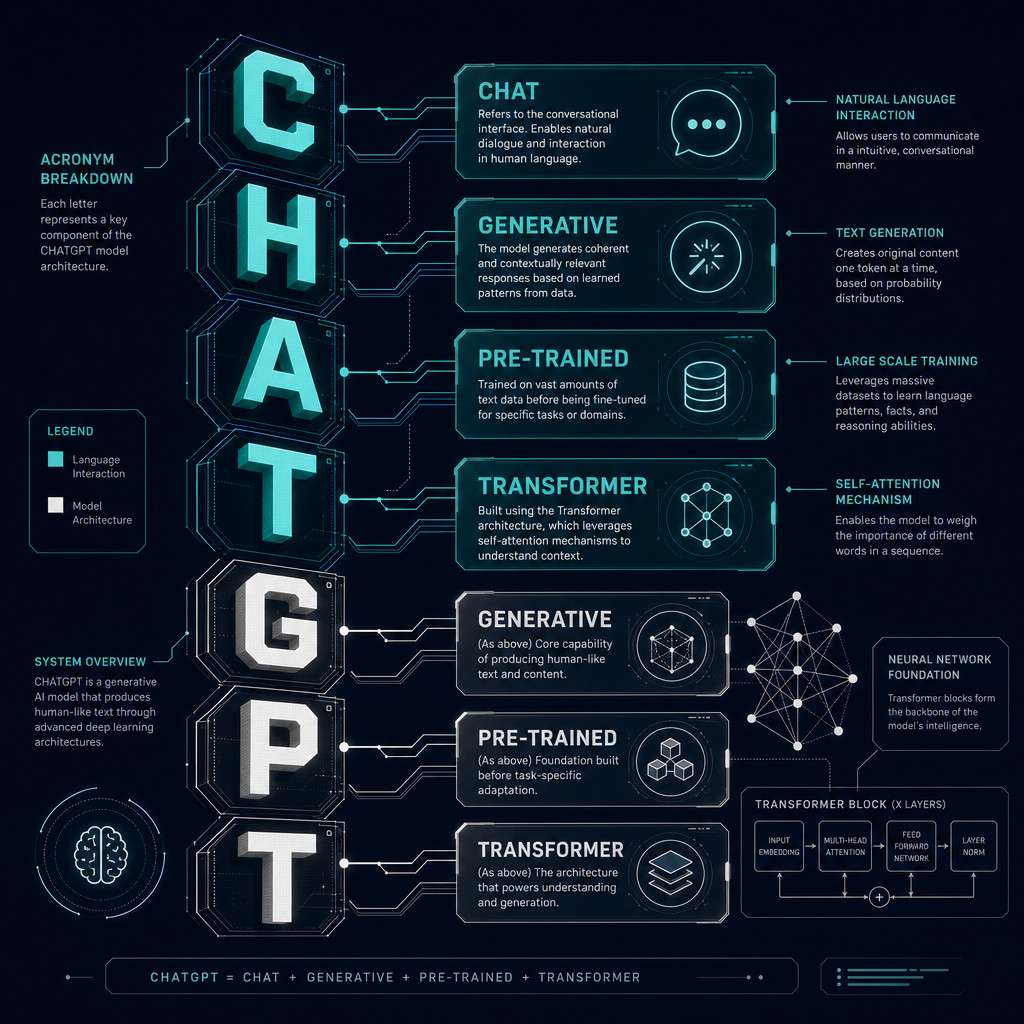
Here is what each part means:
| Word | What It Means |
|---|---|
| Chat | The interface is conversational — you type, it responds, like a chat window. |
| Generative | The model generates new text rather than retrieving stored answers. |
| Pre-trained | It was trained on a massive dataset before being fine-tuned for conversation. |
| Transformer | It uses the Transformer neural network architecture, introduced by Google researchers in 2017. |
The name was not the result of a lengthy branding exercise. According to a report by the Times of India, OpenAI employees settled on “ChatGPT” during a late-night internal discussion, largely because it was descriptive and simple [3]. The “Chat” prefix was added to distinguish it from the underlying GPT model series, which had existed since 2018.
Decoding ChatGPT’s full form matters because it clarifies that the product is a specific application layer, not the model itself. GPT is the engine; ChatGPT is the car.
Who Created ChatGPT and Why?
OpenAI created ChatGPT. The company was founded in December 2015 by a group that included Sam Altman, Greg Brockman, and Elon Musk (who later departed the board), with the stated goal of developing AI that benefits all of humanity [2].
The “why” behind ChatGPT specifically was partly strategic. OpenAI had already released GPT-3 via an API in 2020, but access was limited to developers. ChatGPT was designed to put a friendly, accessible interface in front of the underlying model so that anyone could use it, not just engineers [7].
According to MIT Technology Review’s oral history of the product, the team also wanted to gather real-world feedback at scale, which a public chatbot could do far more efficiently than a closed API [7]. The result was a product that served both a research purpose and a commercial one.
What Kind of Data Was ChatGPT Trained On?
ChatGPT was pre-trained on a large corpus of text from the internet, books, and other written sources, then fine-tuned using human feedback. The base GPT-3.5 model learned from hundreds of billions of words scraped from sources like Common Crawl, Wikipedia, and digitized books [2].
The fine-tuning stage used a method called Reinforcement Learning from Human Feedback (RLHF). Human trainers ranked model responses, and those rankings were used to teach the model which kinds of answers were more helpful, accurate, and appropriate [8].
This two-stage process is why ChatGPT feels different from a raw language model: the pre-training gives it broad knowledge, and the RLHF fine-tuning shapes its conversational behavior.
Important caveat: The training data has a knowledge cutoff date. Earlier versions of ChatGPT had a cutoff of early 2022. Newer models have more recent cutoffs, but no version has real-time internet access unless a browsing tool is explicitly enabled.
How Is ChatGPT Different From Other AI Chatbots?
ChatGPT differs from most earlier chatbots in that it generates free-form responses rather than following scripted decision trees. Traditional chatbots matched user input to pre-written responses. ChatGPT predicts the most contextually appropriate next word, sentence by sentence, which allows it to handle open-ended questions.
Compared to other large language model chatbots:
- Google Gemini is tightly integrated with Google Search and Google Workspace, giving it stronger real-time retrieval. ChatGPT has a broader plugin and API ecosystem.
- Anthropic’s Claude is often cited for longer context windows and a focus on safety-oriented outputs.
- Meta’s Llama models are open-weight, meaning developers can run them locally, which ChatGPT’s models are not.
For a broader look at AI tools and platforms, the 45 must-visit AI websites guide covers the wider ecosystem well.
How Does ChatGPT Compare to Google Bard (Now Gemini)?
Google Bard was rebranded as Gemini in early 2024. As of 2026, Gemini and ChatGPT are the two most widely used AI assistants, and they differ most in their integration depth and default behavior.
| Feature | ChatGPT (OpenAI) | Google Gemini |
|---|---|---|
| Default model (free tier) | GPT-4o mini | Gemini 1.5 Flash |
| Real-time web access | Optional (with tool) | Default on |
| Google Workspace integration | Limited | Native |
| Code generation | Strong | Strong |
| Pricing (paid tier) | $20/month | $19.99/month |
Choose ChatGPT if you want a broader third-party plugin ecosystem or are building on the OpenAI API. Choose Gemini if you live inside Google Docs, Gmail, or Google Drive and want seamless document assistance.
How Much Does ChatGPT Plus Cost?
ChatGPT Plus costs $20 per month as of 2026. The free tier still exists and runs on a lighter version of the model, but it has usage limits and does not include the most capable models.
What you get with Plus:
- Access to GPT-4o and GPT-5 (where available)
- Higher message limits during peak hours
- Priority access to new features like voice mode and advanced data analysis
- Access to the GPT Store for third-party plugins
OpenAI also offers a ChatGPT Team plan at around $25 per user per month (billed annually) for small businesses, and an Enterprise tier with custom pricing for large organizations [2].
Decision rule: If you use ChatGPT more than 30 minutes a day for work tasks, the Plus plan typically pays for itself in time saved. If you use it occasionally for casual questions, the free tier is sufficient.
Is ChatGPT Good for Students or Professionals?
Yes, ChatGPT is useful for both students and professionals, but in different ways and with different risks. The key is knowing what it does well and where it falls short.
For students:
- Explaining complex concepts in plain language
- Summarizing long texts
- Brainstorming essay structures (not writing essays for submission, which raises academic integrity issues)
For professionals:
- Drafting emails, reports, and proposals
- Writing and debugging code
- Summarizing meeting notes or research papers
If you are using ChatGPT for content work, the AI-powered content optimization guide offers practical frameworks for integrating it into real workflows.
Can ChatGPT Write Complex Code or Just Simple Scripts?
ChatGPT can write complex, multi-file code across many programming languages, not just simple scripts. It handles Python, JavaScript, SQL, Bash, and dozens of other languages. It can write API integrations, debug stack traces, and refactor legacy code.
That said, it has limits:
- It can produce code that looks correct but contains subtle logic errors.
- It performs better with well-defined problems than with vague or highly specialized requirements.
- For large codebases, it lacks persistent memory of the full project unless you paste the relevant context.
For developers who want AI-assisted coding environments, tools like Cursor AI and Bolt AI integrate language models directly into the coding workflow, which can be more efficient than copy-pasting between ChatGPT and an editor.
Why Is My ChatGPT Giving Weird or Incorrect Answers?
ChatGPT produces incorrect answers because it is a probabilistic text generator, not a fact database. It predicts likely next words based on patterns in training data, which means it can generate fluent, confident-sounding text that is factually wrong. This is called “hallucination” [1].
Common causes of bad outputs:
- Vague prompts: The less specific your question, the more the model has to guess your intent.
- Questions outside its training data: It may fill gaps with plausible-sounding fabrications.
- Knowledge cutoff: Events after its training cutoff will not be reflected accurately.
- Leading questions: If your prompt implies a false premise, the model may go along with it.
Fix it by: Being specific, asking the model to cite its reasoning step by step, and verifying any factual claims against primary sources before using them.
What Are Common Mistakes People Make When Using ChatGPT?
The most common mistake is treating ChatGPT as a search engine that returns verified facts. It is a language model that generates plausible text, and those are very different things.
Other frequent mistakes:
- Submitting sensitive data: Entering passwords, personal identification numbers, or confidential business information into the chat window is a serious privacy risk.
- Accepting first drafts: The first response is rarely the best one. Iterating with follow-up prompts almost always improves output quality.
- Ignoring the system prompt: Many users do not realize they can set a persona or context at the start of a conversation to shape all subsequent responses.
- Over-relying on it for legal or medical advice: ChatGPT is not a licensed professional. Its outputs in these domains require expert review.
For automating ChatGPT into business workflows responsibly, the ChatGPT automation guide covers no-code integration options in detail.
Is ChatGPT Safe to Use for Sensitive Information?
No. You should not enter sensitive personal, financial, or confidential business information into ChatGPT. OpenAI’s default settings allow conversation data to be used to improve models, though users can opt out in settings [10].
Specific risks:
- Data entered in chats may be reviewed by human trainers in some cases.
- Enterprise plans offer stronger data privacy agreements, but the free and Plus tiers do not guarantee the same protections.
- If you are in a regulated industry (healthcare, finance, law), check whether your use of ChatGPT complies with relevant data protection regulations before using it for client or patient data.
Safe practice: Treat ChatGPT like a public forum. Only share information you would be comfortable making public.
What Are the Ethical Concerns Around ChatGPT?
The main ethical concerns around ChatGPT involve bias, misinformation, intellectual property, and displacement of human labor. These are not hypothetical risks; they are active debates in policy and research circles [8].
Key concerns:
- Bias: Because it was trained on internet text, it can reproduce and amplify existing biases around gender, race, and culture.
- Misinformation: Its ability to generate convincing text makes it a potential tool for producing disinformation at scale.
- Copyright: OpenAI has faced lawsuits from authors and publishers who argue their work was used in training without consent.
- Job displacement: Roles involving routine writing, basic coding, and data summarization are already being affected.
OpenAI has published usage policies and content filters to address some of these concerns, but critics argue the safeguards are inconsistent and that the pace of deployment has outrun regulatory frameworks [7].
What Are Some Good Alternatives to ChatGPT?
The strongest alternatives to ChatGPT in 2026 are Google Gemini, Anthropic’s Claude, and Meta’s Llama-based tools. Each has a different strength profile.
- Google Gemini: Best for users embedded in Google’s ecosystem and those who need real-time web access by default.
- Anthropic Claude: Often preferred for long-document analysis and safety-conscious outputs.
- Meta Llama (via Hugging Face or local deployment): Best for developers who want to run a model privately without sending data to a third-party server.
- Perplexity AI: A strong choice for research tasks because it cites sources inline.
- Microsoft Copilot: Built into Microsoft 365, making it the natural choice for heavy Office users.
For developers exploring open-source model options, the deep dive into open-source language model notebooks is worth reading.
The Model Evolution: From GPT-3.5 to GPT-5
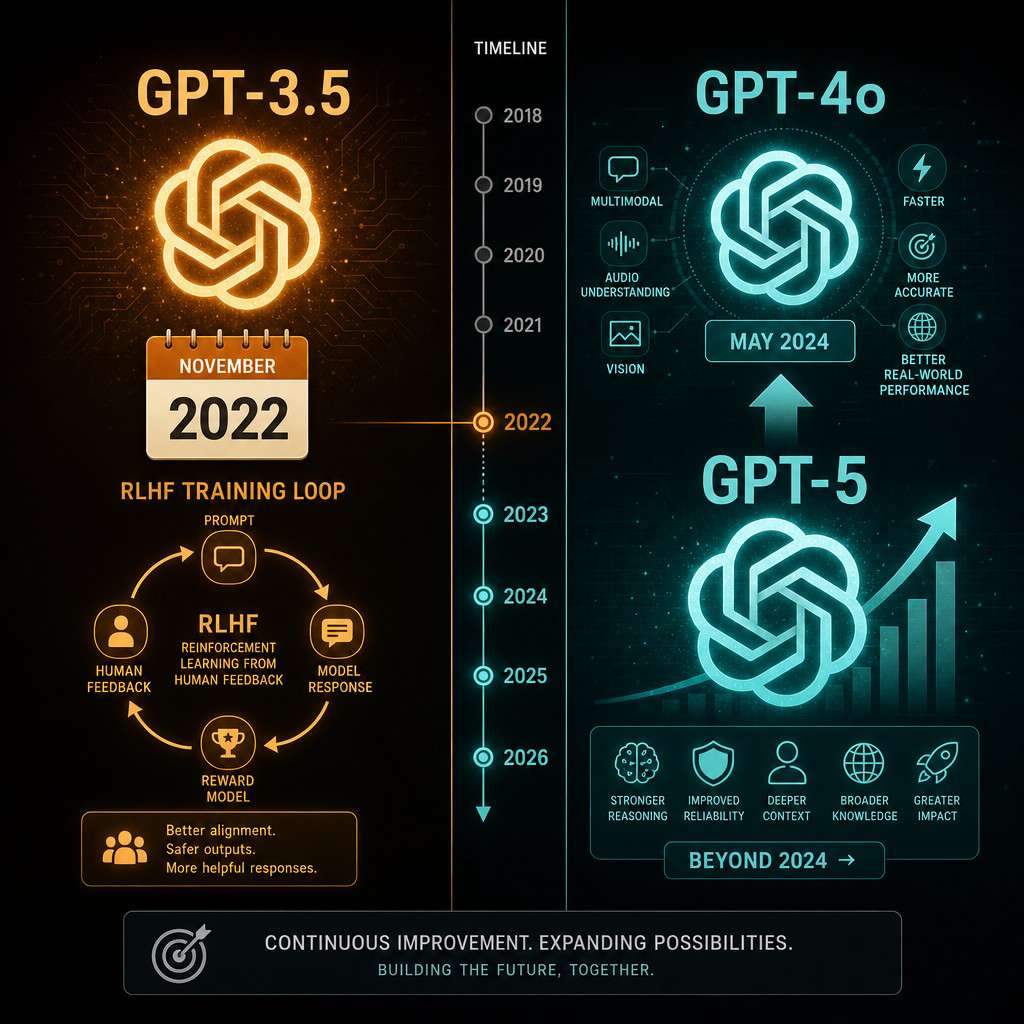
ChatGPT has moved through several model generations since its 2022 launch, with each iteration improving reasoning, speed, and multimodal capability.
- GPT-3.5 (2022): The model that powered the original ChatGPT launch. Strong for text but limited in reasoning.
- GPT-4 (2023): Introduced multimodal inputs (images), significantly better reasoning, and a larger context window [6].
- GPT-4o (2024): A faster, more efficient version of GPT-4 with improved voice and vision capabilities.
- GPT-5 (2025-2026): OpenAI’s most capable model to date, with stronger multi-step reasoning and broader tool use.
This progression is central to decoding ChatGPT’s full form and origins: the “Pre-trained” in the name reflects a training philosophy that has scaled consistently, with each generation trained on more data with better techniques.
Conclusion
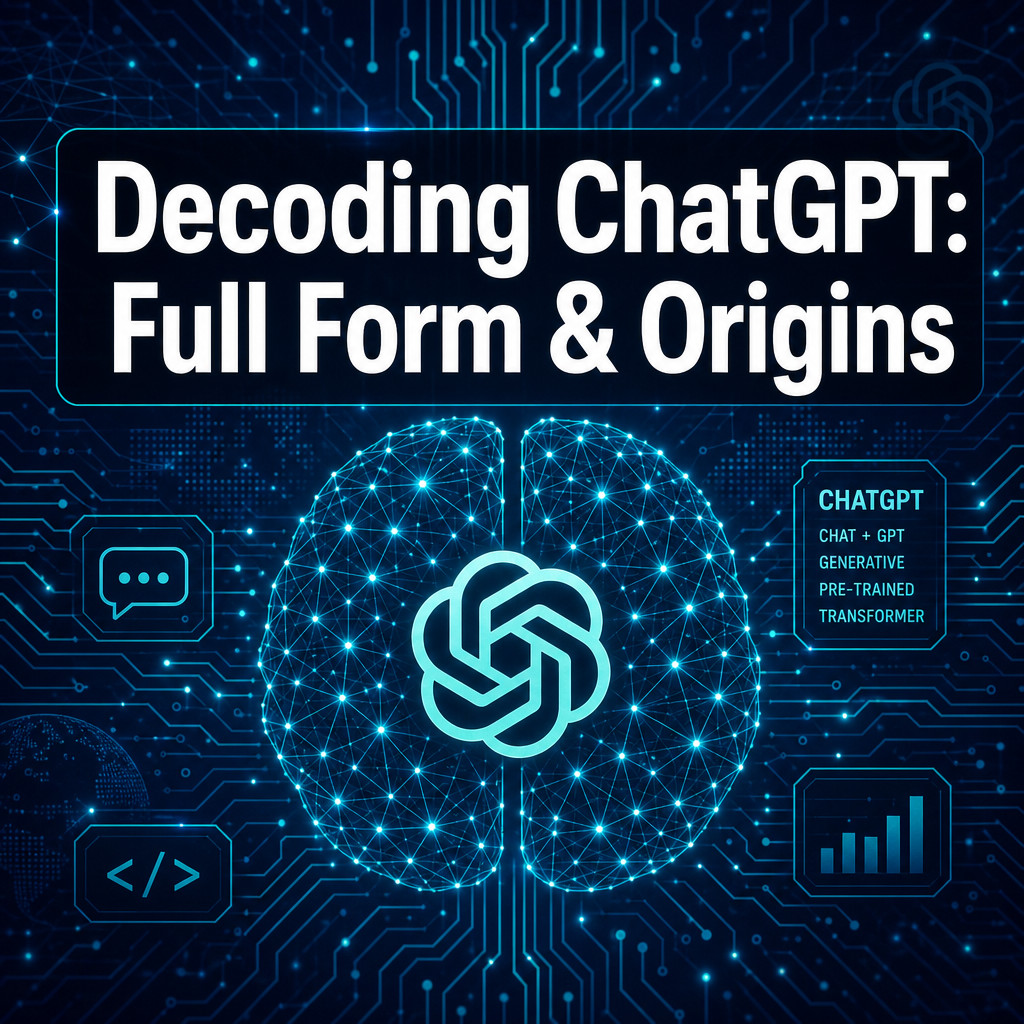
Decoding ChatGPT: the full form and origins of OpenAI’s model reveals a product that is more than a clever acronym. Chat Generative Pre-trained Transformer describes a specific technical approach: broad pre-training on text data, followed by human-guided fine-tuning to make the model conversational and useful.
Understanding what ChatGPT is, and what it is not, is the most practical thing you can do before using it. It is a powerful text generation tool, not a search engine, not a licensed expert, and not a secure vault for sensitive data.
Actionable next steps:
- Start with the free tier to understand what the model can and cannot do for your specific use case.
- Upgrade to ChatGPT Plus only if you hit the free tier’s limits regularly.
- Learn to write better prompts: specificity, context, and step-by-step instructions consistently improve output quality.
- Never enter sensitive personal or business data into a standard ChatGPT session.
- Cross-check any factual claims the model makes before using them in professional or academic work.
- Explore alternatives like Claude or Gemini for tasks where ChatGPT’s outputs feel inconsistent.
The tool will keep evolving. The underlying principle, that a well-trained language model can be a genuine productivity asset when used with clear expectations, is already proven.
FAQ
What does GPT stand for in ChatGPT? GPT stands for Generative Pre-trained Transformer. It refers to the type of neural network architecture and training method used to build the model.
When was ChatGPT released? ChatGPT was publicly released on November 30, 2022 [2].
Who owns ChatGPT? ChatGPT is owned and operated by OpenAI, an AI research company headquartered in San Francisco. Microsoft has made significant investments in OpenAI and integrates its models into products like Copilot.
Is ChatGPT free to use? Yes, a free tier exists. ChatGPT Plus, which unlocks more capable models and higher usage limits, costs $20 per month as of 2026.
Can ChatGPT access the internet? By default, no. ChatGPT relies on its training data. However, a browsing tool can be enabled in settings for Plus and higher-tier users, allowing it to retrieve current web content.
Is ChatGPT the same as GPT-4? No. GPT-4 is a model; ChatGPT is a product that can run on different models including GPT-3.5, GPT-4, GPT-4o, and GPT-5 depending on your subscription tier.
Can ChatGPT replace a human writer? For routine drafting tasks, it can significantly reduce time. For work requiring original insight, lived experience, or accountability, human writers remain essential.
Why does ChatGPT sometimes make up facts? This is called hallucination. The model generates statistically likely text, which can produce confident-sounding statements that are factually incorrect, especially on niche or recent topics [1].
Is ChatGPT available as an API? Yes. OpenAI offers the underlying GPT models via a paid API, allowing developers to build their own applications on top of the same technology.
What is RLHF and why does it matter for ChatGPT? RLHF stands for Reinforcement Learning from Human Feedback. It is the training technique that made ChatGPT conversational by having human raters score model responses and using those scores to guide further training [8].
References
[1] ChatGPT Decoded: A Deep Dive Into The AI Phenomenon – https://productivitystacks.com/chatgpt-decoded-a-deep-dive-into-the-ai-phenomenon/
[2] ChatGPT – Wikipedia – https://en.wikipedia.org/wiki/ChatGPT
[3] How ChatGPT Got Its Name – Times of India – https://timesofindia.indiatimes.com/technology/tech-news/how-chatgpt-got-its-name-the-late-night-discussion-and-what-it-means/articleshow/122253782.cms
[6] A Short History of ChatGPT – Forbes – https://www.forbes.com/sites/bernardmarr/2023/05/19/a-short-history-of-chatgpt-how-we-got-to-where-we-are-today/
[7] Inside Story: How ChatGPT Built OpenAI – MIT Technology Review – https://www.technologyreview.com/2023/03/03/1069311/inside-story-oral-history-how-chatgpt-built-openai/
[8] ChatGPT – Britannica – https://www.britannica.com/technology/ChatGPT
[10] What Is ChatGPT? – IBM – https://www.ibm.com/think/topics/chatgpt