Last updated: June 9, 2026
Quick Answer: ChatGPT’s accuracy varies significantly by task type, domain, and model version. On structured benchmarks, GPT-4 and later models score impressively, but real-world factual accuracy is lower and inconsistent. For high-stakes decisions in medicine, law, or finance, ChatGPT should be treated as a starting point, not a final authority.
Key Takeaways
- ChatGPT performs well on standardized tests and structured tasks but struggles with real-time facts, niche topics, and complex reasoning chains
- Hallucination (generating false but confident-sounding information) remains a documented problem across all current versions [1]
- GPT-4 and GPT-4o show measurable accuracy improvements over GPT-3.5, especially in medical and scientific question-answering [2]
- Accuracy drops noticeably in languages other than English, particularly low-resource languages [6]
- Prompting technique directly affects output quality: specific, structured prompts consistently outperform vague ones
- ChatGPT should not be used as a sole source for academic citations, clinical decisions, or legal advice without expert verification
- Researchers measure ChatGPT accuracy using benchmarks like MMLU, TruthfulQA, and domain-specific clinical or legal evaluations
- Hallucination rates vary by domain but have been reported in studies examining medical, legal, and scientific queries [3][9]
How Accurate Is ChatGPT Compared to Human Experts
ChatGPT performs near or at human expert level on many standardized exams, but falls short in nuanced, judgment-heavy professional tasks. The gap between passing a test and practicing a profession is real and important.
On the United States Medical Licensing Examination (USMLE), GPT-4 has scored at or above the passing threshold in multiple studies [2]. Similar results have been documented for bar exam questions and graduate-level subject tests. These are genuine achievements.
But expert performance is more than test-taking. A physician interprets ambiguous symptoms in context, asks follow-up questions, and accounts for patient history. ChatGPT cannot do any of that reliably. Studies examining clinical question accuracy found that while ChatGPT answered many questions correctly, it also produced plausible-sounding errors that could mislead non-experts [9].
Choose ChatGPT if: you need a well-informed starting point, a summary of established knowledge, or help structuring your thinking. Defer to human experts for final decisions in high-stakes domains.
What Are the Biggest Mistakes ChatGPT Makes
The most common and dangerous error ChatGPT makes is hallucination: generating false information with confident, authoritative phrasing [1]. Other frequent mistakes include outdated facts, misattributed quotes, flawed mathematical reasoning, and oversimplified answers to complex questions.
Common error patterns include:
- Fabricated citations: ChatGPT sometimes invents journal articles, case law, or book references that do not exist
- Date errors: Events after the model’s training cutoff are either unknown or incorrectly described
- Overconfidence: The model rarely signals uncertainty clearly, even when it should
- Arithmetic mistakes: Multi-step calculations, especially with large numbers or unit conversions, are error-prone
- Context drift: In long conversations, ChatGPT can lose track of earlier instructions or facts
For users relying on ChatGPT for AI-powered content generation, these errors are particularly worth monitoring, since a confident-sounding wrong answer can slip through editorial review.
Can ChatGPT Be Trusted for Academic or Professional Writing
ChatGPT can assist with drafting, editing, and structuring academic or professional writing, but it cannot be trusted as a factual source without verification. Using it to generate citations or specific data claims without checking is a documented risk [3].
For academic writing specifically:
- Do not use ChatGPT-generated references without verifying each one in an actual database
- Treat any statistic or study finding it produces as unverified until confirmed
- Use it for paraphrasing, outlining, and improving clarity, not for sourcing facts
For professional writing (legal briefs, medical reports, financial analyses), the same caution applies with higher stakes. Several legal cases have involved attorneys submitting ChatGPT-generated citations that turned out to be fabricated.
How Does ChatGPT Perform in Different Languages
ChatGPT performs best in English and shows declining accuracy in other languages, particularly those with limited training data. Research has documented meaningful performance gaps between high-resource languages (English, Spanish, French, German) and low-resource ones [6].
Key findings on multilingual performance:
- High-resource languages: Performance is generally strong, though still below English in most benchmarks
- Low-resource languages: Accuracy drops substantially; grammar errors, factual mistakes, and translation artifacts increase
- Code-switching: When users mix languages mid-conversation, output quality becomes less predictable
- Cultural context: Even in well-supported languages, culturally specific references or idioms may be mishandled
If you’re using ChatGPT for multilingual content, always have a native speaker review the output, especially for professional or public-facing material.
What Are the Limitations of ChatGPT’s Knowledge
ChatGPT’s knowledge has a training cutoff date, meaning it has no awareness of events, publications, or developments after that point. Beyond the cutoff, the model also has uneven coverage of niche topics, regional information, and specialized professional knowledge [4].
Specific knowledge limitations include:
- No access to real-time data (news, stock prices, current research) unless connected to external tools
- Thin coverage of highly specialized subfields, small-language literatures, and regional regulatory frameworks
- Tendency to generalize where specificity is needed
- Limited ability to reason about genuinely novel problems with no precedent in training data
For users exploring open-source language model alternatives, understanding these knowledge boundaries helps in choosing the right tool for the right task.
Is ChatGPT More Accurate Than Other AI Language Models
ChatGPT (particularly GPT-4 and later versions) ranks among the top-performing general-purpose language models on most benchmarks, but the gap between leading models has narrowed considerably in 2026. Google’s Gemini, Anthropic’s Claude, and Meta’s Llama variants all show competitive performance on many tasks [4].
The honest answer is: it depends on the task.
- Coding tasks: Several benchmarks show GPT-4 and Claude performing comparably, with task-specific variation
- Long-document analysis: Claude has shown advantages in handling very long contexts
- Factual Q&A: Differences between top models are often smaller than differences caused by prompting technique
- Multilingual tasks: No single model dominates across all languages
For a broader comparison of AI tools and their real-world performance, see our comprehensive guide to AI-powered content generation tools.
How Often Does ChatGPT Hallucinate or Generate False Information
Hallucination frequency varies by domain and task type, but it is not rare. Studies examining ChatGPT responses in medical contexts found error rates significant enough to warrant caution in clinical settings [9][10]. In general knowledge tasks, hallucination rates are lower but still present [1].
Factors that increase hallucination risk:
- Asking about very recent events (post-training cutoff)
- Requesting specific citations, statistics, or named sources
- Asking about niche or obscure topics with limited training coverage
- Prompts that are vague or allow the model to “fill in” missing context
Factors that reduce hallucination risk:
- Providing source material in the prompt and asking the model to work from it
- Asking the model to say “I don’t know” when uncertain
- Breaking complex queries into smaller, verifiable steps
What Types of Tasks Is ChatGPT Most and Least Accurate At
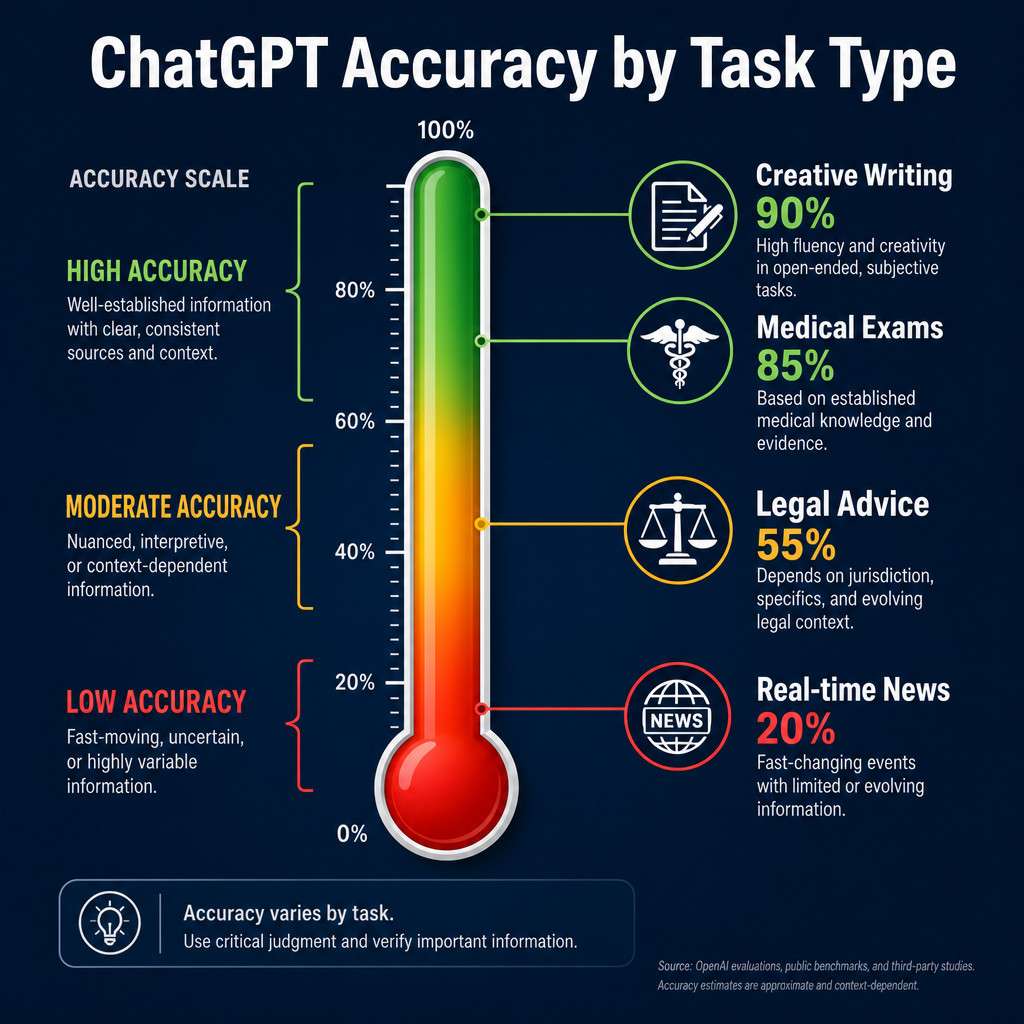
ChatGPT is most reliable for language-centric tasks with clear structure and least reliable for tasks requiring real-time data, precise numerical reasoning, or deep domain expertise [4][8].
Highest accuracy tasks:
- Summarizing provided text
- Grammar and style editing
- Generating creative writing from a brief
- Explaining established concepts in plain language
- Writing and debugging common programming patterns
Lowest accuracy tasks:
- Providing current news or real-time information
- Complex multi-step mathematical proofs
- Generating verified citations or legal case references
- Diagnosing medical conditions from symptoms
- Predicting outcomes in rapidly evolving fields
How Do Researchers Measure ChatGPT’s Accuracy
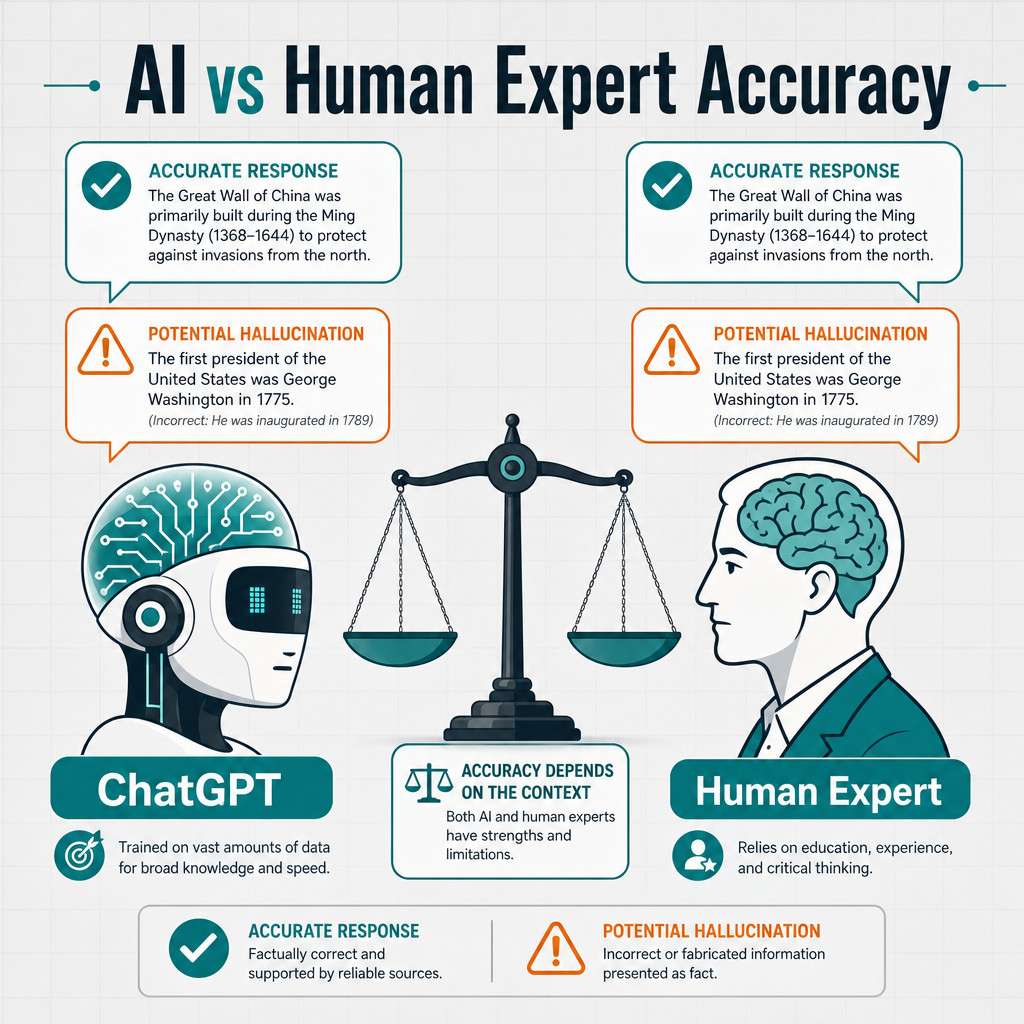
Researchers use a combination of standardized benchmarks, human evaluation panels, and domain-specific test sets to measure ChatGPT accuracy. No single metric captures the full picture [3][5].
Common measurement approaches:
- MMLU (Massive Multitask Language Understanding): Tests knowledge across 57 academic subjects
- TruthfulQA: Specifically designed to catch models that give false but popular answers
- Domain-specific exams: Medical licensing, bar exams, CPA exams used as real-world proxies
- Human rater panels: Experts in a field evaluate model responses for correctness and completeness
- Red-teaming: Adversarial prompts designed to expose weaknesses
Each method has blind spots. Benchmark scores can overstate real-world performance because models may be partially trained on benchmark-adjacent data.
Can ChatGPT Be Used Reliably in Scientific or Technical Fields
ChatGPT can support scientific and technical work in specific, bounded ways, but it is not a reliable standalone tool for generating novel research findings or verifying technical specifications [3][8].
Appropriate uses in scientific/technical contexts:
- Drafting literature review summaries (with source verification)
- Explaining methodology concepts to non-specialist audiences
- Generating boilerplate code for standard analyses
- Brainstorming research questions or experimental designs
Inappropriate uses:
- Generating or interpreting statistical results without verification
- Citing specific studies without checking the actual paper
- Making engineering or safety-critical calculations
Research published in peer-reviewed journals has documented both the promise and the risk of ChatGPT in clinical and scientific settings [5][7]. The consensus: useful as an assistant, not as an authority.
For those using AI in automation workflows, our guide to ChatGPT automation and no-code workflow integration covers practical safeguards worth building in.
What Factors Affect ChatGPT’s Accuracy
Several variables directly influence how accurate ChatGPT’s output is on any given task. Understanding these gives users practical control over output quality [1][4].
Key factors:
- Model version: GPT-4 and GPT-4o consistently outperform GPT-3.5 on factual tasks
- Prompt clarity: Specific, well-structured prompts produce more accurate outputs than vague ones
- Domain familiarity: Topics well-represented in training data yield better results
- Temperature settings: Higher temperature increases creativity but also increases error risk
- Context length: Very long conversations can degrade accuracy as context management becomes harder
- User-provided context: Supplying relevant background information in the prompt significantly improves output quality
How Does ChatGPT’s Accuracy Change With Different Prompting Techniques
Prompting technique is one of the most controllable variables in ChatGPT accuracy. Well-designed prompts can meaningfully reduce errors and hallucinations [6][8].
Techniques that improve accuracy:
- Chain-of-thought prompting: Ask the model to “think step by step” before answering; this reduces reasoning errors
- Role assignment: Framing the model as a specific expert can improve domain-relevant responses
- Few-shot examples: Providing 2-3 examples of the desired output format and quality sets a clear standard
- Verification requests: Ask the model to list its assumptions or flag areas of uncertainty
- Source-grounded prompts: Paste in the reference material and ask the model to work only from that
For teams building AI-assisted content pipelines, AI-powered content optimization strategies often incorporate these prompting principles at the workflow level.
Are There Specific Industries Where ChatGPT Is Less Reliable
Yes. Industries where accuracy is safety-critical, highly regulated, or dependent on real-time information see the highest risk from ChatGPT errors [7][10].
Industries with elevated reliability concerns:
- Healthcare: Diagnostic suggestions and drug interaction information require expert verification; errors can harm patients [10]
- Legal: Case citations, jurisdiction-specific rules, and recent rulings must be independently verified
- Finance: Regulatory compliance, tax law, and market data are not reliably accurate from ChatGPT alone
- Engineering and construction: Safety calculations and code compliance require certified professional review
- Journalism: Real-time facts, source attribution, and quote accuracy all require human verification
Industries where ChatGPT is generally more reliable:
- Content marketing and copywriting (with editorial review)
- Software development assistance for common languages and frameworks
- Education support for explaining established concepts
- Customer service scripting for non-technical topics
For more on how AI tools are evaluated across different platforms and use cases, the ChatGPT Archives on WebAIStack covers ongoing developments worth tracking.
Conclusion
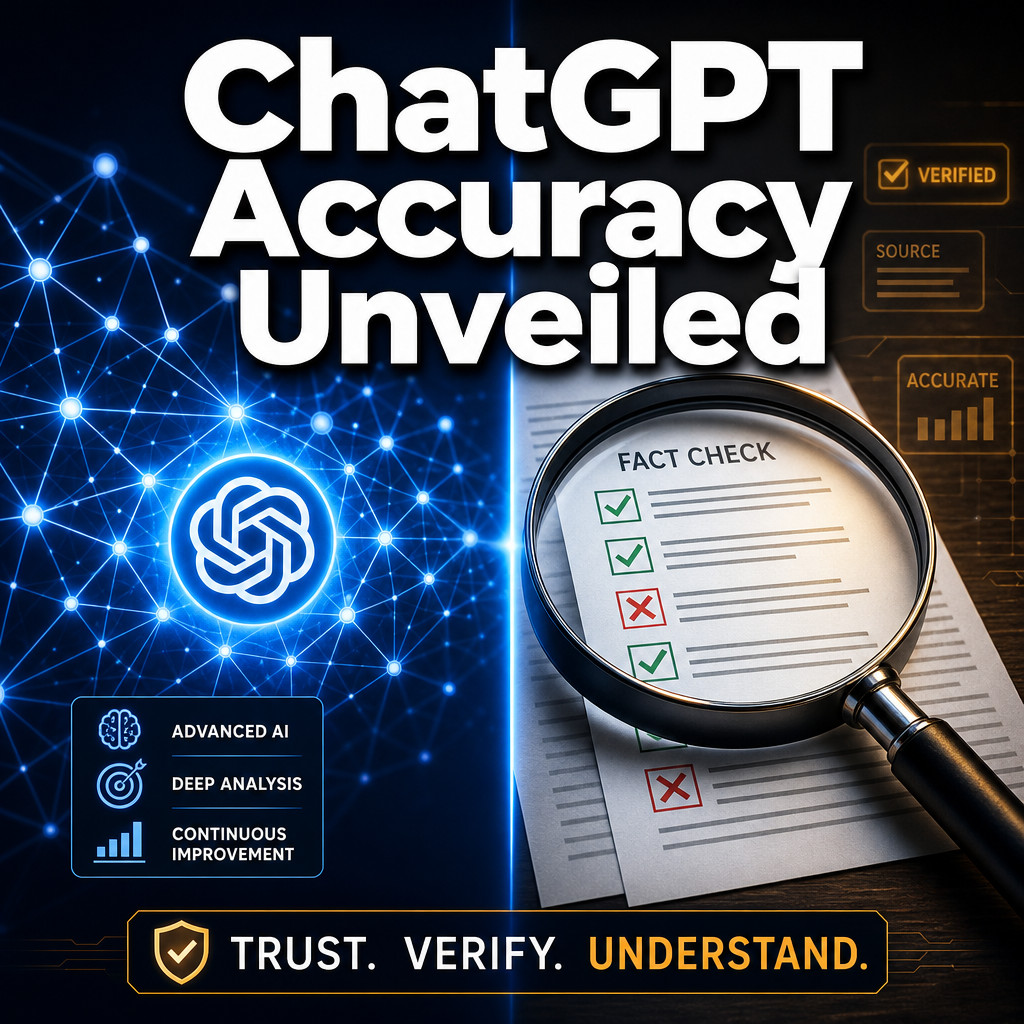
ChatGPT Accuracy Unveiled: A Comprehensive Analysis of AI Language Model Performance leads to one clear conclusion: this technology is genuinely powerful and genuinely limited, often at the same time. The model excels at language tasks, structured explanations, and creative drafting. It struggles with real-time facts, precise citations, and high-stakes professional judgment.
Actionable next steps for users in 2026:
- Match the tool to the task. Use ChatGPT for drafting, summarizing, and brainstorming. Verify anything factual before publishing or acting on it.
- Invest in prompting skills. Chain-of-thought prompts, role framing, and source-grounded queries measurably improve output quality.
- Build verification into your workflow. Treat ChatGPT output as a first draft, not a final answer, especially in regulated industries.
- Stay current on model updates. Accuracy improvements between versions are real, and the landscape is changing quickly.
- Combine AI with human expertise. The strongest results consistently come from teams where AI handles volume and humans handle judgment.
For deeper reading on how AI tools compare and how to use them effectively, explore our comprehensive guide to the most influential AI websites and the AI-powered content generation tools overview.
FAQ
Q: Is ChatGPT accurate enough to use for medical advice? ChatGPT can provide general health information and has passed medical licensing exam benchmarks, but it is not reliable for personal medical advice. Always consult a licensed healthcare provider for clinical decisions.
Q: How often does ChatGPT make up sources or citations? Hallucinated citations are a documented and recurring problem. Never use a ChatGPT-generated reference without verifying it in an actual academic database like PubMed or Google Scholar.
Q: Does GPT-4 hallucinate less than GPT-3.5? Yes. GPT-4 shows measurable reductions in hallucination rates compared to GPT-3.5 on most benchmarks, but hallucination has not been eliminated in any current version.
Q: Can I use ChatGPT for legal research? ChatGPT can help you understand general legal concepts, but it should not be used for jurisdiction-specific legal research, case citations, or compliance decisions without attorney review.
Q: What is the best way to reduce ChatGPT errors? Use specific, structured prompts; provide source material for the model to work from; ask it to reason step by step; and always verify factual claims independently.
Q: Is ChatGPT accurate in Spanish, French, or German? Performance in major European languages is generally good but below English-language accuracy. For professional or public-facing content, native speaker review is recommended.
Q: How do I know if ChatGPT is giving me outdated information? ChatGPT has a training cutoff date. If your question involves recent events, regulations, or research, assume the information may be outdated and check a current source.
Q: Is ChatGPT better than Google for factual questions? For well-established facts, both can be accurate, but Google retrieves current web sources while ChatGPT generates from training data. For recent or time-sensitive information, Google (or a search-augmented AI tool) is more reliable.
Q: Can ChatGPT be used for scientific research? It can assist with literature summaries, concept explanations, and code generation, but should not be used to generate or verify novel research findings without expert review.
Q: What industries trust ChatGPT most? Content marketing, software development, and education support see the widest adoption with manageable risk. Healthcare, law, and finance require the most caution.
References
[1] Is ChatGPT Accurate – https://www.chatbase.co/blog/is-chatgpt-accurate [2] PMC10002821 – https://pmc.ncbi.nlm.nih.gov/articles/PMC10002821/ [3] S41598-025-15898-6 – https://www.nature.com/articles/s41598-025-15898-6 [4] Is ChatGPT Accurate – https://livechatai.com/blog/is-chatgpt-accurate [5] PMC12366716 – https://pmc.ncbi.nlm.nih.gov/articles/PMC12366716/ [6] 10447318.2024 – https://www.tandfonline.com/doi/full/10.1080/10447318.2024.2344142 [7] PMC12495368 – https://pmc.ncbi.nlm.nih.gov/articles/PMC12495368/ [8] PMC11157293 – https://pmc.ncbi.nlm.nih.gov/articles/PMC11157293/ [9] PMC10722294 – https://pmc.ncbi.nlm.nih.gov/articles/PMC10722294/ [10] PMC10961658 – https://pmc.ncbi.nlm.nih.gov/articles/PMC10961658/