Last updated: May 1, 2026
Quick Answer: The 10 best character AI websites for storytelling in 2026 are Character.AI, Janitor AI, SillyTavern, DreamGen, Fables.gg, Venus Chub AI, Moescape, Backyard AI, NovelAI, and Kindroid. Each platform offers distinct strengths — from collaborative group fiction to solo emotional roleplay — so the right choice depends on your genre, technical comfort level, and content preferences.
Key Takeaways
- Character.AI leads the market with over 20 million users and an average session time of roughly 12 minutes and 33 seconds per visit [2]
- Janitor AI offers more than 32,000 pre-made avatars, making it one of the most customizable platforms available [2]
- Most platforms are free to start, with premium tiers ranging from $9 to $25 per month for advanced features
- AI character tools speed up backstory creation, personality design, and dialogue consistency, freeing writers to focus on plot structure [1]
- Choose platforms based on three factors: content restrictions, collaboration features, and technical setup requirements
- Character.AI’s “Stories” feature introduced choose-your-own-adventure style interactive fiction designed for teen audiences [4]
- Group storytelling platforms like Fables.gg support multiple participants simultaneously, which solo tools cannot replicate [2]
- Writers building story-driven websites or digital products can pair these AI tools with AI-powered content generation tools for a complete creative workflow
What Are the 10 Game-Changing Character AI Websites That Will Revolutionize Your Storytelling?
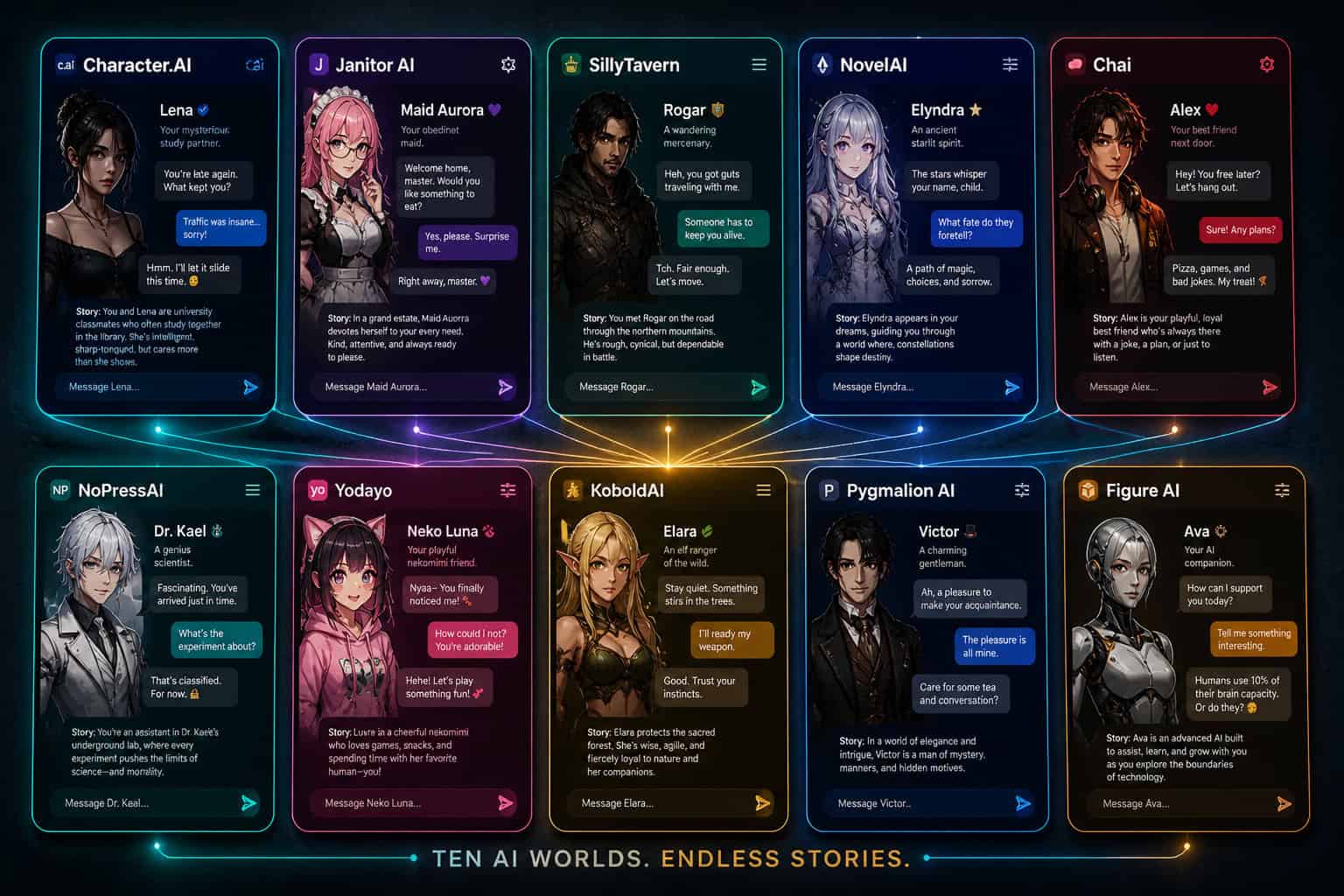
The 10 platforms covered in this guide are Character.AI, Janitor AI, SillyTavern, DreamGen, Fables.gg, Venus Chub AI, Moescape, Backyard AI, NovelAI, and Kindroid. Each one uses large language models to generate dynamic, in-character dialogue and narrative responses in real time.
Here’s a quick-reference comparison before we go deeper:
| Platform | Best For | Free Tier | Content Filters | Group Play |
|---|---|---|---|---|
| Character.AI | General audiences, beginners | ✅ Yes | Strict | ❌ No |
| Janitor AI | Avatar customization | ✅ Yes | Moderate | ❌ No |
| SillyTavern | Tech-savvy roleplayers | ✅ Yes | Flexible | ❌ No |
| DreamGen | Gaming narrative | ✅ Limited | Moderate | ❌ No |
| Fables.gg | Collaborative fiction | ✅ Yes | Moderate | ✅ Yes |
| Venus Chub AI | Emotional depth | ✅ Yes | Flexible | ❌ No |
| Moescape | Immersive relationships | ✅ Limited | Moderate | ❌ No |
| Backyard AI | Custom scenario design | ✅ Yes | Flexible | ❌ No |
| NovelAI | Long-form narrative writing | ❌ Paid only | Minimal | ❌ No |
| Kindroid | Companion AI with memory | ✅ Limited | Moderate | ❌ No |
Platform-by-Platform Breakdown: Which Tool Fits Your Creative Style?
Each platform below solves a different storytelling problem. Read the “choose this if” line for each one to find your match quickly.
1. Character.AI
Character.AI is the most widely used AI character platform in 2026, with over 20 million users and average daily engagement of two hours per user [2]. Its appeal comes from a massive library of community-built characters and an accessible interface that requires zero technical setup.
- Key feature: The “Stories” format lets users create visual, choose-your-own-adventure narratives with AI characters [4]
- Content policy: Strict family-friendly filters — adult or graphic content is not permitted
- Pricing: Free with a Character.AI+ subscription at roughly $9.99/month for faster responses and priority access
- ✅ Choose this if: You’re new to AI roleplay or want a safe, moderated environment for teen-appropriate storytelling
2. Janitor AI
Janitor AI stands out for sheer customization volume, offering over 32,000 pre-made avatars with adjustable dialogue styles and behavior parameters [2]. Writers who want a character that feels uniquely theirs — rather than a generic preset — will find this depth useful.
- Key feature: Granular control over character personality, tone, and response style
- Content policy: Moderate filters with some flexibility depending on account settings
- Pricing: Free tier available; premium unlocks faster API access
- ✅ Choose this if: You need a highly specific character persona for a recurring story or series
3. SillyTavern
SillyTavern is a self-hosted frontend that connects to multiple AI backends, giving technically comfortable users the most control over their storytelling environment [2]. It’s not a hosted service — you run it locally or on a server — which means content restrictions are largely determined by the AI model you connect to it.
- Key feature: Supports multiple LLM backends (OpenAI, Claude, local models)
- Content policy: Flexible — depends entirely on the connected model
- Pricing: Free and open-source; costs come from API usage of connected models
- ✅ Choose this if: You’re comfortable with basic technical setup and want maximum flexibility
4. DreamGen
DreamGen focuses on gaming-adjacent narrative roleplay, allowing users to craft storylines and modify plot directions in real time [2]. It’s particularly well suited for writers who think in terms of scenes, quests, and branching outcomes rather than linear prose.
- Key feature: Dynamic plot adaptation — the story responds to your choices as a participant
- Content policy: Moderate, with some mature content options
- Pricing: Limited free access; subscription required for extended sessions
- ✅ Choose this if: You write interactive fiction or game narratives and want AI that adapts to player decisions
5. Fables.gg
Fables.gg is the strongest option for collaborative group storytelling, supporting multiple participants co-authoring a narrative with AI assistance [2]. Most character AI platforms are single-user by design, so this is a meaningful differentiator for writing groups, tabletop RPG players, or classroom creative writing exercises.
- Key feature: Multi-user sessions with shared narrative control
- Content policy: Moderate community guidelines
- Pricing: Free to join with optional premium features
- ✅ Choose this if: You want to co-write with friends or run a collaborative fiction session
6. Venus Chub AI
Venus Chub AI prioritizes emotional depth over action-driven plot, making it a good fit for character studies, introspective fiction, and stories where relationships are the central element [2]. The platform’s design encourages longer, more nuanced exchanges rather than rapid-fire dialogue.
- Key feature: Emotional resonance in responses — characters express vulnerability, conflict, and growth
- Content policy: Flexible with account-level settings
- Pricing: Free tier with premium options
- ✅ Choose this if: Your stories center on character psychology, grief, romance, or interpersonal tension
7. Moescape
Moescape builds immersive virtual relationships through AI character interactions, with a design philosophy that encourages long-term narrative engagement [2]. Users report strong attachment to ongoing story arcs, which makes it effective for serialized fiction with recurring characters.
- Key feature: Persistent character memory across sessions
- Content policy: Moderate
- Pricing: Limited free access; subscription for full features
- ✅ Choose this if: You’re writing a serialized story and need a character that remembers past events
8. Backyard AI
Backyard AI gives writers advanced persona and scenario design tools, making it one of the more flexible platforms for building custom story worlds from scratch [2]. You can define detailed character backgrounds, set scene parameters, and adjust narrative tone before a session begins.
- Key feature: Pre-session scenario builder with persona templates
- Content policy: Flexible with user-defined settings
- Pricing: Free with optional premium tiers
- ✅ Choose this if: You want to build a fully designed story world before your first AI interaction
9. NovelAI
NovelAI is a subscription-only platform built specifically for long-form narrative writing, with a text editor interface that feels closer to a word processor than a chat app. It uses proprietary models trained on literary fiction, which produces prose with a different stylistic quality than general-purpose chatbots.
- Key feature: Lorebook system for storing world-building details the AI references during writing
- Content policy: Minimal restrictions on paid tiers
- Pricing: Starts at $10/month; no free tier
- ✅ Choose this if: You’re writing a novel or long-form story and need an AI writing partner, not just a chat companion
10. Kindroid
Kindroid combines AI character interaction with persistent memory and a companion-focused design, making it useful for writers who develop characters over weeks or months rather than single sessions. Its memory system tracks relationship history, which helps maintain character consistency across a long project.
- Key feature: Long-term memory and relationship tracking
- Content policy: Moderate with some customization
- Pricing: Limited free access; full features require subscription
- ✅ Choose this if: You’re developing a character over an extended creative project and need continuity
How Do These Platforms Actually Improve Your Storytelling?
AI character tools improve storytelling by handling the mechanical work of character consistency so writers can focus on narrative architecture [1]. Specifically, they help with three common friction points:
1. Backstory generation: Instead of spending hours building a character history, you can prompt the AI with a few traits and receive detailed backstory suggestions to edit and refine.
2. Dialogue consistency: AI character platforms maintain a character’s voice across long conversations, which is especially useful when testing how a character would respond to different plot scenarios.
3. Writer’s block: When a scene stalls, running it through an AI character interaction often generates unexpected directions — not because the AI is “creative,” but because it introduces responses a single writer might not anticipate.
Character AI tools accelerate character development by providing detailed suggestions for backstories, personality traits, and consistent dialogue, allowing writers to focus on overall narrative structure rather than granular details. [1]
Writers who also publish their work online can benefit from pairing these tools with AI-powered content optimization strategies to improve how their stories reach readers.
Free vs. Paid: What Do You Actually Get for the Money?
Most platforms offer a usable free tier, but premium subscriptions unlock features that matter for serious storytelling work. Here’s what the upgrade typically buys you:
| Feature | Free Tier | Paid Tier |
|---|---|---|
| Response speed | Slower (shared servers) | Priority/faster |
| Session length | Limited | Unlimited or extended |
| Memory/continuity | Short-term only | Long-term character memory |
| Model quality | Standard | Advanced model access |
| Content flexibility | More restricted | More customizable |
| API access | None | Available (some platforms) |
Common mistake: Many writers pay for a premium tier on the first platform they try, then discover a different platform fits their genre better. Start with free tiers across two or three platforms before committing to a subscription.

What Makes the 10 Game-Changing Character AI Websites Stand Out From Generic Chatbots?
Standard chatbots are designed for information retrieval. Character AI platforms are designed for sustained, in-character narrative engagement — and the difference shows in three specific ways.
Persona persistence: A generic chatbot resets context frequently. Character AI platforms maintain a defined persona across an entire session (and sometimes across sessions), which is essential for fiction where character voice must stay consistent.
Narrative framing: These platforms accept story-mode prompts — “you are a 19th-century detective investigating a murder” — and stay within that frame rather than breaking character to clarify they’re an AI.
Community character libraries: Platforms like Character.AI and Janitor AI host thousands of user-created characters, so writers can interact with existing fictional archetypes rather than building from zero every time.
Character AI platforms are experiencing rapid growth in 2026, with offerings ranging from playful collaborative experiences to deeply emotional interactions [3]. This growth reflects a genuine shift in how writers approach character development — less as a solitary craft and more as an interactive process.
For writers who also build digital products around their stories, tools like no-code website design platforms can help publish story worlds without needing development skills.
Who Are These Platforms For (and Who Should Skip Them)?
These platforms work well for:
- Fiction writers developing complex characters for novels, screenplays, or games
- Tabletop RPG game masters building NPC personalities and dialogue
- Writing teachers running collaborative creative exercises
- Hobbyist roleplayers who enjoy interactive fiction
- Game developers prototyping narrative branches
These platforms are less useful for:
- Writers who need factual research support (use a general-purpose AI assistant instead)
- Projects requiring legal or medical accuracy in dialogue (AI character responses are not reliable for technical accuracy)
- Anyone who needs guaranteed content consistency without human editing — AI outputs always require review
Edge case: If you’re writing a story that requires a very specific cultural or historical voice, AI character platforms may produce anachronistic or culturally inconsistent responses. Treat outputs as drafts, not final text.
Creators building full digital storytelling experiences may also find value in exploring AI graphic design tools to pair visual assets with their narrative work.

Step-by-Step: How to Start Using a Character AI Platform for Your Story
Getting started takes less than 15 minutes on most platforms. Here’s a practical sequence:
Define your character before you open the platform. Write down three personality traits, one core motivation, and one speech pattern. This gives you a prompt foundation.
Choose a platform based on your content needs. If your story contains mature themes, avoid Character.AI’s strict filters. If you want group input, go to Fables.gg.
Create or select a character. On Character.AI or Janitor AI, browse existing characters first — you may find one close to what you need and can adapt.
Set the scene in your opening prompt. Don’t just say “hi.” Give the AI context: “We’re in a 1940s noir city. You’re a cynical private investigator. I’m a client who just walked into your office.”
Run a test scene. Write a scene you already know the outcome of — this helps you evaluate whether the AI’s character voice matches your vision.
Iterate the persona. Most platforms let you edit character descriptions. Adjust based on what the test revealed.
Export or copy useful outputs. None of these platforms are writing software — paste useful dialogue into your actual manuscript tool for editing.
Writers who want to publish their stories as web content can also explore how AI website creators can help build story-focused sites quickly.
FAQ: Character AI Websites for Storytelling
Q: Is Character.AI safe for teenagers? Yes. Character.AI uses strict content filters and launched its “Stories” feature specifically for teen audiences [4]. It’s one of the most moderated platforms in this category.
Q: Can I use AI character platforms commercially — for a novel or game I plan to sell? Terms of service vary by platform. Most platforms allow personal creative use but restrict commercial resale of AI-generated content. Check each platform’s ToS before publishing commercially.
Q: Which platform has the most characters to choose from? Janitor AI, with over 32,000 pre-made avatars [2]. Character.AI also has a large community library, though exact counts change frequently.
Q: Do these platforms remember previous conversations? Most free tiers have limited or no cross-session memory. Kindroid and Moescape offer longer-term memory on paid tiers. SillyTavern supports memory extensions depending on the connected model.
Q: Are there offline character AI options? SillyTavern can run locally with a local language model (like LLaMA-based models), making it the most viable offline option. Setup requires moderate technical knowledge.
Q: How much do these platforms cost per month? Free tiers exist on most platforms. Paid tiers typically range from $9.99 (Character.AI+) to $25/month (NovelAI Opus tier). API-based setups like SillyTavern cost vary based on usage.
Q: Can multiple writers use these platforms together? Fables.gg is the primary platform designed for multi-user collaborative storytelling [2]. Most others are single-user by design.
Q: Do AI character platforms replace human beta readers? No. They help with character voice and dialogue drafting, but they don’t evaluate story structure, pacing, or emotional impact the way a human reader does.
Q: Which platform is best for fantasy or sci-fi worldbuilding? NovelAI’s Lorebook feature is purpose-built for storing and referencing world-building details. Backyard AI’s scenario builder is also strong for this use case.
Q: Can I import my own characters into these platforms? Yes on most platforms — Backyard AI, SillyTavern, and Janitor AI all support custom character creation with detailed persona inputs.
Q: Is there a platform that works well for screenwriters specifically? DreamGen’s scene-based, branching narrative format aligns well with screenplay structure. NovelAI also works for script-adjacent long-form writing.
Q: How do I avoid the AI breaking character mid-story? Use specific, detailed persona descriptions at the start of each session. Platforms with stronger persona persistence (Kindroid, Moescape) break character less frequently than general-purpose tools.

Conclusion: Your Next Steps for AI-Assisted Storytelling
The 10 game-changing character AI websites that will revolutionize your storytelling aren’t magic — they’re tools that work best when you bring a clear creative direction to them. The platforms covered here each solve a specific problem: Character.AI and Janitor AI lower the barrier to entry, SillyTavern and Backyard AI give technical users maximum control, Fables.gg enables collaboration, and NovelAI serves long-form narrative writers who need a dedicated writing environment.
Here’s what to do next:
- Pick one platform based on the “choose this if” criteria above — don’t try all ten at once
- Spend 30 minutes running a test scene with a character you already know well from your own work
- Evaluate the output for voice consistency, not plot quality — that’s still your job
- If the platform fits, explore its premium features before paying — most offer trial periods
- Pair your AI character work with a structured writing tool so outputs feed into an actual manuscript
Writers who want to extend their storytelling into digital formats — websites, interactive content, or branded story worlds — can explore resources on building professional websites without code and AI-powered content generation to complete the creative-to-publication pipeline.
The best character AI platform is the one you actually use consistently. Start simple, stay specific, and treat every AI output as a first draft worth editing.
See also: Character.AI.
References
[1] How To Utilize Character AI For Creative Storytelling – https://ramzvpn.com/blog/en/how-to-utilize-character-ai-for-creative-storytelling/
[2] 10 AI Character Roleplay Tools To Enhance Your Storytelling – https://blog.prodia.com/post/10-ai-character-roleplay-tools-to-enhance-your-storytelling
[3] Character AI Platforms That Are Growing Rapidly In 2026 – https://scribehow.com/page/Character_AI_Platforms_That_Are_Growing_Rapidly_in_2026__qK7MCNZARTmUfxk9wEj6bQ
[4] Introducing Stories: A New Way To Create, Play, And Share Adventures With Your Favorite Characters – https://blog.character.ai/introducing-stories-a-new-way-to-create-play-and-share-adventures-with-your-favorite-characters/