Last updated: May 7, 2026
Quick Answer: Vertical AI refers to artificial intelligence systems built specifically for a single industry or domain—such as healthcare, legal, or manufacturing—rather than general-purpose tools designed to work across all fields. These specialized systems outperform horizontal AI on domain-specific tasks because they are trained on industry data, follow sector-specific compliance rules, and solve problems that generic AI simply cannot handle with the same precision. For any organization operating in a regulated or data-intensive industry, vertical AI is the faster, more accurate, and often more cost-effective path to measurable results.
Key Takeaways
- Vertical AI is growing 4X faster than traditional AI applications, with some sectors seeing up to 400% year-over-year expansion [2]
- The vertical AI market is projected to grow at a CAGR of 24.5% through the coming decade [10]
- Specialized AI systems achieve up to 95% accuracy on domain-specific tasks like medical diagnostics, compared to lower benchmarks from general-purpose tools [2]
- AlphaSense hit $100M+ ARR by focusing exclusively on financial intelligence, proving the commercial power of vertical focus [2]
- Mayo Clinic built 200+ specialized AI use cases in under three years using a vertical AI factory approach [2]
- Luminance Legal’s vertical AI delivers $2M+ in annual savings on contract review alone [2]
- Vertical AI customer acquisition costs are 8X lower than horizontal AI competitors for enterprise deals [2]
- An estimated 80% of the world’s data is unstructured—vertical AI’s ability to handle contracts, records, and multimedia is finally bringing underserved industries into the modern era [3]
- Data defensibility—owning proprietary industry datasets—is the key competitive moat for vertical AI companies in 2026 [4]
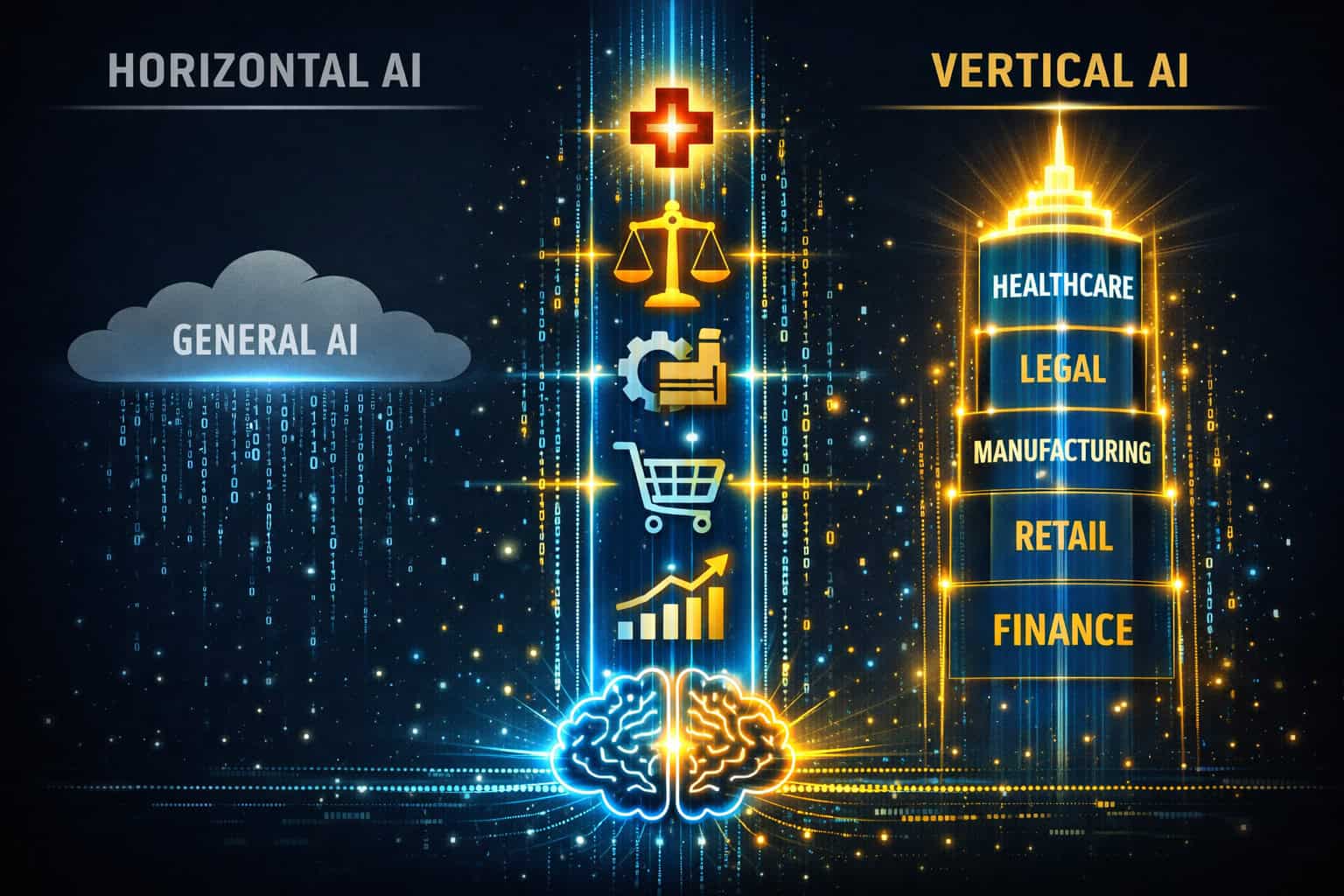
What Is Vertical AI and How Does It Differ from Horizontal AI?
Vertical AI is an artificial intelligence system designed and trained for one specific industry or use case. Horizontal AI, by contrast, is built to work broadly across many domains—think general-purpose large language models or standard machine learning platforms.
The difference is not just technical. It’s strategic.
| Feature | Vertical AI | Horizontal AI |
|---|---|---|
| Training data | Domain-specific (EHRs, legal contracts, ERPs) | General datasets (web text, Wikipedia) |
| Accuracy on specialized tasks | Up to 95% [2] | Varies; lower on niche tasks |
| Compliance | Built-in sector-specific governance | Generic guardrails |
| Setup time | Faster for target industry | Requires heavy customization |
| Cost per enterprise deal | 8X lower CAC vs. horizontal [2] | Higher acquisition and integration costs |
| Best for | Regulated, data-intensive industries | Cross-industry, general workflows |
The core distinction: Vertical AI solutions are trained on domain-specific datasets—electronic health records, legal case files, industrial sensor logs—rather than general internet data [5]. This means the model already understands the language, context, and constraints of your industry before you deploy it.
“Choose vertical AI if your industry has specialized terminology, regulatory requirements, or proprietary data that general models consistently misinterpret.
Common mistake: Many organizations assume a well-prompted general AI can replace a vertical one. For simple tasks, it can. But for high-stakes decisions—diagnostic support, contract risk assessment, financial crime detection—the accuracy gap is significant enough to matter legally and financially.
Why Is Vertical AI Growing So Fast in 2026?
Vertical AI is growing at this pace because three forces converged at the same time: large language models became capable enough to handle unstructured data at scale, industry-specific datasets became more accessible, and enterprises grew frustrated with the customization burden of horizontal tools.
An estimated 80% of the world’s data is unstructured—contracts, medical records, audio, video, emails [3]. For years, this data sat unused because standard software couldn’t process it reliably. Vertical AI, built on modern LLM foundations and fine-tuned on industry corpora, can now extract meaning from this data in ways that create direct business value.
Three growth drivers in 2026:
- Regulatory pressure — Industries like healthcare and finance face strict compliance requirements that generic AI tools can’t satisfy out of the box. Vertical AI ships with sector-specific guardrails already built in [5].
- Proprietary data moats — Vertical AI startups that secure exclusive access to industry-specific training data—medical imaging libraries, legal case archives, industrial sensor histories—build defensible competitive advantages that horizontal players can’t easily replicate [4].
- Proven ROI — Early adopters have published real numbers. When Luminance Legal reports $2M+ in annual savings from contract review alone [2], procurement teams in other law firms pay attention.
The market is responding accordingly. Vertical AI solutions are growing 4X faster than traditional AI applications, with some verticals expanding at 400% year-over-year [2], and the broader market is projected at a 24.5% CAGR [10].
For teams building or deploying AI-powered tools, understanding how AI content and workflow systems work at a deeper level is useful context—see this practical guide to AI-powered content optimization for related principles that apply across digital workflows.

Which Industries Benefit Most from Vertical AI: Revolutionizing Industry-Specific Solutions?
Healthcare, legal, financial services, manufacturing, and retail are currently seeing the highest returns from vertical AI adoption. Each of these sectors has deep pools of domain-specific data, strict compliance requirements, and workflows where accuracy directly affects outcomes—financial, medical, or legal.
Healthcare
- Mayo Clinic’s AI factory model produced 200+ specialized use cases in under three years [2]
- Diagnostic AI trained on medical imaging achieves up to 95% accuracy on specific conditions [2]
- Applications include radiology support, drug interaction checks, and patient triage
Legal
- Luminance Legal’s contract review AI delivers $2M+ in annual savings [2]
- Use cases: contract risk flagging, due diligence acceleration, regulatory compliance scanning
- Vertical AI understands legal clause structures that general models frequently misread
Financial Services
- AlphaSense reached $100M+ ARR by building AI specifically for financial research and intelligence [2]
- Applications include earnings call analysis, regulatory filing review, and financial crime pattern detection [6]
- Vertical AI understands regulatory language (SEC filings, FINRA rules) without extensive prompt engineering
Manufacturing
- Predictive maintenance AI trained on equipment sensor data reduces unplanned downtime
- Vertical models understand machine-specific failure signatures that generic models don’t recognize [6]
- Integration with ERP systems enables real-time production optimization
Retail
- Vertical AI analyzes consumer buying behavior patterns to personalize marketing at scale [6]
- Inventory forecasting models trained on retail-specific seasonality data outperform general forecasting tools
Edge case: Vertical AI is less valuable for organizations with small, low-quality datasets in their domain. The model needs sufficient industry-specific training data to outperform a well-configured general tool. If your industry data is sparse or poorly labeled, start with data collection before committing to a vertical AI build.
How Does Vertical AI Transform Business Intelligence?
Vertical AI transforms business intelligence by shifting it from descriptive (what happened) to predictive and prescriptive (what will happen and what to do about it), using domain-specific context that generic BI tools lack.
Standard business intelligence tools report on structured data—sales figures, inventory counts, customer records. They answer “what happened.” Vertical AI reads unstructured data—contracts, emails, maintenance logs, clinical notes—and answers “what does this mean for our specific situation, and what should we do next?”
What this looks like in practice:
- A financial analyst using vertical AI gets earnings call summaries that already account for industry-specific accounting standards, not just keyword extraction
- A hospital administrator gets patient flow predictions that factor in local epidemiological patterns, not just historical averages
- A manufacturing operations manager gets maintenance alerts that distinguish between normal sensor variance and early failure signatures specific to their equipment model
This is the core of vertical AI: revolutionizing industry-specific solutions and transforming business intelligence from a reporting function into a decision-support system that speaks the language of your industry.
For teams already using AI tools to build and manage digital products, the same principle applies—specialized tools consistently outperform general ones. The comprehensive guide to AI-powered content generation tools explores how this specialization plays out in content workflows.

What Are the Real-World Results of Vertical AI Implementations?
The clearest evidence for vertical AI’s value comes from organizations that have deployed it at scale and published measurable outcomes.
Case examples with verified figures:
| Organization | Sector | Application | Result |
|---|---|---|---|
| AlphaSense | Finance | Financial research AI | $100M+ ARR [2] |
| Mayo Clinic | Healthcare | AI factory model | 200+ use cases in <3 years [2] |
| Luminance Legal | Legal | Contract review AI | $2M+ annual savings [2] |
| Various manufacturers | Manufacturing | Predictive maintenance | Reduced unplanned downtime (sector-wide trend) [6] |
What drives these results:
- Domain-specific training means less time correcting AI outputs and more time acting on them
- Built-in compliance reduces legal review cycles for AI-generated outputs
- Lower integration friction because the system already understands industry data formats (EHRs, ERPs, legal databases) [5]
- Faster user adoption because the AI speaks the same professional language as the end user
A note on ROI timelines: Vertical AI implementations in well-documented sectors like legal and finance tend to show measurable ROI within 6-18 months, based on reported case data [2]. Healthcare implementations often take longer due to regulatory validation requirements. Manufacturing deployments vary significantly based on equipment standardization.
How to Evaluate Whether Vertical AI Is Right for Your Organization
Vertical AI is the right choice when your organization operates in a domain with specialized data, regulatory requirements, or workflows where general AI consistently underperforms. It’s not the right choice when your needs are genuinely cross-functional and domain-agnostic.
Use this decision framework:
✅ Choose vertical AI if:
- Your industry has specialized terminology that general models misinterpret (medical, legal, financial)
- You operate under sector-specific regulations (HIPAA, FINRA, FDA, GDPR sector variants)
- Your core workflows involve unstructured domain data (contracts, clinical notes, sensor logs)
- You need AI outputs that can be audited against industry standards
- You’re competing in a market where accuracy differences of 5-10% have significant financial or legal consequences
⚠️ Reconsider if:
- Your dataset is too small to fine-tune a domain-specific model effectively
- Your workflows are genuinely generic (email drafting, basic scheduling, general research)
- Your budget doesn’t support the higher upfront cost of a specialized build or vendor
- Your industry lacks established vertical AI vendors and you’d need to build from scratch
Common mistake: Organizations often underestimate the data preparation work required before deploying vertical AI. The model is only as good as the domain data it’s trained on. Budget for data cleaning, labeling, and governance before you budget for the AI system itself.
For organizations building AI-integrated digital products, understanding how AI tools fit into broader workflows is essential. The AI website creator guide shows how AI specialization applies even in web development contexts.

What Are the Key Challenges and Risks of Vertical AI Adoption?
Vertical AI adoption carries real risks, and organizations that ignore them tend to overpay for underperforming systems. The three most common challenges are data quality, vendor lock-in, and regulatory validation.
Challenge 1: Data quality and availability Vertical AI needs high-quality, domain-specific training data. Many organizations discover their internal data is inconsistent, poorly labeled, or legally restricted from use in model training. This is especially common in healthcare (patient privacy) and finance (data sharing restrictions).
Challenge 2: Vendor lock-in Specialized vertical AI vendors often build proprietary data pipelines and model architectures. Switching vendors later can mean losing the performance gains that came from your historical data being incorporated into the model. Negotiate data portability terms before signing.
Challenge 3: Regulatory validation In healthcare and financial services, AI systems used for consequential decisions often require regulatory review or internal validation before deployment. This adds time and cost that organizations frequently underestimate.
Challenge 4: Narrow applicability A vertical AI system built for one sub-sector may not transfer well to adjacent areas. A legal AI trained on M&A contracts may perform poorly on employment law documents. Scope your deployment carefully.
Challenge 5: Talent gap Implementing and maintaining vertical AI requires people who understand both the AI technology and the domain. This combination is rare and expensive. Factor in training or hiring costs.
“The organizations that get the most from vertical AI are the ones that treat it as a system, not a product—they invest in data governance, domain expertise, and change management alongside the technology itself.”
Vertical AI vs. General AI Agents: What’s the Difference in 2026?
Vertical AI agents are a specific category of AI agents designed to autonomously complete multi-step tasks within a defined industry context. They differ from general AI agents in that they operate with domain-specific knowledge, compliance constraints, and integration with industry-standard systems [8].
A general AI agent might browse the web, draft emails, and summarize documents. A vertical AI agent in healthcare might review a patient’s EHR, cross-reference current clinical guidelines, flag potential drug interactions, and generate a structured clinical note—all within HIPAA-compliant infrastructure.
Key differences:
| Dimension | General AI Agent | Vertical AI Agent |
|---|---|---|
| Task scope | Broad, cross-domain | Narrow, domain-specific |
| Compliance | Generic | Sector-specific (HIPAA, SOX, etc.) |
| System integrations | Standard APIs | EHR, ERP, legal databases |
| Accuracy on domain tasks | Moderate | High (up to 95%) [2] |
| Autonomy level | Supervised | Can be higher in validated contexts |
IBM’s research on vertical AI agents highlights that the combination of domain knowledge, tool access, and compliance constraints is what makes these systems viable for high-stakes enterprise workflows [8]. General agents, without these constraints, introduce too much risk in regulated environments.
For teams integrating AI into specific digital workflows—such as WordPress-based platforms—the principle of specialization also applies. See the guide on AI plugins for WordPress automation for a practical example of how specialized AI tools outperform general ones in specific platform contexts.

How Are Vertical AI Startups Building Competitive Moats in 2026?
The most defensible vertical AI companies in 2026 are winning on data, not just models. Proprietary datasets—medical imaging libraries, legal case archives, industrial sensor histories—are the primary competitive moat because they’re hard to replicate and improve model performance in ways that public data cannot [4].
The playbook for vertical AI startups, according to Bessemer Venture Partners [9]:
- Secure exclusive data partnerships with industry incumbents before competitors do
- Build workflow integration so deeply that switching costs are high
- Focus on a specific sub-vertical rather than an entire industry (e.g., radiology AI before general medical AI)
- Publish accuracy benchmarks against general AI tools to establish credibility with enterprise buyers
- Design for compliance from day one—retrofitting compliance is expensive and often incomplete
The economic advantage is real: vertical AI companies report customer acquisition costs 8X lower than horizontal AI competitors for enterprise deals [2]. This is because the product speaks the buyer’s language immediately, reducing the sales cycle and proof-of-concept burden.
What this means for enterprise buyers: If you’re evaluating vertical AI vendors, ask specifically about their training data provenance, their compliance certifications, and their data portability terms. The best vendors can answer all three clearly.
For anyone building AI-integrated digital products or platforms, understanding how AI tools fit into broader content and automation strategies is valuable context. The advanced WordPress strategies guide and the AI SEO tools for WordPress guide both illustrate how specialized AI tools create measurable advantages in specific platform contexts.
FAQ: Vertical AI Questions Answered Directly
Q: What is the simplest definition of vertical AI? Vertical AI is an AI system built and trained for one specific industry—like healthcare, legal, or manufacturing—rather than a general-purpose tool. It uses domain-specific data and follows sector-specific rules.
Q: How is vertical AI different from a general AI chatbot? A general AI chatbot is trained on broad internet data and works across many topics. Vertical AI is trained on specialized datasets (medical records, legal contracts, industrial logs) and is optimized for accuracy within one domain. The accuracy difference on specialized tasks can be significant—up to 95% for vertical AI in medical diagnostics versus lower benchmarks for general tools [2].
Q: Which industries are using vertical AI most actively in 2026? Healthcare, legal, financial services, manufacturing, and retail are the leading adopters. Healthcare and legal show the clearest ROI data, with documented examples like Mayo Clinic’s 200+ AI use cases [2] and Luminance Legal’s $2M+ annual savings [2].
Q: Is vertical AI more expensive than general AI? Upfront, yes—vertical AI typically costs more to build or license because of specialized training data and domain expertise. But the total cost of ownership is often lower because it requires less customization, achieves higher accuracy faster, and has 8X lower customer acquisition costs for enterprise deals compared to horizontal AI [2].
Q: Can a small business benefit from vertical AI? Yes, if a pre-built vertical AI vendor exists for their sector. Small businesses in legal, accounting, or retail can access vertical AI through SaaS products without building their own. The challenge is when no vendor exists and a custom build is required—that’s typically out of reach for small organizations.
Q: What data do vertical AI systems need to work well? They need high-quality, domain-specific datasets—electronic health records for healthcare AI, legal case files for legal AI, sensor logs for manufacturing AI [5]. The more labeled, structured, and proprietary the data, the better the model performs. Poor data quality is the most common reason vertical AI underperforms expectations.
Q: How long does it take to see ROI from a vertical AI deployment? Based on reported case data, well-scoped vertical AI deployments in legal and finance tend to show measurable ROI within 6-18 months [2]. Healthcare deployments often take longer due to regulatory validation requirements.
Q: What is a vertical AI agent? A vertical AI agent is an AI system that autonomously completes multi-step tasks within a specific industry context—for example, reviewing a patient’s records, cross-referencing clinical guidelines, and generating a compliant clinical note, all without human intervention at each step [8].
Q: How does vertical AI handle compliance? Vertical AI systems are designed with sector-specific governance built in—HIPAA for healthcare, FINRA for financial services, and so on [5]. This is a major advantage over general AI, which requires extensive customization to meet regulatory requirements.
Q: What’s the biggest risk of adopting vertical AI? Vendor lock-in and data quality are the two most common risks. If your training data is incorporated into a proprietary model, switching vendors can mean losing performance gains. Always negotiate data portability terms before signing with a vertical AI vendor.
Q: Is vertical AI replacing horizontal AI entirely? No. Horizontal AI is still valuable for cross-domain tasks—general writing, scheduling, basic research. Vertical AI excels where domain specificity, accuracy, and compliance matter. Most enterprises will use both: horizontal AI for general workflows and vertical AI for high-stakes domain tasks.
Q: Where can I learn more about AI tools for specific workflows? For AI tools applied to content and digital workflows, the AI archives at WebAIStack cover a wide range of practical AI applications, including automation, content generation, and platform-specific integrations.
Conclusion: What to Do Next with Vertical AI
Vertical AI: revolutionizing industry-specific solutions and transforming business intelligence is not a future trend—it’s a present reality with documented results. AlphaSense’s $100M+ ARR, Mayo Clinic’s 200+ use cases, and Luminance Legal’s $2M+ annual savings are not projections. They’re benchmarks that procurement teams, CIOs, and founders are already using to justify investment [2].
The market trajectory—24.5% CAGR and growing [10]—reflects genuine demand from industries that have been underserved by general-purpose software for decades. The 80% of the world’s data that sits unstructured in contracts, records, and logs is finally becoming accessible through vertical AI systems built to read it [3].
Here’s what to do now, based on where you are:
- If you’re evaluating vertical AI: Run the readiness assessment above. If your score is high, start with a single high-value use case, audit your data quality, and evaluate 2-3 vendors with published accuracy benchmarks.
- If you’re building a vertical AI product: Secure proprietary data partnerships before competitors do. Data defensibility is your primary moat in 2026 [4]. Focus on a specific sub-vertical before expanding.
- If you’re not ready yet: Start collecting and labeling domain-specific data now. Document where general AI fails in your workflows—that becomes your business case for a vertical deployment in 12-18 months.
The organizations that move deliberately—with clear use cases, clean data, and realistic ROI expectations—will be the ones that look back on 2026 as the year they got ahead of this shift.
References
[1] Vertical AI Transforming Industries With Tailored Solutions – https://newsgpt.ai/2023/07/10/vertical-ai-transforming-industries-with-tailored-solutions/
[2] How Vertical AI Is Making Legacy SaaS Obsolete Key Data – https://www.virtasant.com/ai-today/how-vertical-ai-is-making-legacy-saas-obsolete-key-data
[3] Vertical AI – https://greylock.com/greymatter/vertical-ai/
[4] Vertical AI Startup Ideas 2026 Dominating Industry Specific Niches – https://wearepresta.com/vertical-ai-startup-ideas-2026-dominating-industry-specific-niches/
[5] Rise Of Vertical AI – https://yellow.systems/blog/rise-of-vertical-ai
[6] Vertical AI Industry Specific AI – https://www.symphonyai.com/glossary/ai/vertical-ai-industry-specific-ai/
[7] Horizontal Vs Vertical AI – https://www.digitaldividedata.com/blog/horizontal-vs-vertical-ai
[8] Vertical AI Agents – https://www.ibm.com/think/topics/vertical-ai-agents
[9] Building Vertical AI An Early Stage Playbook For Founders – https://www.bvp.com/atlas/building-vertical-ai-an-early-stage-playbook-for-founders
[10] Vertical AI Market – https://market.us/report/vertical-ai-market/
Related: Claude New Fable 5: The Complete Guide to Anthropic's Most Powerful Model