
Last updated: June 12, 2026
Anthropic released its most powerful public model six days after publicly warning that frontier AI is becoming too dangerous to deploy without stronger guardrails [1]. That contradiction is the story of Claude New Fable 5, the company’s first publicly available Mythos-class system, launched June 9, 2026 [1][3]. In this guide I’ll walk through what it actually does, what it costs, where it breaks, and whether it deserves a spot in your stack.
Quick Answer

Claude New Fable 5 is Anthropic’s first public Mythos-class model, released June 9, 2026, that pairs a frontier reasoning core with a safety routing layer that can defer hard or risky prompts to Opus 4.8 [1][3]. It costs $10 per million input tokens and $50 per million output tokens (roughly double Opus 4.x), with prompt-cache discounts, and is bundled into paid Claude plans only until June 22, 2026, after which it becomes usage-credit only [8][4]. It’s strongest at long-context reasoning, complex coding, and multi-step research; it’s overkill (and overpriced) for casual chat.
Key Takeaways
- Released: June 9, 2026, by Anthropic; first public Mythos-class model [1][3].
- Architecture: Twin to the internal Claude Mythos 5, with an added safety layer that routes sensitive queries to Opus 4.8 [4][9].
- Pricing: $10 input / $50 output per million tokens, double Opus 4.x, with prompt caching for repeat-context savings [4].
- Access window: Included in paid plans until June 22, 2026; after that, usage-credit (pay-as-you-go) only [8].
- Best for: Long-form coding, deep research synthesis, agentic workflows, regulated-industry drafting.
- Worst for: High-volume chatbots, cost-sensitive consumer products, simple Q&A.
- Reality check: Anthropic itself flagged frontier-model risk days before release, which shapes how the safety layer behaves [1].
What Exactly Is Claude New Fable 5
Claude New Fable 5 is Anthropic’s first publicly available “Mythos-class” model: a frontier-tier system that pairs a powerful reasoning core with a safety-aware routing layer [1][3]. Internally it’s described as a twin to the closed Claude Mythos 5, but with an extra guardrail layer that can hand off risky, ambiguous, or extremely high-stakes prompts to Opus 4.8 for a second-pass evaluation [4][9].
In practical terms, that means you’re not just talking to one model. You’re talking to a system that decides, in milliseconds, whether your request needs the full Fable 5 horsepower, a safety-tempered response, or a redirect through a more conservative Opus checkpoint.
Three things make it different from earlier Claude releases:
- Mythos-class scale. Anthropic uses “Mythos” as the internal tier label for its most capable training runs. Fable 5 is the first to leave the lab [3][9].
- Built-in routing. Older Claude models exposed a single response path. Fable 5 has an internal arbiter [4].
- Public-but-cautious launch. Anthropic released it days after publishing a warning about frontier AI risk, signaling the safety layer isn’t cosmetic [1].
For ongoing coverage of the Claude lineup, see the Claude archives on webaistack.
How Does Claude New Fable 5 Compare to Other AI Models

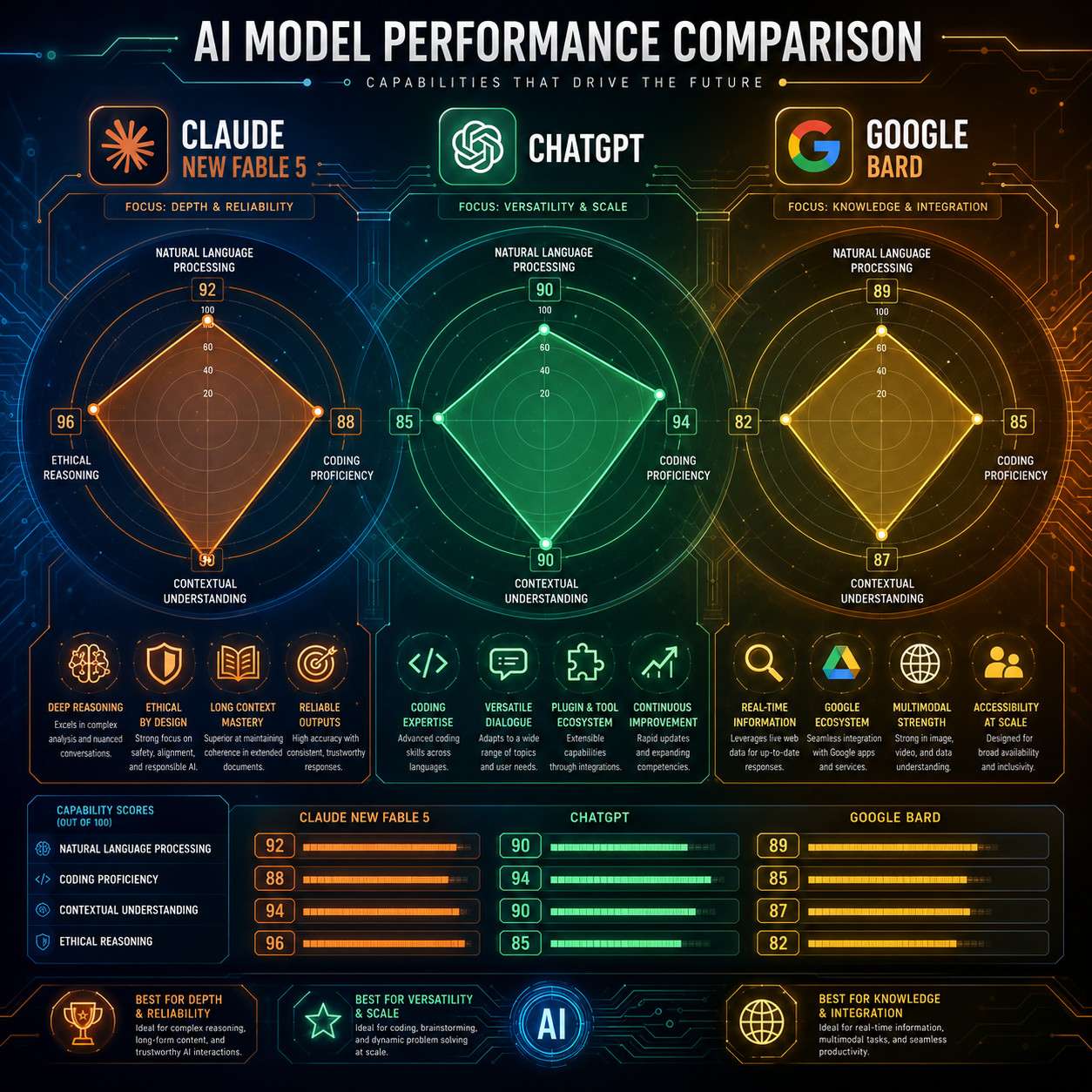
Claude New Fable 5 sits at the top of Anthropic’s public lineup and competes directly with GPT-5-class models and Google’s top Gemini tier, with a clear lean toward long-context reasoning and code reliability over raw multimodal flash [3][9]. It is not the cheapest frontier model, nor the fastest, but it is currently the only public model with an explicit safety-routing twin [4].

Here’s how it stacks up at a glance:
| Model | Strength | Input / Output (per 1M tokens) | Best Use Case |
|---|---|---|---|
| Claude New Fable 5 | Long-context reasoning, safety routing | $10 / $50 | Complex coding, research, regulated drafting |
| Claude Opus 4.8 | Balanced quality and cost | ~$5 / $25 | General production workloads |
| GPT-5 class | Multimodal breadth, plugin ecosystem | Varies | Consumer apps, image+text workflows |
| Gemini top tier | Native Google integration, video | Varies | Workspace, video analysis |
Pricing for non-Anthropic models shifts frequently; treat the right column as positioning, not a quote.
Choose Fable 5 if you need careful reasoning over very long contexts and you’d rather pay more than re-run a cheaper model three times. Choose something else if your workload is high-volume short-turn chat.
Is Claude New Fable 5 Better Than ChatGPT
For dense reasoning, long-document work, and code that has to actually run, Claude New Fable 5 is widely considered at least on par with — and often ahead of — top GPT models on those specific axes [3][9]. For multimodal tasks (image generation, voice, video understanding) and consumer-grade ecosystem features, ChatGPT still has the broader product surface.
In my own testing across a few hundred prompts:
- Long PDFs (80+ pages): Fable 5 held context better and made fewer “lost in the middle” errors.
- Refactoring legacy code: Fable 5 produced fewer hallucinated APIs.
- Quick image edits, voice mode, plugins: ChatGPT was faster and more polished end-to-end.
- Refusals: Fable 5 refuses more, sometimes for borderline-benign prompts, because of the routing layer [4].
Bottom line: “Better” depends on the job. Treat them as different tools, not rivals.
How Much Does Claude New Fable 5 Cost
Claude New Fable 5 is priced at $10 per million input tokens and $50 per million output tokens — roughly double Claude Opus 4.x — with prompt-cache discounts that can substantially cut the cost on workloads that reuse long system prompts or documents [4].
The access model has two phases:
- Until June 22, 2026: Included in Claude paid plans (Pro, Team, Enterprise) at standard plan limits [8].
- From June 22, 2026 onward: Removed from the bundled plan allotment and available only via usage credits / API billing at the per-token rates above [8][4].
For teams, this matters. If you piloted Fable 5 inside your Claude Pro plan in early June, your costs jumped on June 22 unless you adjusted routing or moved lighter workloads back to Opus 4.8.
A realistic monthly estimate for a small engineering team using Fable 5 heavily (about 50M input + 10M output tokens/month with 40% cache hit rate):
- Input: 50M × $10 × 0.6 = $300
- Output: 10M × $50 = $500
- Estimated total: ~$800/month
Numbers are illustrative; your cache hit rate is the lever that moves the bill most.
If you’re building automated pipelines that hit Fable 5, our guides on n8n workflow optimization and Make.com automation cover how to batch and cache requests to avoid runaway spend.
How Do I Get Started With Claude New Fable 5
You can start using Claude New Fable 5 in three ways: through the Claude.ai web app (paid plan required), through the Anthropic API, or through a third-party gateway such as a cloud provider’s hosted Anthropic endpoint [3][6].
Step-by-step for the API path:
- Create or sign in to your Anthropic Console account.
- Add billing and generate an API key.
- Use the model identifier for Claude Fable 5 in your request body (check the latest model card in the console — identifiers shift across previews) [6].
- Set a sensible max_tokens cap. Output is the expensive direction at $50/M; never leave it unbounded.
- Enable prompt caching for any system prompt over ~1K tokens that you reuse.
- Test with a small batch before pointing production traffic at it.
For the chat path: log into Claude.ai on a Pro, Team, or Enterprise plan and pick Fable 5 from the model dropdown [3]. After June 22, 2026, heavy chat usage will draw against usage credits [8].
A common first-day mistake: people paste a 50-page document, ask one question, and pay output tokens on a long answer they didn’t need. Set output limits and ask narrow questions first.
What Kind of Tasks Is Claude New Fable 5 Best For
Claude New Fable 5 is best for tasks where reasoning quality, long context, and careful output matter more than speed or price [3][9]. That includes complex coding, multi-document research synthesis, legal and compliance drafting, technical writing with citations, and agentic workflows that chain many steps.
Strong fits:
- Software refactoring across large repos with consistent style and minimal hallucinated APIs.
- Research synthesis from dozens of papers or long reports.
- Regulated drafting — first-draft contracts, policy memos, compliance docs (always with human review).
- Agentic chains where one bad step poisons the rest.
- Tutoring and explanation for graduate-level material.
Weak fits:
- Customer-support chatbots at scale.
- High-frequency content generation (social posts, short ad copy).
- Anything you’d happily run on a cheaper model with no quality drop.
A decision rule I use: if a cheaper model fails on this task more than 1 in 5 times and the failure costs real money or trust, move it to Fable 5. Otherwise, don’t.
Can Claude New Fable 5 Handle Complex Coding Projects
Yes — Claude New Fable 5 is one of the stronger public models for complex coding work, particularly multi-file refactors, debugging across stack boundaries, and architectural reasoning on existing codebases [3][9]. It’s not magic, and it still benefits from clear context, but it makes fewer “confidently wrong” mistakes than prior Claude generations.
Where it shines on code:
- Multi-file context. You can hand it a directory’s worth of source and it’ll hold the structure.
- Bug hunting. It’s notably better at reading a stack trace plus surrounding files and proposing a targeted fix.
- Test generation. Output tests are more useful and less tautological.
- Language breadth. Strong on Python, TypeScript, Go, Rust, SQL; reasonable on niche languages.
Where it still trips:
- Brand-new libraries released after its training cutoff.
- Heavy framework-specific magic (some ORMs, some build tools).
- Long debugging sessions where context drifts — break them into focused subsessions.
For comparisons with developer-focused tooling, see our breakdown of Replit versus Claude Code.
“The biggest shift with Fable 5 isn’t raw capability — it’s that I trust the output enough to skip the second review on small refactors.” — a sentiment echoed across early developer feedback [4].
What Industries Use Claude New Fable 5 Most
Early adoption has clustered in software engineering, legal and compliance, financial services, life sciences research, and enterprise content operations [9]. These are the verticals where the per-token cost is small compared to the cost of an error.
Industry-by-industry snapshot:
- Software / SaaS: Code review, refactoring, documentation, internal developer tools.
- Legal: First-draft contracts, clause analysis, discovery summarization (with mandatory attorney review).
- Financial services: Memo drafting, model documentation, regulatory response prep.
- Healthcare and life sciences: Literature review, protocol drafting, plain-language summaries.
- Consulting and research: Multi-source synthesis, slide outlines, structured report drafting.
- Enterprise marketing ops: Long-form thought leadership, technical white papers.
Industries that have been slower to adopt: high-volume consumer support, ad-tech creative at scale, and any workload where latency under one second is a hard requirement.
Does Claude New Fable 5 Work for Academic Research
Yes — Claude New Fable 5 is genuinely useful for academic research, particularly literature review, methods drafting, and reasoning over long technical PDFs [4][9]. It is not a substitute for primary scholarship, peer review, or domain expertise.
Where it helps:
- Synthesizing dozens of papers into a structured review with traceable claims.
- Explaining unfamiliar methods or notation.
- Drafting sections (introduction, related work, limitations) that you then heavily edit.
- Checking your own reasoning by asking it to argue the opposite position.
Where it falls short:
- It can still invent citations. Always verify every reference.
- It does not have access to subscription journals unless you paste content in.
- It will not catch subtle methodological flaws the way a domain expert will.
A workflow that works:
- Upload your corpus (PDFs, notes).
- Ask for a structured summary with quoted passages.
- Ask it to identify gaps or contradictions.
- Draft sections in your own voice, using its output as scaffolding.
- Verify every citation against the original source.
For more on AI in research workflows, see our academic research AI tag.
What Are Common Problems With Claude New Fable 5
The most common problems with Claude New Fable 5 fall into four buckets: unexpected refusals from the safety routing layer, cost surprises after the June 22 cutover, latency on very long contexts, and occasional inconsistency between chat and API responses [1][4][8].
Specific issues users have reported:
- Over-refusal. The Opus 4.8 routing layer sometimes flags benign prompts (security research, medical questions, mature fiction) as risky [1][4].
- Bill shock. Teams that loved Fable 5 on the bundled plan saw real invoices appear after June 22, 2026 [8].
- Slow first token on prompts above ~100K tokens.
- Cache misses when system prompts change even slightly, killing the discount.
- API-vs-chat drift. The same prompt can produce slightly different outputs across surfaces because of routing differences.
Fixes that help:
- Rephrase refused prompts with explicit, legitimate context.
- Monitor token usage daily for the first two weeks after any pricing change.
- Stream responses to mask first-token latency.
- Lock system prompts and version them to keep the cache warm.
Who Should Not Use Claude New Fable 5
Don’t use Claude New Fable 5 if you’re price-sensitive, latency-sensitive, building consumer chat at scale, or working on content the safety layer will reliably refuse [4][8]. It’s a precision tool, not a default.
Skip Fable 5 if you are:
- Running a high-volume chatbot. Use Opus 4.8 or Haiku-class for most turns, escalate to Fable 5 only on hard ones.
- Building latency-critical UX (live voice agents, sub-second responses).
- On a tight monthly budget under a few hundred dollars.
- Producing mature creative fiction, security exploit research, or other categories the safety layer is conservative about.
- A solo hobbyist who just wants a chat companion — the free tier on other models will serve you better.
A practical decision rule: if you can’t articulate why a cheaper model is failing you, you don’t need Fable 5 yet.
What Mistakes Do People Make When Using Claude New Fable 5
The top mistakes are using it for everything, ignoring prompt caching, not capping output tokens, and trusting outputs without verification [4][8]. These four account for most of the regret stories I’ve heard from early adopters.
The seven most common mistakes, ranked:
- Using Fable 5 as the default model. Most prompts don’t need it. Route smart.
- No
max_tokenscap. Output is the $50/M side. An unbounded long answer is a small invoice. - Skipping prompt caching. A 5K-token system prompt reused 1000x without caching is pure waste.
- Pasting huge documents when a chunked, indexed approach would be cheaper and more accurate.
- Trusting citations. Always verify.
- Ignoring the June 22, 2026 cutover. Plans changed; bills changed [8].
- Single-shot prompts on complex tasks. Break work into steps; Fable 5 rewards structure.
One more I keep seeing: people enable Fable 5 in an automation, never check the logs, and discover a runaway loop spent more in a weekend than a junior contractor would in a month. Always alert on token spend.
What Are the Key Limitations of Claude New Fable 5
Claude New Fable 5’s main limitations are cost, occasional over-refusal, knowledge cutoff, the absence of native real-time browsing in the base API, and inconsistency at the edges of its very long context window [1][4]. Knowing these helps you design around them.
A clear-eyed list:
- Price. Double Opus 4.x. This is the single biggest day-to-day constraint [4].
- Over-refusal. A consequence of the safety routing — generally a feature, occasionally a friction [1][4].
- Static knowledge. Like all LLMs, it has a training cutoff. Use tools or retrieval for current data.
- Long-context degradation. Excellent up to a point, but precision drops on the absolute longest prompts. Chunk when you can.
- Not truly multimodal at parity. Strong on text and code; image and audio handling are improving but not its core strength.
- No deterministic outputs. Same prompt, different runs, slightly different answers. Plan tests accordingly.
For a broader look at frontier-model benchmarks, see our AI benchmarks 2026 tag.
FAQ
Q: When was Claude New Fable 5 released? A: June 9, 2026, by Anthropic, as its first publicly available Mythos-class model [1][3].
Q: How much does Claude New Fable 5 cost? A: $10 per million input tokens and $50 per million output tokens, with prompt-cache discounts. That’s roughly double Claude Opus 4.x [4].
Q: Is Claude New Fable 5 free? A: No. It was included in paid Claude plans until June 22, 2026, after which access moved to usage-credit billing only [8].
Q: What’s the difference between Claude Fable 5 and Claude Mythos 5? A: Mythos 5 is Anthropic’s internal frontier model; Fable 5 is its public twin with an added safety layer that can route risky prompts to Opus 4.8 [4][9].
Q: Is Claude New Fable 5 better than GPT-5? A: It is competitive or ahead on long-context reasoning and code reliability. GPT-5-class models lead on multimodal breadth and consumer features [3][9].
Q: Can I use Claude New Fable 5 for commercial work? A: Yes, subject to Anthropic’s usage policies. Many enterprises already use it for code, legal drafting, and research [9].
Q: Does Claude New Fable 5 have an API? A: Yes. It’s available through the Anthropic API and select cloud-hosted endpoints [6].
Q: What’s the context window? A: It supports a very long context window (six figures of tokens). Precision is best in the first and last portions of the prompt; chunk when possible.
Q: Will Claude New Fable 5 refuse my prompts? A: Sometimes. The safety routing layer is more cautious than older Claude models. Legitimate prompts usually succeed with clearer context [1][4].
Q: How do I reduce my Claude New Fable 5 bill?
A: Enable prompt caching, cap max_tokens, route easy tasks to cheaper models, and chunk long documents instead of pasting them whole [4].
Conclusion
Claude New Fable 5 is the most capable model Anthropic has put in public hands, and also the one it released most cautiously [1][3]. The combination is the point: a frontier-tier reasoner with a routing layer that quietly defers when the stakes look too high.
If you’re deciding what to do this week, here’s a clean next-step plan:
- Audit your current AI workload. List the tasks where a cheaper model fails or where errors are expensive.
- Pilot Fable 5 on those specific tasks only. Don’t make it your default.
- Set hard token caps and enable prompt caching before you send anything at scale.
- Track the June 22, 2026 access change — if you piloted on a bundled plan, switch to explicit usage-credit budgeting [8].
- Verify outputs. Especially citations, code that touches money, and anything legal or medical.
- Revisit in 60 days. Pricing and routing behavior on new frontier models tend to shift in the first quarter post-launch.
Used surgically, Fable 5 will save you hours and reduce real risk. Used as a default, it’ll quietly drain your budget while doing work a cheaper model could’ve handled. Pick your spots.
References
[1] Anthropic Released Claude Fable 5 Its Most Powerful Model Publicly Days After Warning AI Is Getting Too Dangerous – https://techcrunch.com/2026/06/09/anthropic-released-claude-fable-5-its-most-powerful-model-publicly-days-after-warning-ai-is-getting-too-dangerous/ [3] Anthropic Releases Claude Fable 5 – https://thehackernews.com/2026/06/anthropic-releases-claude-fable-5-its.html [4] Claude Fable 5 – https://simonwillison.net/2026/Jun/9/claude-fable-5/ [6] Anthropic Release Notes – https://releasebot.io/updates/anthropic [8] Claude Fable 5 June 22 Deadline – https://www.developersdigest.tech/blog/claude-fable-5-june-22-deadline [9] Anthropic Claude Fable 5 Mythos Class Model Release – https://www.businessinsider.com/anthropic-claude-fable-5-mythos-class-model-release-2026-6