Last updated: June 9, 2026
Quick Answer: AI-driven chat technologies use large language models and machine learning to hold natural, context-aware conversations with users at scale. They differ from older rule-based chatbots by understanding intent, not just keywords. In 2026, these systems are reshaping customer service, healthcare, education, and dozens of other fields — but they work best when deployed thoughtfully, not as a blanket replacement for human judgment.
Key Takeaways
- AI chat systems process natural language using large language models, making them far more flexible than scripted chatbots.
- The gap between AI chat and human agents is narrowing fast, but complex emotional or legal situations still favor human support.
- Enterprise AI chat solutions range from roughly $50/month for small-business tools to $100,000+ per year for custom deployments.
- Healthcare, retail, financial services, and tech support see the strongest measurable returns from AI chat adoption.
- Privacy risks are real: data residency, consent frameworks, and vendor security practices must be evaluated before deployment.
- The most common implementation mistake is going live without a proper training dataset or escalation path.
- Small businesses can access capable AI chat tools for under $100/month using platforms like Intercom, Tidio, or Crisp.
- AI chat is not suitable for every use case — high-stakes medical advice, legal counsel, and crisis support still require humans.
What Exactly Is AI Chat Technology and How Does It Work
AI chat technology refers to software that uses machine learning — specifically natural language processing (NLP) and large language models (LLMs) — to understand and respond to human text or voice input in real time. Unlike static FAQ pages or phone trees, these systems interpret meaning, context, and even tone before generating a reply.
Here is a simplified view of what happens during a single AI chat interaction:
- Input parsing: The user’s message is tokenized and analyzed for intent, entities, and sentiment.
- Context retrieval: The system checks conversation history and, in retrieval-augmented systems, pulls relevant documents or knowledge base entries.
- Response generation: The LLM generates a reply based on the parsed input and retrieved context.
- Output filtering: Safety layers and brand-specific guardrails review the response before it reaches the user.
- Feedback loop: User reactions (ratings, follow-up questions) feed back into model fine-tuning over time.
This architecture is what makes AI chat feel conversational rather than mechanical. For a deeper look at how AI models are built and iterated, see this guide on open-source language model notebooks.
How Is AI Chat Different from Regular Chatbots
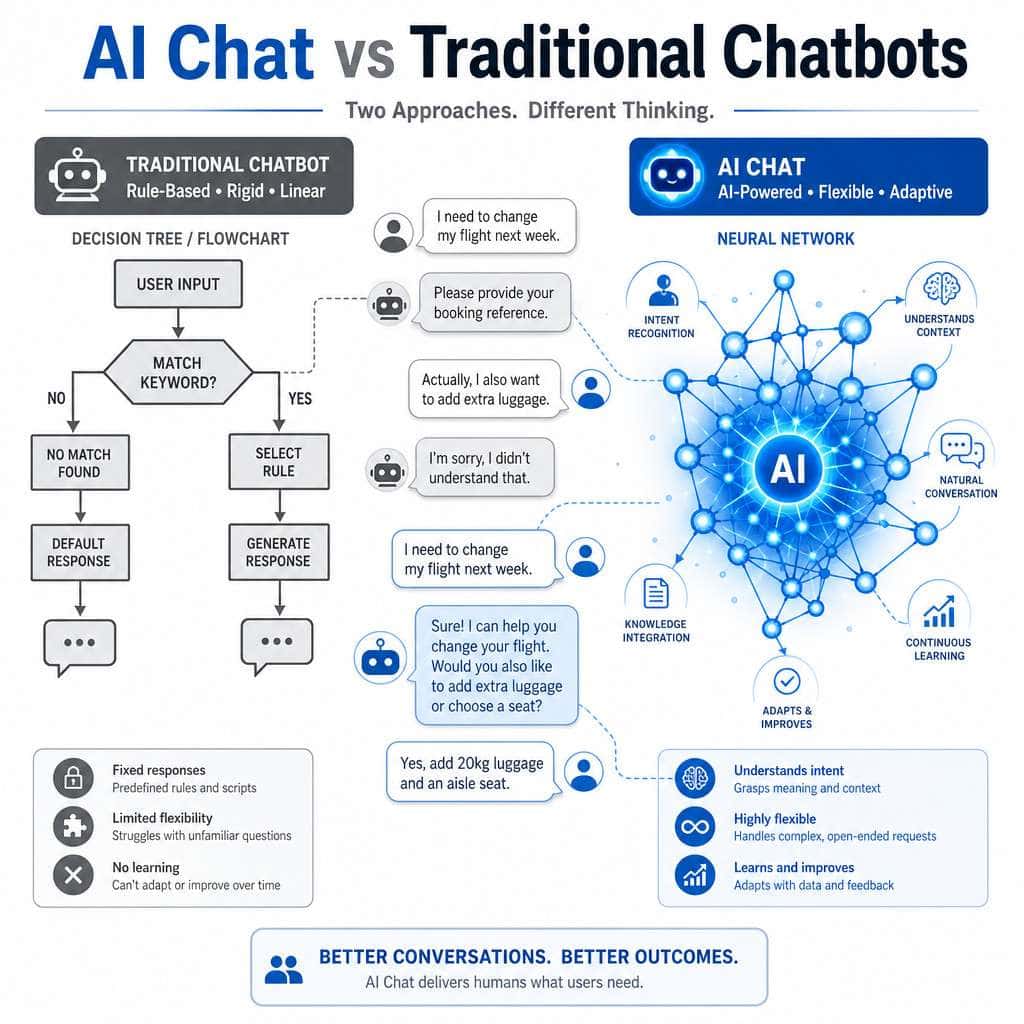
Traditional chatbots follow decision trees. They match keywords to pre-written responses and fail the moment a user phrases something unexpectedly. AI chat systems, by contrast, understand intent — so “my order hasn’t shown up” and “where’s my package?” both route correctly without separate rules for each phrase.
Key differences at a glance:
| Feature | Rule-Based Chatbot | AI Chat System |
|---|---|---|
| Understanding | Keyword matching | Intent and context |
| Flexibility | Rigid scripts | Handles novel phrasing |
| Training required | Manual rule writing | Data-driven fine-tuning |
| Escalation handling | Often fails silently | Can detect frustration and hand off |
| Cost to update | High (manual edits) | Lower (model retraining) |
The practical result: AI chat handles a much wider range of queries without breaking. That said, rule-based systems still have a place in highly regulated environments where every possible response must be pre-approved.
Which AI Chat Platforms Are the Best Right Now
The best AI chat platform depends on your use case, budget, and technical resources. As of 2026, the leading options fall into three tiers:
Enterprise-grade:
- Salesforce Einstein Bots — deep CRM integration, strong for sales and service workflows
- Microsoft Copilot Studio — tight Azure and Teams integration, good for internal enterprise use
- Google Dialogflow CX — strong multilingual support, suited for large contact centers
Mid-market:
- Intercom Fin — well-regarded for SaaS customer support, uses GPT-4 class models
- Zendesk AI — solid ticketing integration, good for teams already on Zendesk
Small business / self-serve:
- Tidio — affordable, easy setup, works well for e-commerce
- Crisp — generous free tier, good for startups
- ChatGPT-based custom bots — flexible if you have light technical skills
For hands-on guidance on building and automating chat workflows, the ChatGPT automation guide covers no-code integration options in detail.
How Much Does an Enterprise AI Chat Solution Cost
Enterprise AI chat pricing varies widely based on conversation volume, customization depth, and support level. As a general estimate (based on publicly available pricing tiers as of 2026):
- Small business tools: $50–$300/month for up to 5,000 conversations
- Mid-market platforms: $1,000–$10,000/month depending on seats and integrations
- Full enterprise deployments: $50,000–$250,000+ per year, including custom model training, security review, and dedicated support
Hidden costs to budget for include: integration development, staff training, ongoing model fine-tuning, and compliance audits. A common mistake is budgeting only for the license fee and ignoring the 30–50% implementation overhead.
Can AI Chat Replace Human Customer Service Representatives
AI chat can handle a large share of routine customer service queries — FAQs, order status, password resets, basic troubleshooting — without human involvement. However, it cannot fully replace human agents for complex, emotionally charged, or high-stakes interactions.
A practical framework: use AI chat as the first line of response for tier-1 queries, and build a clear escalation path to human agents for anything involving complaints, refunds above a threshold, medical questions, or legal matters. Companies that skip the escalation path see measurable drops in customer satisfaction scores.
When AI chat works well:
- High-volume, repetitive queries
- 24/7 coverage requirements
- Multilingual support needs
- Internal HR or IT helpdesks
When human agents are still essential:
- Emotional support or crisis situations
- Complex multi-step negotiations
- Situations requiring legal or medical judgment
- High-value client relationships
What Industries Benefit Most from AI Chat Technologies
Retail, financial services, healthcare administration, and technology support consistently show the strongest returns from AI-driven chat deployment. Each benefits for slightly different reasons.
- Retail and e-commerce: Order tracking, product recommendations, and return processing are high-volume and highly repetitive — a perfect fit.
- Financial services: Account balance queries, fraud alerts, and loan status checks can be automated safely with proper authentication layers.
- Healthcare administration (not clinical advice): Appointment scheduling, insurance verification, and prescription refill reminders are well-suited to AI chat.
- Tech support: Tier-1 troubleshooting, password resets, and software guidance handle well at scale.
Industries where AI chat adds less value include highly regulated legal services, mental health support, and complex B2B sales that require relationship-building over time.
What Are the Common Mistakes Companies Make When Implementing AI Chat
The single most common mistake is deploying an AI chat system without a quality training dataset. A model trained on generic data will give generic answers. A model fine-tuned on your actual customer conversations, product documentation, and support tickets will perform dramatically better.
Other frequent mistakes:
- No escalation path: Users who can’t reach a human when needed leave frustrated and don’t return.
- Ignoring tone and brand voice: A chat system that sounds nothing like your brand erodes trust.
- Skipping A/B testing: Launching without testing different conversation flows means leaving performance gains on the table.
- Neglecting post-launch monitoring: AI chat systems drift over time as language and customer needs evolve. Monthly reviews of low-rated conversations are essential.
- Over-automating too fast: Rolling out AI chat across all channels simultaneously before validating on one channel is a recipe for a messy rollout.
If you’re building automated workflows around your chat system, the n8n automation guide covers integration patterns that pair well with AI chat deployments.
Are There Privacy Concerns with Using AI Chat Systems
Yes, and they are significant enough to warrant careful vendor evaluation before signing any contract. AI chat systems process personal data — sometimes sensitive personal data — in real time, which creates exposure under GDPR, CCPA, HIPAA, and other frameworks depending on your region and industry.
Key privacy questions to ask any vendor:
- Where is conversation data stored, and for how long?
- Is data used to train shared models, or kept isolated to your account?
- What encryption standards apply at rest and in transit?
- Can users request deletion of their conversation history?
- Does the vendor hold relevant compliance certifications (SOC 2, ISO 27001)?
A practical rule: if your AI chat system will touch health, financial, or identity data, require a data processing agreement (DPA) and a security review before go-live. Don’t accept a vendor’s marketing language as a substitute for documented controls.
How Do Different AI Chat Technologies Compare in Accuracy and What Training Do They Need
Accuracy in AI chat is measured by intent recognition rate, resolution rate (how often the bot solves the query without escalation), and hallucination rate (how often it generates incorrect information). These metrics vary significantly by platform and, more importantly, by how well the system has been trained on domain-specific data.
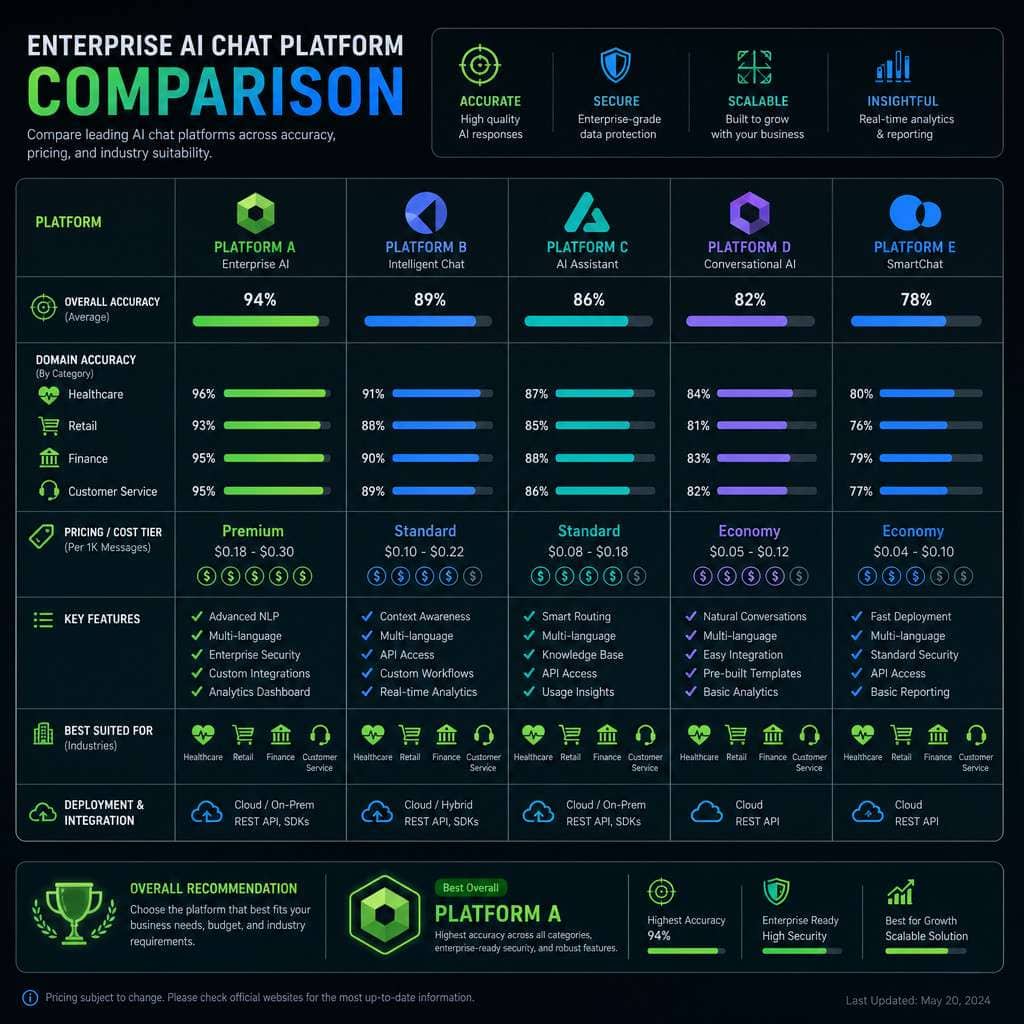
General-purpose LLMs score well on broad knowledge but can hallucinate on niche product or policy questions. Fine-tuned domain models score better on specific tasks but require more upfront investment.
Training requirements by deployment type:
- Out-of-the-box tools (Tidio, Crisp): Minimal training needed; connect your knowledge base and go.
- Mid-market platforms (Intercom Fin, Zendesk AI): Upload support docs, FAQs, and past ticket data for best results.
- Enterprise custom models: Require 10,000+ labeled conversation examples, ongoing human review, and quarterly retraining cycles.
For teams exploring AI-powered content and generation tools that complement chat systems, this guide to AI-powered content generation tools is a useful companion resource.
Who Shouldn’t Use AI Chat Technologies
Not every organization is a good candidate for AI chat right now. Avoid deploying AI chat as a primary communication channel if:
- Your query volume is low enough that a small human team handles it efficiently (under ~200 queries/week).
- Your product or service involves advice that carries legal or medical liability.
- Your customer base skews toward demographics with low digital literacy or strong preferences for phone support.
- You don’t have the internal resources to monitor, maintain, and retrain the system after launch.
- Your data environment doesn’t meet the security requirements of available platforms.
In these cases, a well-organized human support team or a simple FAQ page will outperform a poorly maintained AI chat system every time.
How Can Small Businesses Afford AI Chat Solutions
Small businesses can access solid AI chat capabilities for $50–$150/month using self-serve platforms. The key is matching the tool’s complexity to actual needs rather than buying enterprise features you won’t use.
Practical path for small businesses:
- Start with a free tier (Crisp, Tidio) to validate that AI chat reduces your support volume.
- Connect your existing knowledge base or FAQ page as the primary training source.
- Set a 30-day review checkpoint: if resolution rate exceeds 60%, upgrade to a paid plan.
- Add integrations (CRM, e-commerce platform) only after the core chat flow is stable.
The AI chatbot builder resources at WebAIStack cover specific setup walkthroughs for small-business use cases. Also worth exploring are free AI tools that can supplement a lean chat stack without adding significant cost.
Conclusion: Practical Next Steps for Adopting AI-Driven Chat Technologies
Revolutionizing communication through AI-driven chat technologies is not a matter of buying the most expensive platform or deploying the largest model. It comes down to matching the right tool to a clearly defined problem, training it on your actual data, and building human oversight into the workflow from day one.
Here are the actionable steps I’d recommend for any organization evaluating AI chat in 2026:
- Audit your current support volume — identify the top 10 query types that account for 80% of your tickets.
- Choose a platform tier that matches your volume and budget (see the cost breakdown above).
- Build your training dataset from real customer conversations before launch, not after.
- Define escalation rules so users always have a path to a human when needed.
- Set measurable KPIs — resolution rate, CSAT score, average handle time — and review them monthly.
- Stay current on privacy requirements for your industry and region, and re-evaluate vendor compliance annually.
The organizations seeing the best results from AI-driven chat in 2026 are not the ones who moved fastest. They’re the ones who moved most deliberately — and that approach is available to any business, regardless of size.
For teams looking to extend AI capabilities beyond chat, the AI-powered content optimization guide covers how to connect chat insights to broader content and marketing workflows.
Frequently Asked Questions
What is the difference between AI chat and a live chat widget? A live chat widget connects users to human agents in real time. An AI chat system responds automatically using machine learning, without a human in the loop unless escalation is triggered.
Can AI chat systems handle multiple languages? Yes. Most enterprise and mid-market platforms support 30–100+ languages. Accuracy varies by language; English, Spanish, French, and Mandarin typically perform best due to larger training datasets.
How long does it take to implement an AI chat system? Self-serve tools can be live in a day. Mid-market deployments typically take 2–6 weeks. Full enterprise custom deployments with security review and model fine-tuning can take 3–6 months.
Does AI chat work for voice as well as text? Yes. Many platforms now offer voice AI chat using speech-to-text and text-to-speech layers on top of the same LLM core. Accuracy for voice is slightly lower than text in noisy environments.
What happens when an AI chat system gives a wrong answer? Most platforms allow users to flag incorrect responses. Those flags feed into human review queues and are used to correct the model in the next training cycle. Without this feedback loop, errors persist.
Is AI chat GDPR compliant? It can be, but compliance depends on vendor configuration and your own data practices. You must ensure lawful basis for processing, provide users with deletion rights, and sign a data processing agreement with your vendor.
How do I measure whether my AI chat system is working? Track three core metrics: resolution rate (queries solved without escalation), customer satisfaction score (CSAT) post-chat, and containment rate (percentage of sessions that never reach a human agent).
Can AI chat integrate with my existing CRM? Most mid-market and enterprise platforms offer native integrations with Salesforce, HubSpot, Zendesk, and similar tools. Self-serve platforms often support Zapier or webhook-based connections.
What is a hallucination in AI chat? A hallucination is when an AI system generates a confident but factually incorrect response. It’s more common when the model lacks domain-specific training data. Retrieval-augmented generation (RAG) architectures reduce hallucination rates significantly.
Should I build a custom AI chat system or buy a platform? Buy before you build. Custom development costs are high and timelines are long. Only consider building custom if you have a genuinely unique use case that no existing platform supports, and you have an internal ML team to maintain it.
Useful Resources: ChatGPT by OpenAI & OpenAI research blog