Last updated: June 9, 2026
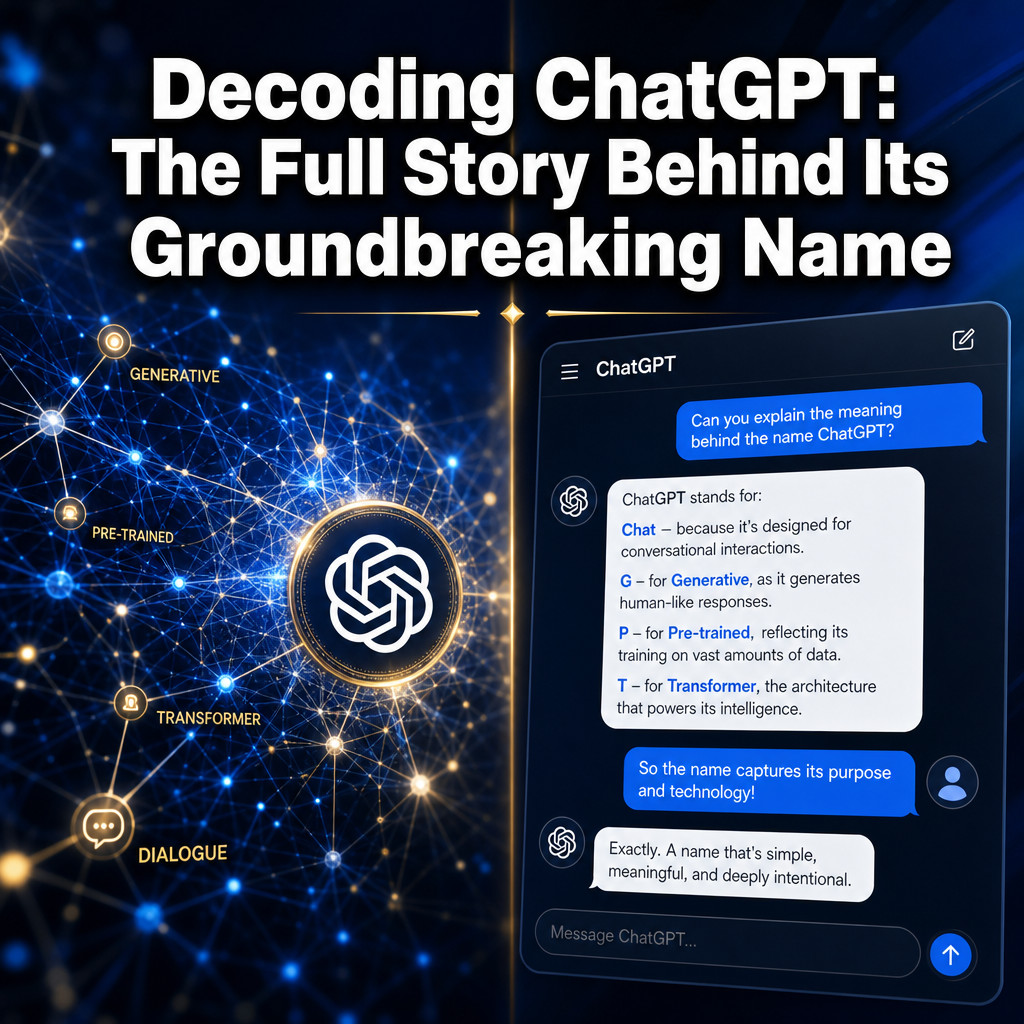
Quick Answer: ChatGPT stands for “Chat Generative Pre-trained Transformer.” The name was finalized in a late-night internal discussion at OpenAI just hours before the product launched in November 2022, replacing the original working title “Chat with GPT-3.5.” Each word in the name describes both how the tool works and how users interact with it, making it one of the most technically accurate brand names in AI history.
Key Takeaways
- The original name was “Chat with GPT-3.5” — the team changed it to “ChatGPT” the night before launch because the original was too long and awkward [1][2][3]
- GPT stands for Generative Pre-trained Transformer, describing the underlying neural network architecture [6][7][8]
- “Chat” was added to signal a conversational interface accessible to everyday users, not just developers [7][8]
- ChatGPT is fundamentally different from older chatbots because it generates contextual, original responses rather than pulling from scripted trees
- OpenAI trains GPT models on massive text datasets before fine-tuning them for specific tasks like conversation [6][7]
- ChatGPT supports over 50 languages, though accuracy varies significantly by language
- It makes mistakes, especially with recent events, math, and highly specialized professional knowledge
- It cannot fully replace human writers, but it does change how writing work is structured
- Ethical concerns include bias, misinformation, academic dishonesty, and job displacement
- Industries like healthcare, law, marketing, and software development see the most measurable productivity gains
The Late-Night Decision That Named an Era
The name “ChatGPT” almost never existed. According to Nick Turley, the product lead at OpenAI, the team had planned to launch the product under the name “Chat with GPT-3.5.” During an internal discussion the night before the November 2022 public release, the team decided that name was too long, too technical, and too clunky to say out loud [1][2][3].
The fix was simple: compress it. Drop the “with,” shorten the version number, and you get “ChatGPT.” That late-night call turned out to be one of the most consequential branding decisions in tech history [4].
Turley and principal researcher Mark Chen later described the choice as driven by two things: brevity and memorability. A name people can say, spell, and search for in seconds spreads faster than one that requires explanation [1][2][7].
What Does GPT Actually Stand For
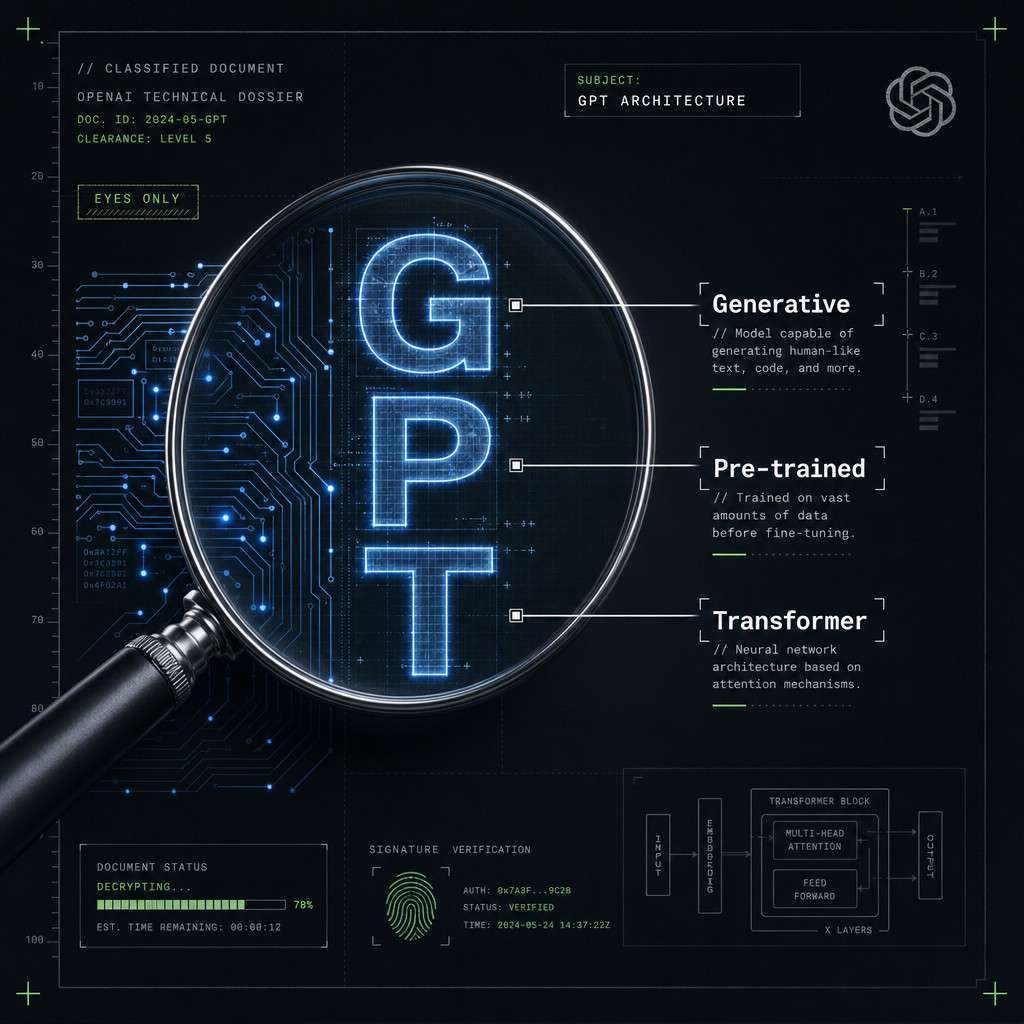
GPT is an acronym for Generative Pre-trained Transformer. Each word describes a specific technical property of the model [6][7][8].
Here is what each part means:
| Term | What It Means |
|---|---|
| Generative | The model creates new text rather than retrieving stored answers |
| Pre-trained | It was trained on a massive corpus of text data before being fine-tuned |
| Transformer | The neural network architecture that uses “attention” to process language |
The Transformer architecture, introduced by Google researchers in a 2017 paper titled “Attention Is All You Need,” changed how AI models process sequences of words. Instead of reading text left to right in a fixed order, Transformers weigh the relevance of every word to every other word simultaneously. That is why ChatGPT can handle nuanced, multi-sentence questions rather than just keyword matching [6][8].
So when you say “ChatGPT,” you are actually saying: “A conversational AI that generates text using a pre-trained Transformer model.” The name is the spec sheet.
For a broader look at how AI naming and branding works, see this analysis of Bolt AI’s iconic logo and design story.
How Is ChatGPT Different From Regular Chatbots
ChatGPT generates original, context-aware responses. Traditional chatbots follow decision trees or keyword triggers, returning pre-written answers. ChatGPT produces new text every time based on the full context of the conversation [7][8].
Older chatbots work like phone menus: press 1 for billing, press 2 for support. ChatGPT works more like a knowledgeable colleague who reads your entire message before responding. The difference is not just speed — it is the quality and flexibility of the output.
Key differences:
- Context retention: ChatGPT tracks the conversation thread; most older bots reset after each message
- Open-ended responses: No scripted answer library — responses are generated fresh each time
- Tone adaptation: It adjusts formality, length, and style based on how you write
- Task variety: One model handles writing, coding, summarizing, translating, and more
The tradeoff is that generated responses can be wrong in ways that scripted bots cannot be. A decision-tree bot either finds a match or says “I don’t understand.” ChatGPT will confidently produce a plausible-sounding but incorrect answer. This is called a hallucination, and it is a known limitation [7][8].

How Much Does ChatGPT Cost for Businesses
As of 2026, OpenAI offers ChatGPT at several price tiers. The free tier provides access to GPT-4o with usage limits. ChatGPT Plus costs $20 per month for individuals and includes higher usage caps and access to newer models. ChatGPT Team runs approximately $25–$30 per user per month with shared workspaces and admin controls. Enterprise pricing is negotiated directly with OpenAI and varies by usage volume and contract terms.
For API access (which businesses use to build ChatGPT-powered products), OpenAI charges per token — roughly per word chunk — with rates varying by model version. GPT-4o is more expensive per token than GPT-3.5-based models but produces significantly better results for complex tasks.
Choose the free tier if: you are exploring capabilities for personal use. Choose Plus if: you use it daily for writing, research, or coding assistance. Choose Team or Enterprise if: multiple employees need access, data privacy controls, or custom integrations.
For teams building automated workflows around ChatGPT, our comprehensive guide to ChatGPT automation and no-code workflow integration covers practical setup options.
Why Do Some People Say ChatGPT Makes Mistakes
ChatGPT makes mistakes because it predicts likely text rather than retrieving verified facts. The model does not “know” things the way a database does — it generates responses based on statistical patterns learned during training [7][8].
Common error types:
- Hallucinations: Confidently stating false information, including fake citations or wrong statistics
- Knowledge cutoff: No awareness of events after its training data ends
- Math errors: Arithmetic and multi-step calculations are unreliable without tools enabled
- Outdated context: Professional standards, laws, and prices change; the model may not reflect current reality
The practical rule: treat ChatGPT output as a first draft, not a final source. Always verify claims that matter — especially in legal, medical, or financial contexts.
Can ChatGPT Replace Human Writers Completely
No — ChatGPT cannot fully replace human writers, but it does restructure writing work significantly. It handles first drafts, outlines, and repetitive formats well. It struggles with original reporting, lived experience, brand voice consistency, and creative risk-taking that requires genuine human judgment.
What changes in practice:
- Writers who use AI tools produce more output in less time
- Editors spend more time fact-checking and refining rather than drafting from scratch
- Highly commoditized writing (product descriptions, templated reports) faces real displacement
- Investigative journalism, personal essays, and expert commentary remain firmly human territory
The honest framing: ChatGPT is a writing accelerator, not a writer replacement. For an example of how AI tools are reshaping content workflows, see our AI-powered content optimization guide.
Is ChatGPT Good for Students or Just Cheating
ChatGPT is a legitimate study tool when used to learn, and an academic integrity violation when used to submit work as your own. The distinction matters, and most educational institutions now have explicit policies on the difference.
Legitimate student uses:
- Explaining difficult concepts in plain language
- Generating practice questions for exam prep
- Getting feedback on a draft you wrote yourself
- Summarizing long readings to identify key themes before engaging with the source
Problematic uses:
- Submitting AI-generated essays as original work
- Using it during closed-book assessments without disclosure
- Replacing research with AI summaries without verifying primary sources
The key question is whether the AI is helping you understand or helping you avoid understanding. One builds skills; the other erodes them.
What Are the Ethical Concerns With AI Language Models
The main ethical concerns with AI language models like ChatGPT include bias in training data, potential for misinformation at scale, privacy risks, and economic disruption to knowledge workers. These are not hypothetical — they are documented and actively debated by researchers and policymakers [7][8].
Specific concerns worth knowing:
- Bias: Models trained on internet text absorb and sometimes amplify existing social biases
- Misinformation: Fluent, confident-sounding text is easier to spread and harder to fact-check
- Privacy: Data entered into ChatGPT may be used for model improvement unless enterprise privacy settings are enabled
- Consent: The original training data included text from authors and creators who did not opt in
- Dependency: Over-reliance on AI for decision-making reduces critical thinking in individuals and organizations
OpenAI has published usage policies and safety guidelines, but enforcement is imperfect and the technology evolves faster than regulation.
Which Industries Benefit Most From ChatGPT
Software development, legal services, healthcare administration, marketing, and customer support see the most consistent productivity gains from ChatGPT. These industries share a common trait: high volumes of text-based, repeatable tasks that benefit from fast drafting and summarization.
Industry-by-category breakdown:
- Software development: Code generation, debugging, documentation — tools like those covered in our AI coding tools resources show how deep this integration runs
- Legal: Contract summarization, research memos, first-draft clauses (always requires attorney review)
- Healthcare: Patient communication drafts, administrative documentation, clinical note formatting
- Marketing: Ad copy, email sequences, social content, SEO outlines
- Customer support: Response templates, knowledge base articles, ticket triage
Industries with lower gains: trades, physical manufacturing, hands-on healthcare, and any field where output quality depends on physical presence or licensed professional judgment.
What Are the Limitations of ChatGPT’s Current Version
ChatGPT’s current limitations in 2026 include a training knowledge cutoff, unreliable performance on complex math without tool use, inconsistent accuracy on niche professional topics, and an inability to access real-time information unless connected to browsing tools.
Additional constraints:
- Cannot retain memory across separate conversations by default (unless memory features are enabled)
- Output length is capped per response
- Performance degrades on very long documents loaded into context
- Does not independently verify the accuracy of its own outputs
- Multilingual quality drops significantly for lower-resource languages
How Does OpenAI Train Their Language Models
OpenAI trains GPT models in two main phases: pre-training on a large corpus of text data, then fine-tuning using human feedback. The pre-training phase exposes the model to hundreds of billions of words from books, websites, and other text sources. The model learns to predict the next word in a sequence, which builds broad language understanding [6][7][8].
The fine-tuning phase uses a technique called Reinforcement Learning from Human Feedback (RLHF). Human raters evaluate model responses and rank them by quality. The model is then updated to produce responses more like the highly-rated ones. This is what makes ChatGPT conversational rather than just predictive [6][7].
For a deeper technical look at open-source language model development, see our deep dive into open-source language model notebooks.
Can ChatGPT Understand Multiple Languages
Yes — ChatGPT supports over 50 languages, but performance is uneven. English, Spanish, French, German, and Mandarin Chinese see the strongest results because those languages are heavily represented in training data. Accuracy, fluency, and nuance drop for lower-resource languages like Swahili, Bengali, or Welsh [7][8].
Practical guidance by use case:
- High-resource languages (English, Spanish, French): Suitable for professional drafting with review
- Mid-resource languages: Useful for summarization and translation drafts, but verify carefully
- Low-resource languages: Use only for basic tasks; errors may be fluent but wrong
What Kind of Tasks Should I Not Use ChatGPT For
Avoid using ChatGPT as a sole source for medical diagnoses, legal advice, financial decisions, real-time information, or any task where a factual error carries serious consequences. The model is not a licensed professional and does not carry liability for incorrect outputs.
Specific tasks to avoid or approach with caution:
- Diagnosing symptoms or choosing medications
- Filing legal documents without attorney review
- Making investment decisions based on AI analysis alone
- Verifying current news, prices, or regulatory changes
- Generating content that will be published without human fact-checking
The rule: the higher the stakes of being wrong, the less you should rely on ChatGPT as your final authority.
How Accurate Is ChatGPT Compared to Human Experts
ChatGPT performs comparably to generalist human knowledge on broad, well-documented topics, but falls short of domain experts on specialized, current, or judgment-intensive questions. Studies in medical licensing and bar exam contexts have shown GPT-4 scoring at or above passing thresholds — but passing a test is not the same as practicing professionally.
The accuracy gap widens when:
- The question requires up-to-date information
- The answer depends on local laws, regulations, or context
- Professional judgment, ethics, or liability are involved
- The topic is niche and underrepresented in training data
Use ChatGPT to accelerate expert work, not to replace expert judgment.
Decoding ChatGPT: The Full Story Behind Its Groundbreaking Name — Why Branding Mattered
The story of how ChatGPT got its name is also a story about why names matter in technology. “Chat with GPT-3.5” would have told developers exactly what they were getting. “ChatGPT” told everyone — including people who had never heard of a language model — that this was something they could use [1][2][3][4].
That accessibility was intentional. The “Chat” prefix communicates a low barrier to entry. You do not need to know what a Transformer is. You just need to know how to type [7][8].
Nick Turley’s late-night rebranding call is now cited as one of the clearest examples of how product naming shapes adoption curves. Within two months of launch, ChatGPT reached 100 million users — a growth rate that no consumer app had matched at the time [4]. The name did not cause that growth alone, but it removed friction from the first impression.
For more context on how AI companies approach product identity, see the full ChatGPT archive on WebAIStack.
FAQ
What does ChatGPT stand for? ChatGPT stands for Chat Generative Pre-trained Transformer. “Chat” refers to the conversational interface; “GPT” describes the underlying AI architecture.
Who named ChatGPT? The name was finalized by OpenAI’s product team, with Nick Turley (product lead) and Mark Chen (principal researcher) involved in the late-night decision the evening before the November 2022 launch [1][2][3].
What was ChatGPT almost called? The original working name was “Chat with GPT-3.5.” The team shortened it to “ChatGPT” hours before launch because the original was considered too long and technical [1][2][3].
Is ChatGPT the same as GPT-4? No. GPT-4 is the underlying model; ChatGPT is the product (the interface). ChatGPT has run on different model versions over time, including GPT-3.5, GPT-4, and GPT-4o.
Can ChatGPT access the internet? By default, no. With browsing tools enabled (available in certain plans), it can retrieve current web information. Without that, it relies on training data with a fixed cutoff date.
Is ChatGPT free to use? A free tier exists with usage limits. Paid plans (Plus, Team, Enterprise) offer higher limits, newer models, and additional features.
How many people use ChatGPT? OpenAI reported passing 100 million users within two months of launch in late 2022. By 2026, the user base has grown substantially, though current figures should be verified against OpenAI’s latest public statements.
Does ChatGPT remember previous conversations? Not by default. Each new conversation starts fresh. Optional memory features, when enabled, allow some information to persist across sessions.
Is ChatGPT safe for children to use? OpenAI’s terms of service require users to be at least 13 years old (with parental consent for under-18 users in some regions). Content filters exist but are imperfect. Parental supervision is recommended.
What language is ChatGPT best at? English produces the most accurate and fluent results, followed by other high-resource languages like Spanish, French, German, and Mandarin.
Can I use ChatGPT for coding? Yes — ChatGPT handles code generation, debugging, and explanation across most major programming languages. For more advanced AI coding assistance, see our coverage of AI coding assistants.
What is the difference between ChatGPT and other AI chatbots? ChatGPT was among the first to combine a large language model with a consumer-friendly chat interface at scale. Competitors like Google Gemini and Anthropic Claude use similar Transformer-based architectures with different training approaches and safety philosophies.
Conclusion
Decoding ChatGPT: The Full Story Behind Its Groundbreaking Name reveals something useful beyond trivia — the name itself is a map of how the technology works and who it was built for. “Chat” signals accessibility. “GPT” signals the technical architecture. Together, they describe a product that was designed to be powerful enough for researchers and simple enough for anyone with a keyboard.
Here are the actionable steps to take from this article:
- Use the name as a mental model. When you know GPT means Generative Pre-trained Transformer, you understand why the tool sometimes makes things up — it generates, it does not retrieve.
- Match the tool to the task. ChatGPT excels at drafting, summarizing, explaining, and coding. It is unreliable for real-time facts, licensed professional advice, and high-stakes decisions.
- Set appropriate expectations at work. If you are introducing ChatGPT to a team, frame it as a drafting and research accelerator — not an oracle.
- Stay current. OpenAI updates models and pricing regularly. Check the ChatGPT category on WebAIStack for ongoing coverage of changes that affect how you use the tool.
The late-night decision to rename a product changed how millions of people first encountered AI. Understanding that story helps you use the tool more clearly — and think more critically about the AI names and claims you encounter next.
References
[1] OpenAI Named ChatGPT In A Late Night Decision – https://technews.tw/2025/07/04/openai-named-chatgpt-in-a-late-night-decision/ [2] Times of India – How ChatGPT Got Its Name: The Late-Night Discussion – https://timesofindia.indiatimes.com/technology/tech-news/how-chatgpt-got-its-name-the-late-night-discussion-and-what-it-means/articleshow/122253782.cms [3] The Origins And Impact Of ChatGPT: How A Last-Minute Name Shaped AI History – https://windowsforum.com/threads/the-origins-and-impact-of-chatgpt-how-a-last-minute-name-shaped-ai-history.372414/ [4] How ChatGPT’s Name Was Chosen Last Minute – https://www.datastudios.org/post/how-chatgpt-s-name-was-chosen-last-minute-now-we-know-the-story-behind-openai-s-best-brand [6] GPT Full Form: Decoding The Meaning Behind ChatGPT – https://www.optnation.com/blog/gpt-full-form-decoding-the-meaning-behind-chatgpt/ [7] BytePlus – ChatGPT Name and Architecture Overview – https://www.byteplus.com/en/topic/558649 [8] What’s In A Name: The Story Behind ChatGPT – https://expertbeacon.com/whats-in-a-name-the-story-behind-chatgpt/