Last updated: June 9, 2026
Quick Answer: The best ChatGPT checkers in 2026 include Originality.ai, GPTZero, Copyleaks, Winston AI, Sapling, ZeroGPT, and Turnitin’s AI detector. Each tool uses statistical language modeling to flag AI-generated text, but accuracy varies by use case. For most users, Originality.ai leads on accuracy for web content, while GPTZero is the top free option for educators.
Key Takeaways
- AI content detectors analyze patterns in text, such as perplexity and burstiness, to estimate whether a human or AI wrote it
- No detector is 100% accurate; false positive rates remain a real concern, especially for non-native English writers
- Originality.ai, GPTZero, and Copyleaks consistently rank highest for detection accuracy across independent tests
- Free tools exist, but paid plans (typically $10-$30/month) offer higher word limits and API access
- Most detectors can flag content from multiple AI models, including Claude, Gemini, and GPT-4
- Schools, publishers, SEO agencies, and legal teams are the heaviest users of these tools
- AI detectors are not plagiarism checkers; they serve a different and complementary function
- Partially AI-generated content is harder to detect; mixed documents often score inconsistently
- No technical skills are required to use most tools; paste text and click a button
What Exactly Is an AI Content Detector and How Does It Work
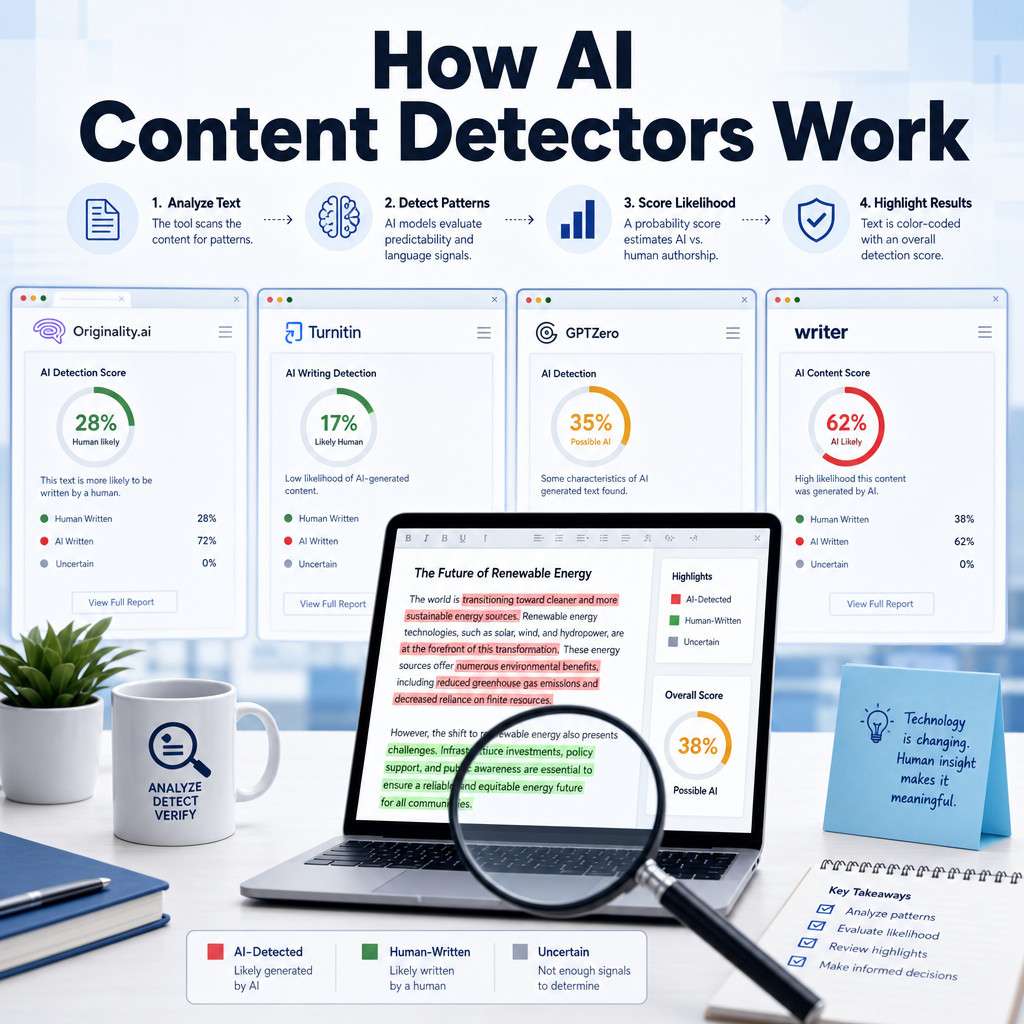
An AI content detector is a software tool that analyzes text to estimate whether a human or an AI model wrote it. These tools work by measuring two key signals: perplexity (how unpredictable the word choices are) and burstiness (how much sentence length varies). AI-generated text tends to score low on both because language models produce statistically “safe,” consistent output.
Most detectors are trained on large datasets of confirmed human and AI writing. When you paste text in, the tool runs it through a classifier model and returns a probability score, such as “87% likely AI-generated.”
How the detection process works, step by step:
- Text is tokenized into smaller chunks
- The model scores each chunk for perplexity and burstiness
- A classifier compares those scores to its training data
- The tool returns a confidence percentage and often highlights suspect sentences
Common mistake: Treating the output as a verdict rather than a probability. A score of 75% AI does not mean the writer used ChatGPT. It means the text pattern resembles AI output statistically.
Which ChatGPT Checker Is Most Accurate for Free
GPTZero is the most capable free AI content detector available in 2026. It offers sentence-level highlighting, a document-level score, and a reasonable free tier with no account required for short texts. For educators and students, it’s the practical starting point.
Free tools worth trying:
- GPTZero – Best overall free option; sentence-level breakdown included
- ZeroGPT – Simple interface, handles up to 15,000 characters free
- Sapling AI Detector – Clean output, good for short blog posts
- Writer.com AI Detector – No login needed, fast results
Choose a free tool if you’re checking occasional documents, you’re a student verifying your own work, or you just need a quick sanity check before submitting content.
Edge case: Free tools typically cap word counts at 2,000 to 5,000 words per check. For longer documents, you’ll need to split text manually or upgrade.
How Much Do Professional AI Content Detection Tools Cost
Most professional AI detection tools cost between $10 and $30 per month for individual plans, with enterprise pricing available on request. Here’s a direct comparison of the major paid options:
| Tool | Starting Price | Word Limit (per month) | Best For |
|---|---|---|---|
| Originality.ai | $30/month (or $0.01/100 words) | Pay-as-you-go | SEO agencies, publishers |
| Copyleaks | $13.99/month | 100 pages | Education, HR |
| Winston AI | $18/month | 80,000 words | Content teams |
| GPTZero (Pro) | $15/month | 150,000 words | Educators |
| Turnitin | Institutional pricing | Unlimited (per contract) | Universities |
Decision rule: Choose Originality.ai if you’re running a content agency and need API access. Choose GPTZero Pro if you’re a teacher grading student work regularly. Choose Turnitin only if your institution already licenses it, since individual pricing isn’t publicly available.
For a broader look at how AI tools are reshaping content workflows, see this comprehensive guide to AI-powered content generation tools.
Can These Tools Detect AI Writing From Different Models Like Claude or Gemini
Yes, most modern AI detectors can flag content from multiple AI models, not just ChatGPT. Originality.ai, Copyleaks, and Winston AI all claim multi-model detection covering GPT-4, Claude, Gemini, and Llama variants. However, accuracy drops somewhat when detecting newer or less common models, because detectors need training data from those specific models to perform well.
What the tools detect reliably:
- GPT-3.5 and GPT-4 output (highest accuracy across all tools)
- Claude 2 and Claude 3 (good accuracy on Originality.ai and Copyleaks)
- Gemini output (moderate accuracy; improving in 2026 updates)
What they struggle with:
- Heavily edited AI text
- AI output translated from another language
- Fine-tuned or custom AI models with non-standard output patterns
For more on how AI tools like these interact with content creation workflows, the ChatGPT resource archive covers related tools and use cases.
Are AI Detectors Reliable or Do They Have High False Positive Rates
AI detectors are useful but imperfect. False positive rates, where a tool flags human writing as AI-generated, are a documented problem. Non-native English speakers, writers who use formal or academic language, and anyone who writes in a highly consistent style are more likely to be falsely flagged.
Key reliability facts (based on published tool claims and independent reviewer testing as of 2025-2026):
- Originality.ai reports roughly 96% accuracy on clearly AI-generated content in its own benchmarks
- GPTZero has published third-party validation showing strong performance on academic writing
- All tools perform worse on short texts (under 300 words), where statistical signals are weak
Practical guidance:
- Never use a single detector result as the sole basis for an accusation
- Cross-check with a second tool if the stakes are high
- Look at sentence-level highlights, not just the overall score
“A high AI score is a signal worth investigating, not a verdict worth acting on alone.”
What Industries Need AI Content Checkers the Most
Publishers, educational institutions, SEO agencies, legal firms, and HR departments are the heaviest users of AI detection tools. Each has a distinct reason for needing them.
- Publishing and media: Editors need to verify that freelance submissions meet editorial standards for original human writing
- Education: Teachers and universities check student assignments for academic integrity
- SEO and content marketing: Agencies verify that outsourced content isn’t purely machine-generated before publishing (Google’s quality guidelines penalize low-effort AI content)
- Legal and compliance: Contracts and legal briefs must be verifiable as human-authored for liability reasons
- HR and recruiting: Some teams screen AI-generated cover letters and application essays
If you manage content at scale, pairing an AI detector with AI-powered content optimization practices helps maintain both quality and authenticity.
Will Schools and Universities Find These Tools Helpful
Yes, but with important caveats. Schools and universities are among the primary users of AI detection tools, and Turnitin’s AI detector is now embedded in many institutional licenses. GPTZero was specifically built with educators in mind and offers a classroom dashboard.
What works well for education:
- Batch submission checking for entire class assignments
- Sentence-level highlighting that shows which parts triggered the flag
- Integration with learning management systems (Turnitin, Copyleaks)
What doesn’t work well:
- Using detector scores as automatic grounds for academic penalties
- Checking very short answers or single-paragraph responses (accuracy is low)
- Assuming all flagged students cheated, since false positives affect ESL students disproportionately
Many universities now pair AI detection with a conversation-based review, where instructors ask students to explain their work verbally before any action is taken.
How Do AI Content Detectors Compare to Plagiarism Checkers
AI detectors and plagiarism checkers solve different problems. Plagiarism checkers (like Turnitin’s traditional engine or Copyscape) compare your text against a database of existing documents to find copied content. AI detectors analyze the statistical properties of your text to estimate whether a human or machine wrote it.
Key differences:
| Feature | Plagiarism Checker | AI Content Detector |
|---|---|---|
| What it checks | Matches to existing text | Writing pattern analysis |
| Can catch ChatGPT | Only if the exact output exists in its database | Yes, by design |
| False positive risk | Low | Moderate |
| Best for | Copyright and copying | Authenticity verification |
Some tools, like Copyleaks and Turnitin, now combine both functions in a single platform. That’s a practical advantage for institutions that need both capabilities.
Can AI Checkers Detect Partially AI-Generated Content
Partially AI-generated content is the hardest category for detectors to handle accurately. When a writer uses AI to draft a section and then rewrites it heavily, or mixes their own paragraphs with AI-generated ones, the overall document score often lands in an ambiguous middle range (40-60% AI probability).
What helps in this scenario:
- Tools that provide sentence-level or paragraph-level breakdowns (GPTZero, Originality.ai, Winston AI) are more useful than those that only give a single document score
- Reviewing highlighted sections individually gives a clearer picture than the aggregate score
Common mistake: Assuming a 50% score means the content is half AI. It actually means the detector is uncertain, not that exactly half the text is machine-generated.
Which AI Detector Is Best for Bloggers and Content Creators, and Are There Free Alternatives
For bloggers and content creators, Originality.ai is the strongest paid option because it’s built specifically for web content and checks for both AI generation and plagiarism. Winston AI is a close second for teams managing multiple writers.
Free alternatives that genuinely work:
- ZeroGPT – Handles longer texts than most free tools
- Sapling Detector – Clean interface, no signup needed for basic checks
- GPTZero (free tier) – Best sentence-level detail available for free
Choose free if you’re checking your own content occasionally before publishing. Choose paid if you’re managing freelance writers, running a content agency, or need audit trails for client reporting.
For content creators using AI tools as part of their workflow, understanding AI content creation best practices helps balance efficiency with authenticity. You might also find value in exploring AI content tools that complement detection with quality improvement.
What Technical Skills Do I Need to Use These AI Checkers Effectively
No technical skills are required to use any of the seven tools covered here. Every tool listed offers a simple paste-and-check interface. You copy your text, paste it into the tool’s text box, and click a button. Results appear in seconds.
For users who want more advanced features:
- API access (available on Originality.ai and Copyleaks) requires basic familiarity with REST APIs or a developer to set it up
- Bulk upload features on Winston AI and GPTZero Pro accept .docx or .pdf files, which requires no technical skill beyond uploading a file
- CMS integrations (some tools offer WordPress plugins or browser extensions) are plug-and-play
If you’re already using AI tools to automate your content pipeline, pairing a detector with your workflow is straightforward. See how AI content automation fits into broader publishing systems for context.
The 7 Best ChatGPT Checkers: Quick Reference Summary
Here’s a consolidated view of the 7 best ChatGPT checkers for unmasking AI-generated content in 2026:
- Originality.ai – Best for SEO agencies and publishers; highest accuracy on web content
- GPTZero – Best free option for educators; strong sentence-level analysis
- Copyleaks – Best combined AI detection and plagiarism checking
- Winston AI – Best for content teams managing multiple writers
- Sapling AI Detector – Best lightweight free tool for quick checks
- ZeroGPT – Best free tool for longer documents
- Turnitin AI Detector – Best for universities with existing Turnitin licenses
Frequently Asked Questions
Can AI detectors be fooled? Yes. Paraphrasing tools, heavy manual editing, and prompt engineering techniques can reduce AI detection scores. No detector is cheat-proof, which is why human review remains essential.
Is Originality.ai worth the cost? For content agencies or publishers checking more than 50,000 words per month, yes. The pay-as-you-go model at $0.01 per 100 words is cost-effective at scale.
Does Google penalize AI-generated content? Google’s guidelines penalize low-quality, unhelpful content regardless of how it was produced. High-quality AI-assisted content that genuinely helps readers is not automatically penalized.
How accurate is GPTZero? GPTZero has published validation data showing strong accuracy on academic writing samples, but like all tools, it performs less reliably on short texts under 300 words or heavily edited AI content.
Can I use these tools on content in other languages? Most tools are optimized for English. Copyleaks and Originality.ai offer some multilingual support, but accuracy drops noticeably in non-English languages.
What’s the best tool for checking a single blog post quickly? ZeroGPT or Sapling’s free detector. Both require no account and return results in under 10 seconds.
Do AI detectors work on images or audio? No. The seven tools covered here analyze text only. AI image detection and audio detection are separate tool categories.
Is it legal to use AI detectors on employee or student work? In most jurisdictions, yes, but organizations should disclose their use of AI detection as part of their academic integrity or content policies to avoid disputes.
Which tool has the best API for developers? Originality.ai and Copyleaks both offer well-documented REST APIs suitable for integrating detection into custom content workflows.
Can a detector tell me exactly which AI model wrote the text? Some tools attempt model attribution (Originality.ai labels GPT-4 vs. Claude, for example), but this feature is experimental and should not be treated as definitive.
Conclusion
The 7 best ChatGPT checkers for unmasking AI-generated content in 2026 give individuals, educators, and organizations a practical way to verify content authenticity. No single tool is perfect, and false positives remain a real limitation, especially for non-native English writers and formal academic styles.
Actionable next steps:
- Start with GPTZero’s free tier to get familiar with how AI detection scores work
- If you manage a content team, trial Originality.ai’s pay-as-you-go plan before committing to a subscription
- Always cross-check flagged content with a second tool before drawing conclusions
- Pair detection with a clear editorial policy so writers know what’s expected
- Revisit your tool choice every six months, since detection accuracy evolves as AI models change
The goal isn’t to eliminate AI from your workflow. It’s to maintain transparency and quality in whatever content you publish or evaluate. Used correctly, these tools are a valuable layer of editorial oversight, not a replacement for human judgment.
Useful Resources: ChatGPT by OpenAI & OpenAI research blog