Last updated: June 9, 2026
Quick Answer: ChatGPT is a large language model that researchers can use to accelerate literature scoping, draft outlines, synthesize concepts, and brainstorm research angles — but it must be paired with verified sources and critical judgment. It does not replace peer-reviewed databases, and any output it produces should be treated as a starting point, not a final authority.
Key Takeaways
- ChatGPT is most useful for research planning, concept explanation, and first-draft synthesis — not for sourcing verified facts.
- Always verify any claim, citation, or statistic ChatGPT produces against a primary source such as PubMed, JSTOR, or Google Scholar.
- ChatGPT Plus (GPT-4o) costs $20/month as of 2026 and offers meaningfully better reasoning for academic tasks than the free tier.
- Plagiarism risk is low if you treat ChatGPT output as a scaffold, not a submission — but institutional policies vary widely.
- Fields with well-established conceptual frameworks (STEM, social sciences, law) tend to benefit most from AI-assisted research scoping.
- Most institutions and major style guides (APA, MLA, Chicago) now have specific guidance on how to cite AI-generated content.
- The biggest mistake researchers make is trusting ChatGPT’s citations without checking them — it frequently generates plausible but non-existent references.
- Ethical use requires transparency: disclose AI assistance according to your institution’s or journal’s policy.
What Exactly Is ChatGPT and How Can Researchers Use It
ChatGPT is a conversational AI built on OpenAI’s large language model architecture. For researchers, it functions as an on-demand thinking partner — one that can explain dense concepts, help structure arguments, generate search query variations, and produce rough drafts for review.
Practically, researchers use ChatGPT to:
- Scope a new topic by asking for an overview of key debates, major theorists, or foundational papers in a field.
- Generate search terms for database queries (e.g., Boolean strings for PubMed or Scopus).
- Simplify complex methodology sections when reading outside your primary discipline.
- Draft outlines for literature reviews, grant proposals, or discussion sections.
- Stress-test arguments by asking ChatGPT to identify weaknesses in a thesis.
The key distinction: ChatGPT generates language based on patterns in training data. It does not search live databases or access paywalled journals in real time (unless connected to a browsing tool). Think of it as a highly articulate research assistant who has read a great deal but whose memory is imperfect and whose footnotes need checking.
For a broader look at how AI tools support academic workflows, the academic research tools archive at WebAiStack covers a growing range of options worth exploring.
How Does ChatGPT Compare to Traditional Academic Research Methods
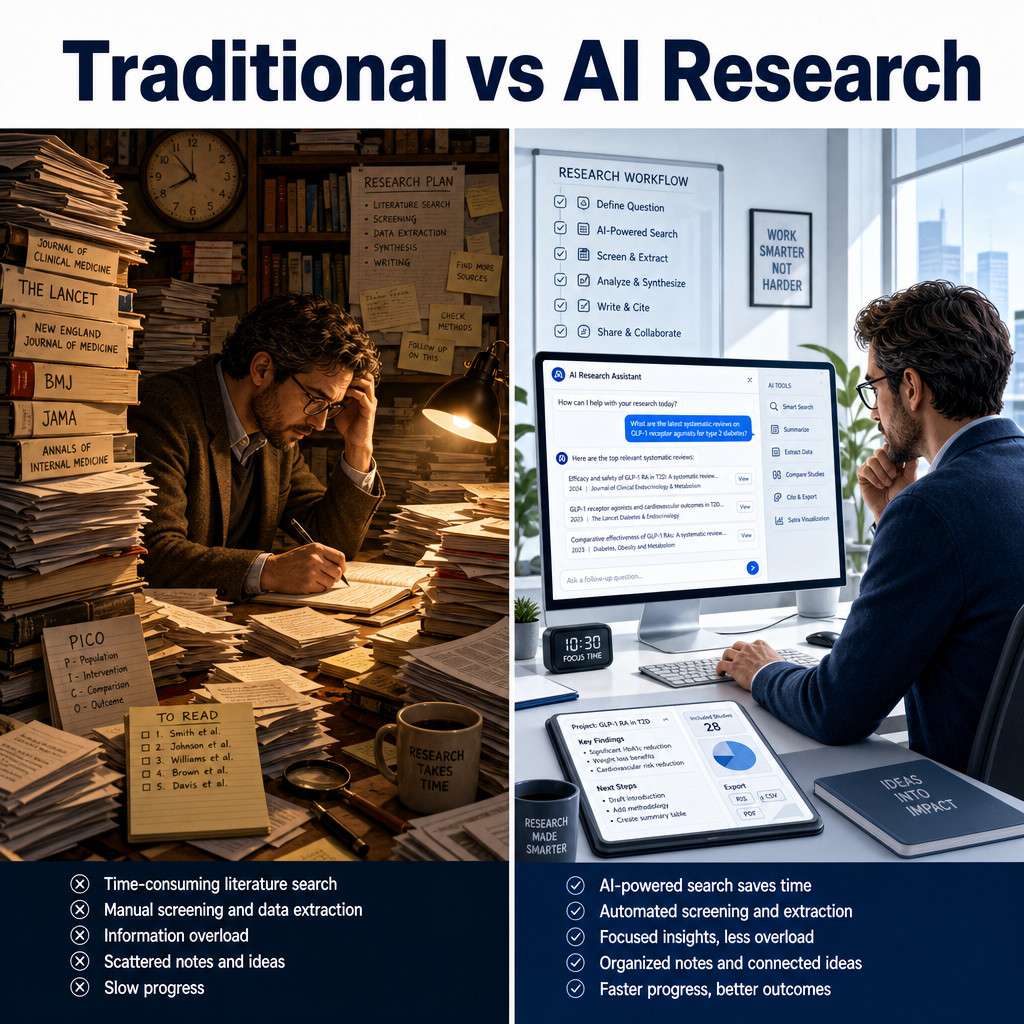
Traditional research methods — database searches, interlibrary loans, peer consultation, manual citation tracking — are slow, thorough, and verifiable. ChatGPT is fast, flexible, and approximate. Neither replaces the other.
| Dimension | Traditional Methods | ChatGPT |
|---|---|---|
| Source reliability | High (peer-reviewed) | Variable (needs verification) |
| Speed | Slow to moderate | Very fast |
| Citation accuracy | High | Low — hallucinations common |
| Conceptual explanation | Depends on researcher skill | Strong |
| Access to recent papers | Yes (via databases) | Limited by training cutoff |
| Cost | Database subscriptions vary | Free tier available; Plus at $20/mo |
Choose traditional methods when you need verified citations, current data, or publishable evidence. Use ChatGPT when you need to think through a problem, draft a structure, or get oriented in an unfamiliar field quickly.
For a direct comparison of AI research tools, the NotebookLM vs Gemini research tool showdown offers a useful side-by-side perspective on how different AI systems handle academic tasks.
Are There Ethical Guidelines for Using AI in Academic Research
Yes, and they are evolving rapidly. Most major universities, journals, and funding bodies had published AI-use policies by 2025, and those policies tightened through 2026 as AI-generated content became harder to detect.
Core ethical principles that appear across most institutional guidelines:
- Transparency: Disclose if and how AI was used in your research process.
- Accountability: The researcher, not the AI, is responsible for accuracy and integrity.
- Non-substitution: AI should not replace human intellectual contribution in ways that misrepresent authorship.
- Data privacy: Do not input confidential participant data, unpublished results, or proprietary information into a public AI tool.
The Committee on Publication Ethics (COPE) and the International Committee of Medical Journal Editors (ICMJE) have both stated that AI tools cannot be listed as authors because they cannot take responsibility for a work. Check your target journal’s specific policy before submission — they differ considerably.
What Are the Limitations of ChatGPT in Scholarly Work
ChatGPT’s most serious limitation for academic research is hallucination: it generates confident-sounding citations, statistics, and author names that do not exist. This is not a bug being fixed soon — it is a structural feature of how language models work.
Other significant limitations:
- Training cutoff: ChatGPT’s knowledge has a cutoff date, meaning recent publications, datasets, or policy changes may not be reflected.
- No database access: Without a browsing plugin, it cannot retrieve live journal articles.
- Discipline depth varies: It performs well in fields with abundant training data (medicine, law, computer science) and less well in niche subfields or non-English literature.
- No primary data: It cannot analyze your raw dataset, run statistical models, or access proprietary research tools.
- Bias in training data: Dominant perspectives in the training corpus may be over-represented, which matters in fields like history, sociology, or postcolonial studies.
Common mistake: Treating a ChatGPT-generated literature summary as a substitute for a proper database search. It is not. Use it to identify what questions to ask, then go to JSTOR, PubMed, or Scopus to find the actual papers.
How Much Does ChatGPT Plus Cost for Academic Use
As of 2026, ChatGPT Plus costs $20 per month for individual users. OpenAI also offers a ChatGPT Team plan at approximately $25–$30 per user per month for collaborative academic groups, and an Enterprise tier with custom pricing for institutions.
The free tier (GPT-4o mini) is functional for basic tasks but produces noticeably weaker reasoning on complex academic problems. For serious research use — multi-step analysis, long document synthesis, or nuanced argument evaluation — the Plus plan is worth the cost.
Some universities have negotiated institutional access. Check with your library or IT department before paying personally.
Can ChatGPT Help Me Write Research Papers or Citations
ChatGPT can help you draft sections of a research paper, but it cannot reliably generate accurate citations. This distinction matters enormously.
What it does well:
- Drafting introduction and discussion sections from your notes
- Suggesting transitions and improving paragraph flow
- Reformatting content between citation styles (APA, MLA, Chicago) — though always verify output
- Generating a first-pass abstract from a completed draft
What it does poorly:
- Producing accurate in-text citations or reference lists (hallucination risk is high)
- Accessing the actual text of paywalled papers
- Replacing your own analytical voice and original argument
For citation generation, use dedicated tools like Zotero, Mendeley, or Citation Machine alongside ChatGPT. The AI can help you format once you have the verified source details in hand.
You can also explore our comprehensive guide to AI-powered content generation tools for a broader look at how AI writing assistants fit into a research and writing workflow.
What Kinds of Academic Fields Work Best with ChatGPT Research
Fields with large, well-documented bodies of English-language literature and established conceptual frameworks tend to benefit most. This includes medicine, law, computer science, economics, psychology, and most natural sciences.
Fields where ChatGPT is less reliable:
- Niche humanities subfields with limited digitized sources
- Non-English literature where training data is thinner
- Emerging research areas published after the model’s training cutoff
- Highly quantitative disciplines where you need actual data analysis, not language generation
That said, even in less-ideal fields, ChatGPT can still help with concept mapping, argument structuring, and plain-language explanation of methodology — tasks that are field-agnostic.
For researchers exploring how AI tools intersect with academic writing, the academic AI tools resource page tracks developments across multiple disciplines.
Are There Risks of Plagiarism When Using ChatGPT in Research
The plagiarism risk is real but manageable. If you submit ChatGPT output verbatim as your own work without disclosure, most institutional policies classify that as academic misconduct — regardless of whether a detection tool flags it.
How to stay on the right side of policy:
- Use ChatGPT output as a scaffold, then rewrite substantially in your own voice.
- Disclose AI assistance in your methods section or acknowledgments, as required by your institution.
- Never submit AI-generated text as original analysis without significant transformation and verification.
- Check your institution’s specific AI policy — they range from permissive to prohibitive.
AI detection tools (Turnitin, GPTZero) are imperfect and produce false positives. The safest approach is transparency and substantive human revision, not trying to “beat” detection.
Is ChatGPT Reliable for Scientific Literature Reviews
No, not as a standalone tool. ChatGPT should not be the primary instrument for a scientific literature review because it cannot guarantee the existence, accuracy, or completeness of the sources it references.
What it can do in a literature review workflow:
- Help you identify key themes and organize your review structure
- Suggest search terms you may not have considered
- Summarize a paper’s argument if you paste the abstract or full text into the prompt
- Identify gaps in an argument once you have gathered real sources
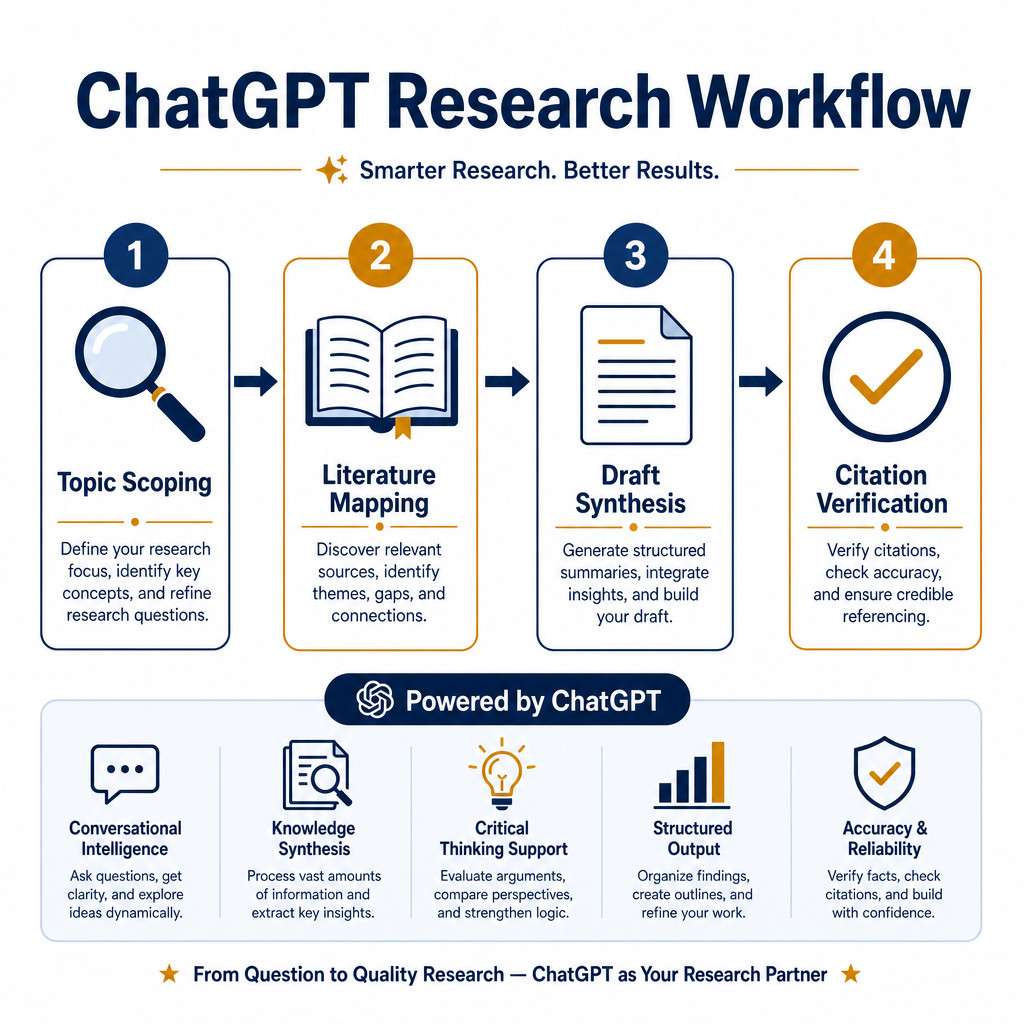
What you still need: A systematic search across verified databases (PubMed, Cochrane, Web of Science), PRISMA-compliant screening, and human judgment on source quality. ChatGPT is a pre-search and post-search tool, not a search tool itself.
For researchers interested in how multiple AI platforms handle research tasks differently, see the ChatGPT category archive for ongoing coverage of model updates and academic use cases.
Which Version of ChatGPT Is Most Suitable for Academic Research
As of 2026, GPT-4o (available on the Plus plan) is the most capable version for academic work. It handles longer documents, produces more nuanced reasoning, and is less prone to confident errors than earlier versions.
- Free tier (GPT-4o mini): Adequate for simple tasks like explaining a concept or drafting a short paragraph.
- ChatGPT Plus (GPT-4o): Recommended for literature scoping, argument analysis, long-form drafting, and working with uploaded documents.
- ChatGPT Enterprise: Best for institutions needing data privacy guarantees and team collaboration features.
If your research involves heavy document analysis, also consider tools like NotebookLM, which is purpose-built for working with uploaded source materials.
How Do I Properly Cite AI-Generated Research Content
Major style guides updated their AI citation guidance between 2023 and 2025. Here are the current formats:
APA 7th Edition:
OpenAI. (2026). ChatGPT (GPT-4o) [Large language model]. https://chat.openai.com
Include the date you generated the content, since outputs are not retrievable by others.
MLA 9th Edition:
“Your prompt text here.” ChatGPT, GPT-4o version, OpenAI, 9 June 2026, chat.openai.com.
Chicago (Notes-Bibliography):
OpenAI. “Response to [your prompt].” ChatGPT. Accessed June 9, 2026. https://chat.openai.com.
Practical rule: Always include the model version, the date of generation, and your prompt (or a summary of it). Because AI outputs are not stable or retrievable, many journals require you to include the full exchange in supplementary materials.
For deeper guidance on AI tools in professional workflows, the mastering ChatGPT automation guide covers integration strategies that apply to research environments as well.
What Are Common Mistakes Researchers Make with AI Research Tools
The most damaging mistake is citation trust: accepting ChatGPT’s references without verification. In a 2023 case that circulated widely in legal academia, attorneys submitted court filings with AI-generated citations that did not exist. The same risk applies to academic papers.
Other frequent mistakes:
- Prompt vagueness: Asking “tell me about climate change” produces generic output. Ask instead: “Summarize the main methodological debates in attribution science for extreme weather events since 2018.”
- Single-pass use: Treating the first response as final. Iteration — follow-up prompts, challenges, requests for counterarguments — produces far better results.
- Over-reliance on AI for analysis: ChatGPT can describe what scholars have argued; it cannot perform original analysis of your data.
- Ignoring the training cutoff: Assuming ChatGPT knows about papers published in the last year or two.
- Skipping disclosure: Failing to note AI use in a paper that a journal or institution requires disclosure for.
Unlocking academic frontiers through AI research strategies requires treating the tool as a collaborator with known limitations, not an oracle.
Conclusion
Unlocking academic frontiers by leveraging ChatGPT for comprehensive research strategies is genuinely achievable in 2026 — but only with a clear-eyed understanding of what the tool does and does not do well. ChatGPT accelerates the thinking and drafting phases of research. It does not replace the verification, analysis, and original contribution that define scholarly work.
Actionable next steps:
- Start with a specific, well-scoped prompt rather than a broad question — precision in, precision out.
- Use ChatGPT to generate search terms, then run those terms in PubMed, JSTOR, or Scopus to find real sources.
- Paste verified abstracts or excerpts into ChatGPT for synthesis help, rather than asking it to recall papers from memory.
- Check your institution’s AI disclosure policy before submitting any work that involved AI assistance.
- Upgrade to ChatGPT Plus if you are doing sustained academic work — the reasoning quality difference is meaningful.
- Cite AI use correctly using your required style guide’s current AI citation format.
The researchers who benefit most from AI tools are those who stay curious, stay skeptical, and keep their own judgment at the center of the process. For ongoing coverage of AI tools built for research and productivity, the AI research tools resource and the academic writing tools archive are worth bookmarking.
FAQ
Q: Can I use ChatGPT to find peer-reviewed sources? A: Not reliably. ChatGPT generates plausible-sounding citations that frequently do not exist. Use it to generate search terms, then verify sources in Google Scholar, PubMed, or JSTOR.
Q: Does ChatGPT know about papers published in 2025 or 2026? A: Partially. GPT-4o has a training cutoff that may not include the most recent publications. Use the browsing feature (if enabled) or check databases directly for recent work.
Q: Is it academic dishonesty to use ChatGPT for research? A: It depends on your institution’s policy. Using it as a thinking tool and disclosing that use is generally acceptable. Submitting AI-generated text as your own original work without disclosure is typically a policy violation.
Q: Can ChatGPT read a PDF I upload? A: Yes, with ChatGPT Plus. You can upload a PDF and ask it to summarize, extract key arguments, or identify methodology details. This is one of its most reliable academic use cases.
Q: How do I get better responses from ChatGPT for research tasks? A: Be specific. Include your field, the level of detail you need, and what you already know. Ask it to challenge its own answer or identify limitations in its response.
Q: Can ChatGPT replace a research assistant? A: For some tasks — drafting, summarizing, brainstorming — it can reduce the workload significantly. For tasks requiring verified data, primary source access, or original analysis, a human research assistant is still necessary.
Q: What is the best way to use ChatGPT for a literature review? A: Use it to map the conceptual landscape of a topic and generate search terms. Then conduct your actual search in academic databases. After gathering real sources, use ChatGPT to help organize and synthesize what you have found.
Q: Does ChatGPT work in languages other than English? A: Yes, but with reduced reliability. Its training data is heavily English-dominant, so performance in other languages — especially for specialized academic content — is less consistent.