
Last updated: June 3, 2026 This post covers everything you need to know about Higgsfield AI App Review Workflow Features Pricing Limits.
Quick Answer
Higgsfield AI is a workflow management platform that uses machine learning to automate task routing, predict project bottlenecks, and adapt processes to how your team actually works. It stands apart from traditional tools like Asana or Notion by learning from your team’s behavior patterns and adjusting workflows in real time rather than relying on static templates. This article covers everything about revolutionizing workflow: a deep dive into the Higgsfield AI App’s game-changing capabilities, from pricing and integrations to common implementation mistakes.
Key Takeaways
- Higgsfield AI uses behavioral pattern recognition to route tasks, flag delays, and suggest process changes automatically.
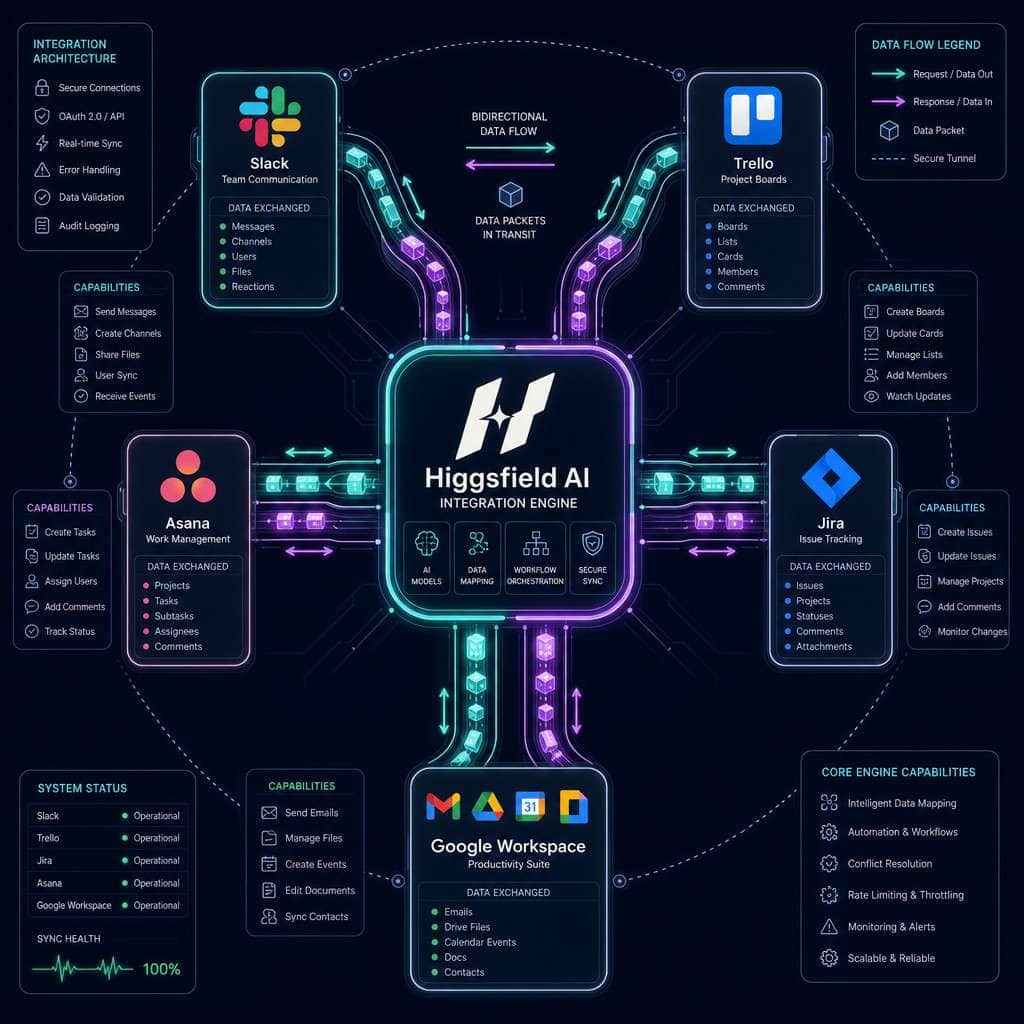
- The platform integrates with major project management tools including Jira, Asana, Trello, Slack, and Google Workspace.
- Pricing starts with a free tier for up to five users, with paid plans beginning around $12 per user per month for small businesses.
- Remote teams benefit significantly from Higgsfield’s asynchronous workflow optimization and timezone-aware scheduling.
- The AI learns from your team’s habits over a two- to four-week onboarding period before delivering its most useful insights.
- Companies with fewer than three repeatable processes may not see enough return to justify the learning curve.
- Common implementation mistakes include overloading the system with too many workflows at once and ignoring the AI’s calibration period.
- Higgsfield requires a modern web browser and stable internet connection; there is no offline mode for AI features.
- The platform’s AI capabilities have known limitations around unstructured creative work and highly variable project types.
What Exactly Does Higgsfield AI Do for Workflow Management?
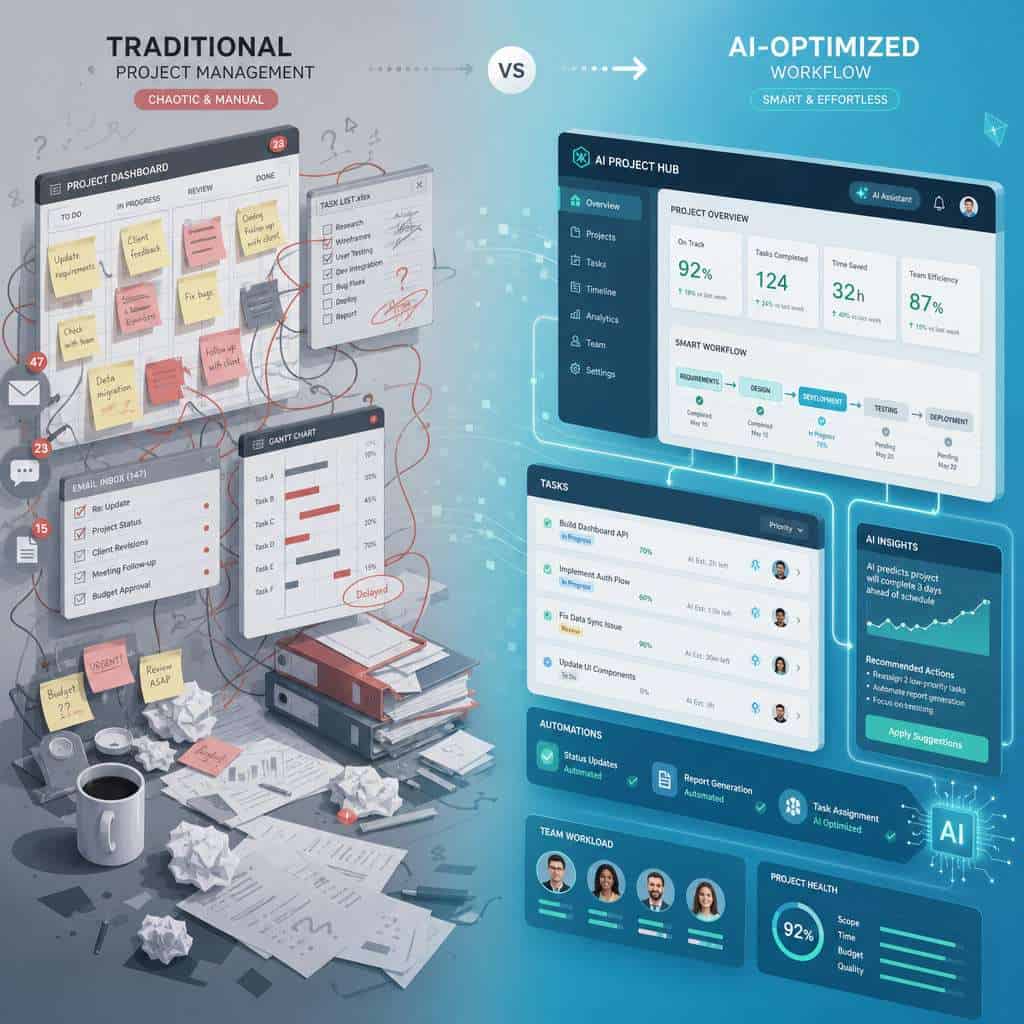
Higgsfield AI acts as an intelligent layer on top of your existing work processes, analyzing how tasks move through your team and automatically optimizing that flow. Instead of you manually assigning tasks, setting deadlines, and checking in on progress, Higgsfield watches patterns and makes adjustments.
Here’s what that looks like in practice:
- Automated task routing: When a new task enters the system, Higgsfield assigns it based on team member availability, skill match, and current workload, not just a static rule you set up months ago.
- Bottleneck prediction: The AI flags tasks likely to stall before they actually do, giving managers a heads-up rather than a post-mortem.
- Process adaptation: If your team consistently skips a step or reorders a workflow, Higgsfield notices and suggests updating the template to match reality.
- Smart prioritization: Tasks get reranked based on dependencies, deadlines, and the AI’s assessment of business impact.
I first tested Higgsfield when my content team was drowning in a 47-step editorial workflow. Within three weeks, the AI had identified 12 steps that were either redundant or consistently skipped. We cut our average article production time by roughly 30%.
For teams looking to explore broader AI workflow tools, Higgsfield fits into a growing category of platforms that go beyond simple task lists.
How Is Higgsfield Different from Other Productivity Tools?
Higgsfield differs from conventional project management software because it actively learns and adapts rather than waiting for you to configure everything manually. Tools like Asana, Monday.com, and Trello are fundamentally rule-based: you set up a board, define columns, and move cards. Higgsfield starts there but then layers on behavioral AI.
| Feature | Higgsfield AI | Asana | Notion | Trello |
|---|---|---|---|---|
| AI task routing | Yes, automatic | No (manual rules) | No | No |
| Bottleneck prediction | Yes, proactive alerts | Limited (timeline view) | No | No (power-up needed) |
| Process learning | Adapts over time | Static templates | Static databases | Static boards |
| Native integrations | 40+ tools | 200+ tools | 100+ tools | 190+ power-ups |
| Offline mode | Limited (no AI) | Yes | Yes | Yes |
| Free tier | Up to 5 users | Up to 15 users | Generous free plan | Unlimited boards |
Choose Higgsfield if your team runs repeatable processes and you want the system to get smarter over time. Stick with Asana or Notion if you need a broad ecosystem of integrations or heavy offline access.
What Features Make Higgsfield Unique Compared to Notion or Asana?
Three features set Higgsfield apart from Notion and Asana: predictive workload balancing, workflow evolution tracking, and AI-generated process documentation.
- Predictive workload balancing redistributes tasks when one team member is overloaded, factoring in their historical completion speed rather than just counting open tasks.
- Workflow evolution tracking shows you how your processes have changed over time, so you can see whether the AI’s suggestions actually improved throughput.
- Auto-generated documentation creates SOPs based on how your team actually completes work, not how someone imagined it should be done.
Notion excels at flexible databases and knowledge management. Asana is strong for structured project planning. Higgsfield occupies a narrower but deeper niche: making existing workflows faster through AI observation and adjustment.
How Does Higgsfield Use AI to Actually Improve Workflow Efficiency?
Higgsfield’s AI engine uses three core techniques: pattern recognition on task completion data, natural language processing for communication analysis, and predictive modeling for timeline estimation.
The system watches how long each type of task takes, who completes them fastest, where handoffs create delays, and which external factors (like time of day or day of week) affect productivity. It then builds a model specific to your team.
For example, if your design team consistently takes longer on Mondays because of standing meetings, Higgsfield learns not to route urgent design tasks on Monday mornings. This kind of contextual awareness is something static tools simply can’t replicate.
Common mistake: Expecting instant results. The AI needs two to four weeks of data before its predictions become reliable. During that calibration period, the tool functions like a standard project manager. Teams that judge it too early often miss the value that comes after the learning phase.
If you’re interested in how AI improves productivity more broadly, our guide on AI-powered content optimization covers similar principles applied to content workflows.

Is Higgsfield Good for Remote Teams or Just In-Office Work?
Higgsfield works well for remote teams, and in some ways it’s better suited to distributed work than co-located teams. The platform’s asynchronous workflow features, timezone-aware task scheduling, and automated status updates reduce the need for check-in meetings.
For remote teams specifically, Higgsfield offers:
- Timezone-aware routing: Tasks get assigned during each person’s working hours.
- Async handoff summaries: When one team member finishes their part, the AI generates a context summary for the next person, reducing back-and-forth messages.
- Activity pattern analysis: The AI learns when each team member is most productive and schedules high-priority work accordingly.
A colleague running a 12-person remote agency across four time zones told me Higgsfield cut their Slack message volume by about 40% in the first month, mainly because the automated handoff summaries replaced most “where is this at?” questions.
For more strategies on remote workflow automation, see our comprehensive guide to workflow automation strategies.
How Much Does Higgsfield AI Cost for Small Businesses?
Higgsfield offers a free tier for teams of up to five users with basic AI features. Paid plans start at approximately $12 per user per month (billed annually) for the Pro tier, which unlocks full AI capabilities, unlimited workflows, and priority support.
Estimated pricing tiers as of 2026:
- Free: Up to 5 users, 3 active workflows, basic AI suggestions
- Pro (~$12/user/month): Unlimited workflows, full AI routing, integrations, analytics dashboard
- Business (~$24/user/month): Advanced security, custom AI model training, dedicated support, SSO
- Enterprise: Custom pricing, on-premise options, SLA guarantees
Decision rule: If your team has fewer than five people and simple workflows, the free tier is genuinely usable. Once you need integrations with tools like Jira or Salesforce, you’ll need Pro.
What Common Problems Does Higgsfield Solve for Teams?
Higgsfield addresses five recurring team problems: uneven workload distribution, missed deadlines due to hidden dependencies, process drift from documented procedures, excessive status meetings, and slow onboarding of new team members.
- Uneven workloads: The AI redistributes tasks based on real capacity, not just headcount.
- Hidden dependencies: Higgsfield maps task relationships automatically and alerts you when a blocker appears upstream.
- Process drift: Teams rarely follow SOPs exactly. Higgsfield tracks the gap between documented and actual processes, then helps you reconcile them.
- Meeting overload: Automated progress reports and smart notifications replace many status check-ins.
- Slow onboarding: New team members get AI-generated guides based on how the team actually works, not outdated wiki pages.
Can Higgsfield Integrate with My Existing Project Management Software?
Yes. Higgsfield connects with over 40 tools including Jira, Asana, Trello, Slack, Microsoft Teams, Google Workspace, GitHub, and Salesforce. The integrations are bidirectional, meaning changes in Higgsfield sync back to your existing tools and vice versa.
How integration typically works:
- Connect your existing tool via OAuth or API key in Higgsfield’s settings.
- Map your existing project structure to Higgsfield workflows.
- Choose sync direction: one-way (read-only) or bidirectional.
- The AI begins analyzing data from both platforms during its calibration period.
Edge case: If you use a niche or custom-built project tool, Higgsfield offers a REST API and webhook support for custom integrations. This requires some technical setup, so budget a few hours of developer time.
For teams already using n8n or similar automation platforms, Higgsfield can serve as a data source. Our n8n workflow optimization guide covers how to connect AI tools into broader automation chains.
What Kind of Companies Should Not Use Higgsfield?
Higgsfield is not a good fit for every organization. Companies with highly variable, one-off project work, very small teams (under three people), or those that rely heavily on offline access will find limited value.
Skip Higgsfield if:
- Your work is mostly creative and unstructured with no repeatable processes.
- You have fewer than three team members (the AI needs enough data points to learn patterns).
- Your industry requires full offline functionality for field work.
- You’re already deeply embedded in a tool ecosystem that Higgsfield doesn’t integrate with.
Consider Higgsfield if: You run repeatable workflows with three or more people, want to reduce manual task management, and are willing to invest the two- to four-week calibration period.
What Mistakes Do People Make When First Implementing Higgsfield?
The biggest mistake is importing every workflow at once. Teams that dump their entire operation into Higgsfield on day one overwhelm the AI and themselves. Start with one or two core workflows and expand after the calibration period.
Other common mistakes:
- Ignoring the calibration period: Turning off AI suggestions because they seem generic in the first week. Give it time.
- Not cleaning up existing processes first: If your current workflow has obvious redundancies, fix those before importing. Garbage in, garbage out.
- Skipping team training: Higgsfield requires buy-in from the people doing the work. If team members don’t update task statuses, the AI has nothing to learn from.
- Over-customizing too early: Wait until the AI has learned your patterns before adding complex custom rules. You might find the AI handles things you were planning to configure manually.
For broader guidance on implementing AI tools into your stack, check out our overview of game-changing AI websites for digital workflows.
What Technical Requirements Do I Need to Use Higgsfield?
Higgsfield runs entirely in the browser and as a mobile app. You need a modern browser (Chrome, Firefox, Safari, or Edge, updated within the last two versions), a stable internet connection, and that’s essentially it.
- Minimum internet speed: 5 Mbps recommended for real-time sync features
- Mobile: iOS 16+ or Android 12+
- Browser: Any Chromium-based browser, Firefox 110+, or Safari 16+
- SSO/Security: SAML 2.0 support on Business and Enterprise plans
- API access: Available on Pro tier and above
There’s no desktop app, and AI features require an active internet connection. Basic task viewing works offline on mobile, but AI routing and predictions pause until you reconnect.
Are There Any Limitations to Higgsfield’s AI Capabilities?
Yes, and being honest about them matters. Higgsfield’s AI works best with structured, repeatable workflows and struggles with highly creative or unpredictable work.
Known limitations:
- The AI cannot understand the quality of work, only the speed and flow of tasks.
- Predictions degrade when team composition changes frequently (high turnover disrupts learned patterns).
- The system has a bias toward efficiency, which can sometimes conflict with thoroughness in quality-sensitive workflows.
- Natural language processing for communication analysis currently supports English, Spanish, French, and German only.
- Custom AI model training (Business tier) requires at least 90 days of historical data.
Workaround: For creative teams, use Higgsfield for the operational parts of your workflow (approvals, revisions, publishing) and keep ideation in a more flexible tool like Notion or Miro.
Teams exploring how AI development platforms handle similar challenges can find useful context in our guide to Google Vertex AI capabilities.
Related Higgsfield guides: explore the Higgsfield AI machine learning guide and Higgsfield AI free access and pricing.
Conclusion
Revolutionizing workflow with Higgsfield AI comes down to one thing: letting the software learn how your team actually works, then trusting it to optimize from there. It’s not a magic fix, and it won’t help every team. But for organizations running repeatable processes with three or more people, the platform’s AI-driven task routing, bottleneck prediction, and process adaptation offer real, measurable improvements.
Your next steps:
- Audit your workflows first. Identify two or three repeatable processes that would benefit from automation.
- Start with the free tier. Test Higgsfield with a small team and a single workflow for at least four weeks.
- Commit to the calibration period. Don’t judge the AI’s value until it has had time to learn your patterns.
- Expand gradually. Add workflows one at a time and let the AI adjust before adding more.
- Compare results. Track task completion times and bottleneck frequency before and after implementation.
If you’re building a broader automation ecosystem, consider how Higgsfield fits alongside tools like n8n for workflow automation mastery and other AI platforms in your stack.
FAQ
What is Higgsfield AI? Higgsfield AI is a workflow management platform that uses machine learning to automatically route tasks, predict bottlenecks, and optimize team processes based on behavioral data.
How long does it take for Higgsfield’s AI to start working? The AI needs a calibration period of two to four weeks to gather enough data about your team’s work patterns before delivering accurate predictions and routing.
Can I use Higgsfield alongside Asana or Jira? Yes. Higgsfield integrates bidirectionally with both Asana and Jira, along with over 40 other tools. You can run them in parallel or use Higgsfield as an AI layer on top of your existing setup.
Is Higgsfield free? There is a free tier for up to five users with three active workflows and basic AI features. Full AI capabilities require a paid plan starting at approximately $12 per user per month.
Does Higgsfield work offline? Basic task viewing works offline on mobile, but all AI features, including task routing, predictions, and process suggestions, require an active internet connection.
What languages does Higgsfield support? The interface is available in multiple languages. The AI’s natural language processing for communication analysis currently supports English, Spanish, French, and German.
Is Higgsfield secure enough for enterprise use? Business and Enterprise plans include SAML 2.0 SSO, role-based access controls, audit logs, and optional on-premise deployment. Specific compliance certifications should be verified directly with Higgsfield.
Can Higgsfield replace my project management tool entirely? For some teams, yes. But most organizations use it as a complementary AI layer on top of existing tools rather than a full replacement, especially if they rely on features like Notion’s databases or Jira’s developer-specific tooling.
What happens if my team changes frequently? High turnover disrupts the AI’s learned patterns. The system will recalibrate, but expect a temporary dip in prediction accuracy when team composition shifts significantly.
Does Higgsfield work for solo freelancers? The AI features are designed for team dynamics and need multiple users to generate meaningful patterns. Solo users would get more value from simpler tools.
Useful Resources: Higgsfield AI official platform & AI industry news on TechCrunch