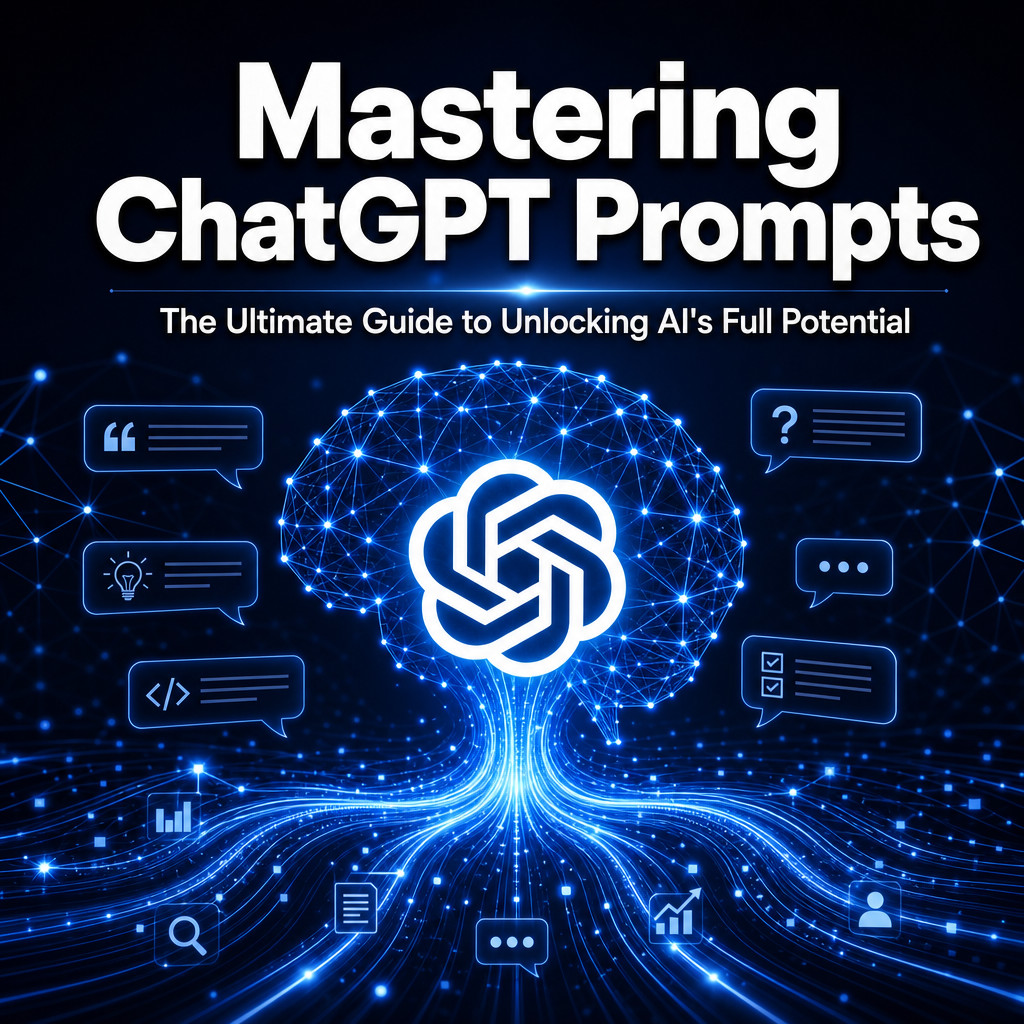
Last updated: June 9, 2026. Mastering ChatGPT Prompts can help you unlock AI’s full potential in your work and creativity.
Quick Answer: ChatGPT prompts are the instructions you give the AI to shape its responses. A well-structured prompt that includes role, context, task, and format consistently produces far better results than a vague one-liner. Anyone can learn this skill, and doing so turns ChatGPT from a novelty into a reliable productivity tool.
Key Takeaways
- A prompt is not just a question — it is a set of instructions that defines role, context, task, and output format.
- Specificity is the single biggest driver of output quality; vague prompts produce vague answers.
- Techniques like chain-of-thought, few-shot examples, and role-assignment are the most consistently effective prompting methods.
- Common mistakes include over-explaining irrelevant background, skipping format instructions, and not iterating on the first response.
- Prompt engineering is a real, growing skill set used across marketing, software development, education, legal research, and healthcare.
- Free resources from OpenAI, Anthropic, and platforms like Learn Prompting cover advanced strategies at no cost.
- Ethical boundaries matter: avoid prompts designed to deceive, generate harmful content, or bypass safety guidelines.
What Exactly Are ChatGPT Prompts and How Do They Work
A ChatGPT prompt is any text input you send to the model to produce a response. The model reads your prompt, predicts the most statistically likely useful continuation based on its training, and returns output. The quality of that output is directly tied to the clarity and structure of what you send in.
Think of it like briefing a very capable contractor. A vague brief (“build me something nice”) produces unpredictable results. A specific brief (“build a two-bedroom garden office with cedar cladding and a north-facing skylight”) gets you what you actually want.
Prompts work by activating different “modes” in the model. When you assign a role (“You are a senior tax attorney”), you shift the vocabulary, tone, and framing of every response that follows. When you specify a format (“Respond in a numbered list under 200 words”), you constrain the output structure. These are not tricks — they are how the model is designed to be used.
For a broader look at how AI systems process and generate content, see this comprehensive guide to AI-powered content generation tools.
How Writing a Good Prompt Is Different from Normal Writing
Good prompting is not the same as good essay writing or even good email writing. Normal writing aims to communicate ideas to a human reader who brings context, empathy, and inference. Prompting aims to constrain a probabilistic system toward a specific output.
The key differences:
- Precision over style: Flowery language wastes tokens and introduces ambiguity. Direct, structured instructions outperform elegant prose.
- Format matters as much as content: Telling ChatGPT “respond in a table with three columns” is as important as telling it what topic to cover.
- Iteration is built in: Unlike an email you send once, a prompt is a starting point. Refining based on the first response is standard practice, not a sign of failure.
- Context must be explicit: The model has no memory of your previous sessions by default. Every prompt needs to carry enough context to stand alone.
Which Prompting Techniques Get the Best Results from AI
Three techniques produce the most reliable improvements for most users: role assignment, chain-of-thought prompting, and few-shot examples.
Role assignment tells the model who it is for the conversation. “You are a senior UX designer reviewing a mobile app” produces more targeted critique than “review my app.”
Chain-of-thought prompting asks the model to reason step by step before giving a final answer. Adding “think through this step by step before responding” to analytical or math-heavy prompts measurably reduces errors, according to research published by Google Brain in 2022.
Few-shot examples show the model what good output looks like by including one or two examples inside the prompt itself. This is especially useful for formatting tasks, tone matching, or niche writing styles.
Additional techniques worth knowing:
- Constraint stacking: Add multiple specific constraints (“under 150 words,” “no jargon,” “active voice only”) to tighten outputs.
- Persona mirroring: Describe your audience so the model calibrates complexity (“Explain this to a first-year marketing student”).
- Negative instructions: Tell the model what to avoid (“Do not use bullet points,” “Do not recommend paid tools”).
For users who want to connect these prompt skills to automated workflows, the ChatGPT automation and no-code workflow integration guide covers how prompts function inside multi-step systems.
What Are the Most Common Mistakes People Make with ChatGPT Prompts
The most common mistake is treating ChatGPT like a search engine and typing a short keyword phrase instead of a full instruction. The second most common mistake is accepting the first response without iteration.
Other frequent errors:
- No format instruction: Asking for a “summary” without specifying length or structure often produces a generic paragraph when you needed a three-point executive brief.
- Burying the actual request: Writing three sentences of background before stating what you want causes the model to weight the background too heavily.
- Assuming shared context: Referencing “the document I mentioned” in a new session produces confusion because the model has no memory of prior conversations.
- Prompt bloat: Overloading a single prompt with five unrelated tasks. Break complex work into sequential prompts instead.
- Skipping iteration: The first response is rarely the final product. Ask the model to revise, expand, or reformat based on what it produced.
Is Prompt Engineering a Real Job or Just a Trend
Prompt engineering is a real and growing skill set, though the job title itself is evolving. As of 2026, many companies embed prompt engineering responsibilities into existing roles — content strategists, data analysts, and product managers — rather than hiring dedicated “prompt engineers.” However, specialized roles do exist, particularly in AI product teams and enterprise automation departments.
The underlying skill is durable regardless of job title. As AI tools become standard across industries, the ability to direct them precisely is as valuable as knowing how to write a clear brief or run a spreadsheet.
For those interested in AI-adjacent career paths, the guide to n8n automation engineering careers offers useful context on how technical AI skills translate into employment.
Can Beginners Learn to Write Great AI Prompts, or Is It Complex
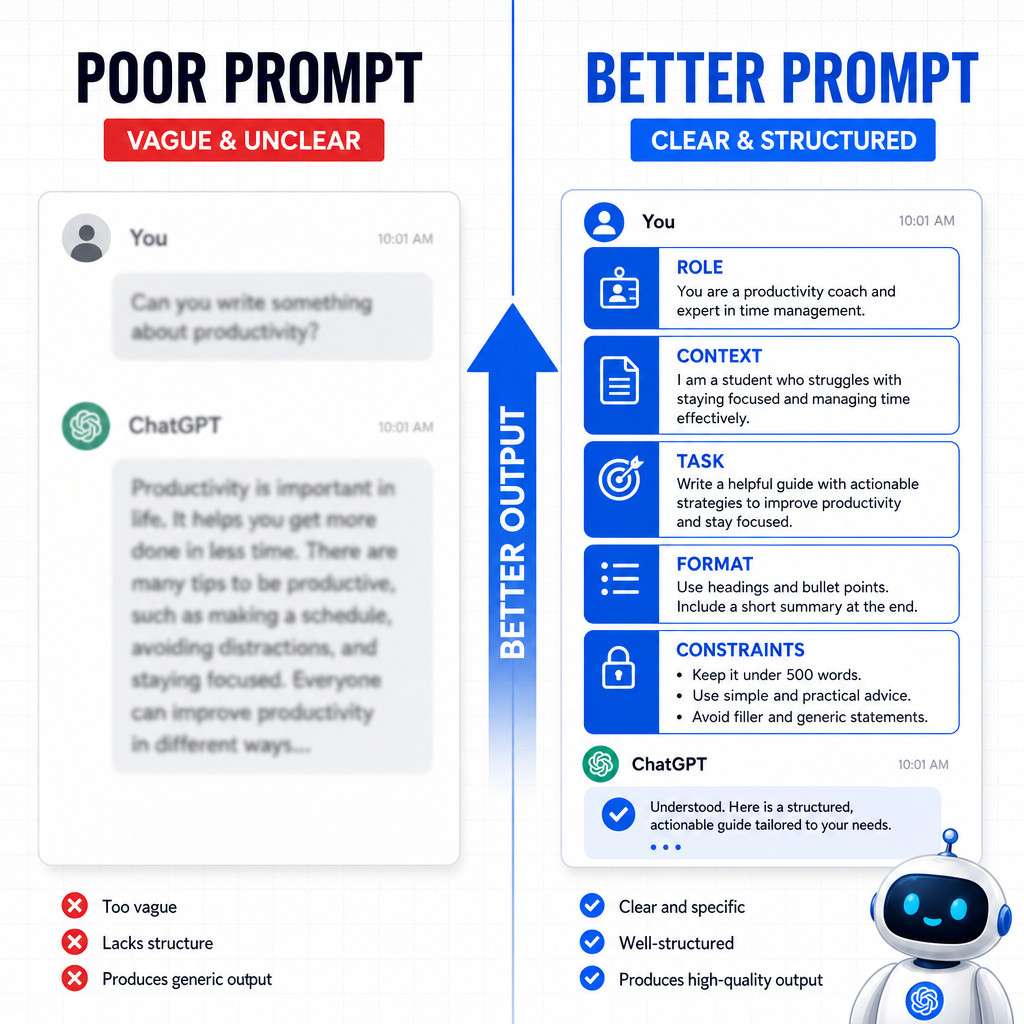
Beginners can absolutely learn effective prompting, and the learning curve is shorter than most people expect. The core framework — Role, Context, Task, Format — takes about 20 minutes to understand and an afternoon of practice to apply reliably.
A simple starter template:
| Element | Example |
|---|---|
| Role | “You are a professional copywriter.” |
| Context | “I run a small e-commerce store selling handmade candles.” |
| Task | “Write a 100-word product description for a lavender soy candle.” |
| Format | “Use sensory language. No bullet points. End with a soft call to action.” |
Combine those four elements and the output quality jumps immediately. Advanced techniques like chain-of-thought and few-shot prompting build naturally on this foundation.
What Kinds of Tasks Can ChatGPT Handle with the Right Prompt
With well-structured prompts, ChatGPT handles a wide range of tasks across professional and creative domains. The right prompt is the difference between a generic response and a genuinely useful output.
Strong use cases:
- Drafting and editing written content (emails, reports, proposals, ad copy)
- Summarizing long documents or research papers
- Writing and debugging code across common languages
- Brainstorming and structured ideation
- Data analysis explanation and interpretation
- Customer service script development
- Language translation with tone guidance
- Research synthesis and literature review outlines
Where it struggles even with good prompts:
- Real-time data retrieval (without tools/plugins enabled)
- Tasks requiring verified factual accuracy without human review
- Highly specialized legal or medical advice that requires licensed judgment
For content-specific applications, the AI-powered content optimization guide covers how to apply these prompt skills directly to SEO and publishing workflows.
Are There Free Resources to Learn Advanced Prompt Strategies
Yes. Several high-quality free resources cover advanced prompting without a paywall.
- Learn Prompting (learnprompting.org): An open-source guide covering everything from basic instructions to advanced techniques like ReACT and prompt chaining.
- OpenAI’s Prompt Engineering Guide: Published directly by OpenAI, covering best practices for GPT-4 class models with concrete examples.
- Anthropic’s Claude documentation: Useful for understanding prompting principles that transfer across models.
- YouTube and community forums: Channels dedicated to AI productivity regularly publish tested prompt frameworks.
Paid courses from platforms like Coursera and DeepLearning.AI typically range from free (audit) to around $49 per month for certificate access as of 2026. Specialized prompt engineering bootcamps can run $500 to $2,000, though the free resources cover the vast majority of practical use cases.
What Makes a Prompt Go from Good to Amazing
Good prompts are specific. Amazing prompts are specific, contextual, and iterative. The jump from good to exceptional usually comes from one of three additions: a concrete example of the desired output, a clearly stated audience, or an explicit quality standard.
For example, compare:
- Good: “Write a LinkedIn post about our new product launch.”
- Amazing: “Write a 150-word LinkedIn post announcing our new project management tool for remote teams. Tone: confident but not salesy. Audience: mid-level operations managers at companies with 50-200 employees. End with a question to drive comments. Here is an example post we liked: [paste example].”
The second version gives the model a target, an audience, a constraint, a tone, and a reference point. The output requires far less editing.
Which Industries Benefit Most from Skilled AI Prompting
Marketing, software development, education, legal research, and healthcare administration see the clearest productivity gains from skilled prompting. These fields share a common trait: they involve high volumes of structured, repeatable writing and analysis tasks.
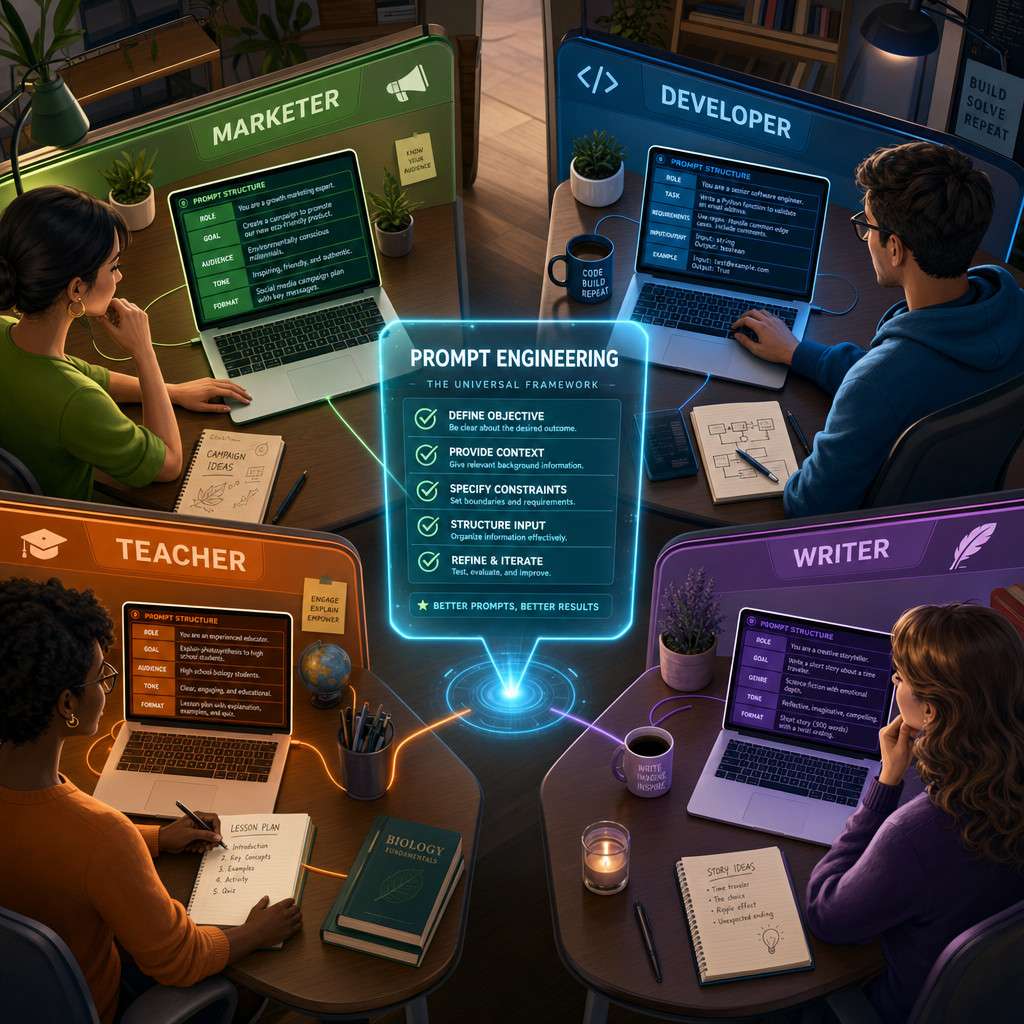
- Marketing: Ad copy, email sequences, social content, SEO briefs
- Software development: Code generation, documentation, debugging explanations
- Education: Lesson plan creation, quiz generation, feedback drafting
- Legal: Contract clause summarization, research memos, precedent analysis
- Healthcare administration: Patient communication templates, policy summaries, training materials
The guide to AI-powered content generation tools explores how these industry applications translate into measurable workflow improvements.
How Do I Structure a Prompt for Complex Creative Tasks
Complex creative tasks require a layered prompt structure that separates the creative brief from the constraints. Start with the big picture (genre, tone, audience), then layer in specific requirements (length, POV, style references), and finish with explicit exclusions.
Structure for a complex creative prompt:
- Establish the creative frame: “Write a short story in the style of literary fiction.”
- Define the core elements: “Protagonist: a retired marine biologist. Setting: a coastal town in winter. Central conflict: she discovers a beached whale that locals want removed.”
- Set tone and style: “Tone: melancholic but not hopeless. Third-person limited POV. Prose style: precise, sensory, restrained.”
- Add constraints: “800 words. No flashbacks. End on an ambiguous note.”
- Optional reference: “Think Marilynne Robinson’s sentence rhythm.”
This approach works for any creative format — screenplays, brand narratives, poetry, game dialogue. The principle is the same: give the model a frame, not just a topic.
What Are the Ethical Boundaries When Using AI Prompts
Ethical prompting means using AI to assist and augment human work, not to deceive, manipulate, or cause harm. The clearest boundaries involve content that could mislead audiences, violate privacy, or bypass safety systems.
Firm ethical lines:
- Do not use prompts to generate disinformation, fake reviews, or impersonation content.
- Do not attempt to extract harmful instructions by framing them as fictional scenarios.
- Disclose AI-generated content in contexts where readers or clients have a reasonable expectation of human authorship.
- Avoid prompts that request personal data analysis without proper consent frameworks.
Gray areas to navigate carefully:
- Academic use: AI-assisted drafting is acceptable in many contexts but must follow institutional policies.
- Marketing copy: Disclosure norms are still evolving; when in doubt, be transparent.
- Legal and medical content: Always include a disclaimer and recommend professional consultation.
Responsible use is also practical. Models are trained to resist harmful prompts, so attempts to push past ethical boundaries typically produce worse, not better, outputs.
Conclusion
Mastering ChatGPT Prompts: The Ultimate Guide to Unlocking AI’s Full Potential comes down to one core principle: the more precisely you define what you want, the more reliably you get it. The Role-Context-Task-Format framework is your starting point. Chain-of-thought reasoning, few-shot examples, and iterative refinement are your next steps.
Actionable next steps for 2026:
- Apply the four-element framework (Role, Context, Task, Format) to your next five ChatGPT requests and compare the results to your previous approach.
- Bookmark Learn Prompting or OpenAI’s Prompt Engineering Guide and work through two advanced techniques this week.
- Identify the three most repetitive writing or analysis tasks in your workflow and build reusable prompt templates for each.
- If you use ChatGPT inside automated workflows, explore how structured prompts integrate with tools covered in the ChatGPT automation and no-code workflow guide.
- Review your prompting practices against the ethical guidelines above, especially if you produce content for public audiences.
The gap between users who get mediocre AI output and those who get exceptional results is almost entirely a prompting gap. That gap is closable, and it closes faster than most people expect.
For more resources on AI tools and strategies, browse the ChatGPT category on WebAIStack and the free AI tools tag for curated recommendations.
FAQ
What is the best format for a ChatGPT prompt? The most reliable format includes four elements: a role assignment, relevant context, a specific task, and a format instruction. Combining all four consistently outperforms single-sentence prompts.
How long should a ChatGPT prompt be? Long enough to include role, context, task, and format — typically 50 to 200 words for most tasks. Longer is not always better; unnecessary background dilutes the core instruction.
Can I reuse prompts across different projects? Yes. Building a personal library of prompt templates for recurring tasks is one of the highest-leverage productivity habits for regular ChatGPT users.
Does ChatGPT remember my previous prompts? By default, ChatGPT does not retain memory between sessions unless the memory feature is explicitly enabled in settings. Always include necessary context in each new session.
What is chain-of-thought prompting? Chain-of-thought prompting asks the model to reason through a problem step by step before giving a final answer. It reduces errors on analytical, mathematical, and multi-step reasoning tasks.
Is prompt engineering hard to learn? The fundamentals take a few hours to learn. Advanced techniques take consistent practice over weeks. Most users see meaningful improvement within their first day of applying structured prompting.
Are there certifications for prompt engineering? Yes. DeepLearning.AI, Coursera, and several AI-focused bootcamps offer prompt engineering certificates as of 2026. Free audit options are available on most platforms.
What should I do when ChatGPT gives a bad response? Iterate rather than start over. Ask the model to revise a specific part, adjust the tone, shorten the output, or try a different approach — and explain why the first response missed the mark.
Can prompts be used to automate business workflows? Yes. Structured prompts are the foundation of AI automation pipelines. They can be embedded in tools like n8n or Make.com to trigger AI actions based on data inputs.
What is the difference between a system prompt and a user prompt? A system prompt sets persistent instructions for the entire conversation (role, rules, tone). A user prompt is the individual message you send in each turn. System prompts are available in the API and in ChatGPT’s custom instructions feature.
Are there ethical rules for using ChatGPT prompts professionally? Yes. Key rules include disclosing AI-generated content where audiences expect human authorship, avoiding prompts that generate deceptive or harmful content, and following platform terms of service.
What industries use prompt engineering the most? Marketing, software development, education, legal research, and healthcare administration currently see the highest adoption and clearest productivity gains from structured AI prompting.
References
- Wei, J., et al. (2022). “Chain-of-Thought Prompting Elicits Reasoning in Large Language Models.” Google Brain. https://arxiv.org/abs/2201.11903
- OpenAI. (2023). “Prompt Engineering Guide.” https://platform.openai.com/docs/guides/prompt-engineering
- Learn Prompting. (2023). Open-source prompt engineering guide. https://learnprompting.org
- Brown, T., et al. (2020). “Language Models are Few-Shot Learners.” OpenAI. https://arxiv.org/abs/2005.14165