Last updated: May 31, 2026
Quick Answer: An ElevenLabs API key is a unique authentication string that grants programmatic access to ElevenLabs’ full suite of AI voice services, including text-to-speech, voice cloning, speech-to-text, conversational agents, sound effects, and music generation [1]. You generate one for free inside your ElevenLabs account settings, and it must be sent in the xi-api-key header with every API request [3]. Free-tier keys come with limited credits, while paid plans scale up to millions of characters per month.
Key Takeaways
Every ElevenLabs API capability (TTS, STT, cloning, agents, dubbing) is unlocked through a single API key [2].
Free accounts get an API key with roughly 10,000 characters per month; paid plans start at $5/month and scale to enterprise tiers [7].
API keys can be scoped to specific endpoints, given custom credit quotas, and restricted by IP address for production security [3].
ElevenLabs positions itself as a premium voice AI platform, not the cheapest option, but consistently ranks high in voice quality benchmarks.
Commercial use is allowed on paid plans, though you should review the terms for voice cloning and consent requirements.
Real-time applications are supported through WebSocket connections and the conversational AI (ConvAI) stack.
Alternatives include Google Cloud TTS, Amazon Polly, Microsoft Azure Speech, and OpenAI’s TTS API, each with different price-quality tradeoffs.
What Is an ElevenLabs API Key?
An ElevenLabs API key is a secret token that authenticates your application when it communicates with ElevenLabs’ REST API. Think of it as a password that tells ElevenLabs’ servers, “This request is from an authorized account.” Every API call, whether you’re converting text to speech, cloning a voice, or running a conversational agent, requires this key in the xi-api-key HTTP header [3].
ElevenLabs now describes its platform as “AI voice infrastructure” rather than just a text-to-speech service [2]. A single API key unlocks:
Text-to-speech (TTS) with dozens of voices and the latest 11v3 model
Speech-to-text (STT) transcription
Voice cloning (instant and professional)
Conversational AI agents (ElevenAgents / ConvAI)
Sound effects and music generation
Audio dubbing across languages
If you’re building any project that involves AI-generated audio, this key is your starting point. For a broader look at AI tools that can complement your workflow, check out our comprehensive guide to AI-powered content generation tools.
How Do I Get an ElevenLabs API Key?
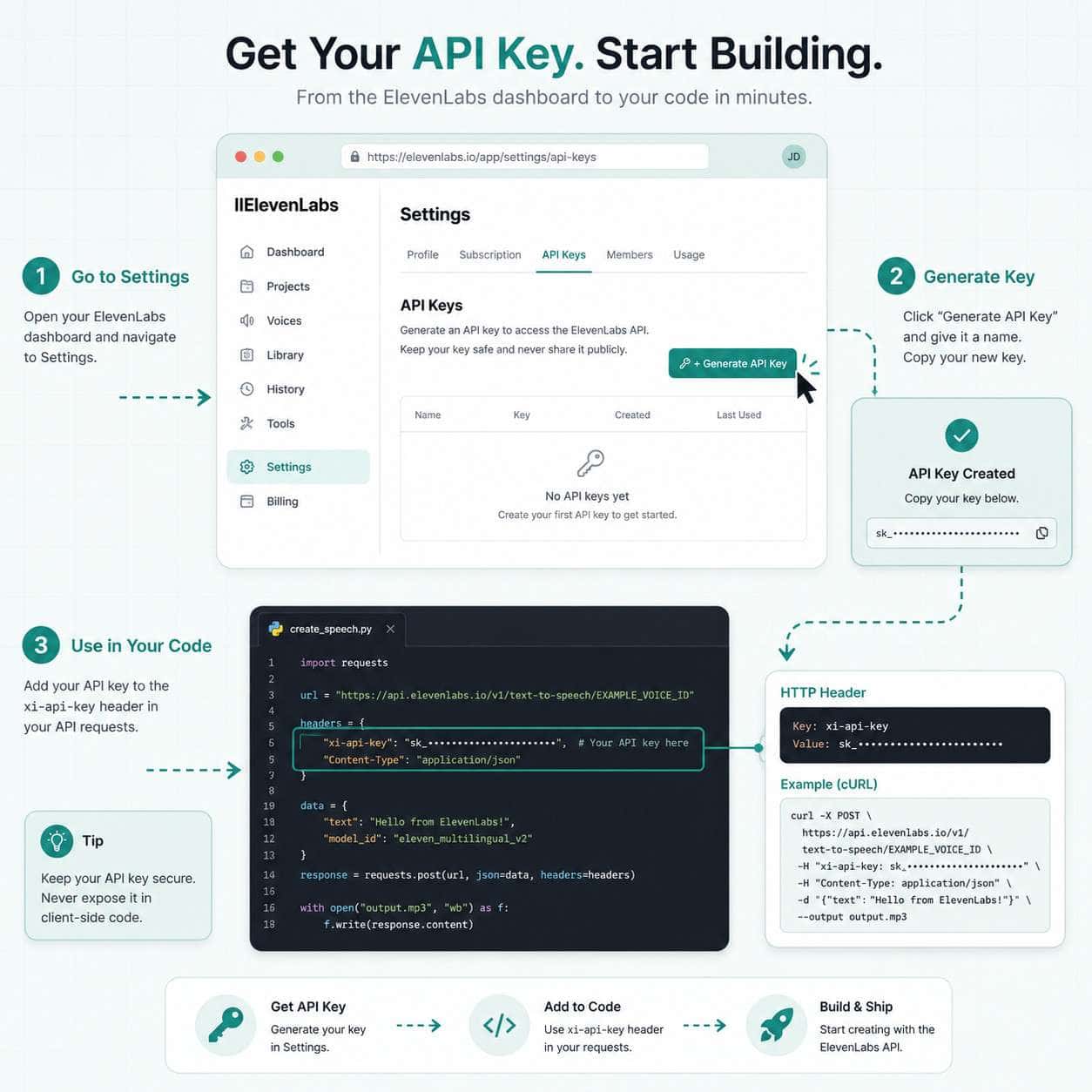
Getting your API key takes about two minutes. Here’s the exact process:
Create an account at elevenlabs.io. A free tier is available.
Log in and click your profile icon in the bottom-left corner of the dashboard.
Go to “Profile + API key” (or navigate to account settings directly) [5].
Click “Generate API Key.” Your key appears once. Copy it immediately and store it securely.
Add the key to your code in the
xi-api-keyheader for every request [3].
A quick Python example using the official SDK:
<code class="language-python">from elevenlabs import ElevenLabs

client = ElevenLabs(api_key="your_api_key_here")
audio = client.text_to_speech.convert(
    text="Hello from ElevenLabs",
    voice_id="Rachel"
)
</code>
Common mistake: Hardcoding your API key directly in client-side JavaScript or a public GitHub repo. Always use environment variables or a backend proxy to keep your key private.
ElevenLabs also provides official Python and TypeScript SDKs that handle authentication automatically once you pass in the key [4].
Is the ElevenLabs API Free to Use?
Yes, but with significant limits. Free-tier accounts receive approximately 10,000 characters per month for text-to-speech, which translates to roughly 5–7 minutes of generated audio [7]. You get a valid API key on the free plan, so you can test endpoints, build prototypes, and evaluate voice quality before committing to a paid subscription.
Choose the free tier if you’re experimenting, building a proof of concept, or only need occasional short audio clips. Move to a paid plan once you need higher volume, commercial rights, or access to professional voice cloning.
How Much Does the ElevenLabs API Cost?
ElevenLabs uses a tiered subscription model. Here’s a summary based on their 2026 pricing structure [7] [10]:
PlanMonthly Cost (approx.)Characters/MonthKey FeaturesFree$0~10,000Basic TTS, limited voicesStarter$5~30,000Custom voices, API accessCreator$22~100,000Professional voice cloningPro$99~500,000Higher concurrency, priorityScale$330~2,000,000Volume pricing, usage analyticsEnterpriseCustomCustomIP whitelisting, SLA, dedicated support
Important details:
Conversational AI (agents) and dubbing consume credits at different rates than standard TTS.
Overage charges apply if you exceed your plan’s character limit.
The new usage analytics endpoints (
/v1/workspace/analytics/query/usage-by-product-over-time) let teams track credit consumption per product and per API key [9].
As one independent pricing analyst noted, the value depends on your workflow: if the API helps you produce content significantly faster or publish more often, the subscription pays for itself. Otherwise, it’s just another bill [8].
If you’re building AI-powered features into a website, our guide on AI-powered content optimization covers how to measure that ROI effectively.
What Can I Do with the ElevenLabs API?
The ElevenLabs API supports a wide range of audio AI tasks, all accessible through the same key [1] [2]:
Generate speech from text in 30+ languages with natural-sounding voices
Clone voices using short audio samples (instant clone) or longer training sets (professional clone)
Transcribe audio to text with their speech-to-text endpoint
Build conversational agents that combine TTS, STT, and LLM reasoning in real-time
Create sound effects from text descriptions
Generate music programmatically
Dub video content into multiple languages while preserving speaker identity
Best for: Content creators automating voiceovers, developers building voice-enabled apps, companies localizing video content, and teams deploying AI phone agents or chatbots.
For those integrating voice features into WordPress sites, you might also find our article on integrating AI-powered chatbots into WordPress useful.
Are There Any Limits to ElevenLabs API Key Usage?
Yes. Limits exist at both the plan level and the key level [3]:
Character quotas: Each plan has a monthly character cap. Once exhausted, requests fail or incur overage fees.
Per-key credit quotas: Admins can set custom credit limits on individual API keys, so a single runaway integration can’t drain an entire account.
Scope restrictions: Keys can be limited to specific endpoints. For example, you could create a key that only accesses TTS but not voice cloning.
IP whitelisting: Enterprise customers (and now service-account keys) can restrict API access to specific IP addresses or CIDR ranges, with support for 1–100 IPs per key [6]. Non-whitelisted requests return HTTP 403.
Rate limits: Concurrent request limits vary by plan. Free and Starter plans have lower concurrency than Pro or Scale.
Edge case: If you’re running multiple environments (staging, production), create separate API keys with different scopes and quotas for each. This prevents test traffic from eating into production credits.
How Does ElevenLabs Compare to Other AI Voice APIs?
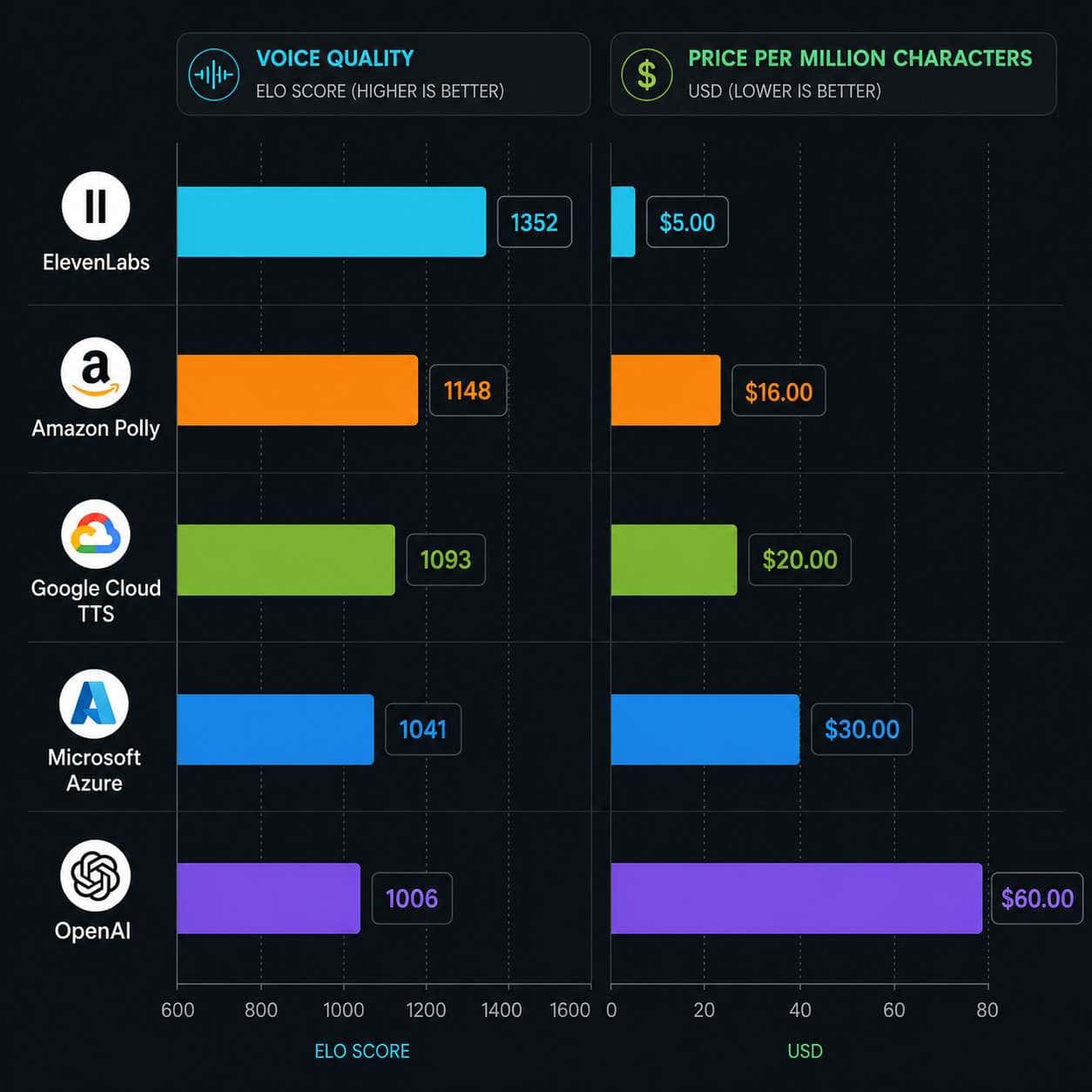
ElevenLabs is a premium option that consistently scores well on voice naturalness but isn’t always the cheapest per character. A May 2026 competitive benchmark by Gradium using the Artificial Analysis ELO Speech Arena placed several ElevenLabs models on the quality leaderboard, though some competitors matched or beat them in quality-per-dollar for specific use cases.
PlatformStrengthsWeaknessesPrice Range (per 1M chars)ElevenLabsTop voice quality, voice cloning, full agent stackHigher cost, credit-based limits~$30–$300 (varies by plan)Google Cloud TTSWide language support, WaveNet voices, scaleLess natural for conversational use~$4–$16Amazon PollyLow cost, AWS integration, SSML supportFewer premium voices~$4–$16Microsoft Azure SpeechEnterprise features, custom neural voiceComplex pricing, setup overhead~$16OpenAI TTSSimple API, good quality, GPT integrationFewer voices, no cloning~$15–$30
Choose ElevenLabs if voice quality and the integrated agent/cloning ecosystem matter more than raw cost. Choose Google or Amazon if you need high volume at low cost and can accept slightly less natural output.
Can I Use the ElevenLabs API for Commercial Projects?
Yes, paid plans include commercial usage rights for generated audio [7]. You can use API-generated speech in YouTube videos, podcasts, apps, phone systems, and products you sell.
Key caveats:
Voice cloning requires consent from the voice owner. ElevenLabs enforces verification steps for professional voice clones.
Free-tier output may have restrictions on commercial use. Check the current terms of service.
If you’re cloning a celebrity or public figure’s voice, legal liability falls on you, not ElevenLabs.
What Are Some Alternatives to the ElevenLabs API?
If ElevenLabs doesn’t fit your budget or use case, consider these alternatives:
Google Cloud Text-to-Speech: Best for high-volume, multi-language projects where cost matters more than peak naturalness.
Amazon Polly: Strong choice if you’re already in the AWS ecosystem.
Microsoft Azure Cognitive Services Speech: Good for enterprise deployments with custom neural voice training.
OpenAI TTS API: Simple integration if you’re already using GPT models.
PlayHT: Competitive voice quality with a focus on content creators.
Murf.ai: Designed for marketing and e-learning voiceovers.
For a broader view of AI tools across different creative workflows, see our roundup of the best AI graphic design tools.
Is the ElevenLabs API Suitable for Real-Time Applications?
Yes. ElevenLabs supports real-time audio streaming through WebSocket connections, and their conversational AI stack is specifically built for low-latency, interactive use cases [9]. Recent updates added features like agent_response_complete WebSocket events and configurable tool timeouts, both designed for production real-time deployments.
Real-time use cases that work well:
AI phone agents and customer service bots
Live voice assistants in apps
Interactive gaming NPCs
Real-time language translation with voice output
Practical tip: Use the streaming TTS endpoint rather than the standard endpoint for real-time applications. The streaming version begins sending audio chunks before the full text is processed, reducing perceived latency.
If you’re building real-time features into a web project, our guide on implementing dynamic page transitions in Webflow covers related performance optimization concepts.
What Are the Privacy Implications of Using the ElevenLabs API?
Any audio data you send to ElevenLabs (for cloning, transcription, or agent training) is processed on their servers. Key privacy considerations:
Voice data retention: Review ElevenLabs’ data processing terms to understand how long uploaded voice samples are stored.
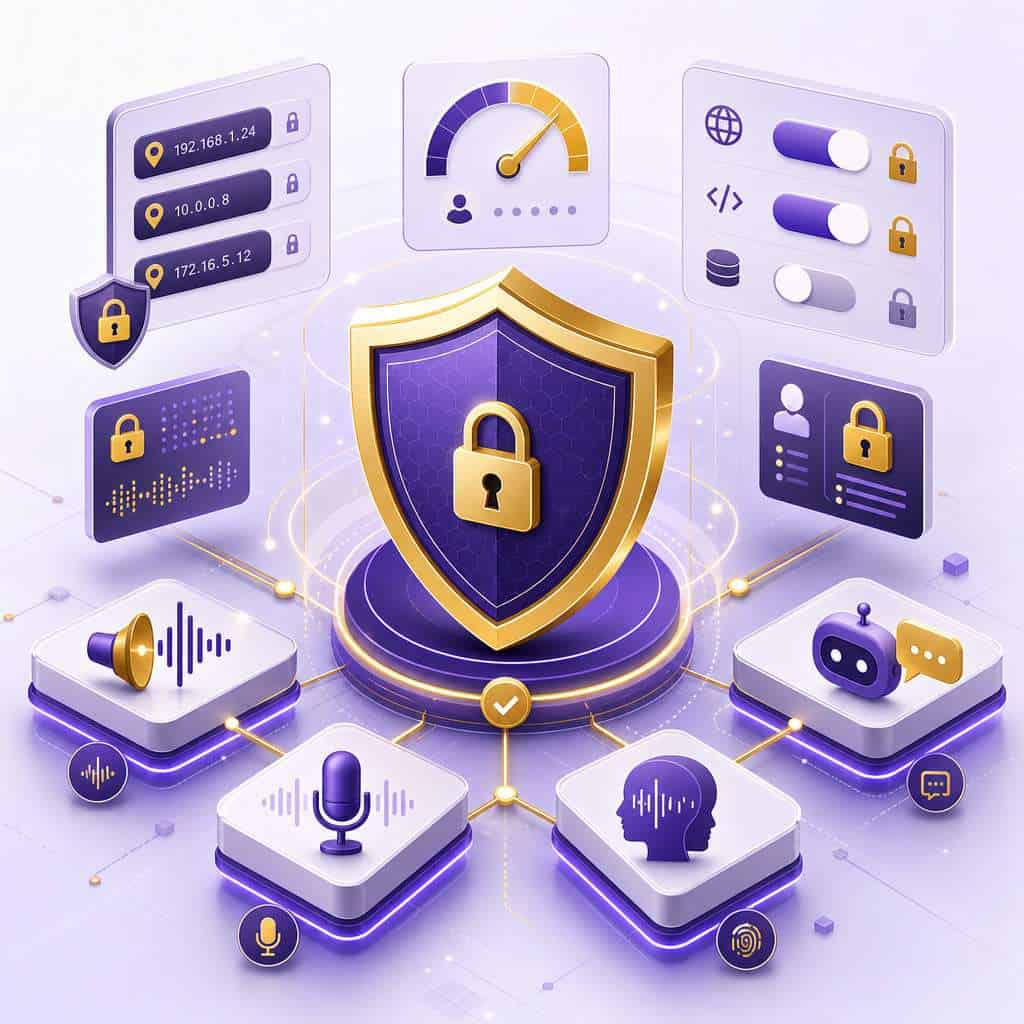
API key security: A leaked key gives full access to your account’s capabilities. Use scoped keys, IP whitelisting, and credit quotas to limit exposure [3] [6].
GDPR and compliance: If you’re processing EU user data (e.g., transcribing customer calls), ensure your use complies with GDPR. ElevenLabs offers enterprise agreements that include data processing addendums.
Voice consent: Cloning someone’s voice without their explicit consent is both an ethical violation and potentially illegal in many jurisdictions.
Best practice: Create separate API keys for each application, restrict their scopes, set credit limits, and rotate keys periodically. The 2026 IP whitelisting feature adds another layer of protection for production environments.
What Are Common Errors When Using the ElevenLabs API Key?
Here are the errors developers encounter most often, and how to fix them:
401 Unauthorized: Your API key is missing, invalid, or expired. Double-check the
xi-api-keyheader spelling and value [3].403 Forbidden: Your IP isn’t on the whitelist (for keys with IP restrictions), or the key’s scope doesn’t include the endpoint you’re calling [6].
429 Too Many Requests: You’ve hit the rate limit. Back off and retry with exponential backoff, or upgrade your plan for higher concurrency.
402 Payment Required: Your character quota is exhausted. Check usage analytics or upgrade your plan.
422 Unprocessable Entity: The request body is malformed. Verify your JSON payload matches the API docs.
Quick troubleshooting checklist:
Confirm your key is active in the dashboard
Verify the header name is exactly
xi-api-key(notAuthorization)Check your remaining character balance
Test with a minimal request before debugging complex payloads
For developers working across multiple platforms, our guide to WordPress plugin development best practices covers similar API integration patterns.
What Kind of Projects Is the ElevenLabs API Best For?
The ElevenLabs API excels in projects where voice quality and flexibility are top priorities:
Audiobook and podcast production where natural-sounding narration matters
Multilingual video dubbing for content creators and media companies
AI-powered customer service agents that need to sound human
Accessibility tools that convert written content to speech
Game development with dynamic NPC dialogue
E-learning platforms with narrated course content
It’s less ideal for bulk notification systems or simple alert sounds where voice quality doesn’t justify the cost. For those use cases, Amazon Polly or Google Cloud TTS will be more cost-effective.
Conclusion
Getting started with the ElevenLabs API is straightforward: create an account, generate a key, and start making requests. The real decisions come after that, choosing the right plan for your volume, securing your keys properly, and picking the right endpoints for your use case.
Your next steps:
Sign up for a free ElevenLabs account and generate your first API key.
Run the quickstart example from the official docs to verify everything works [4].
Set scope restrictions and credit limits on your key before building anything production-facing.
Estimate your monthly character usage and pick a plan that fits, with a small buffer for testing.
Explore the conversational AI features if you’re building anything interactive; the agent stack is where ElevenLabs’ ecosystem advantage is strongest.
The AI voice space is competitive and evolving fast. ElevenLabs has strong backing (crossing $500M ARR with investors like BlackRock and NVIDIA) and a broad feature set, but always benchmark against alternatives for your specific use case. The best API key is the one attached to a platform that actually fits your project.
FAQ
Q: Can I have multiple API keys on one ElevenLabs account?
A: Yes. You can create multiple keys with different scopes, credit limits, and IP restrictions. This is recommended for separating development, staging, and production environments [3].
Q: Does my API key expire?
A: API keys don’t expire automatically, but you can revoke and regenerate them at any time from your account settings. Rotate keys periodically as a security best practice.
Q: Can I use the ElevenLabs API key with third-party tools?
A: Yes. Many platforms (like Zapier, Make, and various WordPress plugins) accept an ElevenLabs API key for integration. Just paste your key into the tool’s configuration.
Q: What happens if I exceed my character limit?
A: Depending on your plan settings, requests will either fail with a 402 error or incur overage charges. Set up usage alerts to avoid surprises [9].
Q: Is voice cloning available on the free plan?
A: Instant voice cloning with a short sample is available on free accounts with limitations. Professional voice cloning (higher quality, longer training) requires a paid plan.
Q: How do I check my remaining API credits?
A: Use the usage analytics endpoints or check the dashboard. The newer analytics API lets you query consumption by product and time interval [9].
Q: Can I restrict my API key to only text-to-speech?
A: Yes. ElevenLabs supports per-key scope restrictions, so you can limit a key to specific endpoints like TTS only [3].
Q: Is the API available globally?
A: Yes. ElevenLabs’ API is accessible worldwide, though latency may vary by region. Enterprise plans may include options for regional optimization.
Q: Do I need programming skills to use the API?
A: Basic programming knowledge (Python or JavaScript) is needed for direct API use. However, many no-code tools integrate with ElevenLabs using just your API key. Explore our list of no-coding website design platforms for tools that simplify integrations.
Q: What’s the difference between the API and the ElevenLabs web app?
A: The web app provides a visual interface for generating speech and managing voices. The API provides programmatic access to the same features, allowing automation, custom integrations, and high-volume processing [1].
References
[1] Introduction – https://elevenlabs.io/docs/api-reference/introduction
[2] Intro – https://elevenlabs.io/docs/overview/intro
[3] Authentication – https://elevenlabs.io/docs/api-reference/authentication
[4] Quickstart – https://elevenlabs.io/docs/eleven-api/quickstart
[5] How To Get Elevenlabs Api Key – https://developer.puter.com/tutorials/how-to-get-elevenlabs-api-key/
[6] elevenlabs Changelog – https://elevenlabs.io/docs/changelog/2026/4/13
[7] Elevenlabs Pricing – https://www.cekura.ai/blogs/elevenlabs-pricing
[8] Is ElevenLabs Worth It? – https://www.youtube.com/watch?v=gSNvaC6S2Uo
[9] Changelog – https://elevenlabs.io/docs/changelog
[10] Elevenlabs Pricing – https://www.photonpay.com/hk/blog/article/elevenlabs-pricing?lang=en