Last updated: June 9, 2026
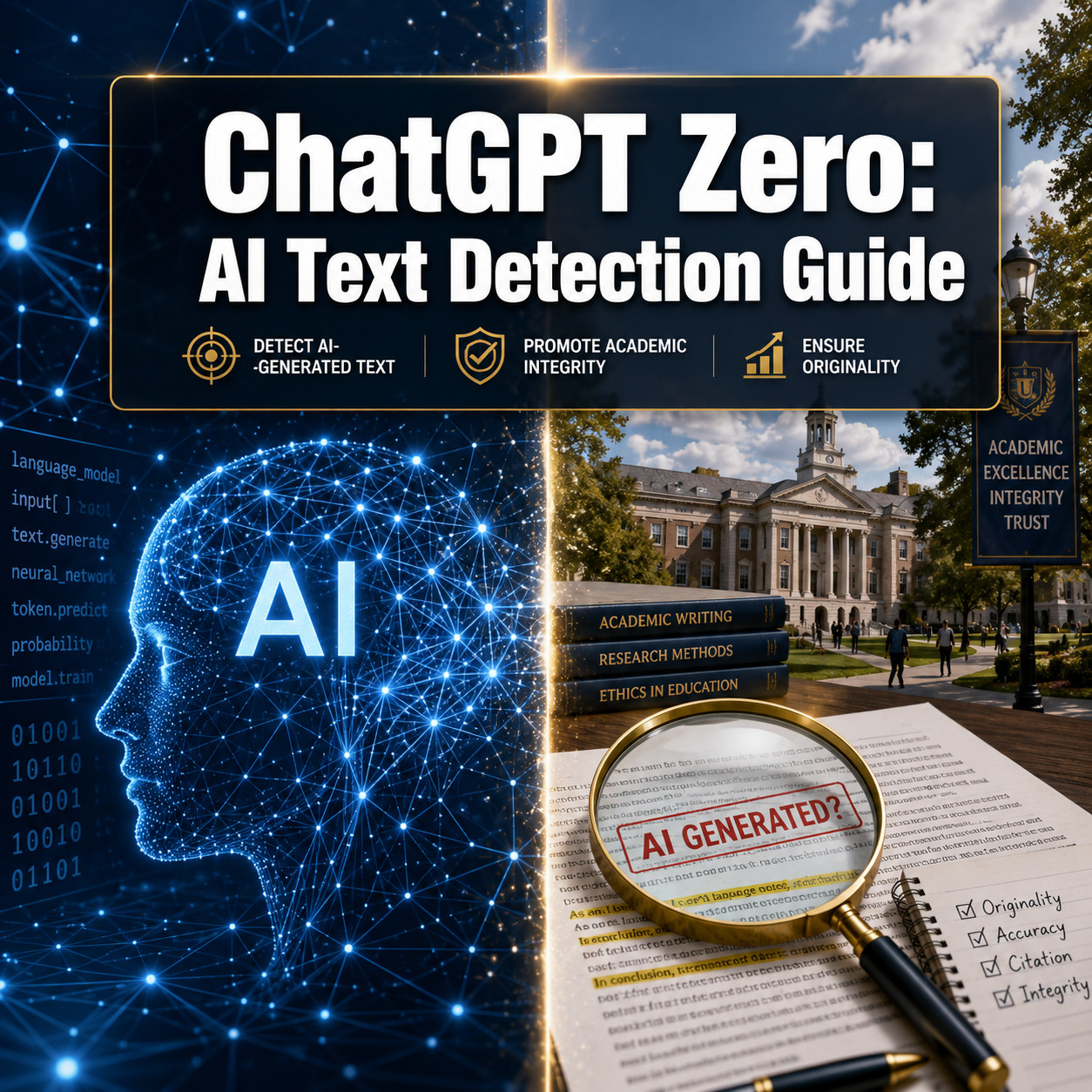
Quick Answer: GPTZero (commonly searched as “ChatGPT Zero”) is an AI text detection tool that analyzes writing for statistical patterns associated with AI-generated content. It uses perplexity and burstiness scores to flag likely AI-written passages. While useful for educators and institutions, no detection tool is 100% accurate, so results should be treated as one signal among several, not as definitive proof.
Key Takeaways
- GPTZero and similar tools detect AI-generated text by measuring how predictable and uniform the writing is, not by reading for meaning
- Detection accuracy varies significantly across tools; false positives remain a genuine concern for non-native English writers
- Universities worldwide are still developing consistent policies on AI use, and enforcement is uneven
- No current tool reliably catches heavily paraphrased or human-edited AI content
- Students caught submitting AI-generated work face consequences ranging from grade penalties to expulsion, depending on institutional policy
- Free tiers exist for most tools, but meaningful batch analysis requires paid plans
- Proving originality requires more than a clean detection score; process documentation matters
- The field is evolving fast, and any tool’s accuracy benchmarks from even one year ago may already be outdated
What Exactly Is ChatGPT Zero and How Does It Work
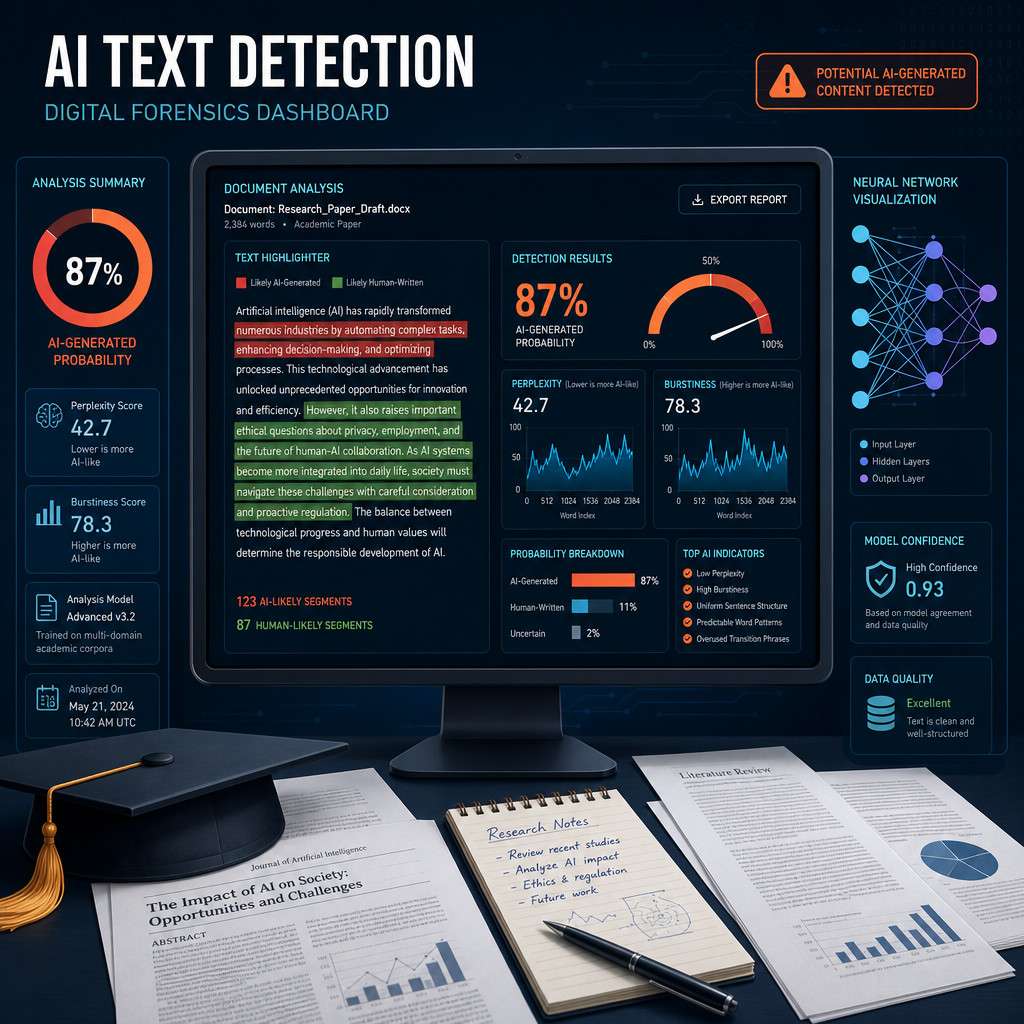
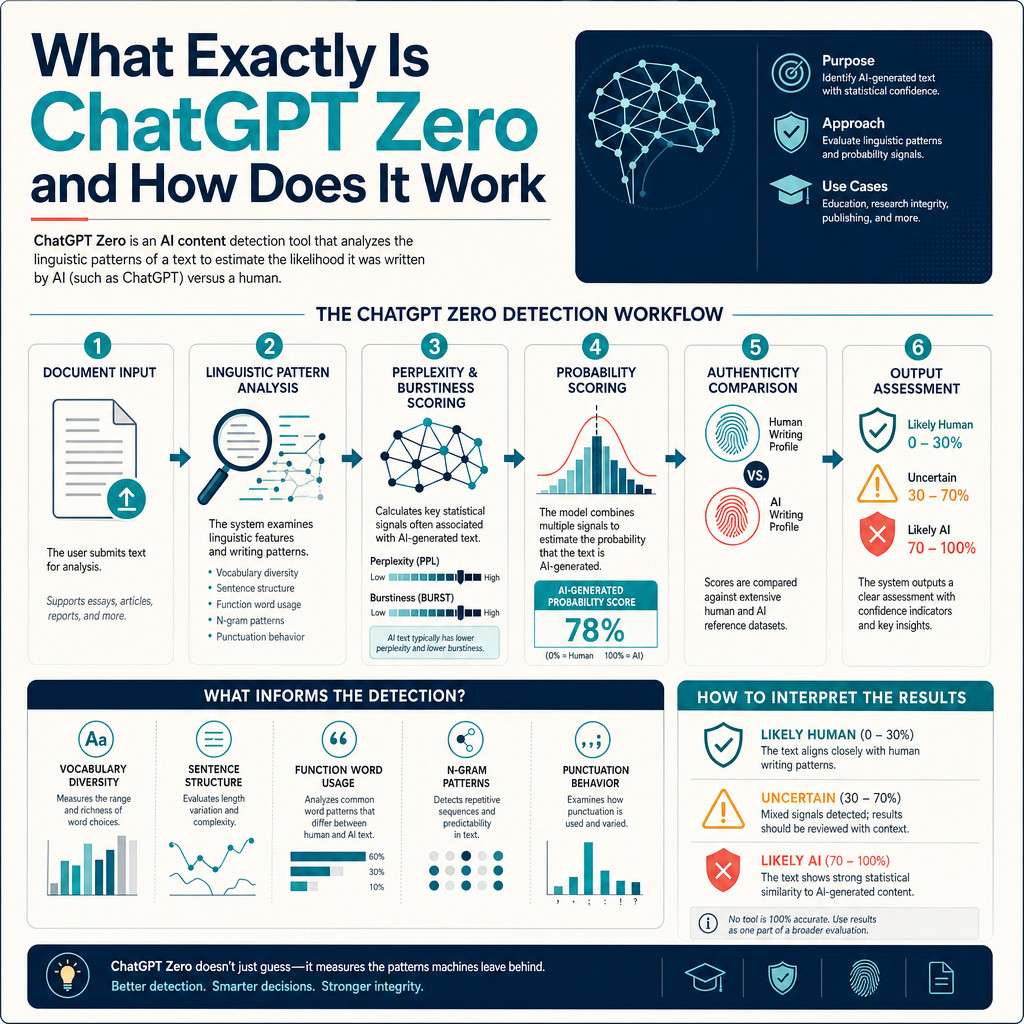
GPTZero, the tool most people mean when they search “ChatGPT Zero,” is an AI text detection platform built by Edward Tian in early 2023. It analyzes submitted text and returns two core metrics: perplexity (how surprising or unpredictable the word choices are) and burstiness (how much sentence length and complexity varies). Human writing tends to score higher on both because people naturally mix short punchy sentences with longer, more complex ones. AI-generated text, by contrast, tends to be statistically smooth and predictable.
Here is how the detection process works in practice:
- Text is submitted via the GPTZero interface or API
- The model runs the text through its own language model to measure how “expected” each word choice is
- Low perplexity signals that the text follows highly predictable patterns, a hallmark of AI output
- Low burstiness signals uniform sentence structure, another AI tendency
- A combined score is returned, often with sentence-level highlighting to show which passages triggered concern
The tool does not “read” for meaning. It is a statistical analysis, which is both its strength and its core limitation. For a broader look at how AI tools are reshaping content workflows, see our comprehensive guide to AI-powered content generation tools.
How Accurate Are AI Text Detection Tools Compared to Each Other
Accuracy varies considerably, and no tool is definitively “best” for every use case. Independent evaluations (including those conducted by university research teams and journalism outlets through 2024 and 2025) consistently show that most leading tools, including GPTZero, Turnitin’s AI detector, Originality.ai, and Copyleaks, achieve detection rates in the 80-95% range on clearly AI-generated text. However, false positive rates on human-written text can run as high as 10-15% in some studies, particularly for non-native English speakers whose writing patterns can resemble AI output.
| Tool | Primary Strength | Known Weakness |
|---|---|---|
| GPTZero | Sentence-level highlighting | Struggles with short texts |
| Turnitin AI Detector | LMS integration | Institutional licensing cost |
| Originality.ai | Bulk URL scanning | Less accurate on GPT-4o output |
| Copyleaks | Multilingual support | Higher false positive rate reported |
| Winston AI | Clean interface | Smaller training dataset |
Decision rule: Use GPTZero if you need free, quick spot-checks on individual documents. Use Turnitin if your institution already licenses it. Use Originality.ai if you need to scan large volumes of web content.
How Much Does ChatGPT Zero Cost for Students and Educators
GPTZero offers a free tier that allows limited word counts per scan, which works for occasional personal use. Paid plans (as of 2026) start at roughly $10-15 per month for individuals and scale upward for institutional access. Educators can access an “Educator” plan that provides batch uploads and classroom management features. Turnitin’s AI detection is bundled into existing institutional licenses, meaning many universities already have access at no extra cost to students or faculty.
For students, the free tier is usually sufficient for self-checking a single paper. For departments running hundreds of submissions per semester, institutional pricing is the practical route.
Why Are Universities Struggling With AI-Generated Text Detection
Universities are struggling because the technology, the policy, and the culture are all moving at different speeds. Detection tools are imperfect. Policies vary wildly between institutions, departments, and even individual instructors. And the definition of “acceptable AI use” is genuinely contested, with some educators encouraging AI as a drafting aid while others treat any AI involvement as a violation.
Three specific friction points stand out:
- Inconsistent policy language. Many academic integrity policies were written before generative AI existed and have been patched rather than rewritten, leaving gray areas that are hard to adjudicate fairly.
- False positive risk. Flagging a student incorrectly can cause serious harm. Institutions are rightly cautious about acting on detection scores alone.
- Rapid model evolution. Each new generation of AI writing models produces text that is harder to detect, meaning tools trained on older outputs lose accuracy over time.
For context on how AI is reshaping research workflows more broadly, explore our resources on academic research tools and academic AI tools.
What Are the Best Alternatives to ChatGPT Zero for Checking Academic Papers
Several strong alternatives exist, each with different strengths depending on who is doing the checking and why.
- Turnitin AI Detection: Best for institutions already using Turnitin for plagiarism. Integrates directly into learning management systems.
- Originality.ai: Strong for content publishers and researchers checking large volumes. Includes plagiarism scanning alongside AI detection.
- Copyleaks: Good multilingual support, useful for international institutions.
- Sapling AI Detector: Free, fast, and straightforward for quick checks.
- Writer.com AI Content Detector: Free tool with a clean interface, useful for shorter texts.
None of these tools should be used as the sole basis for an academic integrity decision. They are screening tools, not verdict machines.
You can also explore our NotebookLM vs Gemini comparison for related research tool analysis.
Who Should Use ChatGPT Zero: Professors, Students, or Researchers
All three groups have legitimate uses, but for different reasons.
Professors and instructors use it to flag submissions for further review. It is a first-pass filter, not a final judgment. The appropriate response to a high AI score is a conversation with the student, not an automatic penalty.
Students can use it proactively to check their own work before submission, especially if they used AI tools for brainstorming or editing and want to confirm their final draft reads as authentically human.
Researchers and content professionals use it to audit content pipelines, verify that outsourced writing meets originality standards, or study AI writing patterns. For those working with AI content at scale, our guide on AI-powered content optimization offers useful context.
Common Mistakes People Make When Trying to Detect AI-Written Text
The biggest mistake is treating a detection score as proof. A high AI probability score means the text has statistical patterns associated with AI output. It does not prove the student used AI. A low score does not prove they did not.
Other frequent errors:
- Submitting very short texts. Detection tools perform poorly on fewer than 250 words. Results on short excerpts are unreliable.
- Ignoring context. Technical writing, scientific abstracts, and highly formulaic genres naturally score high on AI detection because they are intentionally uniform.
- Over-relying on a single tool. Running the same text through two or three tools and comparing results gives a more reliable picture.
- Not documenting the process. Instructors who act on detection results without recording their methodology leave themselves exposed to appeals.
Can ChatGPT Zero Detect Paraphrased or Heavily Edited AI Content
This is where current tools genuinely struggle. If a student generates text with an AI model and then substantially rewrites it, adds personal anecdotes, varies sentence structure, and edits for voice, detection accuracy drops sharply. Most tools, including GPTZero, are trained to recognize the statistical fingerprints of raw AI output. Heavy human editing removes many of those fingerprints.
Paraphrasing tools (sometimes called “AI humanizers”) specifically exploit this weakness by running AI text through additional processing to increase perplexity scores. This is an ongoing arms race, and detection tools are currently losing ground on this specific challenge.
What Happens If a Student Gets Caught Using AI-Generated Text
Consequences depend entirely on institutional policy and the specific circumstances. Common outcomes include:
- A zero on the assignment
- Required resubmission with academic supervision
- A formal academic integrity hearing
- Notation on the student’s academic record
- Suspension or expulsion for repeat or egregious violations
Most institutions in 2026 are still in a transitional phase, meaning penalties are often lighter for first offenses and more severe when there is clear intent to deceive. Context matters: a student who used AI to polish grammar faces a different situation than one who submitted a fully AI-generated essay as original work.
Is ChatGPT Zero Reliable Enough for Formal Academic Integrity Checks
Not as a standalone tool. GPTZero and similar detectors are reliable enough to identify text that warrants closer scrutiny, but they are not reliable enough to serve as the sole evidence in a formal disciplinary process. Academic integrity bodies that have attempted to use AI detection scores as primary evidence have faced successful appeals, particularly where false positive rates for non-native speakers are well-documented.
Best practice is to treat detection results as one input among several, alongside writing style consistency across a student’s body of work, submission metadata, and direct conversation with the student.
Steps to Prove Originality of Academic Work Using AI Detection Tools
If you are a student who wants to proactively demonstrate that your work is original, here is a practical approach:
- Save drafts at multiple stages. Version history in Google Docs or similar tools creates a timestamped record of your writing process.
- Run your final draft through two or three detection tools before submission and save the results.
- Keep your research notes, outlines, and source annotations. These demonstrate the intellectual process behind the work.
- If you used AI for any part of the process (brainstorming, grammar checking, summarizing sources), document exactly how and disclose it per your institution’s policy.
- Request a conversation with your instructor if you receive a false positive flag. Bring your draft history and notes.
For students and researchers using AI tools in their workflow, understanding academic research AI resources can help clarify what responsible use looks like.
What Technical Limitations Exist in Current AI Text Detection Technology
Current detection technology has several hard constraints that users should understand:
- Training data lag. Models are trained on outputs from specific AI versions. As new models release, detectors need retraining to stay current.
- Language bias. Most tools are optimized for English. Accuracy in other languages is meaningfully lower.
- Short text unreliability. Texts under 200-250 words produce statistically noisy results.
- Domain sensitivity. Legal, medical, and scientific writing is inherently formulaic, which inflates false positive rates in those fields.
- No memory of source. Detection tools cannot tell you which AI model generated text, only that it likely was AI-generated.
These are not flaws that will be quickly fixed. They reflect fundamental challenges in statistical text analysis. Anyone building institutional policy around AI detection should account for these constraints explicitly.
FAQ
What is the difference between GPTZero and ChatGPT? ChatGPT is an AI writing assistant made by OpenAI. GPTZero is a separate, independent tool built to detect whether text was written by AI systems like ChatGPT. They are unrelated products from different companies.
Is GPTZero free to use? Yes, GPTZero has a free tier with word count limits per scan. Paid plans unlock higher limits, batch uploads, and API access.
Can GPTZero detect text written by Claude, Gemini, or other AI models? GPTZero is designed to detect AI-generated text broadly, not just ChatGPT output. However, accuracy varies by model, and newer AI systems may evade detection more effectively.
Does GPTZero store the text I submit? GPTZero’s privacy policy (as of 2026) allows users to opt out of having their text used for model training. Review current terms before submitting sensitive academic work.
Can a professor use a GPTZero result to fail a student? A detection result alone is generally not sufficient grounds for a failing grade or formal sanction. Most academic integrity processes require corroborating evidence and a fair hearing.
How do I reduce false positives in my own writing? Vary your sentence length, use personal examples and specific details, and write in an active voice with idiosyncratic phrasing. These are natural features of human writing that detection tools reward with lower AI probability scores.
Is there an API for GPTZero? Yes. GPTZero offers an API for developers and institutions who want to integrate detection into their own platforms or workflows. For those interested in building automated workflows around AI tools, our ChatGPT automation guide covers related integration patterns.
What score on GPTZero should concern an educator? There is no universally agreed threshold. Many practitioners treat scores above 80% AI probability as warranting a follow-up conversation, but this is a convention, not a standard.
Conclusion
This guide to ChatGPT Zero: The Ultimate Guide to AI Text Detection and Academic Authenticity covers the full landscape: how detection tools work, where they fail, what they cost, and how institutions and individuals should use them responsibly. The core takeaway is straightforward: these tools are useful screening aids, not infallible judges.
Actionable next steps:
- If you are an educator, establish a written policy on AI use before deploying any detection tool, and communicate it clearly to students
- If you are a student, document your writing process from the start of every major assignment, regardless of whether you used AI
- If you are an institution, pilot multiple detection tools and compare results before committing to one for formal integrity processes
- Run any high-stakes text through at least two tools and treat divergent scores as a reason for caution, not confidence
The technology will keep improving. So will the AI models it is trying to detect. Staying informed, building fair processes, and keeping human judgment at the center of academic integrity decisions is the most durable approach available in 2026.
For more on how AI tools are changing content and research workflows, explore the ChatGPT resource archive and our broader collection of AI content tools.
Useful Resources: ChatGPT by OpenAI & OpenAI research blog