
Last updated: June 14, 2026
Quick Answer: The Claude API, built by Anthropic, gives developers programmatic access to Claude’s language models for tasks ranging from text generation to autonomous coding agents. Getting started requires an API key, a simple HTTP or Python call, and a clear understanding of which model fits your cost and performance needs. As of mid-2026, the newest publicly available model is Claude Fable 5, priced at $10 per million input tokens and $50 per million output tokens.
Key Takeaways
- The Claude API uses standard REST conventions and is accessible via Python, TypeScript, or direct HTTP calls
- Claude Fable 5, launched June 9, 2026, is the most capable publicly available model and can handle autonomous, multi-hour coding tasks [1]
- Older models including Claude Sonnet 4 and Opus 4 were deprecated with retirement scheduled for June 15, 2026 — migrate now [2]
- The Message Batches API processes up to 10,000 queries asynchronously at 50% lower cost than standard calls [6]
- The Rate Limits API and Enterprise Analytics API (April 2026) let organizations query usage data programmatically [2]
- Claude Connectors now integrate Claude directly with apps like Spotify, Uber, and TurboTax [5]
- Never use third-party proxy services selling discounted Claude access — they harvest user data and pose serious security risks [4]
- System prompts and structured output are your primary tools for controlling Claude’s behavior reliably
What Is the Claude API and Who Should Use It
The Claude API is Anthropic’s developer interface for accessing Claude language models programmatically. It follows standard REST conventions, returns JSON, and supports both synchronous and streaming responses.
Who it’s for:
- Software developers building AI-powered features into products
- Data teams processing large volumes of text (summarization, classification, extraction)
- Enterprises deploying autonomous agents or coding assistants
- Researchers who need a capable, safety-conscious model with long context windows
Who should consider alternatives: If you need real-time image generation or audio synthesis, Claude is not the right tool. For those use cases, look at purpose-built multimodal APIs.
For a broader look at how AI APIs fit into modern development stacks, the AI API guide archives at WebAiStack cover several complementary tools worth reviewing.
How to Authenticate and Make Your First API Call
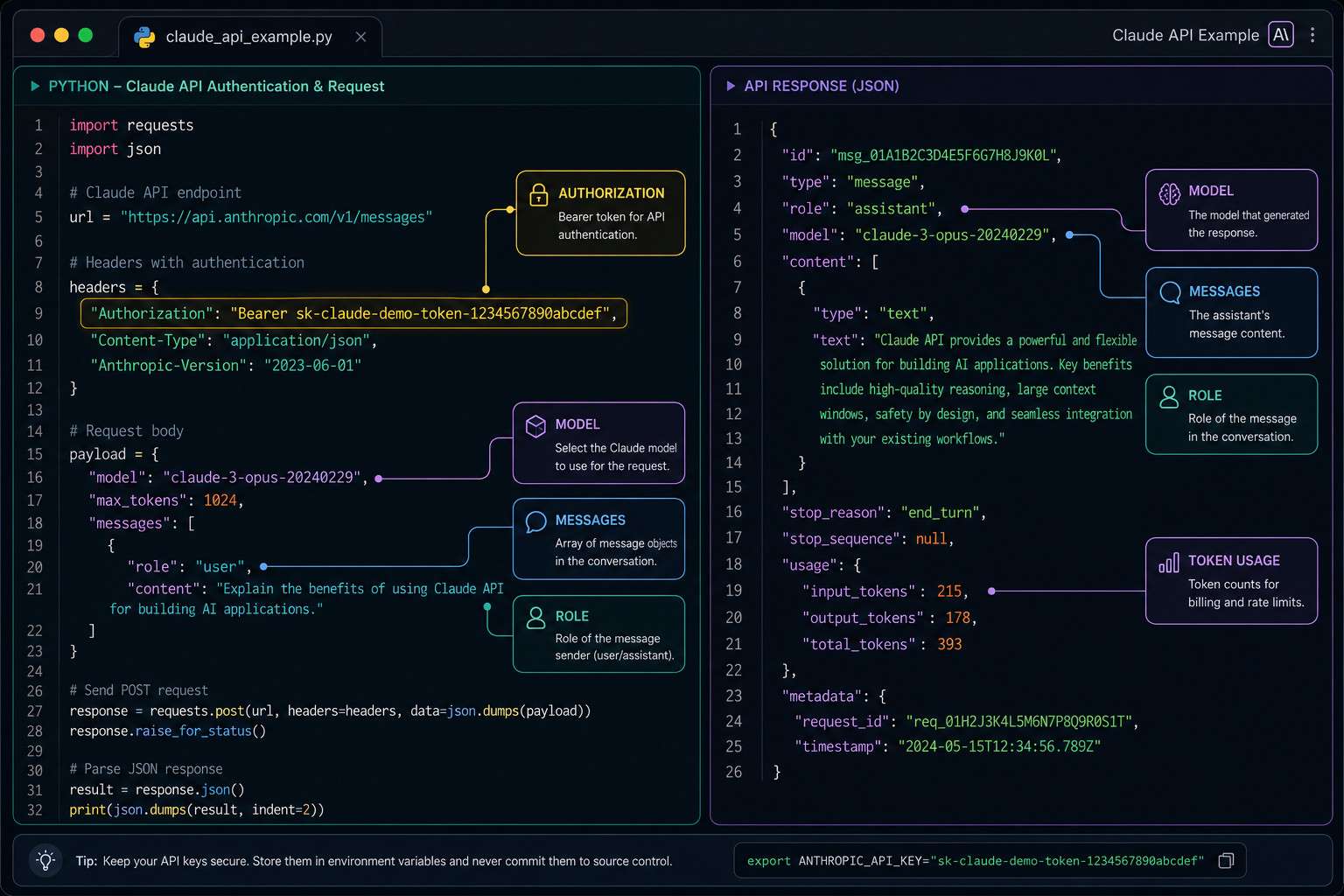
Authentication uses a standard Bearer token passed in the x-api-key header. Get your key from the Anthropic Console, then store it as an environment variable — never hardcode it in source files.
Basic Python example:
<code class="language-python">import anthropic

client = anthropic.Anthropic(api_key="your_api_key_here")

message = client.messages.create(
    model="claude-fable-5-20260609",
    max_tokens=1024,
    messages=[
        {"role": "user", "content": "Explain async/await in Python in two sentences."}
    ]
)

print(message.content)
</code>
Key request parameters:
| Parameter | Required | Notes |
|---|---|---|
model | Yes | Specify the exact model version |
max_tokens | Yes | Hard cap on output length |
messages | Yes | Array of role/content objects |
system | No | System prompt for behavior control |
stream | No | Set true for streaming responses |
temperature | No | 0 to 1; lower = more deterministic |
Common mistake: Leaving max_tokens too low causes truncated responses mid-sentence. Set it generously and let your system prompt control verbosity instead.
Which Claude Model Should You Choose in 2026
Choose based on three factors: task complexity, latency requirements, and budget.
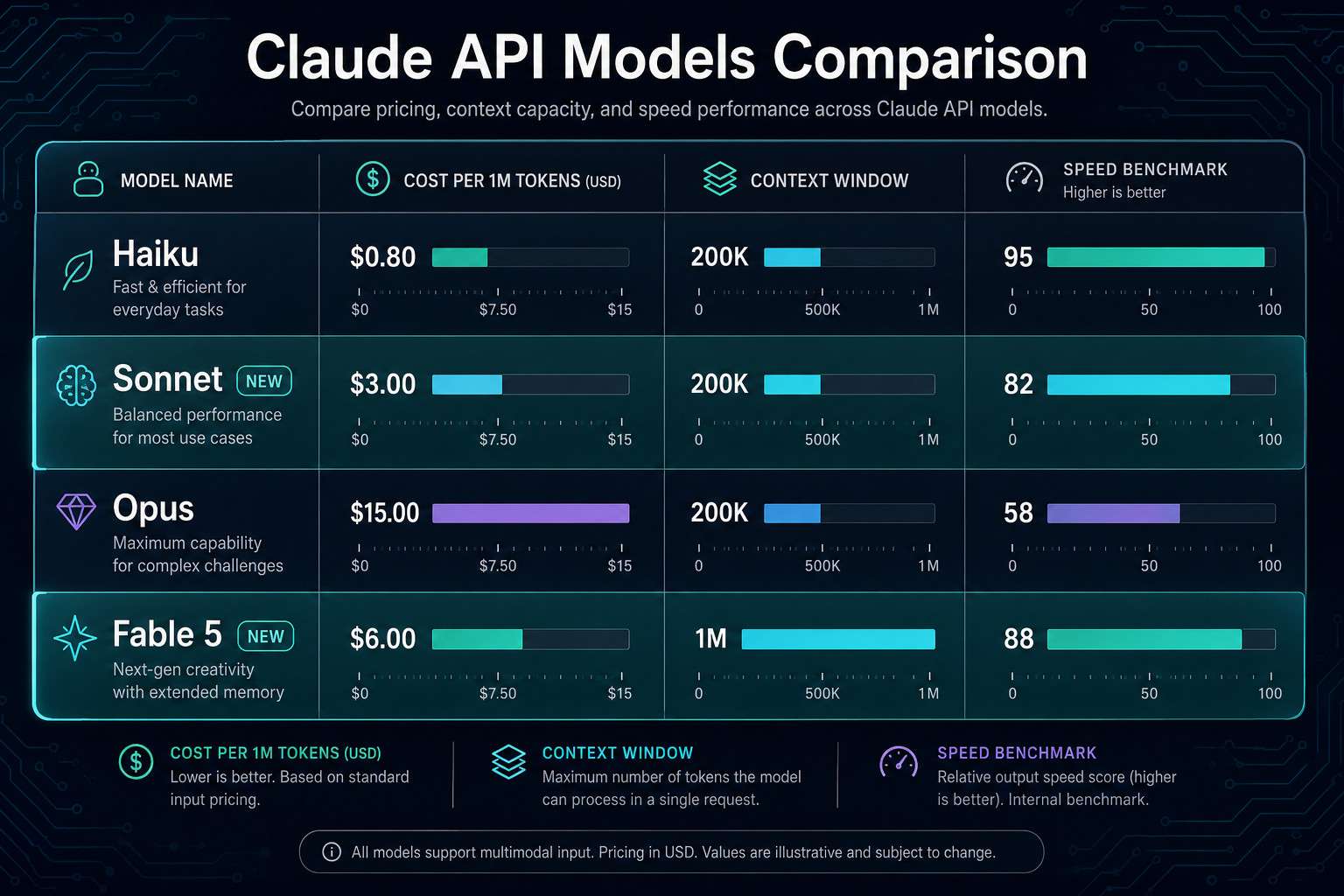
Current model lineup (as of June 2026):
- Claude Haiku — Fastest and cheapest. Best for high-volume, simple tasks like classification or short-form extraction
- Claude Sonnet — Balanced performance. Good for most production use cases including summarization and code review
- Claude Opus 4.7 — Released April 16, 2026, with enhanced reasoning for complex analytical tasks [3]
- Claude Fable 5 — The flagship public model as of June 9, 2026. Demonstrated autonomous migration of a 50-million-line Ruby codebase in a single day [1]. Priced at $10/million input tokens and $50/million output tokens [1]
Decision rule:
- Choose Haiku if cost is the primary constraint and tasks are repetitive and simple
- Choose Sonnet if you need solid reasoning without Opus-level pricing
- Choose Fable 5 if you’re building autonomous agents, handling complex multi-step coding tasks, or need state-of-the-art benchmark performance
Note: The more capable Mythos 5 model is reserved for sensitive scientific and cybersecurity applications through Anthropic’s Project Glasswing and is not generally available [1].
For developers building automated workflows around Claude, the Make.com API workflow automation guide shows how to connect Claude outputs to downstream tools without writing custom integration code.
How to Use System Prompts to Control Claude’s Behavior
System prompts are the most direct way to shape Claude’s output format, tone, and constraints. They run before the user turn and persist across the conversation.
Effective system prompt structure:
- Define Claude’s role clearly (“You are a senior Python code reviewer”)
- Specify output format (“Always respond in JSON with keys: issue, severity, suggestion”)
- Set explicit constraints (“Do not suggest rewrites of more than 10 lines”)
- Include edge case handling (“If the code has no issues, return an empty issues array”)
Example system prompt for a structured extraction task:
<code>You are a data extraction assistant. Extract the following fields from user-provided text:
company_name, founding_year, headquarters_city.
Return only valid JSON. If a field is not found, set its value to null.
</code>
Common mistake: Writing vague system prompts like “Be helpful and concise.” Claude will interpret this differently across sessions. Specific instructions produce consistent results.
What Are the Message Batches API and Admin API
The Message Batches API and Admin API are two developer tools that significantly reduce operational overhead for teams running Claude at scale.
Message Batches API (introduced October 2024): Processes up to 10,000 queries per batch asynchronously, completing within 24 hours at 50% lower cost than standard API calls [6]. This is the right choice for nightly data processing pipelines, bulk document analysis, or any workload where real-time responses aren’t required.
Admin API (introduced November 2024): Lets you programmatically manage your organization’s API resources, including user permissions and workspace settings [8]. Useful for enterprise teams that need to automate onboarding or enforce access controls without manual Console work.
Rate Limits API and Enterprise Analytics API (April 2026): Organizations can now query their rate limits programmatically and pull daily aggregated usage data for Claude and Claude Code Remote [2]. This makes capacity planning and cost attribution far more straightforward for large teams.
If you’re building more complex multi-step workflows around these APIs, the n8n workflow automation guide covers how to chain API calls with conditional logic and error handling.
How to Integrate Claude with External Apps Using Claude Connectors
Claude Connectors extend the API beyond text generation into real-world task execution. Anthropic has integrated Claude with Spotify, Uber, Instacart, TurboTax, and Booking.com, among others [5].
These integrations allow Claude to perform actions — booking a ride, adding items to a cart, retrieving tax information — through a chat interface rather than requiring users to switch between apps.
For developers, this matters because:
- It demonstrates the agentic pattern Claude supports natively
- It shows how tool use (function calling) works in production at scale
- It provides a template for building your own integrations using Claude’s tool use API
Building your own connector: Define tools as JSON schema objects in your API request. Claude will call them when appropriate and return structured arguments your code can act on.
For teams building similar automation pipelines, the ChatGPT automation and no-code workflow guide offers useful patterns that translate directly to Claude-based implementations.
What Security Risks Should Developers Know About
The biggest external security risk is third-party proxy services. Investigations have found a grey market in China reselling Claude API access at up to 90% discounts through proxy networks [4]. These services use stolen credentials and sometimes substitute cheaper models while charging for Claude, and they harvest user data in the process [4].
Security checklist for Claude API deployments:
- Always use official Anthropic endpoints (
api.anthropic.com) - Rotate API keys regularly and revoke unused keys immediately
- Store keys in environment variables or a secrets manager, never in code
- Monitor usage through the Enterprise Analytics API for anomalies [2]
- Apply the principle of least privilege when assigning API keys to team members via the Admin API [8]
- Never pass sensitive user PII to the API unless your data processing agreement covers it
Fable 5 itself includes built-in safety filters that redirect certain high-risk queries to older models and restrict use in advanced AI research tasks [1]. These are Anthropic-side controls — they don’t replace your own application-level security.
For a broader look at platform security practices in AI tooling, the Make.com security guide covers data protection principles that apply equally to API-based AI deployments.
How to Deploy Claude on AWS and Manage Costs at Scale
In May 2026, Anthropic rolled out Claude Platform on AWS, giving developers tighter integration with existing cloud infrastructure for scalable deployments [7].
Cost management strategies:
- Use Haiku for preprocessing and filtering before escalating to Fable 5 for complex reasoning
- Batch non-urgent workloads through the Message Batches API for the 50% cost reduction [6]
- Set hard
max_tokenslimits per request to prevent runaway costs - Use the Rate Limits API to monitor consumption and set alerts before hitting quotas [2]
- Cache repeated system prompts where your infrastructure supports it
Deployment pattern for high-volume production:
- Route incoming requests through a classifier (Haiku) to determine complexity
- Send simple requests to Haiku directly
- Route complex requests to Sonnet or Fable 5
- Log all token usage per request for cost attribution
- Run batch jobs overnight using the Message Batches API
The Replit cloud coding platform guide is worth reading if you want a quick environment for prototyping Claude API integrations without setting up local infrastructure.
Conclusion
Mastering the Claude API in 2026 means staying current with a fast-moving platform. The core mechanics — authentication, message structure, system prompts, and model selection — are stable and well-documented. But the ecosystem around them changes quickly: Fable 5 arrived in June 2026, Sonnet 4 and Opus 4 are being retired, and new APIs for rate limits, analytics, and batch processing have all shipped in the past year.
Your actionable next steps:
- Audit your current model usage and migrate off deprecated Sonnet 4 and Opus 4 before June 15, 2026
- Test Claude Fable 5 for any agentic or complex coding workloads — the performance jump is substantial
- Implement the Message Batches API for any non-real-time processing to cut costs by half
- Set up the Rate Limits API and Enterprise Analytics API for visibility into your usage
- Review your API key security practices against the checklist above
- Explore Claude Connectors if your product involves real-world task execution
The developers who get the most out of this platform are the ones who treat it as infrastructure — not a novelty. Build clean abstractions, monitor costs, and keep your model versions explicit. That discipline pays off every time Anthropic ships something new.
FAQ
What programming languages does the Claude API support? Anthropic provides official SDKs for Python and TypeScript. Any language that can make HTTP requests works with the REST API directly.
What is the context window for Claude Fable 5? Anthropic has not published a specific context window figure for Fable 5 at the time of writing. Check the official platform documentation for current specifications.
Can I use the Claude API for free? There is no permanent free tier. Free access to Fable 5 was granted to select subscribers until June 22, 2026, after which it is pay-to-use [1]. Standard API usage requires a paid account.
How do I handle rate limit errors? Implement exponential backoff with jitter in your retry logic. Use the Rate Limits API (launched April 2026) to query your current limits programmatically and adjust request volume accordingly [2].
What is the difference between Fable 5 and Mythos 5? Fable 5 is the publicly accessible high-performance model. Mythos 5 is more capable but restricted to sensitive scientific and cybersecurity applications through Anthropic’s Project Glasswing [1].
Is streaming supported by the Claude API?
Yes. Set stream: true in your request to receive server-sent events. This is recommended for user-facing applications where response latency matters.
How does tool use (function calling) work? Define tools as JSON schema objects in your API request. Claude identifies when a tool should be called and returns structured arguments. Your code executes the tool and returns the result in the next message turn.
What happened to Claude Sonnet 4 and Opus 4? Both models were deprecated with retirement scheduled for June 15, 2026. Developers should migrate to current models immediately [2].
Can I run Claude on my own infrastructure? Not directly. Claude runs on Anthropic’s infrastructure. AWS deployment (via Claude Platform on AWS, launched May 2026) provides tighter cloud integration but the model itself still runs on Anthropic’s systems [7].
How do I control output format reliably?
Use explicit system prompts specifying the exact format (JSON, Markdown, plain text) and validate outputs programmatically. Setting temperature to 0 increases determinism for structured output tasks.
References
[1] Claude Fable 5 Brings Mythos To The Masses – https://www.tomshardware.com/tech-industry/artificial-intelligence/claude-fable-5-brings-mythos-to-the-masses-anthropics-next-frontier-model-is-state-of-the-art-on-nearly-all-tested-benchmarks
[2] Claude News – API Updates and Deprecations – https://www.claude-news.jp/articles/d5091bc8-42ec-4369-886e-4d526d566aa3
[3] Anthropic Platform Release Notes Overview – https://platform.claude.com/docs/en/release-notes/overview
[4] Chinese Grey Market Sells Claude API Access At 90 Percent Off – https://www.tomshardware.com/tech-industry/artificial-intelligence/chinese-grey-market-sells-claude-api-access-at-90-percent-off-through-proxy-networks-that-harvest-user-data
[5] Claude Now Connects To More Everyday Apps – https://www.tomsguide.com/ai/claude-now-connects-to-more-everyday-apps-heres-what-you-can-do-now
[6] Message Batches API – https://www.claude.com/blog/message-batches-api
[7] Anthropic News Roundup May 2026 – https://www.claudeapi.com/en/blog/news/anthropic-news-roundup-2026-05/
[8] Anthropic Platform API Release Notes – https://platform.claude.com/docs/en/release-notes/api