Last updated: May 23, 2026
Quick Answer
ElevenLabs is an AI voice platform that translates and dubs audio into 70+ languages while preserving the original speaker’s voice, tone, and emotion. Its end-to-end pipeline handles noise removal, speaker identification, transcription, translation, and voice synthesis in a single workflow. As of 2026, ElevenLabs has crossed $500 million in annual recurring revenue and expanded into enterprise, government, and accessibility markets, making it the most commercially advanced voice bridging tool available [1].
Key Takeaways
- ElevenLabs supports 70+ languages with its Eleven v3 model, which became generally available in early 2026 [5].
- The dubbing pipeline preserves individual speaker voice characteristics, including accent and emotional tone, across languages [2][7].
- Pricing starts with a free tier (10,000 characters/month) and scales to enterprise plans with on-premise deployment options [8].
- New “audio tags” let creators control whispers, shouts, pauses, and pacing without manual editing [5].
- Key competitors include Murf.ai, Play.ht, WellSaid Labs, Resemble AI, and Meta’s SeamlessM4T [2][6].
- ElevenLabs now functions as a multimodal production suite with voice, studio, and agent engine components [8].
- The platform serves media, education, enterprise customer service, healthcare accessibility, and government sectors [1].
- Voice cloning requires explicit consent verification, and the company has partnered with accessibility organizations like Bridging Voice [2].
- Technical vocabulary handling has improved but still requires human review for specialized fields like medicine and law.
- The company raised a $500M Series D at an $11B valuation, with investors including BlackRock and NVIDIA [1].
What Exactly Does ElevenLabs Do With AI Voice Translation?
ElevenLabs provides an end-to-end AI dubbing and voice translation system that converts spoken audio from one language into another while keeping the original speaker’s voice intact. It is not a simple text-to-speech tool — it’s a full production pipeline.
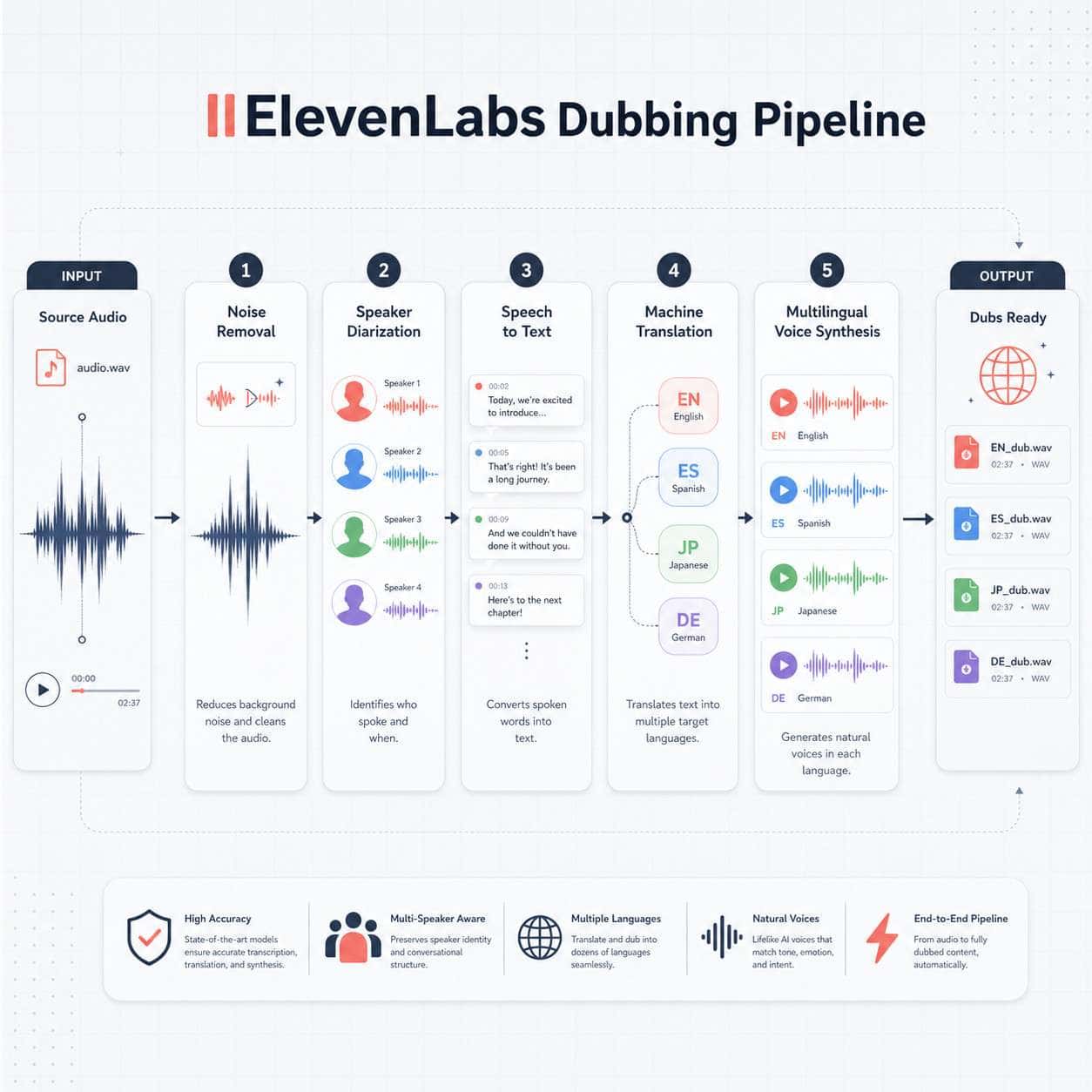
Here’s how the process works under the hood [2][7]:
- Noise removal — Background noise is stripped from the source audio.
- Speaker diarization — The system detects who is speaking and when, even with multiple speakers.
- Speech-to-text transcription — Each speaker’s words are transcribed.
- Machine translation with length adaptation — Text is translated into the target language and adjusted so the timing matches the original speech.
- Multilingual voice synthesis — The translated text is spoken in the target language using a voice clone that matches the original speaker’s characteristics.
This pipeline can handle audio or video of any length with any number of speakers [2]. For creators looking to expand their reach, this approach eliminates the need for separate transcription, translation, and voiceover services. If you’re exploring how AI tools can streamline content workflows more broadly, our guide to AI-powered content generation tools covers the wider landscape.
Common mistake: Many users upload audio with heavy background music, expecting clean results. The noise removal step works best with speech-dominant audio. Strip or lower music tracks before uploading for the best output.
How Much Does ElevenLabs Voice AI Cost Per Month?
ElevenLabs uses a tiered, character-based pricing model. There’s a free plan that gives you 10,000 characters per month — enough to test the platform and produce short clips. Paid plans scale up from there, with the exact pricing depending on character volume, voice cloning features, and API access [8][10].
| Plan Tier | Approximate Monthly Cost | Characters/Month | Key Features |
|---|---|---|---|
| Free | $0 | 10,000 | Basic TTS, limited voices |
| Starter | ~$5 | 30,000 | Voice cloning, more voices |
| Creator | ~$22 | 100,000 | Professional voice cloning, dubbing |
| Pro | ~$99 | 500,000 | Full API access, priority |
| Scale | ~$330 | 2,000,000 | High-volume, commercial use |
| Enterprise | Custom | Custom | On-prem, SLA, compliance |
Note: Pricing may vary. Check ElevenLabs’ official site for current rates. These figures are based on publicly available 2026 information.
Choose the free plan if you’re experimenting or producing under 2 minutes of content per month. Choose Creator or above if you’re dubbing full podcast episodes or video content regularly. Enterprise plans include on-premise deployment and compliance features needed for regulated industries [1].
Can ElevenLabs Translate Any Language or Just Some Languages?
ElevenLabs supports 70+ languages as of the Eleven v3 model release in early 2026 [5][6]. This is a significant expansion from earlier versions. The supported languages span major global markets including English, Spanish, Mandarin, Hindi, Arabic, Japanese, Korean, French, German, Portuguese, and many more.
That said, not all languages perform equally. Languages with larger training datasets (English, Spanish, Mandarin) tend to produce more natural-sounding output. Less commonly spoken languages may have slightly less natural prosody or limited accent options.
Edge case: Regional dialects within a language (e.g., Brazilian Portuguese vs. European Portuguese) are increasingly supported, but results can vary. Always preview output in your target dialect before publishing.
Is ElevenLabs Voice Translation Accurate for Business Meetings?
For pre-recorded business content like presentations, training videos, and marketing materials, ElevenLabs produces high-quality translations suitable for professional use. For live, real-time meetings, the technology is improving but comes with caveats.
The accuracy depends on three factors:
- Audio clarity — Clean, well-recorded speech translates far better than noisy conference room audio.
- Speaking pace — Moderate, clear speech gives the system more to work with.
- Subject matter — General business language translates well. Highly specialized jargon needs review.
Enterprise deployments at companies like Klarna, Revolut, Deutsche Telekom, and Cisco Webex suggest that major organizations trust the technology for customer-facing and internal communications [1]. However, I’d recommend human review for any translation used in contracts, legal proceedings, or regulatory filings.
What Are the Main Competitors to ElevenLabs Voice Technology?
ElevenLabs faces competition from several AI voice platforms, though it’s widely considered the strongest all-around option for voice cloning and multilingual dubbing as of 2026 [6].
| Competitor | Strengths | Where ElevenLabs Wins |
|---|---|---|
| Murf.ai | Easy interface, good for voiceovers | Fewer languages, less natural cloning |
| Play.ht | Blog-to-audio, API access | Narrower dubbing capabilities |
| WellSaid Labs | Enterprise focus, studio quality | Smaller language set |
| Resemble AI | Real-time voice cloning | Less end-to-end dubbing |
| Descript | Video + audio editing suite | Voice is one feature, not the core |
| Meta SeamlessM4T | Open-source, research-grade | Not a commercial production tool |
| Speechify | Consumer reading/listening | Limited professional dubbing |
ElevenLabs differentiates itself by offering the full pipeline — from cloning to dubbing to conversational agents — in one platform [8]. When Meta’s SeamlessM4T launched, it was restricted to research contexts. ElevenLabs, by contrast, opened its dubbing features to all users immediately [2].
For those building websites that need multilingual content, combining voice AI with AI-powered content optimization can create a strong global content strategy.
Which Industries Use ElevenLabs Voice AI the Most?
Media, entertainment, and content creation are the largest user segments, but enterprise adoption is accelerating fast. Here are the primary industries:
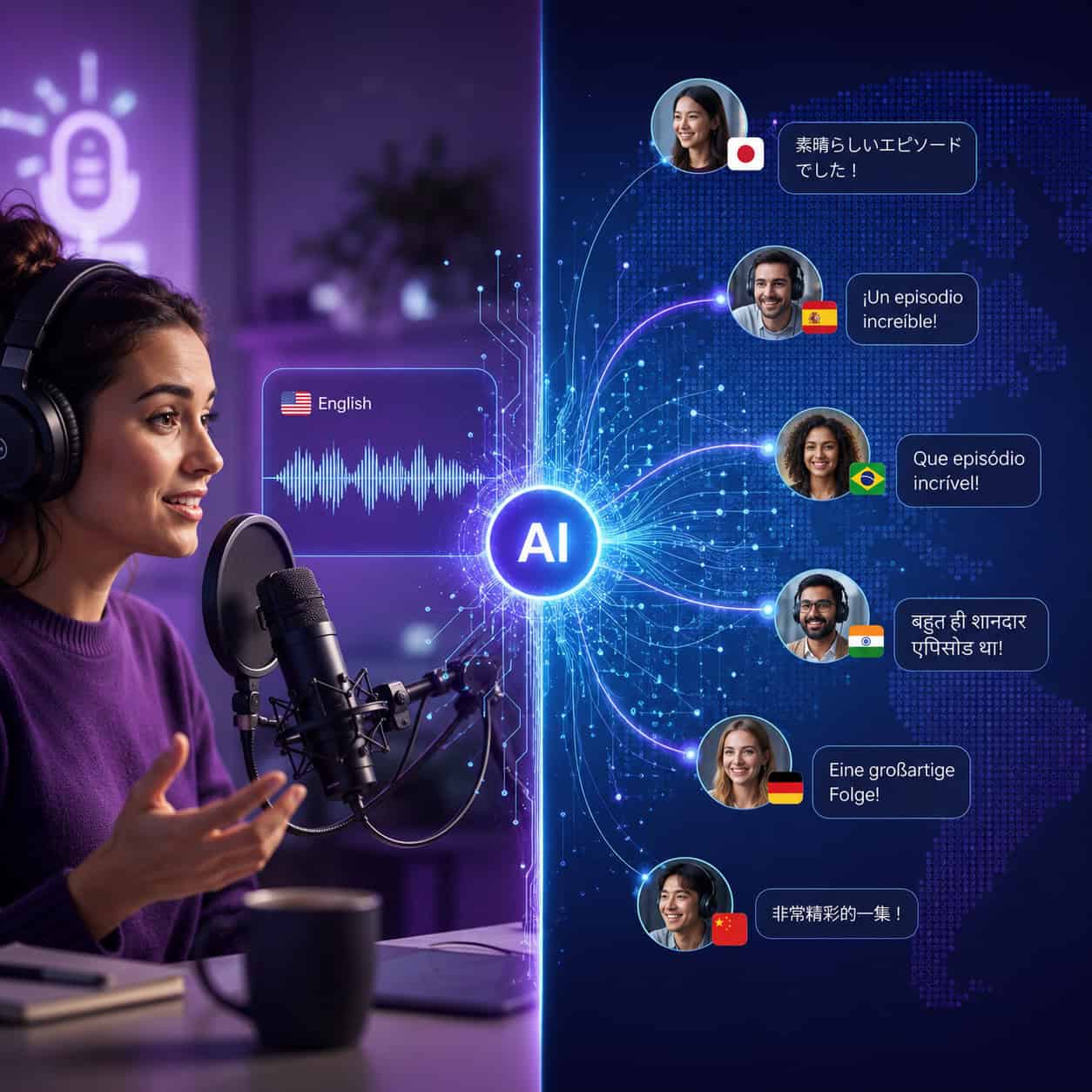
- Media and entertainment — Dubbing films, TV shows, and YouTube content into multiple languages.
- E-learning and education — Creating multilingual course materials and classroom tools [1].
- Enterprise customer service — Powering multilingual voice agents at companies like Klarna and Deutsche Telekom [1].
- Podcasting and audio publishing — Translating episodes for global audiences.
- Healthcare accessibility — Restoring voices for ALS patients through the Bridging Voice partnership [2].
- Government — ElevenLabs launched a dedicated government offering in 2026 with compliance-focused deployment [1].
- Financial services — Revolut and similar companies use it for multilingual customer interactions [1].
If you’re a content creator building a multilingual web presence, you might also benefit from exploring AI website builders that support global audiences.
How Does ElevenLabs Preserve the Original Speaker’s Voice Tone?
This is the core technical achievement that separates ElevenLabs from basic translation tools. The system creates a voice profile of the original speaker, capturing pitch, timbre, speaking rhythm, and emotional characteristics. It then applies that profile when generating speech in the target language [2][7].
The Eleven v3 model introduced “audio tags” — inline text directives like [whispering], [shouting], and [pause 0.5s] — that give creators explicit control over emotion, pacing, and non-verbal sounds [5]. This means you can fine-tune how the translated voice sounds without touching an audio editor.
“The system can handle audio or video of any length with any number of speakers while preserving individual voice characteristics.” — Futurist Matthew Griffin’s analysis of ElevenLabs’ dubbing technology [2]
Decision rule: If preserving the exact emotional tone of your original recording matters (e.g., a CEO’s keynote, a narrator’s dramatic reading), use audio tags to guide the output. If you’re producing informational content where tone is less critical, the default settings work well.
Can ElevenLabs Handle Technical or Medical Vocabulary Translations?
ElevenLabs handles general and moderately technical vocabulary well, but highly specialized terminology in fields like medicine, law, or engineering still benefits from human review.
The translation layer uses large language models that understand context better than previous generations [8]. Medical terms like “myocardial infarction” or legal phrases like “force majeure” are generally translated correctly in major language pairs. But edge cases exist:
- Rare medical conditions may be mistranslated or mispronounced in less common languages.
- Industry-specific acronyms sometimes get expanded incorrectly.
- Regional regulatory terminology (e.g., EU vs. US pharmaceutical naming) can cause confusion.
Best practice: For any content where accuracy is critical — patient instructions, legal disclosures, safety documentation — always have a bilingual subject matter expert review the output before distribution.
Is ElevenLabs Voice AI Good for Podcasters and Content Creators?
Yes, and this is one of the platform’s strongest use cases. Podcasters and content creators can dub their episodes into dozens of languages while keeping their own voice, which maintains brand identity and listener connection.
The Studio 3.0 environment combines video and audio editing with voice synthesis, so creators can manage the entire workflow in one place [8]. For YouTube creators specifically, the cross-lingual dubbing feature means a single video can reach audiences in 70+ languages without hiring voice actors.
Practical example: A YouTube creator with 100,000 English-speaking subscribers could dub their content into Spanish, Hindi, and Portuguese — three of the fastest-growing online audiences — and potentially triple their reach. The best AI graphic design tools can complement this by helping create multilingual thumbnails and visual assets.
Who it’s not ideal for: Creators who rely heavily on wordplay, cultural humor, or language-specific idioms. These elements don’t translate well through any automated system and require cultural adaptation by a human.
What Technical Limitations Does ElevenLabs Voice Translation Have?
Despite its strengths, the platform has real limitations users should understand:
- Latency — Real-time dubbing introduces a slight delay, which can be noticeable in live settings.
- Singing and music — The system is designed for speech, not singing. Musical content doesn’t translate well.
- Background noise sensitivity — Heavy ambient noise degrades transcription accuracy and voice quality.
- Emotional nuance in rare languages — Less-resourced languages may sound flatter or less emotionally varied.
- Character limits on lower tiers — The free and starter plans run out quickly with long-form content.
- Accent specificity — While the system preserves general accent characteristics, very specific regional accents may shift slightly in translation.
How Does ElevenLabs Protect Against Voice Cloning Misuse?
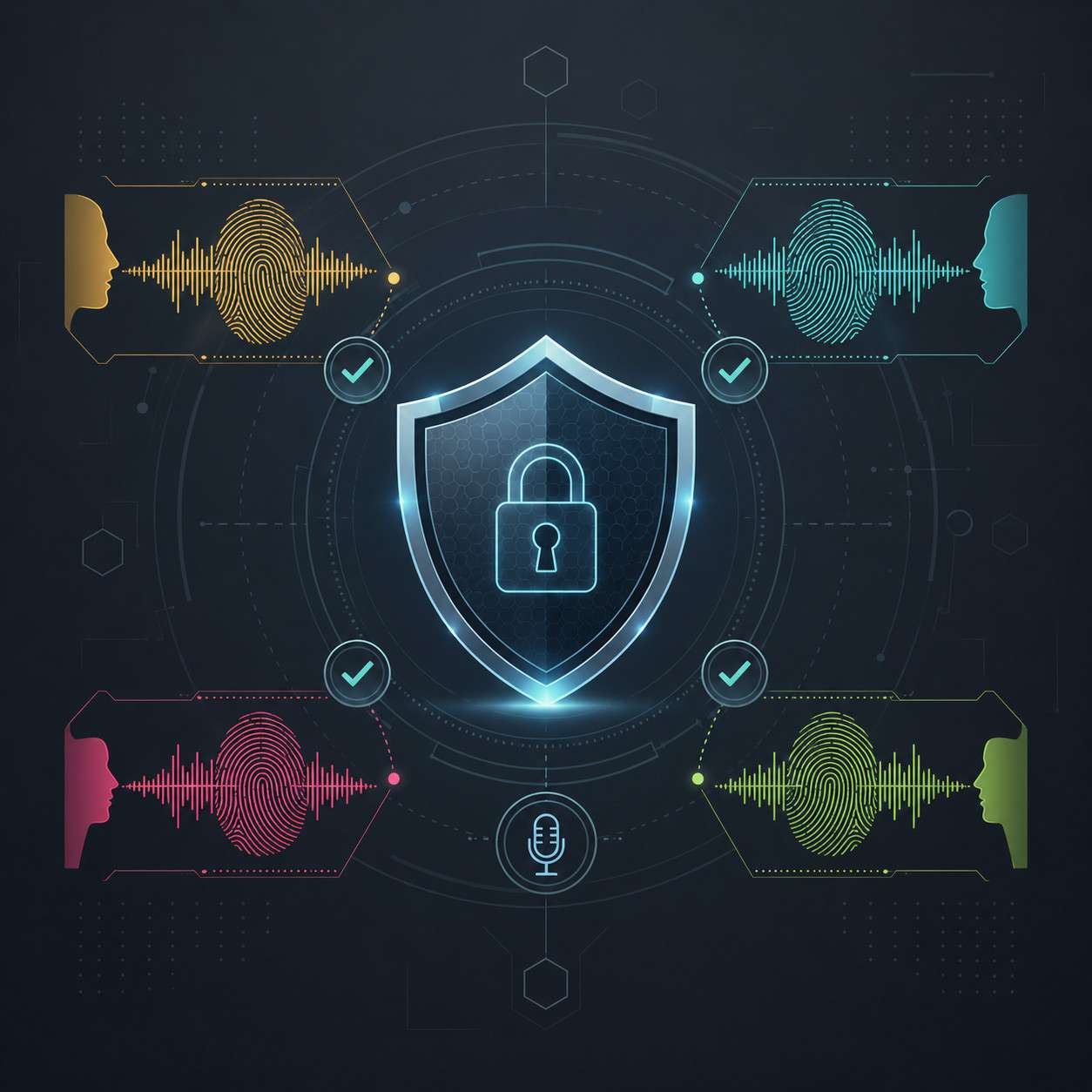
ElevenLabs requires consent verification for voice cloning, meaning you must confirm you have permission to clone a voice before the system processes it [9]. The platform has also implemented detection tools to identify AI-generated audio.
Additional safety measures include:
- Voice verification — Users must provide proof of consent or ownership.
- Content moderation — Automated systems flag potentially harmful uses.
- Watermarking — AI-generated audio can be identified as synthetic.
- Partnerships — The Bridging Voice collaboration focuses on ethical use cases like restoring voices for people with ALS [2].
- Enterprise controls — Government and enterprise plans include additional compliance and audit features [1].
The broader industry is still developing standards for voice AI ethics. ElevenLabs’ approach is more proactive than many competitors, but no system is foolproof. If you’re concerned about deepfakes or unauthorized cloning, the consent verification step is a meaningful safeguard, not a guarantee.
Who Shouldn’t Use ElevenLabs Voice Translation Technology?
ElevenLabs isn’t the right fit for everyone. Here’s when you should look elsewhere:
- Live simultaneous interpretation — If you need real-time human-quality interpretation for diplomatic or legal proceedings, hire professional interpreters.
- Highly regulated medical communications — Patient-facing medical instructions in regulated markets need certified human translators.
- Content that depends on cultural adaptation — Translation isn’t localization. If your content needs cultural rewriting (not just language conversion), you need a human localization team.
- Ultra-low-budget projects — If you can’t afford at least the Creator tier, the free plan’s character limits will frustrate you for anything beyond short clips.
- Music and singing — The technology doesn’t handle musical content.
For website owners focused on SEO in specific markets, combining AI voice tools with proper SEO optimization strategies will yield better results than voice translation alone.
Common Mistakes People Make When Using AI Voice Translation
- Skipping audio cleanup — Uploading noisy, echo-heavy recordings and expecting clean output.
- Ignoring preview — Publishing translated audio without listening to the full output first.
- Assuming perfect accuracy — Treating AI translation as final without any human review, especially for professional content.
- Overloading the free tier — Starting a large project on the free plan and hitting character limits mid-project.
- Neglecting cultural context — A technically correct translation can still miss cultural nuances that confuse or offend the target audience.
- Using one voice for everything — Not taking advantage of speaker diarization when content has multiple speakers.
FAQ
How long does it take to dub a video with ElevenLabs? Processing time depends on video length and the number of target languages. A 10-minute video typically processes in a few minutes per language, though complex multi-speaker content takes longer.
Does ElevenLabs work with video or just audio? Both. Studio 3.0 supports video and audio editing with integrated dubbing [8]. You can upload video files directly.
Can I clone my own voice for free? The free tier includes basic voice cloning with limited characters. For professional-quality cloning with full language support, you’ll need a paid plan [10].
Is the translation quality good enough for YouTube? Yes, many YouTube creators use ElevenLabs for cross-lingual dubbing. The quality is suitable for most content types, though comedy and culturally specific content may need additional human review.
Does ElevenLabs offer an API? Yes, API access is available on Pro plans and above, allowing developers to integrate voice translation into custom applications and workflows [8].
Can ElevenLabs translate in real time? The platform supports near-real-time dubbing, and its Agent Engine enables conversational AI agents that respond in multiple languages [1][8]. True zero-latency live translation is still an evolving capability.
What file formats does ElevenLabs accept? Common audio formats (MP3, WAV, M4A) and video formats (MP4, MOV) are supported. Check their documentation for the full list.
Is ElevenLabs available worldwide? Yes, with recent expansions to Australia, New Zealand, and government markets [1]. Enterprise customers can opt for on-premise deployment for data sovereignty requirements.
How does ElevenLabs compare to Google Translate’s voice features? Google Translate offers basic voice output for translations, but it doesn’t preserve the original speaker’s voice or handle dubbing workflows. ElevenLabs is purpose-built for high-fidelity voice translation and cloning.
Can I use ElevenLabs for audiobook production? Yes, audiobook narration is a major use case. The Eleven v3 model’s emotional range and audio tags make it particularly suited for long-form narration [5].
Conclusion
Breaking language barriers with voice AI has moved from a futuristic concept to a production-ready reality in 2026. ElevenLabs sits at the center of this shift, offering a complete pipeline that handles everything from voice cloning to multilingual dubbing to conversational agents.
Here’s what to do next:
- Test the free tier — Sign up and experiment with 10,000 characters to evaluate quality in your target languages.
- Prepare clean audio — Before uploading, remove background noise and music for the best results.
- Start with one language pair — Don’t try to dub into 20 languages at once. Pick your highest-value target market and refine the workflow.
- Always preview and review — Listen to every translated output before publishing. AI is good, but human ears catch what algorithms miss.
- Consider the full stack — If you need voice agents or integrated video editing, explore Studio 3.0 and the Agent Engine rather than cobbling together separate tools [8].
The technology isn’t perfect, and it won’t replace human translators for every use case. But for creators, businesses, and organizations that need to reach global audiences quickly and affordably, ElevenLabs’ voice bridging technology is the most capable option available right now. Pair it with a solid AI-powered content strategy and you’ll have a multilingual content engine that scales with your ambitions.
References
[1] ElevenLabs Instagram Updates – https://www.instagram.com/p/DWG9mb_kQF3/ [2] ElevenLabs Bridging Voice Partnership – https://bridgingvoice.org/elevenlabs-bridging-voice-partnership/ [5] ElevenLabs Eleven V3 Redefines Expressive AI Voice Generation – https://www.cloudthat.com/resources/blog/elevenlabs-eleven-v3-redefines-expressive-ai-voice-generation/ [6] Best Voice Cloning AI 2026 – https://queststudio.io/blog/best-voice-cloning-ai-2026 [7] ElevenLabs Introduces AI Real Time Dubbing in 20 Languages – https://www.311institute.com/elevenlabs-introduces-ai-real-time-dubbing-in-20-languages/ [8] ElevenLabs Tutorial – https://www.feisworld.com/blog/elevenlabs-tutorial [9] Voice Cloning – https://elevenlabs.io/voice-cloning [10] ElevenLabs Review – https://beststacked.com/reviews/elevenlabs