
{“cover”:”Professional square format (1024×1024) hero image with bold text overlay: ‘Claude AI & Windows Workflows’ in extra large 72pt white bold sans-serif font with dark semi-transparent background bar, centered upper third. Background shows a sleek modern coworking space with multiple professionals at standing desks, large curved monitors displaying Windows interfaces and AI chat panels, warm ambient lighting with blue accent tones, glass walls, collaborative open-plan layout. Color scheme: deep navy, crisp white, electric blue accents. Magazine cover aesthetic, editorial quality, high contrast, photorealistic.”,”content”:[“Landscape format (1536×1024) editorial illustration showing a split-screen Windows desktop environment with Claude AI Cowork interface on the left panel and Microsoft 365 apps (Teams, Outlook, OneDrive) on the right, connected by animated workflow arrows. A professional coworking space background is visible through glass partitions. Overlay shows MCP connector icons, task queue panels, and a mobile device assigning tasks remotely. Color palette: cool blue-gray, white, orange highlights. Clean, tech-forward, infographic-style composition.”,”Landscape format (1536×1024) editorial photo-illustration of a diverse team of four professionals in a modern coworking space gathered around a central monitor showing Claude AI security and permissions dashboard. One person holds a tablet, another points to an on-screen checklist of AI safety settings. Background shows frosted glass privacy booths, shared printer stations, and wall-mounted displays with project timelines. Warm neutral tones with green security-badge accent icons. Realistic, professional, documentary-style composition from a slightly elevated angle.”]

Last updated: June 14, 2026
Quick Answer: Claude AI’s Cowork mode, now fully available on Windows as of February 2026, lets individuals and teams automate multi-step tasks, connect directly to Microsoft 365 services, and interact with desktop applications in real time. For professionals in shared coworking environments, this means less manual coordination, faster project turnaround, and a genuinely useful AI layer built into the Windows tools they already use.
Key Takeaways
- Claude Cowork launched on Windows with full feature parity on February 10, 2026, including file access, plugins, and Model Context Protocol (MCP) connectors [1]
- Claude can directly click, type, and open applications on your Windows desktop in research preview for Pro and Max plan users [2]
- Microsoft 365 integration covers Outlook, OneDrive, SharePoint, and Teams through a secure connector registered in your Microsoft Entra tenant [4]
- Team and Enterprise plan owners can enable or disable Cowork for all organization members from a central settings panel [5]
- You can assign tasks to Claude from your mobile device while Claude works on your desktop, available in beta for Pro and Max plans [6]
- Code execution happens inside an isolated virtual machine, keeping your main system protected while the agent loop runs natively [3]
- Claude retains memory of user preferences across sessions, but sensitive data is excluded and users can edit or delete stored context at any time [2]
- Organizational adoption of AI tools in collaborative settings often stalls due to cultural reluctance and structural barriers, not technology limits [8]
- An open-source alternative called Open Cowork offers free access to similar agent-based desktop features for budget-conscious teams [7]
What Exactly Is Claude AI and How Can It Boost Your Work Efficiency
Claude is an AI assistant built by Anthropic that goes well beyond answering questions. In Cowork mode, it acts as an active agent on your computer, executing tasks across applications, managing files, and connecting to external services without you manually switching between tools.
For productivity in coworking environments, the practical gains come from three areas:
- Task automation: Claude can run multi-step workflows, such as pulling data from OneDrive, drafting a summary in a document, and emailing it via Outlook, without you touching each app separately.
- Context retention: Claude remembers your preferences and past instructions across sessions, so you spend less time re-explaining your setup [2].
- Remote task assignment: You can start a task from your phone and Claude completes it on your desktop, useful when you’re moving between coworking spaces or meeting rooms [6].
For a deeper look at how agentic workflows change day-to-day work, that resource covers the broader automation landscape well.
How Does Claude Compare to Other AI Productivity Tools Like ChatGPT
Claude and ChatGPT both handle writing, research, and coding tasks, but their desktop integration models differ meaningfully in 2026.
| Feature | Claude Cowork | ChatGPT (Desktop) |
|---|---|---|
| Direct computer control (click/type) | Yes, research preview [2] | Limited |
| Native Windows agent loop | Yes [3] | No |
| Microsoft 365 connector | Yes, via Entra tenant [4] | Third-party only |
| Memory across sessions | Yes, user-editable [2] | Yes (limited) |
| Open-source alternative | Open Cowork [7] | No official equivalent |
| Team/Enterprise management | Centralized org controls [5] | Available |
The key differentiator is Claude’s ability to interact directly with your Windows desktop, opening apps, clicking buttons, and typing, rather than just generating text for you to act on. For teams already using Microsoft 365, the native connector is a significant advantage over tools that require workarounds.
For a side-by-side look at AI development platforms, the Replit vs Claude Code comparison covers how Claude stacks up in technical environments.
Pricing for Claude AI for Freelancers and Small Teams
Claude Cowork is available on paid plans only. The free tier does not include Cowork features.
- Pro plan: Individual access to Cowork, including computer use in research preview and mobile task assignment in beta.
- Max plan: Higher usage limits with the same Cowork features as Pro.
- Team plan: Adds centralized organization controls, letting admins enable or disable Cowork for all members [5].
- Enterprise plan: Full organizational management, priority support, and custom security configurations.
For freelancers, the Pro plan is the entry point. For small teams in coworking spaces sharing a single organizational account, the Team plan makes sense because it gives one admin control over who can use Cowork features, which matters when you’re managing access in a shared environment.
Common mistake: Freelancers sometimes sign up for the free tier expecting Cowork features. They don’t exist there. Budget for at least the Pro plan if desktop automation is your goal.
Windows Workflow Integration Tips for Maximum Claude AI Productivity
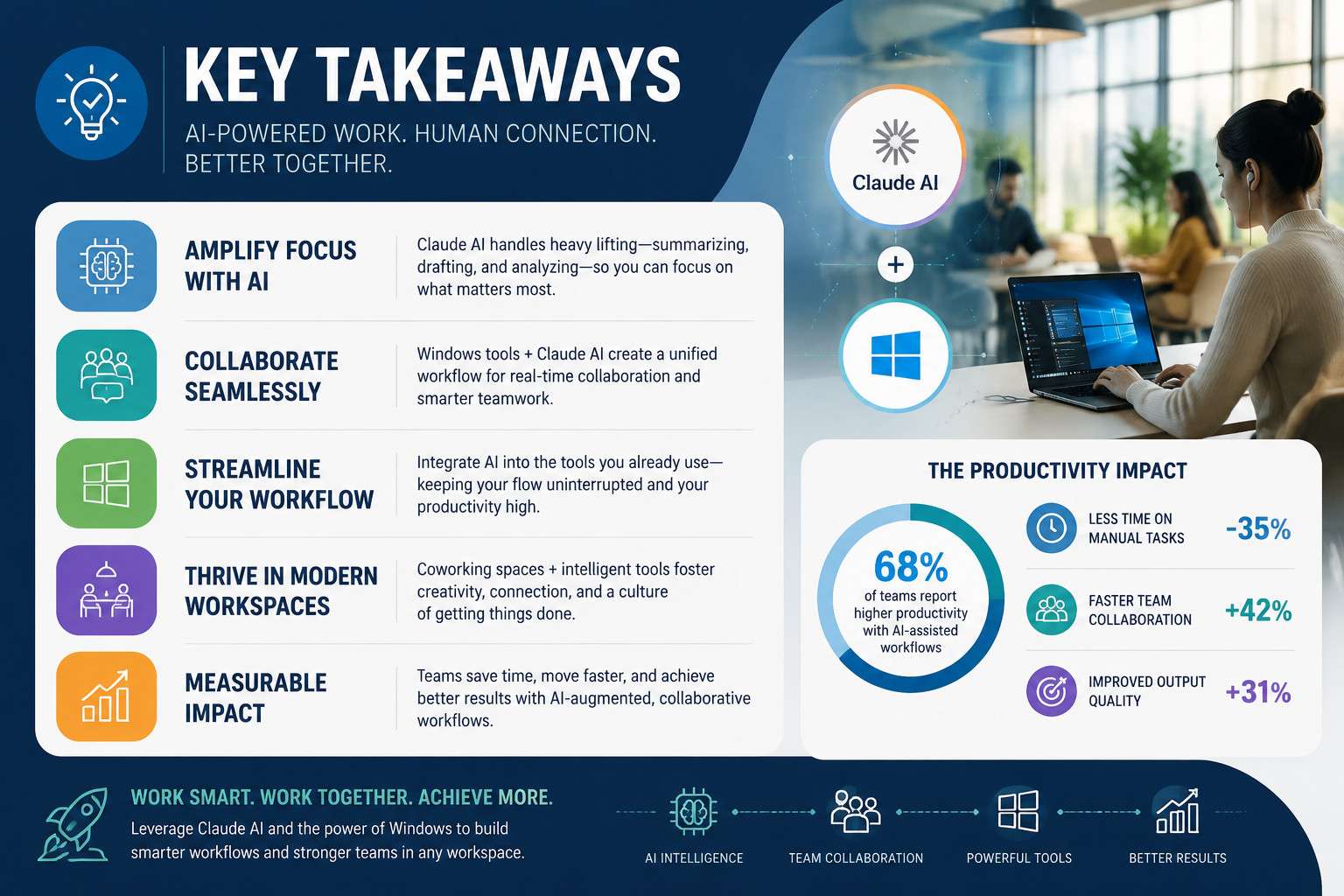
Claude Cowork on Windows achieves full feature parity with macOS, including file access, multi-step task execution, and MCP connectors [1]. Getting the most from it requires deliberate setup.
Step-by-step integration checklist:
- Install Claude Desktop on your Windows machine and sign in with a paid account.
- Connect your Microsoft 365 account through the Entra tenant connector to enable Outlook, Teams, SharePoint, and OneDrive access [4].
- Review and set per-app permissions before enabling computer use, so Claude only accesses the applications you authorize [2].
- Set up the mobile app and link it to your desktop for remote task assignment [6].
- Define recurring task templates (e.g., weekly report drafts, email triage rules) so Claude learns your workflow patterns faster.
- Check Claude’s memory panel regularly and remove any stored context that’s no longer accurate [2].
Edge case: If your coworking space uses a shared network with proxy restrictions, the agent loop’s web fetch capability may be blocked. Test connectivity before relying on Claude for time-sensitive tasks.
For teams also using automation platforms, pairing Claude with n8n automation workflows can extend its reach into more complex multi-system pipelines.
Best Practices for Using Claude in Collaborative Coworking Environments
In a coworking space, the biggest risk with AI tools isn’t capability, it’s coordination. Research from September 2025 found that individual workers adopted AI tools readily, but organizational adoption stalled because teams didn’t share practices or establish common standards [8].
What works in shared environments:
- Establish shared prompt libraries. Teams that document effective Claude prompts in a shared folder (OneDrive or SharePoint works well here) reduce onboarding time for new members.
- Use the Team plan’s admin controls. Organization owners can enable or disable Cowork for specific users, which prevents unauthorized use on shared accounts [5].
- Separate personal and team tasks. Claude’s memory is tied to individual accounts, so personal preferences don’t bleed into team workflows.
- Schedule AI-heavy tasks during off-peak hours. Computer use tasks consume significant processing; scheduling them when you’re not in active meetings avoids conflicts.
For teams using Slack alongside Claude, the Make.com and Slack integration guide shows how to connect notification and workflow layers effectively.
Is Claude AI Good for Designers and Creative Professionals
Claude is genuinely useful for designers, but not as a visual creation tool. Its strength for creative professionals lies in workflow management, brief writing, client communication, and research, not image generation.
Where Claude helps designers:
- Drafting client briefs, revision summaries, and project scopes directly from meeting notes
- Researching design references and compiling mood board descriptions
- Managing project timelines across multiple clients using its multi-step task execution
Where it doesn’t replace specialist tools:
- Claude does not generate images or vector assets
- It cannot replace Figma, Adobe Creative Cloud, or dedicated AI design tools
For designers looking at AI-specific creative tools, the best AI graphic design tools for creative workflows covers that territory. Claude pairs well with those tools by handling the non-visual administrative layer.
Can Claude Help Me Manage Multiple Project Timelines Simultaneously
Yes, and this is one of its more practical strengths in coworking settings. Claude can hold context across multiple projects within a session and, with memory enabled, carry that context across sessions [2].
How to structure multi-project management with Claude:
- Create a named project context for each client or initiative at the start of each session
- Ask Claude to maintain a running status list in a shared document (OneDrive or SharePoint)
- Use the mobile task assignment feature to update project notes when you’re away from your desk [6]
- Set Claude to flag deadline conflicts when you add new tasks
Limitation to know: Claude doesn’t have a native calendar view or Gantt chart interface. It works best as a text-based coordinator that feeds into your existing project management tools, not as a standalone PM platform.
How Do Different Industries Use Claude AI for Team Collaboration
Claude’s agent capabilities apply across industries, but the use cases vary by workflow type.
- Marketing teams: Brief generation, campaign research, drafting copy variations, summarizing analytics reports from SharePoint
- Legal and consulting: Document review, summarizing case files, drafting client correspondence via Outlook integration
- Software development: Code review assistance, documentation drafting, coordinating pull request summaries (see agentic coding workflows)
- Media and journalism: Research aggregation, interview prep, draft structuring (though a 2025 study noted cultural reluctance in newsrooms slows full adoption [8])
- Finance: Summarizing reports, drafting investor updates, coordinating data pulls from shared drives
The common thread is that Claude works best when it connects to existing data sources (Microsoft 365, shared files) rather than operating in isolation.
Limitations of Claude AI in Professional Workspace Settings
Claude Cowork is capable, but it has real constraints worth knowing before you build workflows around it.
- Research preview status: Computer use (clicking, typing on your desktop) is still in research preview as of 2026, meaning it can behave unexpectedly [2].
- No offline mode: Claude requires an internet connection; it won’t function in coworking spaces with unreliable connectivity.
- Memory is account-level, not team-level: Shared memory across a team isn’t currently supported; each user maintains their own context.
- App blocklist restrictions: Some applications are blocked from computer use by default for safety reasons [2].
- Not a replacement for specialized tools: Claude handles coordination and text-based tasks well, but doesn’t replace dedicated project management, design, or data analysis platforms.
Training My Team to Effectively Use Claude AI Workflows
Most teams underestimate how much onboarding Claude requires. The tool is approachable, but using it well in a collaborative Windows environment takes deliberate practice.
A practical training approach:
- Start with a single use case per team member (e.g., email drafting or report summarization) before expanding to full Cowork features.
- Run a shared session where one person demonstrates a complete workflow, from task assignment to output, so the team sees the full loop.
- Document what works. Create a shared prompt library in OneDrive that the whole team can contribute to and edit.
- Assign one person as the Cowork admin to manage organizational settings and troubleshoot access issues [5].
- Review Claude’s memory settings monthly to keep stored context accurate and relevant [2].
The 2025 newsroom study found that individual adoption outpaced organizational adoption primarily because teams lacked shared documentation of what worked [8]. Building that documentation from day one closes that gap.
Security Considerations When Using AI Tools in Shared Workspace

Security in a coworking environment is a genuine concern when an AI tool can interact directly with your desktop, files, and email. Claude Cowork addresses this through several layers, but users need to configure them actively.
Built-in safeguards:
- Code execution runs in an isolated virtual machine, separate from your main system [3]
- Per-app permissions let you control exactly which applications Claude can access [2]
- An app blocklist prevents Claude from interacting with certain sensitive applications by default [2]
- An action review system flags unusual or high-risk actions before executing them [2]
- Sensitive data is excluded from Claude’s memory automatically, and users can view, edit, or delete all stored memory [2]
What you should do in a coworking environment:
- Never use Claude on a shared or public machine where your account could remain logged in
- Review per-app permissions before enabling computer use
- Use the organization admin controls to restrict Cowork access to verified team members only [5]
- For teams with strict data requirements, evaluate whether the Enterprise plan’s security configurations meet your compliance needs
For more on AI security in professional settings, the security resources at WebAiStack cover broader considerations for AI tool deployment.
Conclusion
Maximizing productivity with Claude AI and collaborative Windows workflows in modern coworking spaces comes down to deliberate setup, clear team standards, and honest awareness of the tool’s current limits.
Actionable next steps:
- Start a free trial of the Pro plan and test Claude Cowork on a single Windows workflow before committing to a Team or Enterprise plan.
- Connect your Microsoft 365 account through the Entra tenant connector and run one end-to-end task (draft, save, send) to validate the integration.
- Build a shared prompt library in OneDrive from week one so your team’s best practices don’t stay locked in individual accounts.
- Review security permissions before enabling computer use, and assign one team admin to manage organizational Cowork settings.
- Pair Claude with automation tools like n8n or Make.com for workflows that span multiple systems beyond Microsoft 365.
The teams that get the most from Claude in 2026 aren’t the ones who use it most aggressively. They’re the ones who integrate it carefully, document what works, and treat it as a capable coordinator rather than a magic solution.
FAQ
What is Claude Cowork and how is it different from the regular Claude chat interface? Claude Cowork is an agent mode that runs on your desktop and can execute multi-step tasks, interact with applications, and connect to services like Microsoft 365. The regular chat interface only generates text responses.
Is Claude Cowork available on Windows? Yes. Full feature parity with macOS launched on February 10, 2026, including file access, plugins, and MCP connectors [1].
Can Claude access my Microsoft Teams and Outlook? Yes, through a connector registered in your Microsoft Entra tenant, Claude can access Outlook, OneDrive, SharePoint, and Teams [4].
Is Claude Cowork safe to use in a shared coworking space? It can be, if you configure per-app permissions, use the app blocklist, and never leave your account logged in on a shared machine. Code execution runs in an isolated VM for additional protection [3].
What happens if I assign a task from my phone and then lose connection? The mobile task assignment feature sends the task to your desktop agent, which continues working independently. However, if your desktop loses internet connectivity, Claude cannot complete tasks that require web access [6].
Can my organization restrict who uses Claude Cowork? Yes. Team and Enterprise plan owners can enable or disable Cowork for all users in their organization through the central settings panel [5].
Does Claude remember my preferences between sessions? Yes. Claude Cowork has cross-session memory, but sensitive data is excluded automatically. You can view, edit, or delete everything it remembers at any time [2].
Is there a free version of Claude Cowork? Not from Anthropic. However, Open Cowork is a free, open-source alternative that offers similar agent-based desktop features and supports multiple AI models [7].
Can Claude manage multiple client projects at once? Claude can hold multi-project context within sessions and across sessions with memory enabled, but it works best as a text-based coordinator feeding into your existing project management tools, not as a standalone PM platform.
Is Claude useful for designers and creative professionals? For workflow management, client communication, and research, yes. For image or asset creation, no. Claude handles the administrative and text layer; specialized design tools handle the visual output.
References
[1] Windows – https://coworkerai.io/windows?utm_source=openai [2] support.claude – https://support.claude.com/en/articles/14128542?utm_source=openai [3] 14479288 Claude Cowork Desktop Architecture Overview – https://support.claude.com/en/articles/14479288-claude-cowork-desktop-architecture-overview?utm_source=openai [4] Connectors M365 – https://claude.com/docs/cowork/3p/connectors-m365?utm_source=openai [5] 13455879 Cowork For Team And Enterprise Plans – https://support.claude.com/en/articles/13455879-cowork-for-team-and-enterprise-plans?utm_source=openai [6] 13947068 Assign Tasks To Claude From Anywhere In Cowork – https://support.claude.com/en/articles/13947068-assign-tasks-to-claude-from-anywhere-in-cowork?utm_source=openai [7] Open Cowork – https://github.com/OpenCoworkAI/open-cowork?utm_source=openai [8] arxiv – https://arxiv.org/abs/2509.10950?utm_source=openai